Wearing, Sewing Neoprene–Yes? No? Maybe?

Neoprene is a synthetic rubber; it’s distinguishing feature is a foam core creating a rubbery, spongy hand.  And is most familiar used in wetsuits where the foam core keeps body heat in and moisture out.  Great features for wetsuits, not so much for fashion wear.  However, there are other properties that make Neoprene very desirable for garments.     See Is it Neoprene or Scuba Knit?  Should I Care??? for more information.

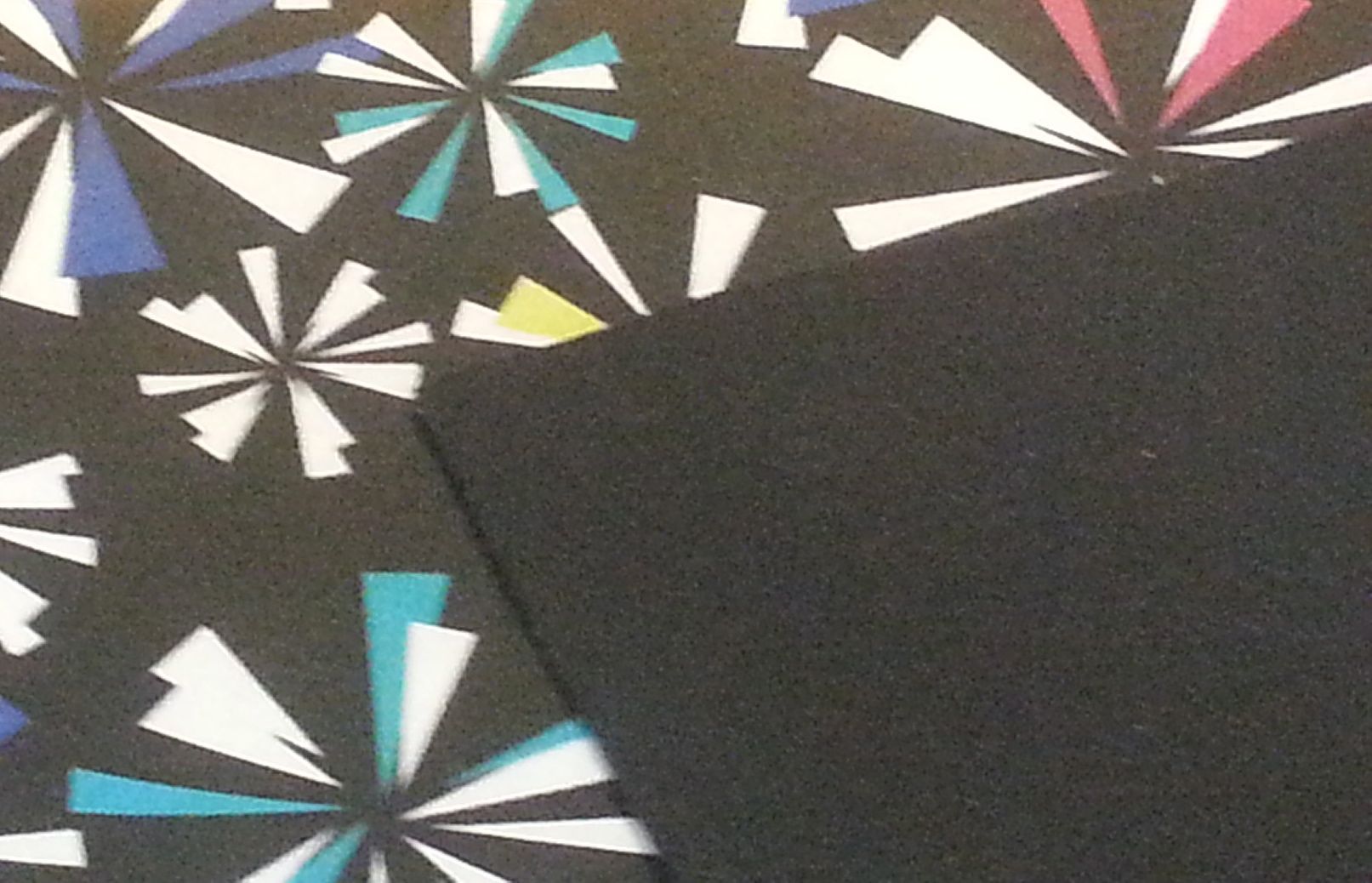
Double Faced Neoprene with foam core

Double Faced Neoprene with foam core

Neoprene properties:

  • insulates
  • light weight
  • wrinkle free
  • wind resistant
  • firm, dense material that holds it shape without under support
  • easy care–wipe off spots or gently wash and air dry.  Did I say it dries quickly?  It does!
  • stain and moisture resistant; liquid beads up
  • double faced so lining is not needed
  • perfect for raw edges–seams and hems
  • raw edge lapped or butt seams reduce bulk


The unique, stylish and comfortable neoprene fabric

Watch the following video for expert advice on what designs work best in Neoprene and how to work Neoprene garments into your wardrobe.


https://www.youtube.com/watch?v=O-_9oH4ZJ9M


How to sew Neoprene

A simple design with few pieces will be quick and easy to sew in Neoprene.  Seam finishes, interfacing, lining are not needed.

  1. Neoprene in 2mm-3mm thickness is best for garments and home sewing machines
  2. Cut with a rotary cutter for perfectly smooth edges that require no further finish
  3. Seam finishes are not necessary as fabric does not ravel
  4. Lapped and butted seams reduce bulk–Google for how-tos
  5. Neoprene should not be pressed; although foam is heat resistant, the outer layers may not be.  In any case, a lapped or butt seam doesn’t need pressing.
  6. Needle–sharp point, size 14-18
  7. Thread–Polyester, wooly nylon–any thread that stretches
  8. Stitch Length–3mm+
  9. Stitch type–straight stitch, zigzag, flatlock–See Serger manual and/or YouTube
  10. Sew slowly as friction may heat needle and melt the thread
  11. Presser Feet–roller foot, walking foot
  12. Sample, Sample, Sample


What should you sew with Neoprene?

My personal recommendation is anything not too close fitting due to it’s thermal properties.  On the other hand, not oversized, as it will not drape.  Simple design is best.

  1. Unlined jacket or vest to layer, or not
  2. Reversible Coat/Raincoat–water resistant; wrinkle free; lapped or butted seams  make it reversible;  all-purpose travel coat
  3. Moto-style jacket
  4. Pencil skirt–won’t wrinkle, form-fit
  5. customized wetsuit
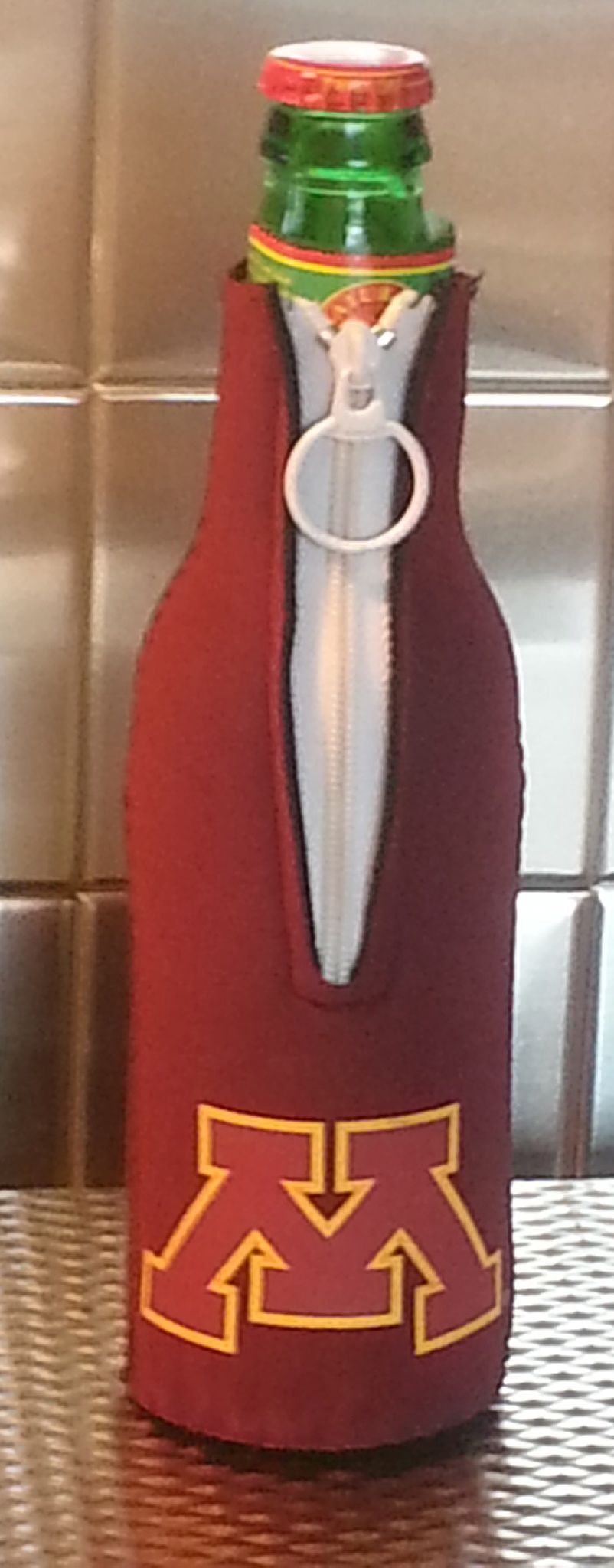
  6. beer kozy, wine carrier
  7. face mask, balaclava
  8. laptop, tablet cases

Neoprene Garment Options

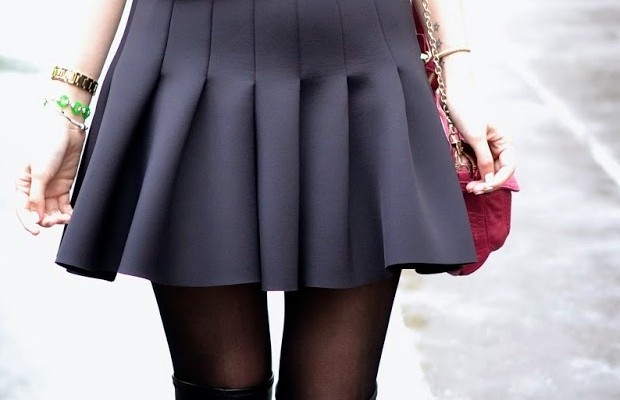
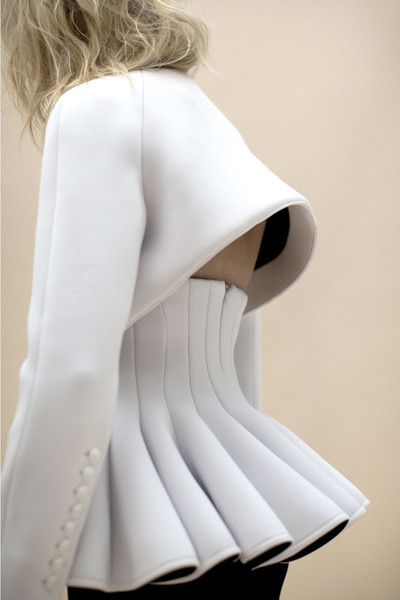
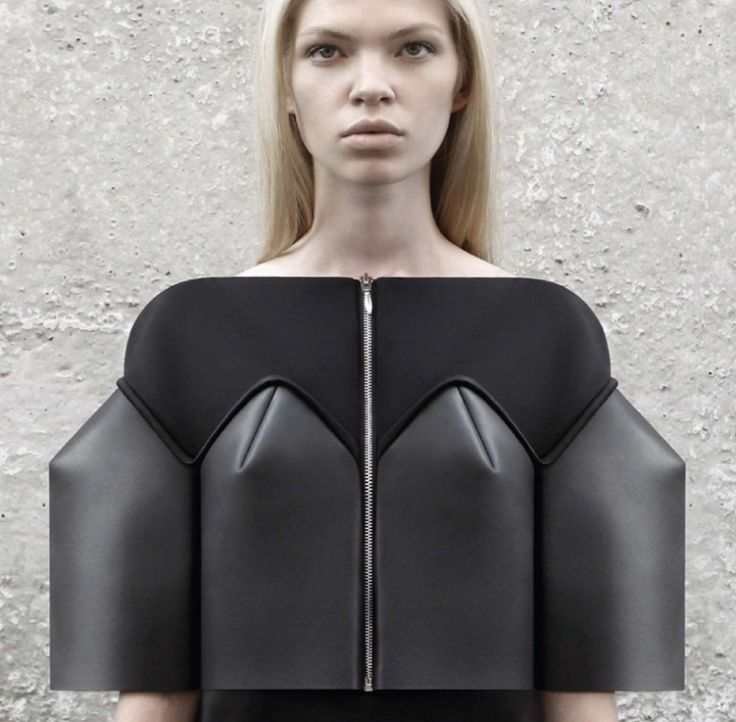
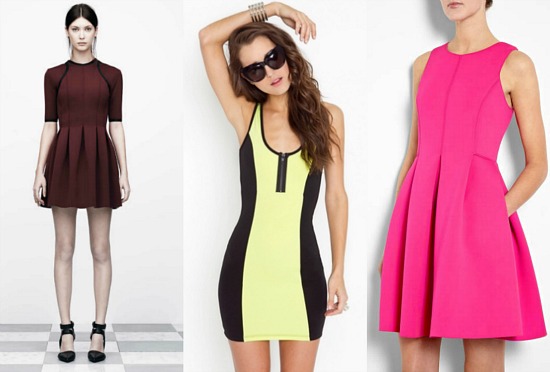
The neon-hued designs and the shape-holding features of Neoprene offer some tantalizing  structural possibilities.  The flared skirt, below, will maintain its shape no matter what.

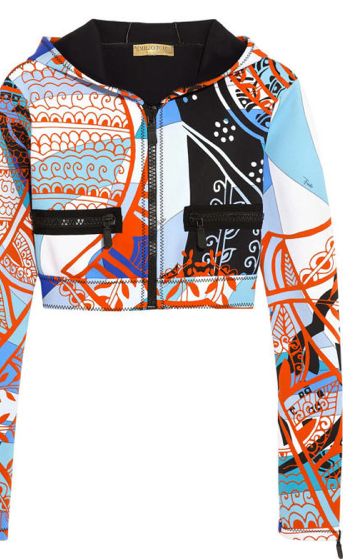
The jacket is also Neoprene and holds it boxy shape while keeping the wearer warm.

Neoprene maintains it shape without under-structure

Neoprene maintains it shape without under-structure


Pleated Skirt with raw edge hem

Pleated Skirt with raw edge hem


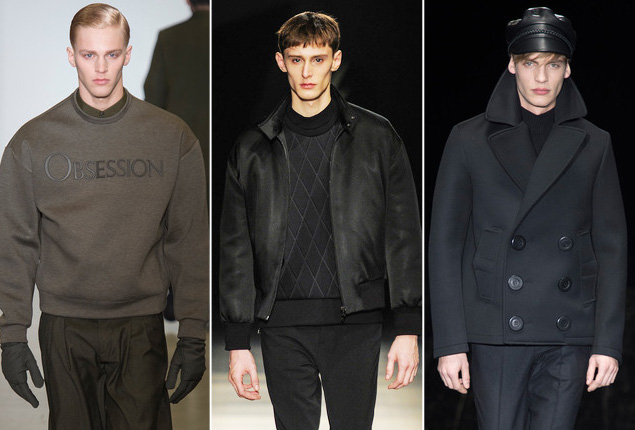
For the Metro Guy/ GQ

For the Metro Guy/ GQ


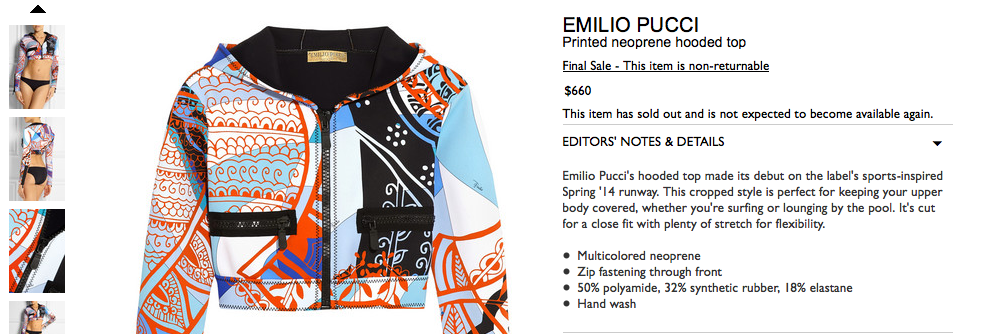
This is a Pucci hooded bomber style jacket.  Similar Pucci jackets are printed silk laminated to Neoprene.  Wouldn’t you like to get your hands on a designer over-run of this!

Screen shot 2015-04-02 at 1.30.37 PM

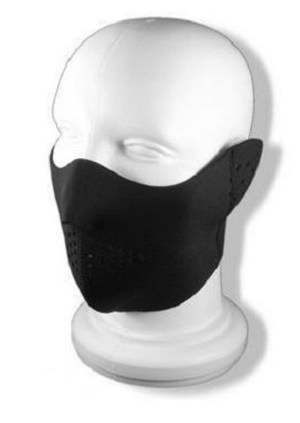
Wind Resistant Face Mask

Wind Resistant Face Mask


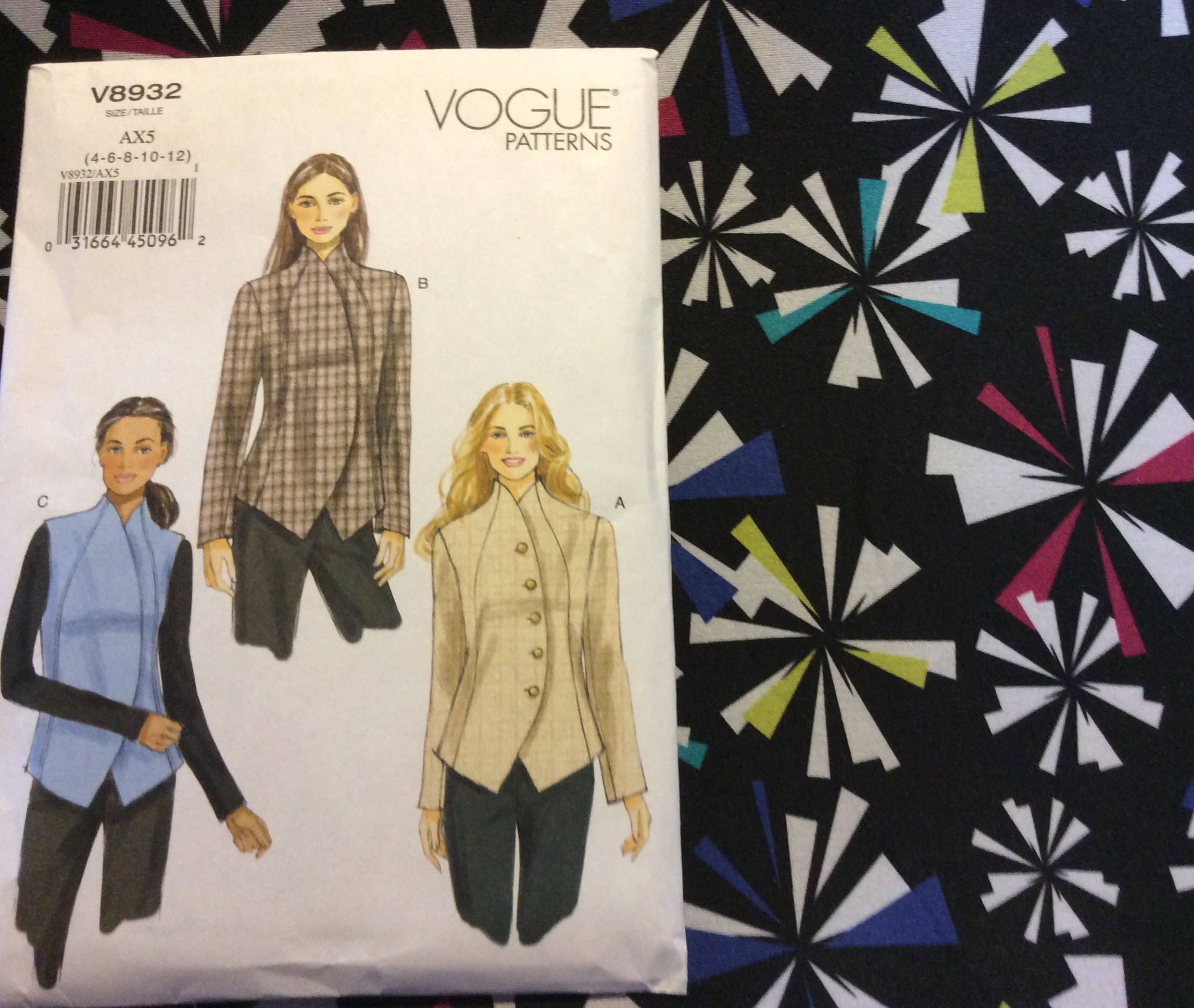
Here is what I will be sewing with Neoprene.  Bought the fabric for a wine kozy so don’t have enough for the vest.  Will supplement with a black Ponte.


What will you be sewing with Neoprene?

Related Posts

Is it Neoprene or Scuba Knit?  Should I Care?

Scuba Knit is the Apparel Neoprene


Posted in FIBER FASHION FUN | Tagged , , , , , , , , , | 12 Comments

Is it Neoprene or Scuba Knit? Should I Care???

Is it Called Neoprene or Scuba Knit?

Neoprene or Scuba Knit,  Scuba Knit or Neoprene.

If you are shopping online for garments and/or fabric you better know what you are buying as it can make a huge difference in use and wearability.                                      (Online shopping does not allow for physical inspection which will display the obvious difference.  Sewers should order fabric swatches.)

Neoprene, Scuba Knit, Ponte

The hottest fabrics around are Hot–literally and figuratively.  Neoprene, Scuba Knit and Ponte are the darlings of the fashion and sewing world.  They are also hot (uncomfortable) to wear due to their thermal and moisture retention properties, but more about that later.

The issue here is the misleading/mislabeling information both in RTW and sewing fabrics.  RTW is glomming unto the term ‘Neoprene’ as it links to a fashionable, recognizable trend in aquatic wear moving from the beach to the street.  And ‘scuba’ is already used in the dive suit industry. Other designers and manufacturers are using the term ‘Scuba Knit’ to describe a knit that mimics (sort of) the texture of Neoprene.

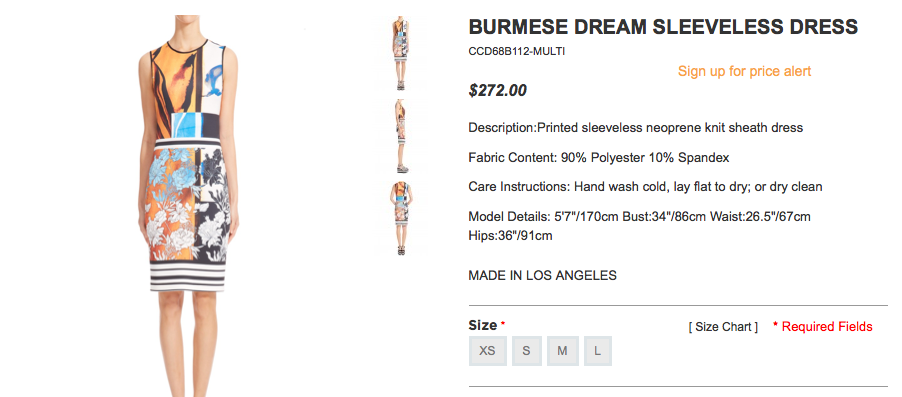
Clover Canyon Floral Discs Neoprene Dress,

Neoprene? Scuba Knit?

Using the terms Neoprene and Scuba Knit interchangeably and together is the real issue as they are not one and the same.

Difference between Neoprene, Scuba Knit and Ponte

  • Neoprene is a foam of synthetic rubber (polychloroprene) formed, along with other ingredients, through heat and pressure into a sheet, usually sandwiched between knit fabrics of polyester or nylon, with the addition of Lycra/Spandex.
  • Scuba Knit is a doubleknit made primarily of very fine filaments (microfiber) of polyester but may include rayon, Lycra/Spandex, acetate.
  • Ponte is also a doubleknit made of thicker fibers of polyester often in combination with rayon and Lycra/Spandex.


False and Misleading Examples

From Elle magazine: How to Wear Neoprene: Summer’s Must Have Material
There are 24 items in this article; some are Neoprene and some are not.  You need to click through to the source site and check the data.

This screen shot is from the designer, Clover Canyon, an LA womenswear brand .  Note the description calls it a ‘neoprene knit’ but the content does not list neoprene, synthetic rubber, or polychloroprene.  Can’t blame Elle for the mis-label as they are quoting directly from the designer.

Clover Canyon composition data from http://clovercanyon.com/shop/dresses.html

Clover Canyon composition data from Clover Canyon April 2015

This one from the same Elle article is labeled correctly.  Note content includes “32% synthetic rubber”.

Screen shot of Pucci Jacket

Screen shot of Pucci Jacket data


Here are a couple of facsimiles of online fabric postings to help you see what to look for–orange comments are my own.

1.  _______Neoprene – mislabeled

Product Description

Content: Acetate Poly Lycra – no mention of Neoprene, synthetic rubber
Type/Weave: Neoprene Knit Neoprene is a foam product, not a type of knit; nor is it a fiber that can be knit or woven
Width: 60
Care: Machine wash gentle, lay flat to dry, cool iron
Uses: Dress Skirt Pants Jacket
Colors:
Needle: Stretch 70/10
Stretch: 75% crosswise

2.   XXXXXXX  Double-Faced Neoprene/Scuba Fabric – better, see below

  • Product Details
  • From stylish dresses to durable wet-suits and scuba gear, neoprene is a renowned, sturdy material to invest in. Presenting … double-faced, neoprene fabrics with different colors on each side… neoprene fabrics measure out to be 2.5mm and they’re waterproof! – 2.5mm refers to the foam core thickness which a novice would not know–order a swatch.Width: 57″
    Content: 100% POLYESTER – the polyester refers to the exterior fabrics; but should include Neoprene as the foam core


Neoprene

Neoprene is newest to the fashion scene even though it has been around since the 1930’s.

Neoprene was invented by DuPont in the 1930’s as a synthetic rubber.  The plastic is a flexible, rubbery material that can be foamed with nitrogen gas to produce an insulating and shock protection product used in wet suits and tablet and laptop sleeves.  These very properties make Neoprene popular in the medical industry as joint braces.  Other desirable properties are chemical inertness, and thermal, oil, water, and solvent resistance.

Up until the early 2000’s, Neoprene was used exclusively for aquatic wear and commercial applications–gaskets, hoses, padding, noise insulation, weather stripping, etc., as well as medical support devices such as joint braces.

The current product is thanks to the development of the sport wetsuit/scuba wear in the 1950’s.   Pure Neoprene is clingy and uncomfortable to wear and it was soon discovered that fabric could be laminated to the foam.  Further improvements are now standard:

  • Double-faced Neoprene is a foam core laminated between layers of a very fine knit polyester or nylon
  • Neoprene’s distinguishing feature is a foam core in 2mm, 3mm, 4mm, 5mm thickness (other thicknesses are available for commercial uses)
  • Lycra/Spandex added to the outer layers provides more flexibility, recovery, stability, and abrasion resistance
  • Exterior fabric properties permits dyeing and printing, often in intense colors


A cross-section of Neoprene shows the defining foam thickness indicative of the product.  The cross-section photos also show the ribbed knit texture of the laminated fabrics.

Kozy

Beer Kozy

Kozy Foam Core Laminated between two knits

Kozy Foam Core Laminated between two knits


Print Neoprene

Printed Laminated Neoprene Fabric, solid color back

Print Neoprene Foam Core

Print Neoprene Foam Core

The foam core is available in 2mm, 3mm, 4mm and 5mm thickness.  The 2mm and 3mm are the most suitable for garments.


Designer and RTW Neoprene Fashion

In the 2000’s fashion designers began experimenting with the fabric in fashion garments, probably because the foam supports any garment shape without the addition of interfacing, crinolines, boning, etc.

Popular Pinterest Neoprene RTW from shop.robertwun.com (out of stock)

Popular Pinterest Neoprene RTW from shop.robertwun.com (out of stock)

Innovative Fashion Design. But not that wearable

Innovative Fashion Design. But not that wearable

Here we see the terms Neoprene and Scuba combined to describe this new fashion.  Scuba is probably added as the fabric was originally used for scuba diving and the designs reflect  that influence.

Neoprene-Scuba dress by Alexander Want

Neoprene-Scuba dress by Alexander Wang


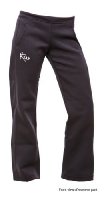
This is a sport pant taking advantage of the thermal property of Neoprene.  Apparently, exercising in a Neoprene garment can cause weight loss due to increased metabolism–it doesn’t breathe, is moisture resistant (won’t wick moisture away from skin) and insulates–it’s hot!–encourages sweating.

Now consider the fashion dresses pictured above and envision their comfort factor.  Perhaps there is a reason most of the dresses/tops are sleeveless, albeit close-fitting, at least through the bodice.

Neoprene Weight Loss Sauna Pant

Neoprene Weight Loss Sauna Pant


Neoprene Fabric Sources

Double Faced Neoprene

Double Faced Neoprene

This double-faced Neoprene is sandwiched between two layers of polyester fabric and is available in a wide combination of colors from Mood Fabrics.  It is sold by the yard.

Seattle Fabrics Neoprene is also sandwiched between fabrics but one side is always black.  They also carry a Neoprene with a black fabric on one side and Neoprene ‘smooth skin’ or ‘mesh skin’ on the other side.  This particular format is more suited to sport and aquatic garments as the Neoprene will cling to the body. It is sold by the square foot, linear foot or as a sheet (48″ X 80″).  This is a convenient way to order if you need small pieces for kozies, wine coolers, etc.

Please post other Neoprene fabric sources in the Comments.


Related Posts

See  Wearing, Sewing Neoprene–Yes? No? Maybe? for what to sew and how to sew Neoprene.

And, all about Scuba Knit, the Apparel Neoprene.


Posted in FIBER FASHION FUN | Tagged , , , , | 16 Comments

SHOWstudio, The Go-To Site for Everything Fashion

If you have any interest in fashion–a sewist, fashionista, consumer, aficianado–you will appreciate SHOWstudio, an “…award-winning fashion website, founded and directed by Nick Knight, that has consistently pushed the boundaries of communicating fashion online.”


Collections

This is your go-to for live, fashion week shows as they happen.

Continue reading

Posted in FIBER FASHION FUN | Tagged , , , , , , | Leave a comment

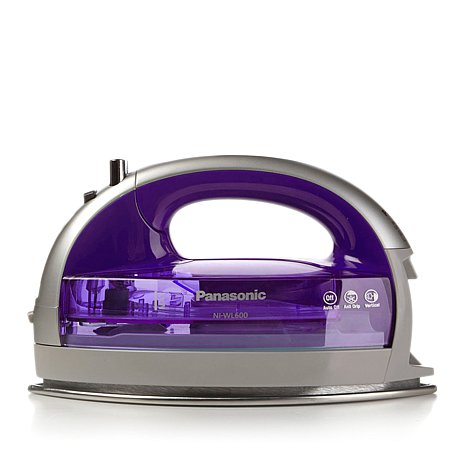
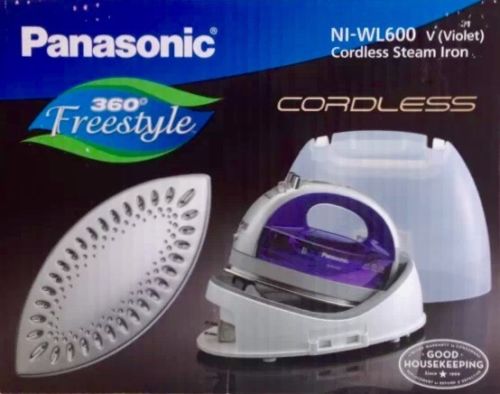
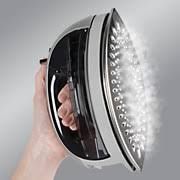
Cordless, 360° Freestyle Iron by Panasonic

Have you seen this?  I was so intrigued when I saw it in a how-to photo on a blog.


Panasonic cordless iron

Panasonic 360° Freestyle Cordless Iron


double point soleplate

Double point soleplate for ironing in any direction

Two features I appreciate:  It’s cordless, and features a double point soleplate for ironing in any direction.  The cord always seems to be in the way, and how many times have you cleared the ironing surface when the cord sweeps across the surface–annoying!  Plus, the double point soleplate makes lots of sense.

Did I say it also this iron steams in the vertical position?!  One appliance for many functions!  I’m on a Live Simple whirl so deleting ‘one use’ appliances is appealing.

Which reminds me, bet there are a couple of travel irons (dragged to Hong Kong and never used; 2 seconds in HK humidity negated any previous ironing), portable  garment steamer–never used, and, oh yes, an electric current converter–probably out of date.

How the Panasonic 360° Freestyle works.

https://www.youtube.com/watch?v=p8oFf9dHdRg

Availability

Amazon

eBay

HSN

Colors:  Blue, Black, Purple

Here’s a Hammacher Schlemmer model; similar price but appears to have more steam vents.

Hammacher Schlemmer

Hammacher Schlemmer Cordless Iron

Do you have one?  Or a any cordless iron?  Tell us about your experience by leaving a comment.

Posted in FIBER FASHION FUN | Tagged , , , , | 1 Comment

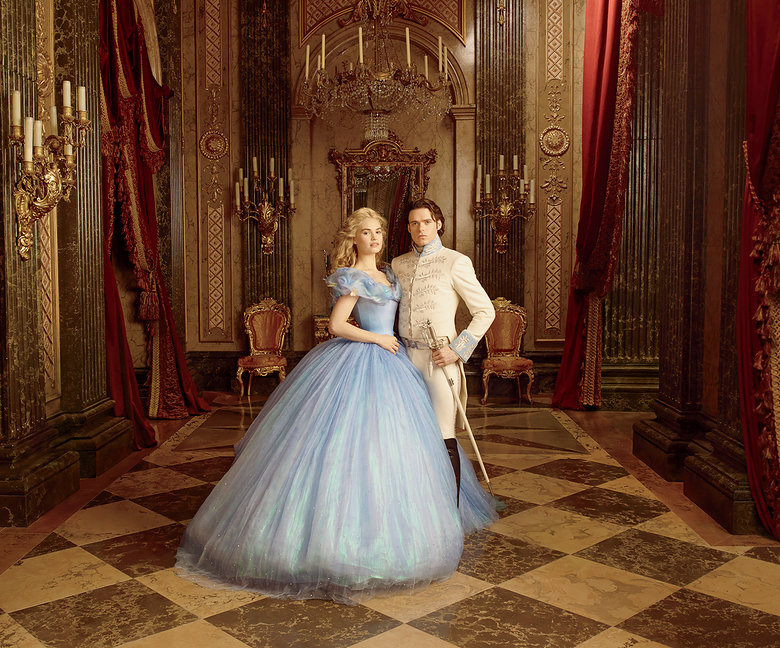
Cinderella Returns to the Big Screen

The news that Cinderella will make another appearance is exciting for all little Girls–and Big Girls like me.  I’m a Musical Theater fanatic and Rogers & Hammerstein are at the top of my list of 20th century musical theater composers.  Another opportunity to hear their musical genius is much anticipated.  FYI:  my Granddaughters are taking Dad to the Cinderella movie for his birthday.  They learned that trick (make gifts do double duty) from their Mormor.

Cinderella, Costumes, Sewing

It’s a bit of a stretch to translate musical theater, Cinderella and costumes into a sewing blog.

But, you see, this really has nothing,  and everything to do with Sewing–fashion, fit, fabric, design, appropriateness, empower the wearer, boost self-confidence…

Take Aways from the Cinderella Costumes for the Sewist

You don’t need to be a costumer  to appreciate and learn from the costumes for this production.  One idea I am taking away is the use of multiple layers of color to create just the Right color.  How about you?  Are there any ‘AHA’ moments here to inspire your sewing?

Read about and view the costumes for the new Disney Cinderella at Oscar-winning costume designer Sandy Powell reinvents the glass-slipper splendor of Cinderella.


Costumes for Cinderella

Another Cinderella Story

The photographer was able to convey the volume and iridescence of the dozen or more layers of sheer silk in shades of pale blue, turquoise and lavender.

Lily James (Rose in Downton Abbey) comments, “When I first put it on, I felt both empowered and scared..”  Sandy Powell’s designs provide the actor the necessary tools to portray their character.

Cinderella Trivia

The original Cinderella was the only musical written for television by Rogers and Hammerstein and aired by CBS on March 31, 1957, preempting Ed Sullivan’s Sunday night TV spot.

It was filmed live with the orchestra off in a small room and the surviving film is in black and white as color recording was not available.

A DVD of dubious quality is available but worth viewing for the appearance of 19 year old Julie Andrews who was in NY making her first American appearance in My Fair Lady, and, of course, the original Rogers and Hammerstein score.


1957 Cinderella DVD

Cinderella with Julie Andrews

Posted in FIBER FASHION FUN | Tagged , , , , , | 2 Comments

Textile Blocks from India

Minnesota winters are not to be born anymore so my escape for many years has been Palm Springs, CA; it’s consistently warm with tremendous mountain views and a walkable, friendly community.  No matter where you go, you are bound to  meet either a Canadian or a Minnesotan, probably because of proximity (Canada) and several direct flights (Minnesota).

One of my favorite things about PS, are all the street fairs/markets.  PS has at least two every weekend, a Farmer’s Market and the Palm Springs Street Market.

Then, on the first Sunday of the month is the  Palm Springs Vintage Market.  Click to read the 2014 post featuring the Cardinal Travel Trailer and Von Briggle pottery.

This year, my last day in PS was on February 1st; my checkout time was 11:00 AM and my flight didn’t leave until 6:30 PM–plenty of time for the Vintage Market.

Vintage Market

Vintage Market

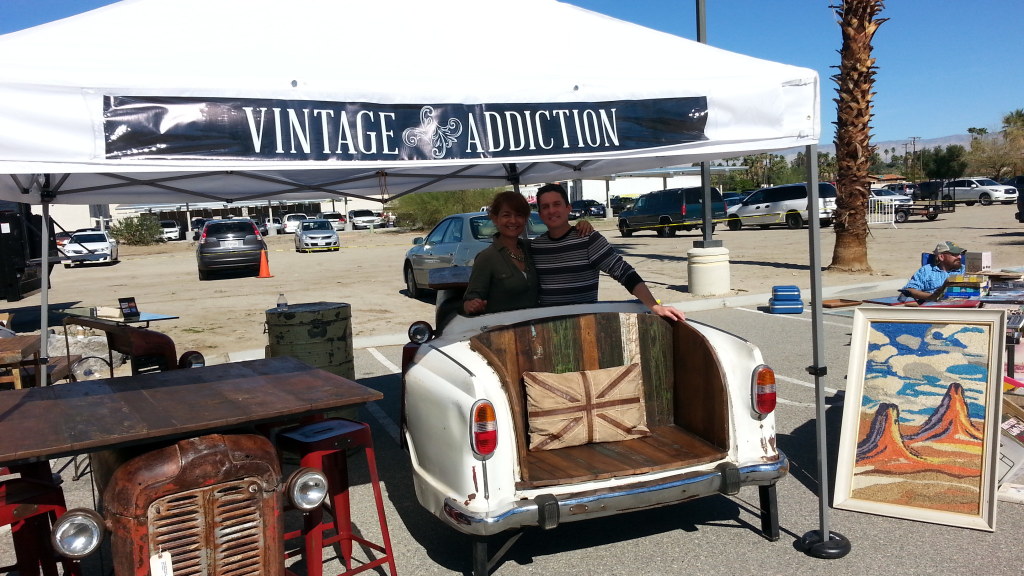
My favorite thing to do is schmooze with the vendors; it’s amazing what you learn.  This year it was textile blocks at Vintage Addictions.  Although there were plenty of repurposed vintage auto parts, the textile blocks from India are what attracted me.  I had recently read Kate’s blog on Tesselation Printing, so block printing was fresh in my mind.


Steve & Alesia

Steve and Alesia of Vintage Addictions and repurposed vintage auto parts

Steve and Alesia travel the world to find vintage-inspired products.  They believe, as I do, the back story is the real beauty behind the artisans and craft items.  And the textile blocks are true works of art in themselves.


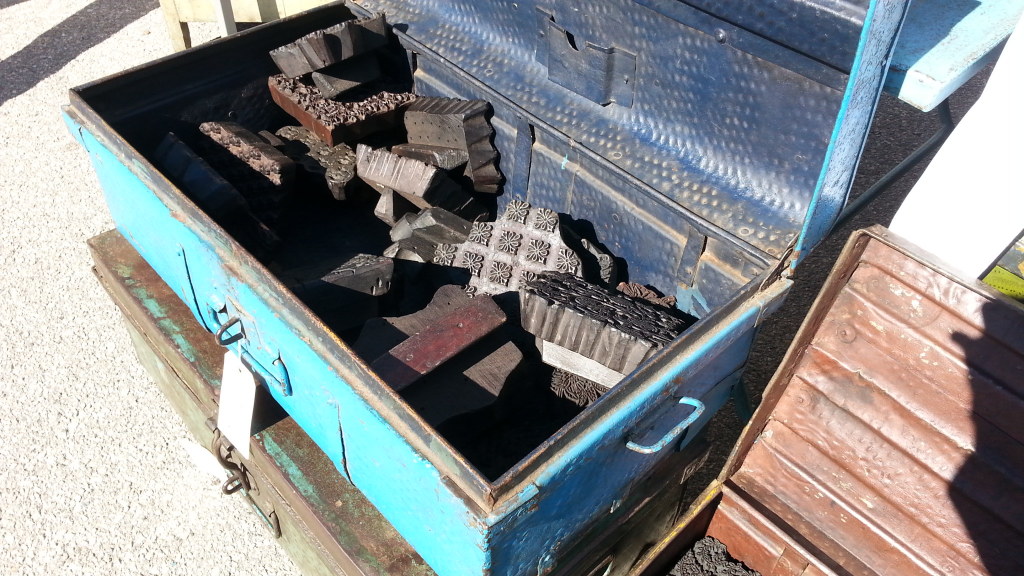
A trunk full of textile blocks

A trunk full of textile blocks

Steve told me the teak blocks are retired designs from India where they saw the ancient, traditional methods practiced.  And they were amazed at how fast the craftsmen were in stamping out yards of cloth at a time all the while maintaining the registration marks.  They tried the stamping and quickly learned it’s not as easy as it looks.

The work of these skilled crafters would challenge modern day screen printing.

Block printing is a simple process, e.g., children’s potato prints.  It was even often a part–a sophisticated part–of college beginning design classes.  But the Indian printing is way beyond a potato or linoleum block.

I had to research the art of block printing in India.  It is an ancient, tradition and the artists are highly skilled.  As  with many traditions, the skill is passed down through generations of family.

To get a feel for the art of block printing in India, watch this brief video which takes you through the design and carving of the blocks, to the fabric preparation and the stamping.

https://www.youtube.com/watch?v=1fTxIpMdinI

For more detailed information about the different types of printing, inks, etc., click here.

With any block printing, it is important to have a smooth, continuous pattern.  Each stamp must be accurately placed with the previous stamp(s).  Registration marks on the blocks facilitate this process but it is also an acquired skill when stamping yards and yards of fabric where speed is important.

It seems block printing is back in my life; it may be just some thing I appreciate or I may actually make use of the blocks I bought–only two due to luggage space!  Or they may be decorative pieces on a bookshelf!

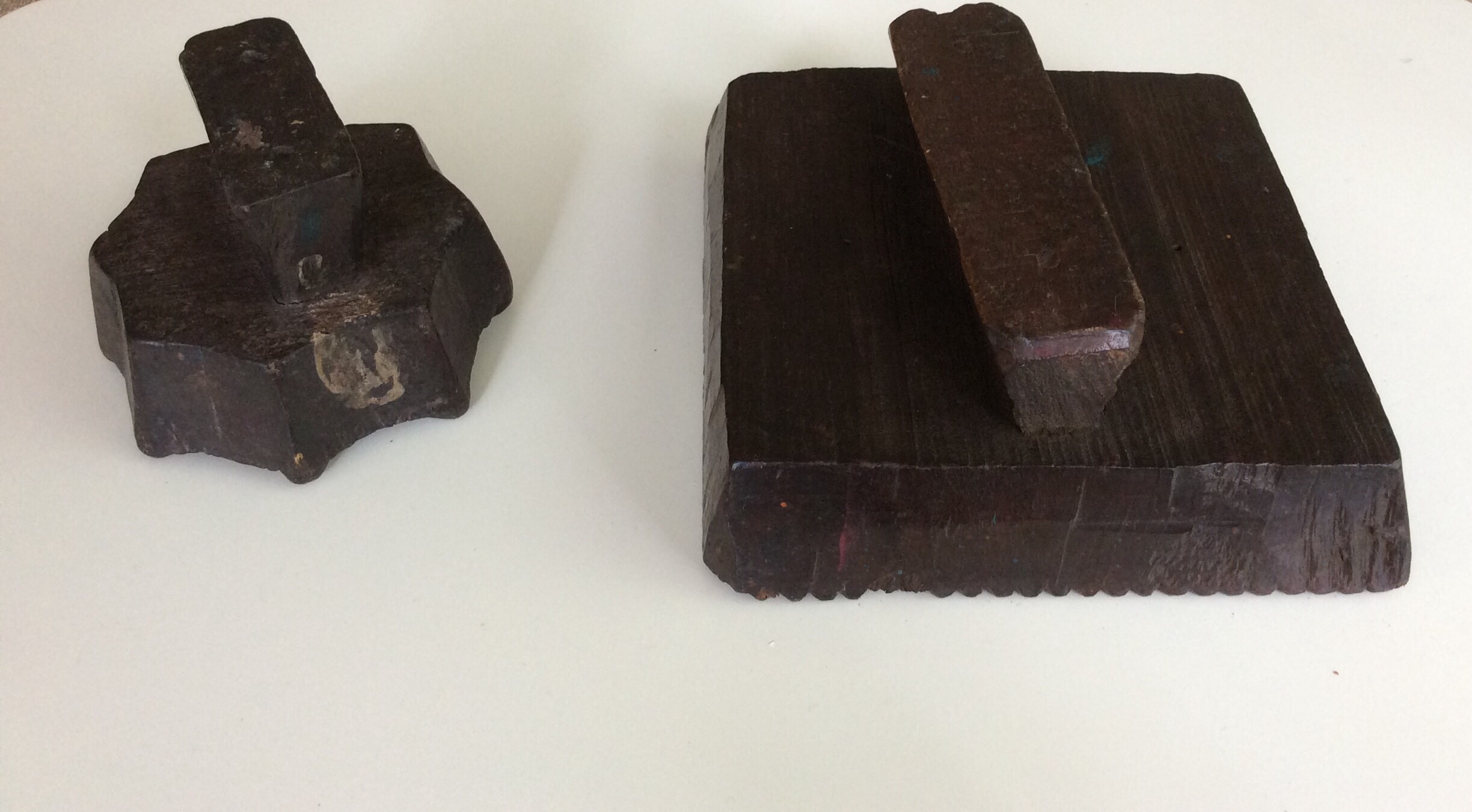
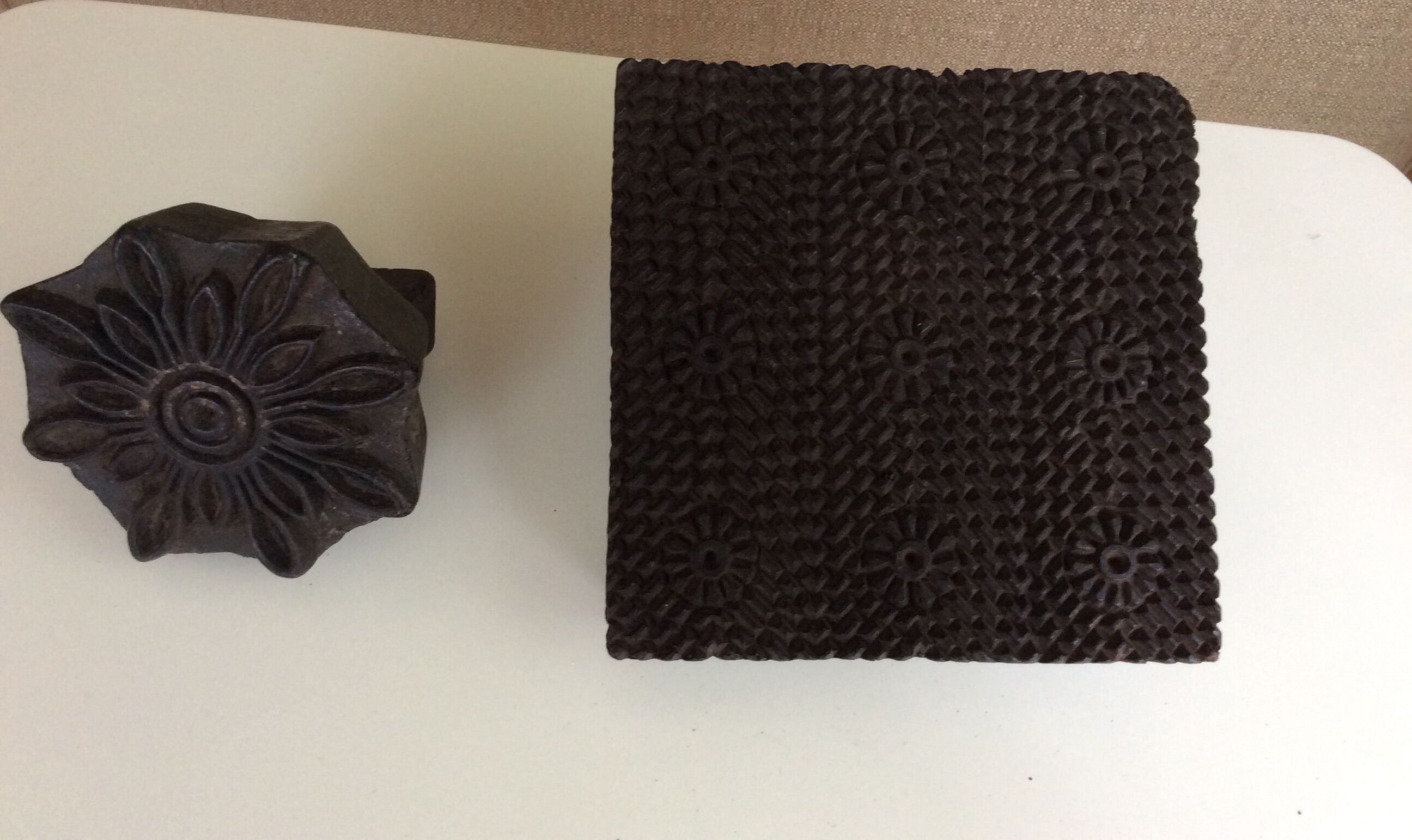
Teak Textile Blocks I bought

Teak Textile Blocks I bought

Carved design

Carved design


Artisan over-printing to add more colors. Accuracy is important to print in previous colorway. Courtesy: ArtyCraftyThings


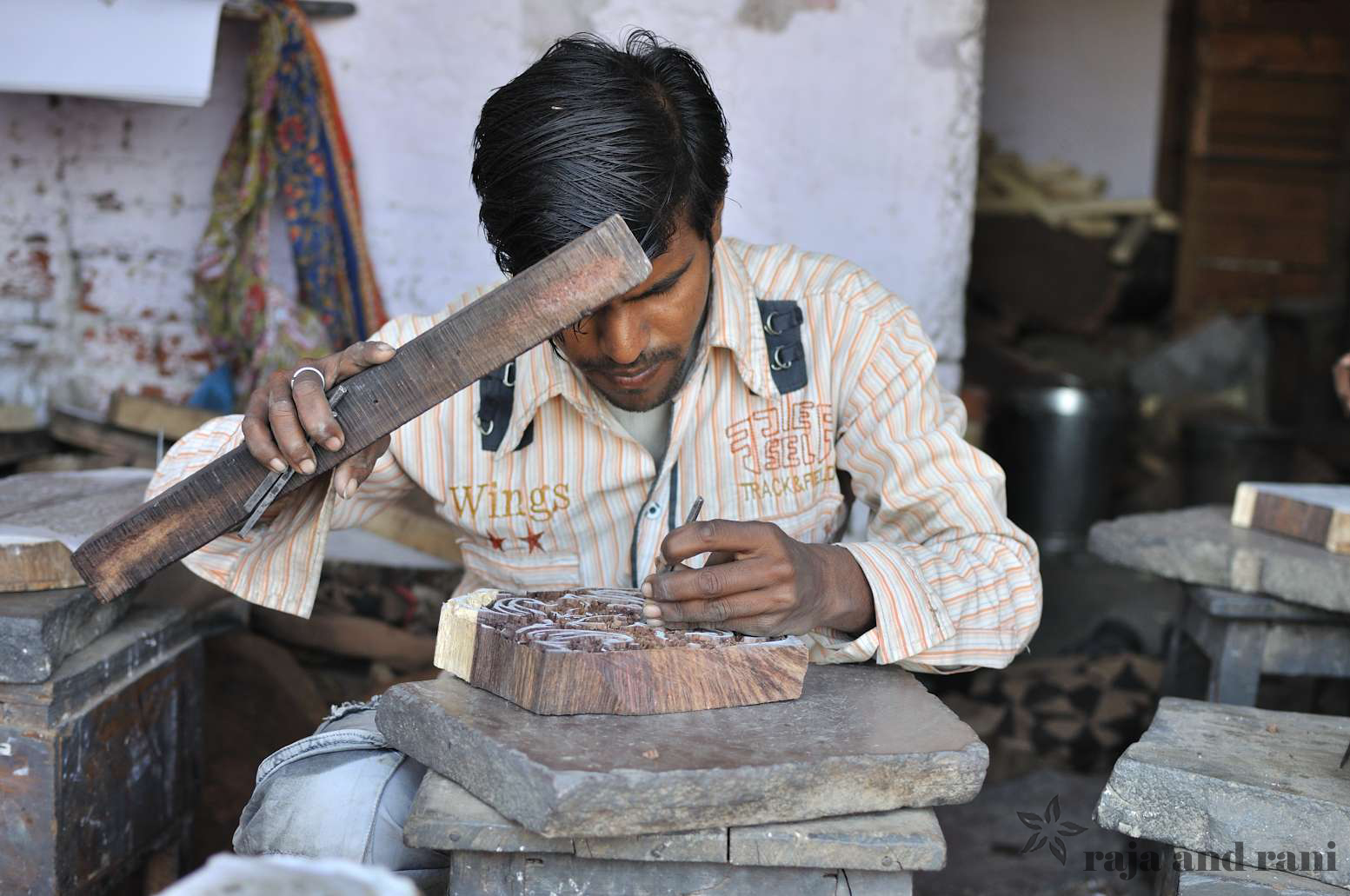
Artisan hand carving textile block Courtesy: raja and rani

What is your experience with creating your own fabric design?

Posted in OUT AND ABOUT | Tagged , , , , , | 2 Comments

Skirt Wardrobe


January 2016 Update

These skirts have become a staple in my wardrobe; they get worn at least once a week, even if just at home.  Hey, it’s just as easy to reach for a skirt & T as leggings, pants!  And, I can sew no matter what I’m wearing.

Turns out, the quilted skirt is a fave.   It’s short- for me–just skimming the knee.  Always wear with leggings as have ‘ugly’ legs.

Not Dead Yet Style just posted about ‘older’ and short skirts.  I say Yay with qualifiers: varicose veins, chubby knees, wisdom spots, etc., need to be covered.


I am not a ‘skirt’ person; haven’t worn them on a regular basis since college days when they were a requirement at the College of Home Economics, University of Minnesota.  Of course, we had work-arounds–roll up the jeans and pop a skirt over.  Never did make much sense as this was Minnesota and tromping around campus in a skirt wasn’t the warmest.  Please note, this was way before leggings and cuddleduds.

Now, for some reason, skirts are again appealing; maybe it’s the availability of leggings, whatever.  I find myself drawn to them and even wear for days at home.

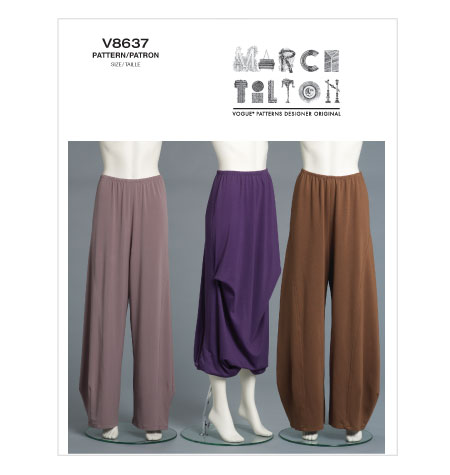
My current fave patterns are both Vogue, and both, of course, are out of print but should still be available.

Vogue 8637

Here are two versions of V8637.
V8637
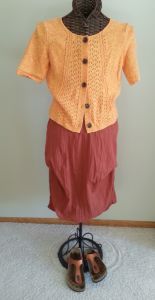
V8637
MT Skirt Orange

V8637

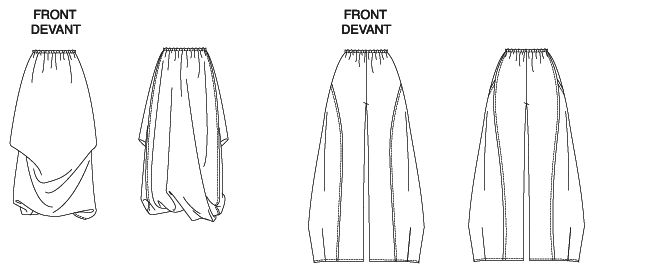
V8637 Pattern Sketch

V8637 Pattern Sketch


Vogue 8637

Vogue 8637

This skirt pattern is for knit fabrics but discovered by accident that it will work for a woven that has a bit of ‘give’.  Both fabrics are textured wovens and drapey.

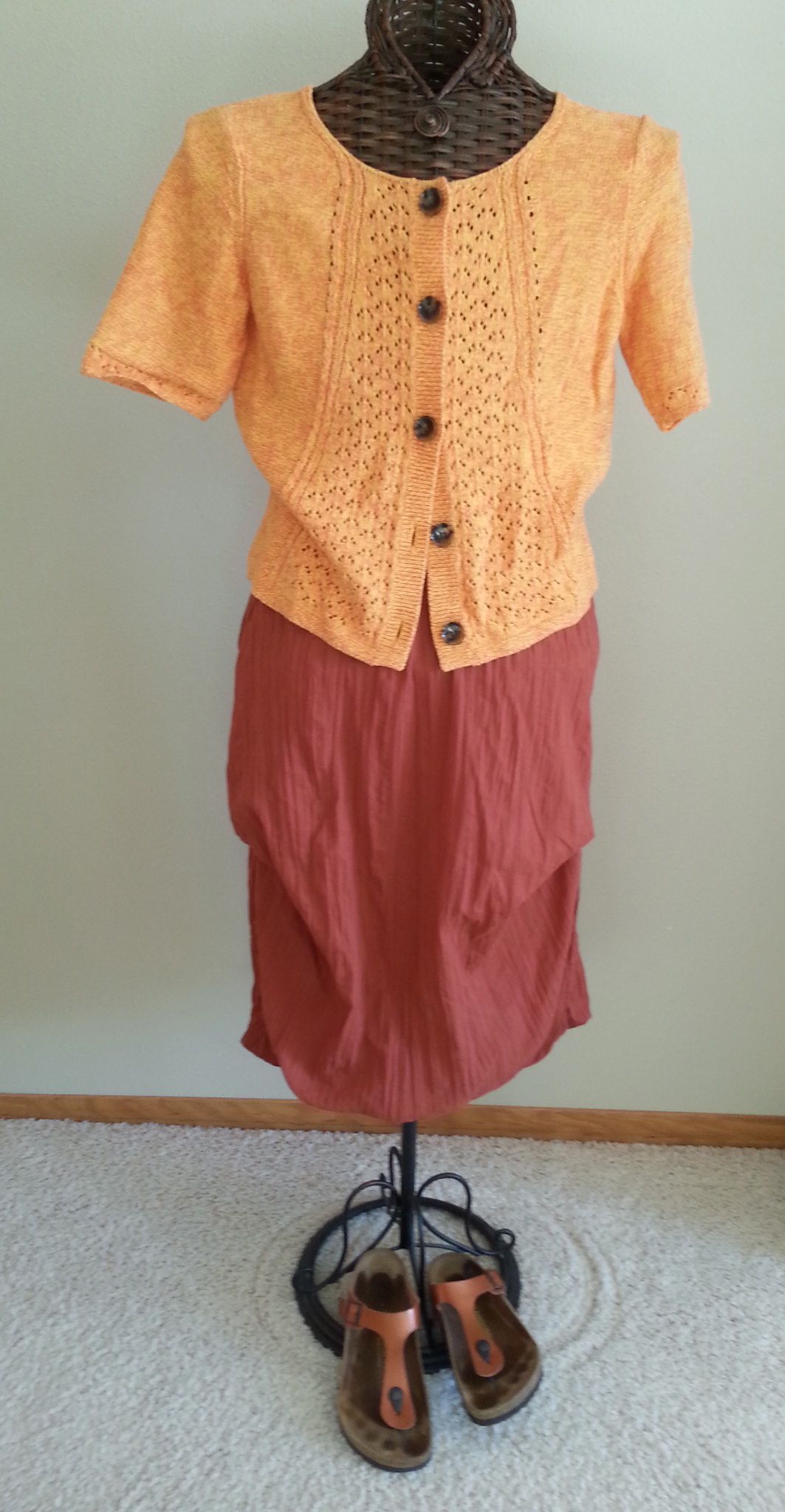
The rust was lanquishing in the stash until I realized it was a good coordinate for the orange sweater.  Had just purchased the Marcy Tilton skirt pattern and decided to see if a woven would work, which it did.

The design features deep tucks on each side of the front and the hem has sewn-in tucks which is then turned under by several inches and held in place by 1/2″ long tacks in about four places.  The hem allowance is offset, i.e., seams, center front, center back, do not match to the garment; this creates the interesting folds.  Be sure to accurately mark where the hem allowance should be tacked as while not difficult, can be confusing.

The rust is probably cotton/poly with a scrunched, crinkled texture that I am guessing is heat set as it holds its texture through the wash process.  It is also light weight and cool for summer wear.   The texture allows enough stretch for an elastic waist plus the design is oversized through the hip and hem.  This skirt is shorter than the pattern due to available fabric; it just covers the knee.  Knees are not my best feature, but it is short enough for warm weather wear.

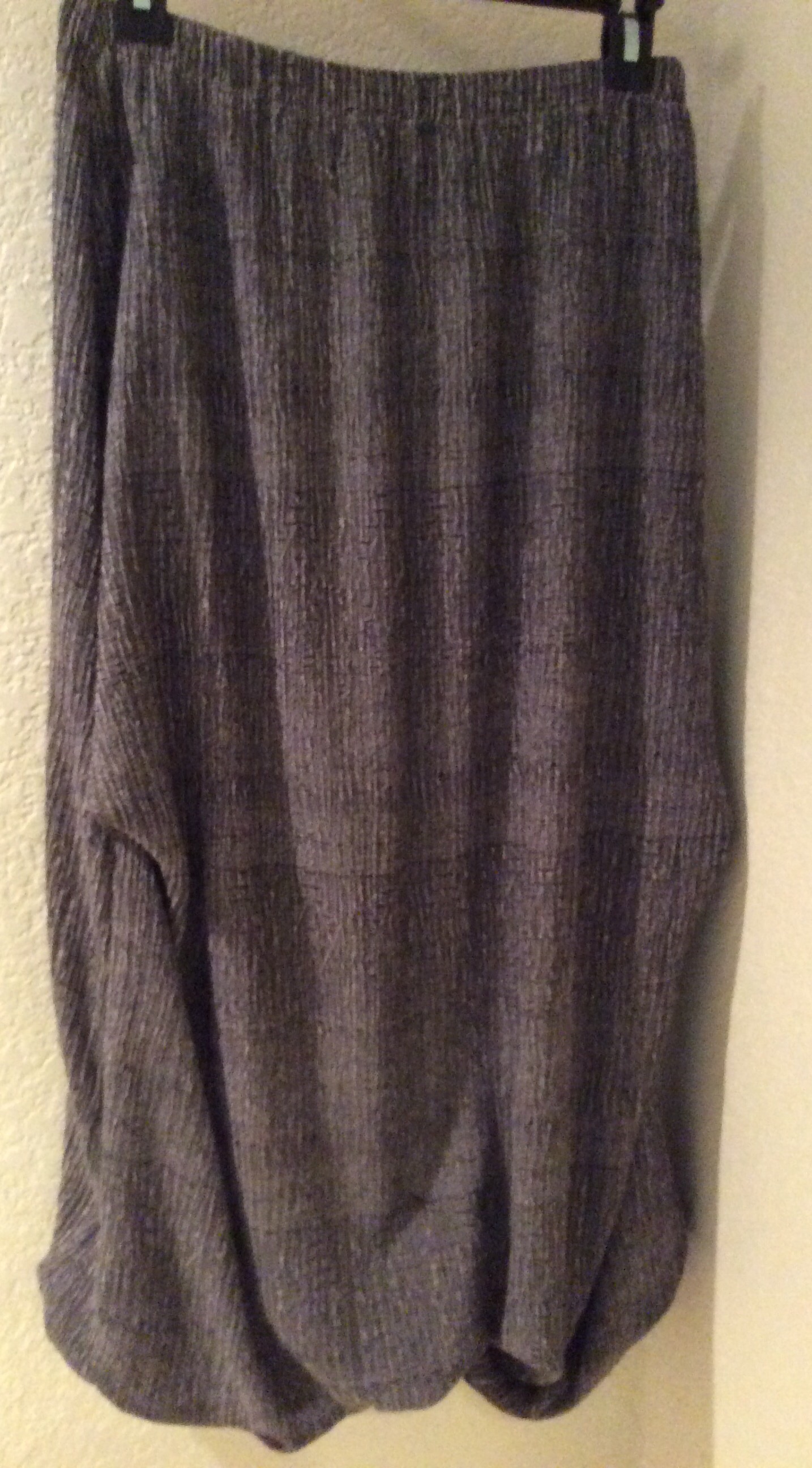
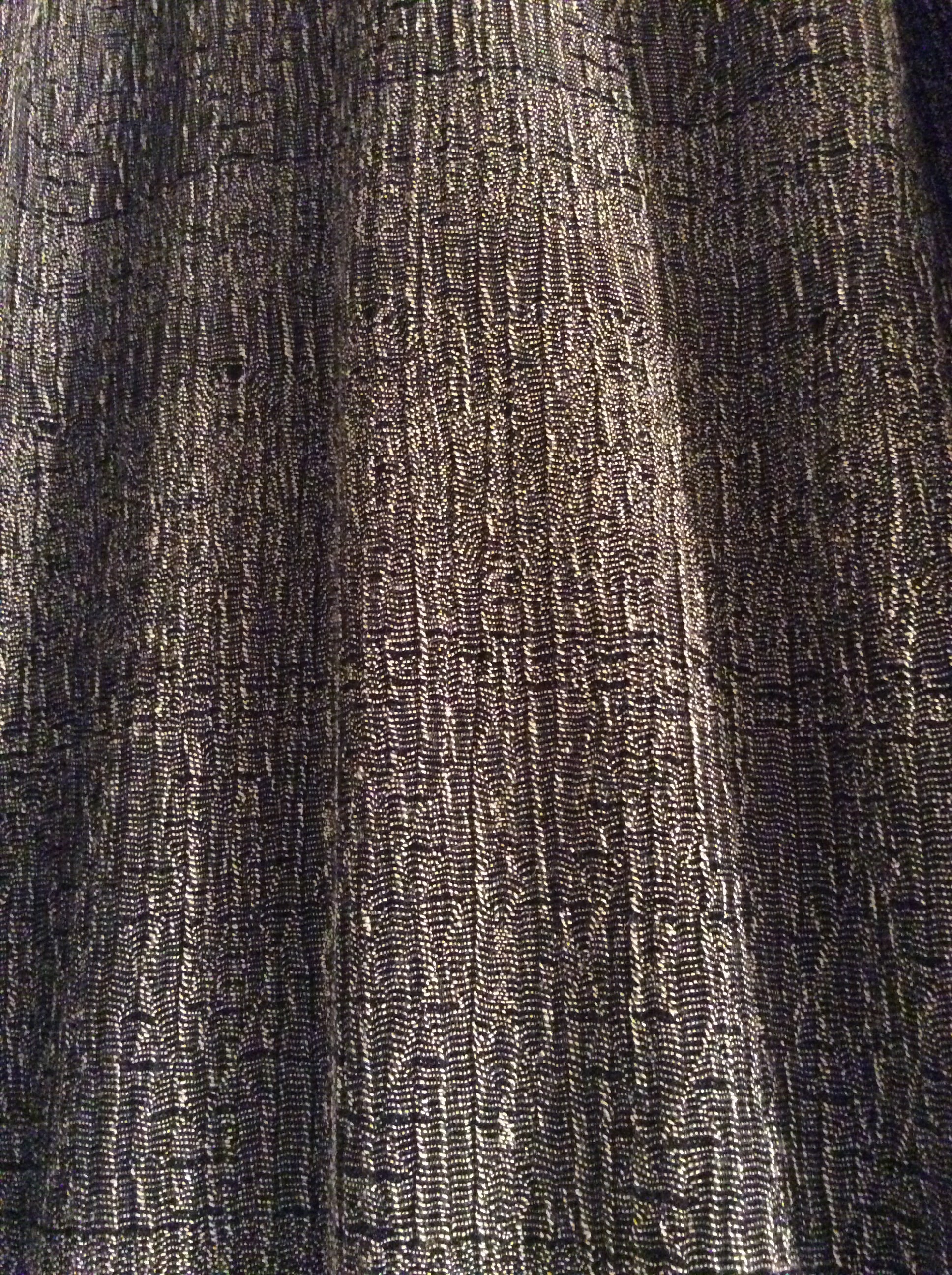
The black fabric has a subtle woven-in design and is also textured, but probably due to the weave.  The fabric cannot be pressed flat and has a lot of stretch.  Fiber is probably cotton/poly.  The texture is permanent and the fabric is a lot heavier than the rust.  Both fabrics travel well; just twist and wrap like a skein of yarn.   This skirt I wear in the Fall and Winter with capri leggings and/or Cuddl Duds plus boots.
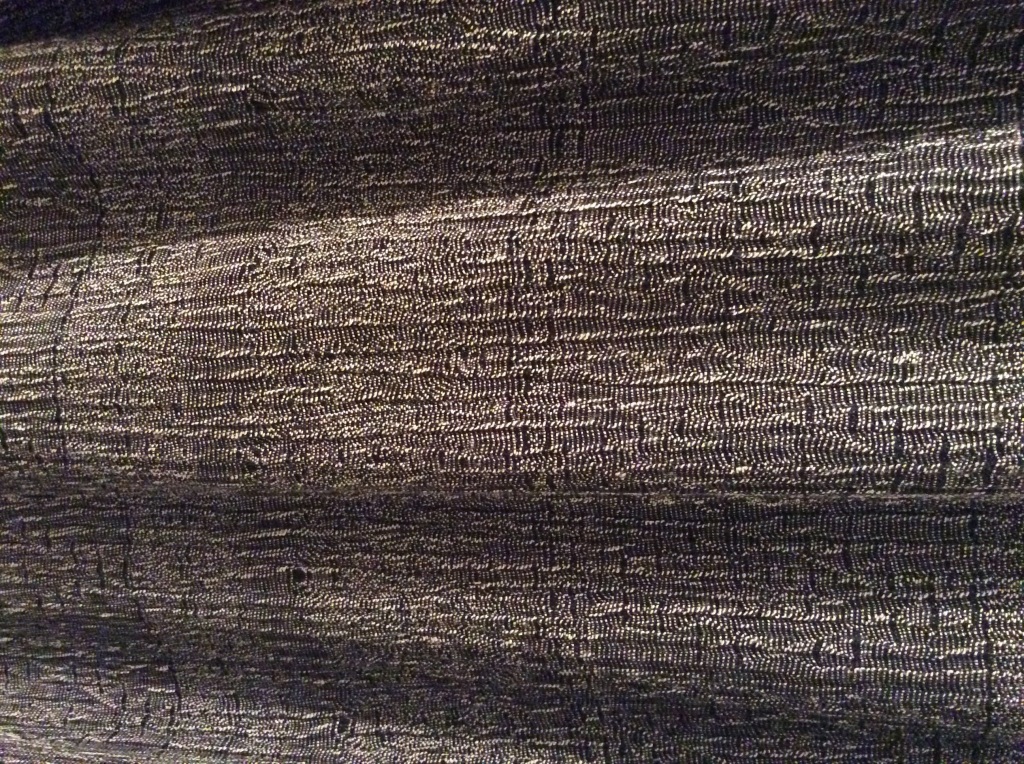
Closeup of texture

Closeup of texture

Because this skirt is mid-calf, I followed the pattern instructions and bound the hem edge in a knit.  It provides some stretch for wearing ease.  The rust skirt hem finish is serged as the shorter length doesn’t need the walking ease.

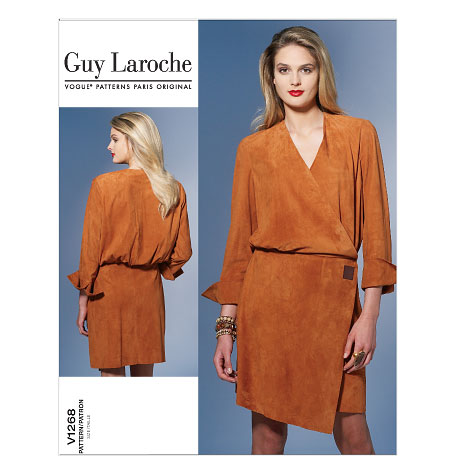
Vogue 1268

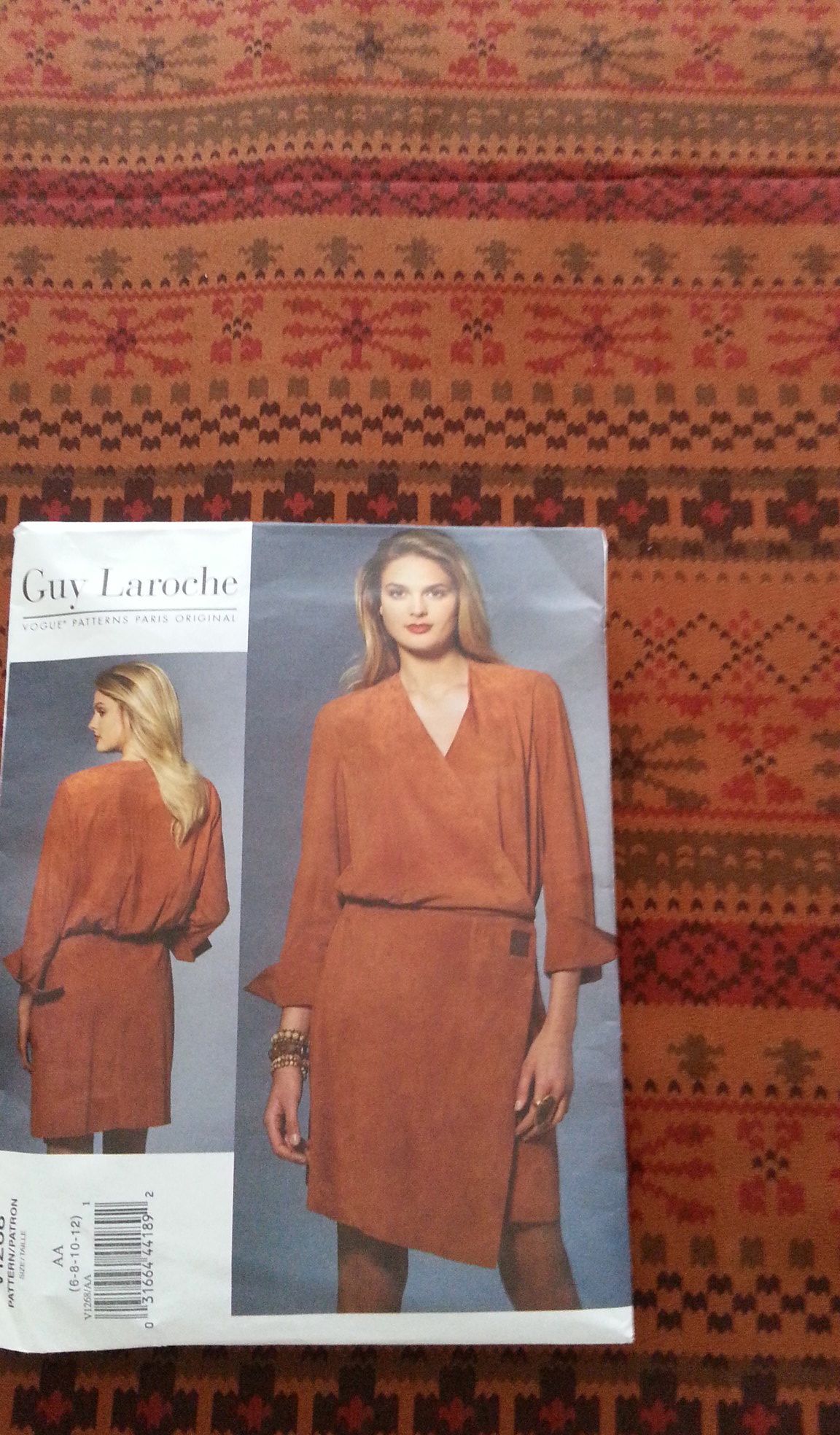
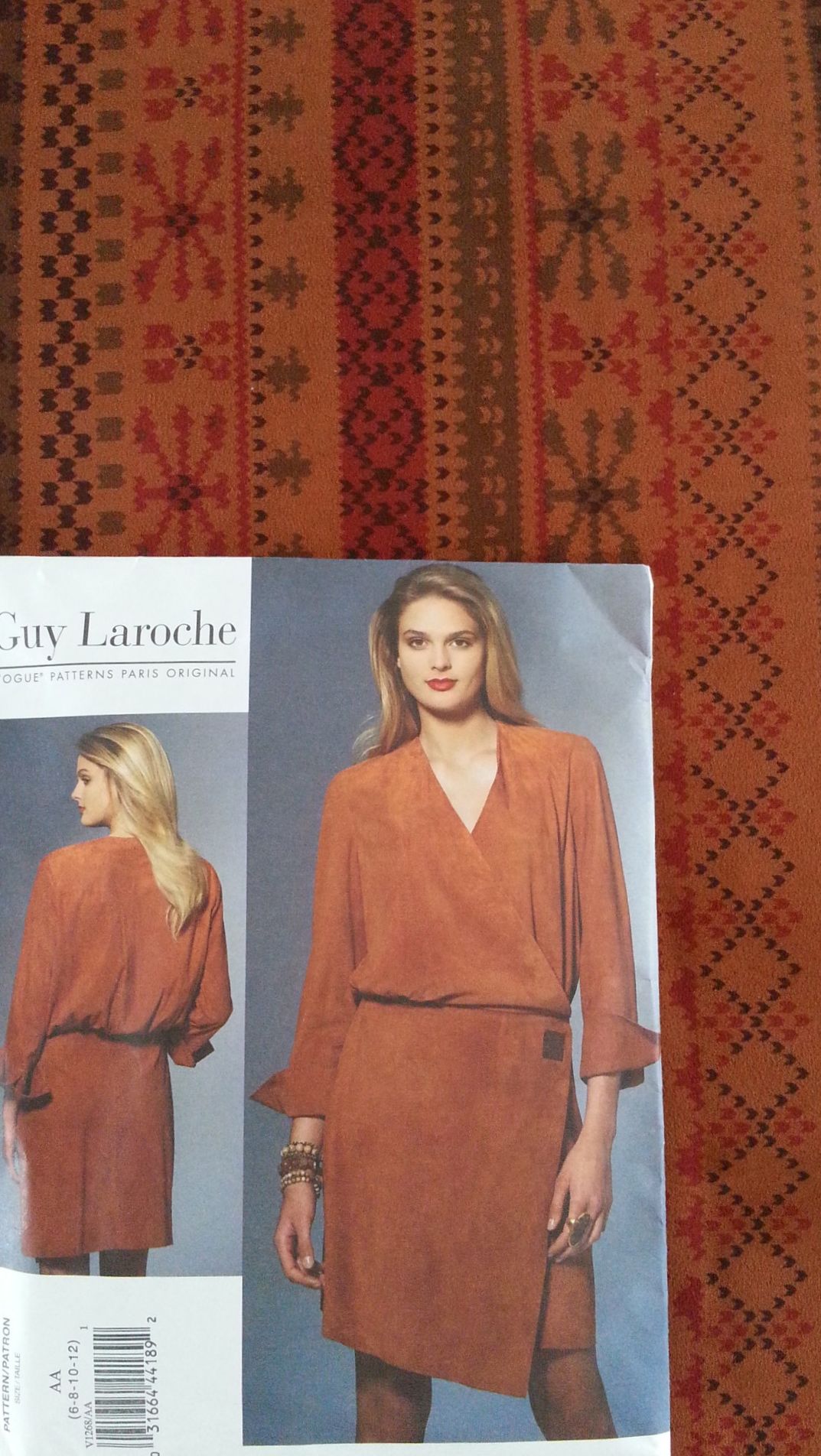
The other skirt pattern I have taken to is Vogue 1268.  It is actually a dress but I always make separates for the greater wearing options.  In a previous post, said I would make the top first, but decided to make the skirt as already had a coordinating top in my wardrobe.


The skirt is only 18″ long, much too short for my wearing comfort, even with leggings and boots.  Lengthened it to mid-calf and tapered the side seams from the hip (9″ below waist) to hem.  The flared hem is too much fabric even though the fabric, a faux suede with a knit back, is soft.  The altered hem width is the same as the hip width.

The other alteration was to eliminate the center back seam; the pattern was placed on the fold so matching the fabric design was unnecessary.

Inspiration

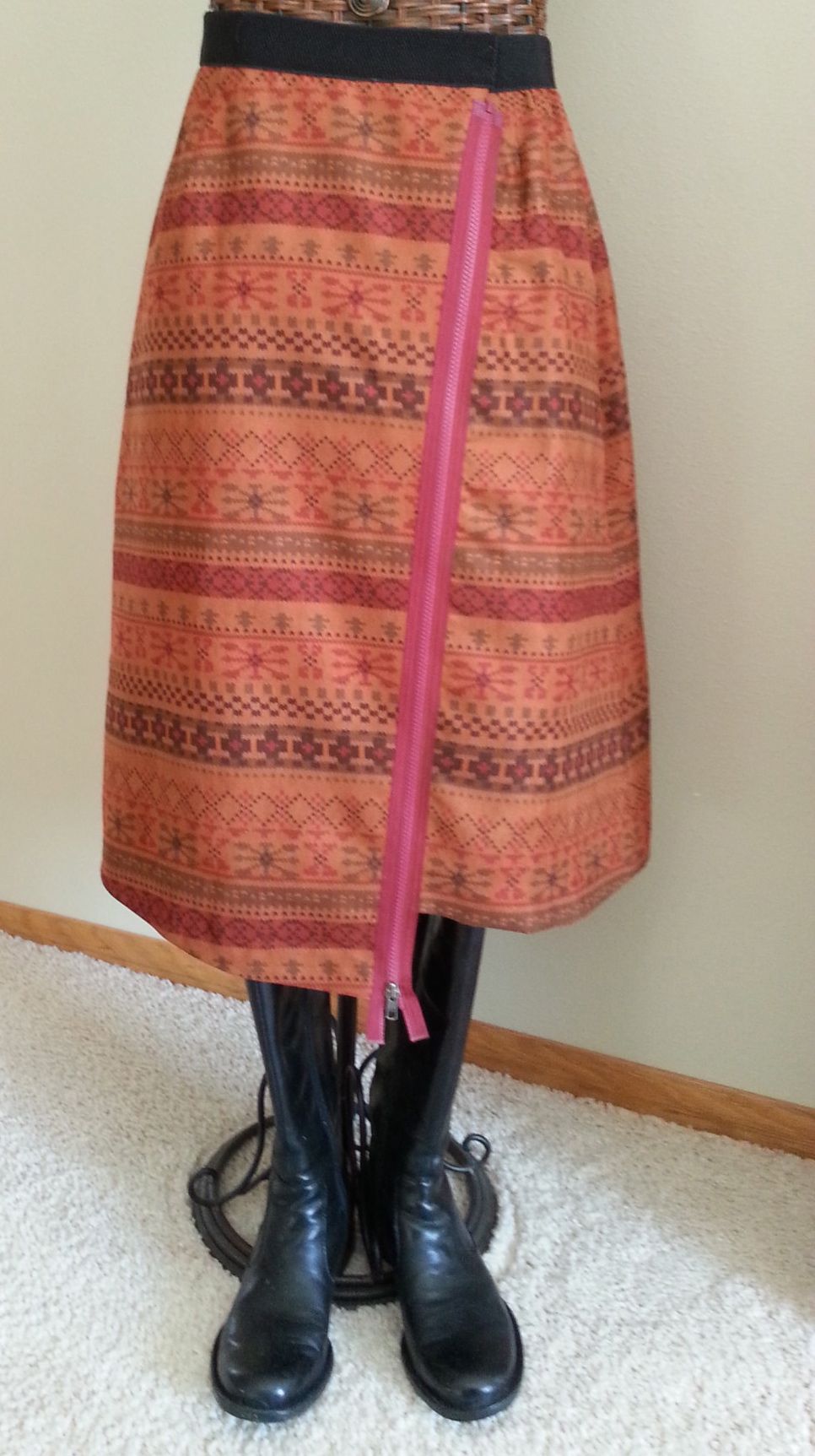
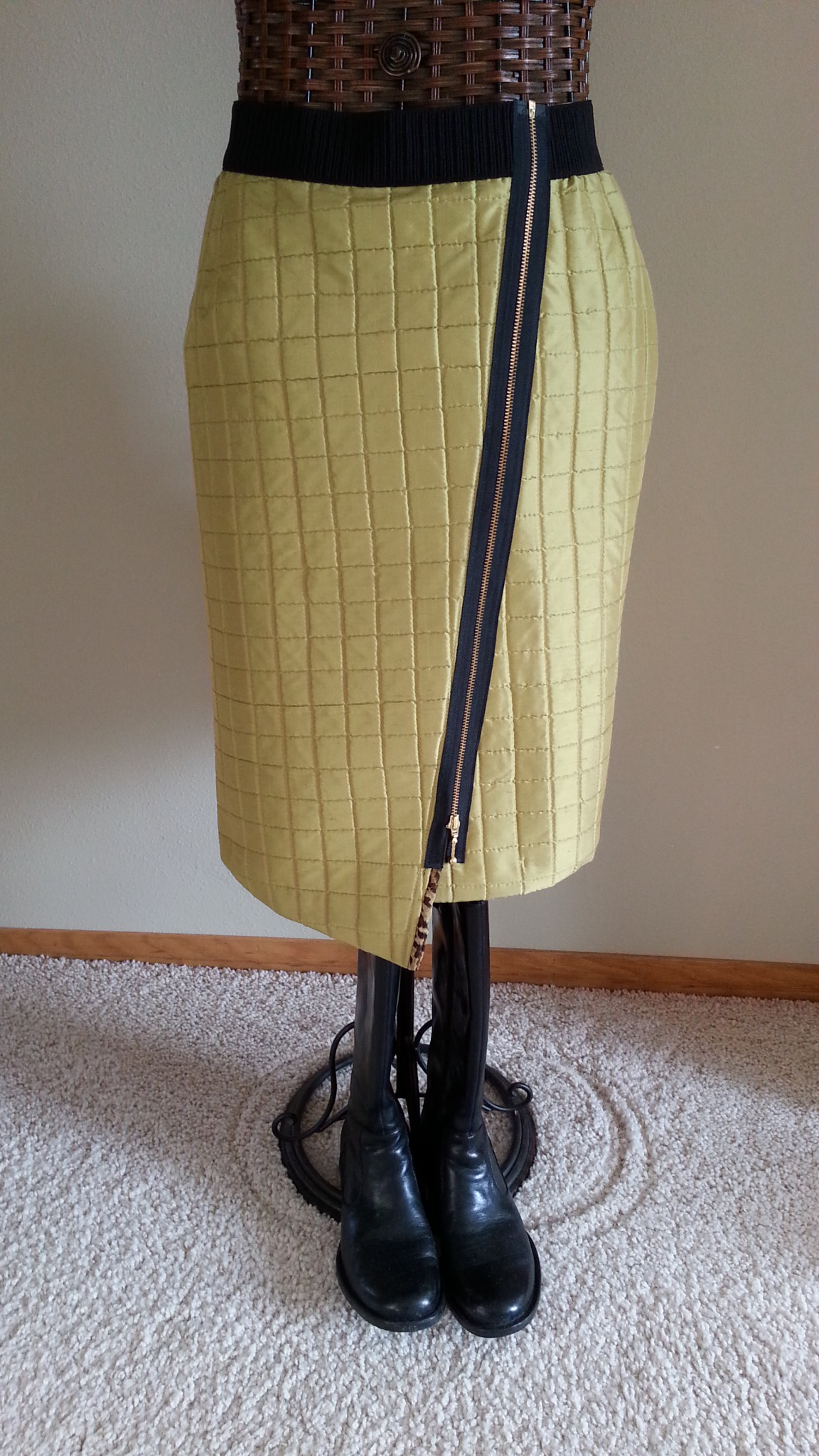
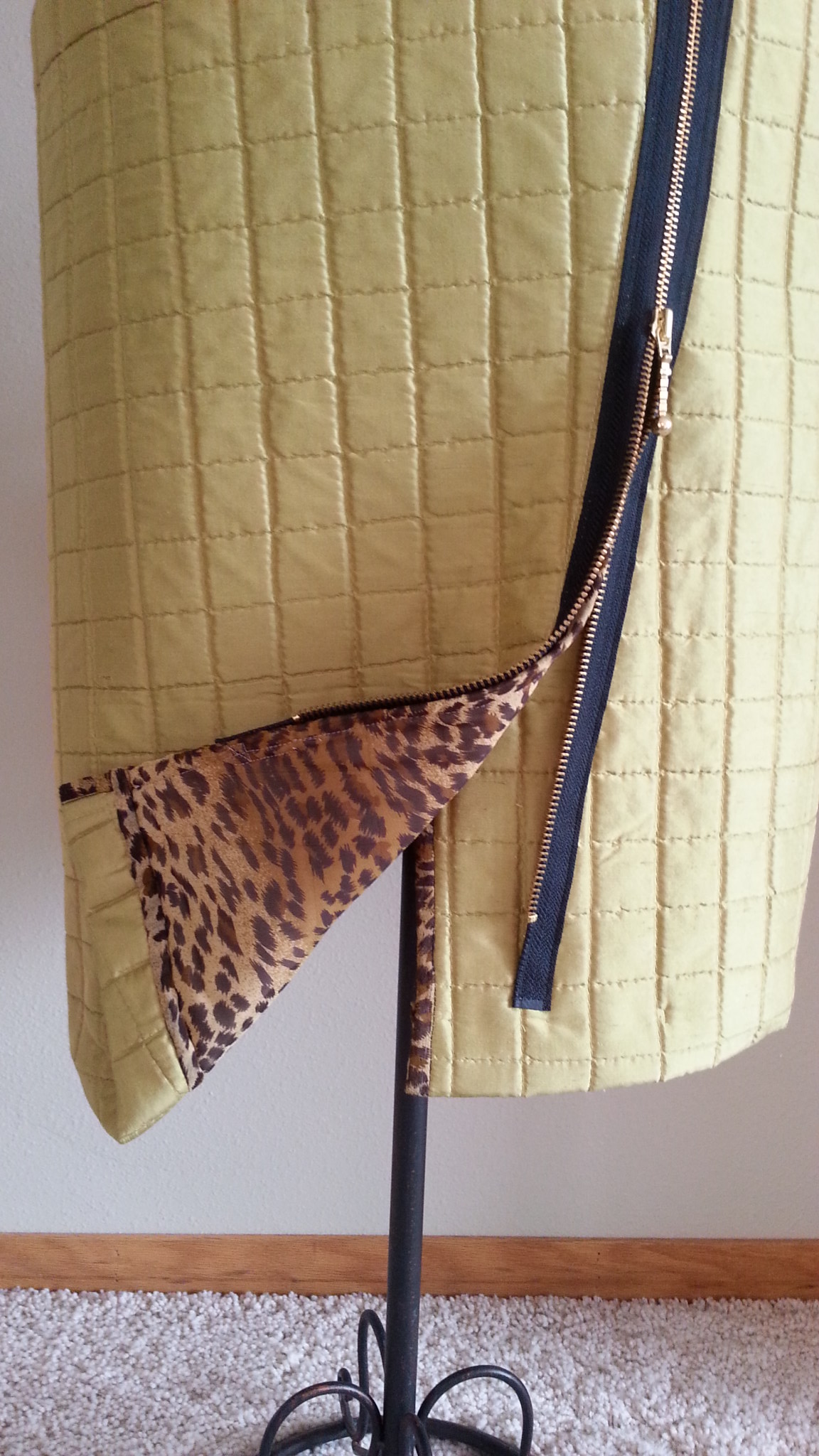
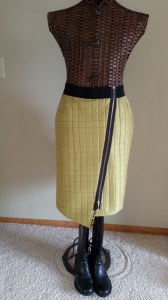
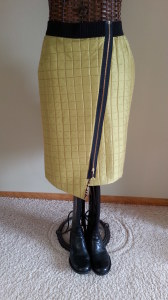
Had collected several RTW skirt ideas with zippers and decided to close the wrap with a separating zipper; the ‘bottom’ of the zipper is at the waist so the opening can be adjusted at the hem if wanted.  Plus, no matter how well fitted a wrap skirt, am never comfortable sitting in one; the zipper controls just how much leg can be exposed.

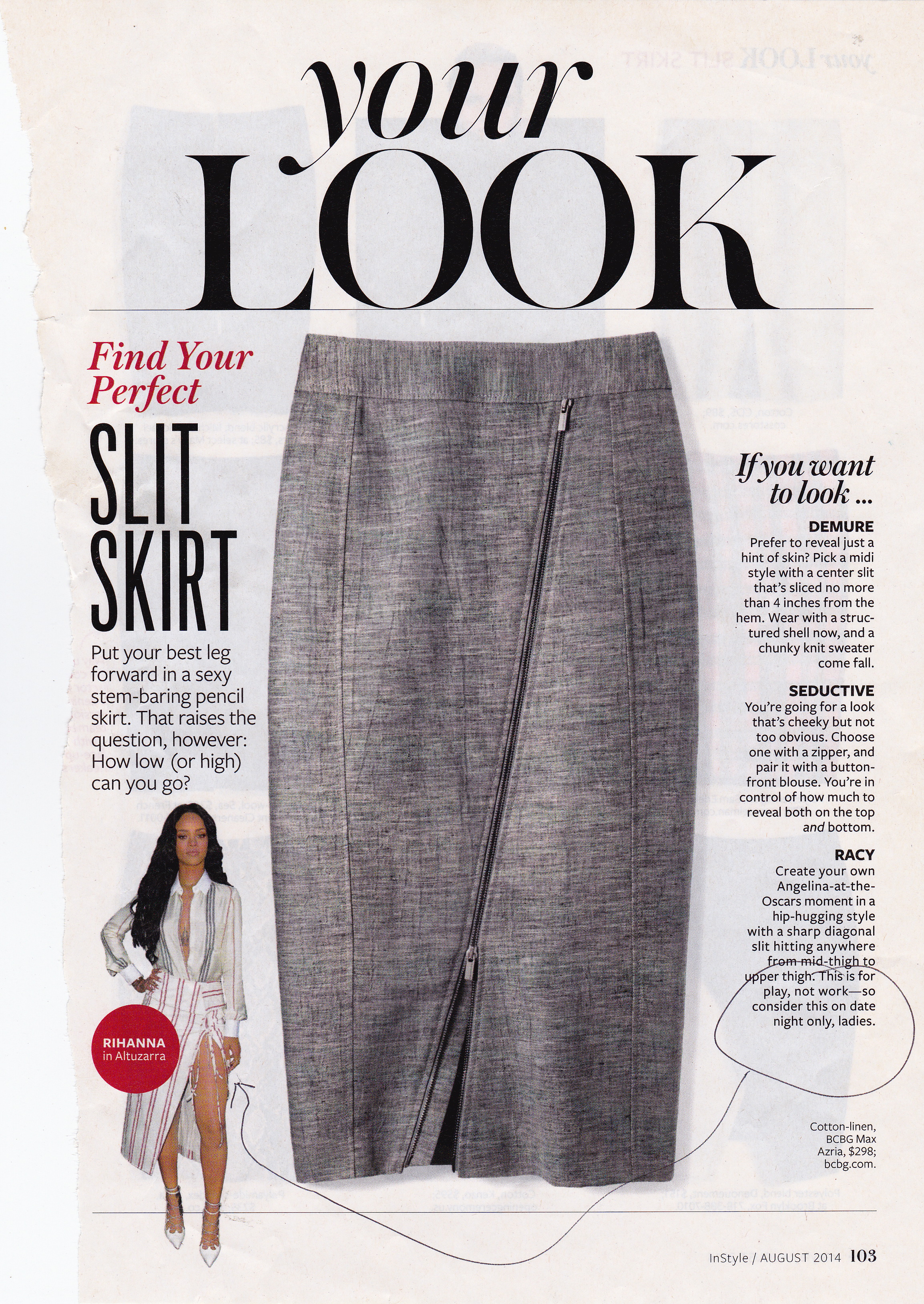
The zippers are exposed–topstitched on the right side of the garment; it’s the fashion and eliminates the need for precise seam allowances along the zipper tape, e.g., see the RTW pencil skirt below and note exact visible zipper width from top to bottom.
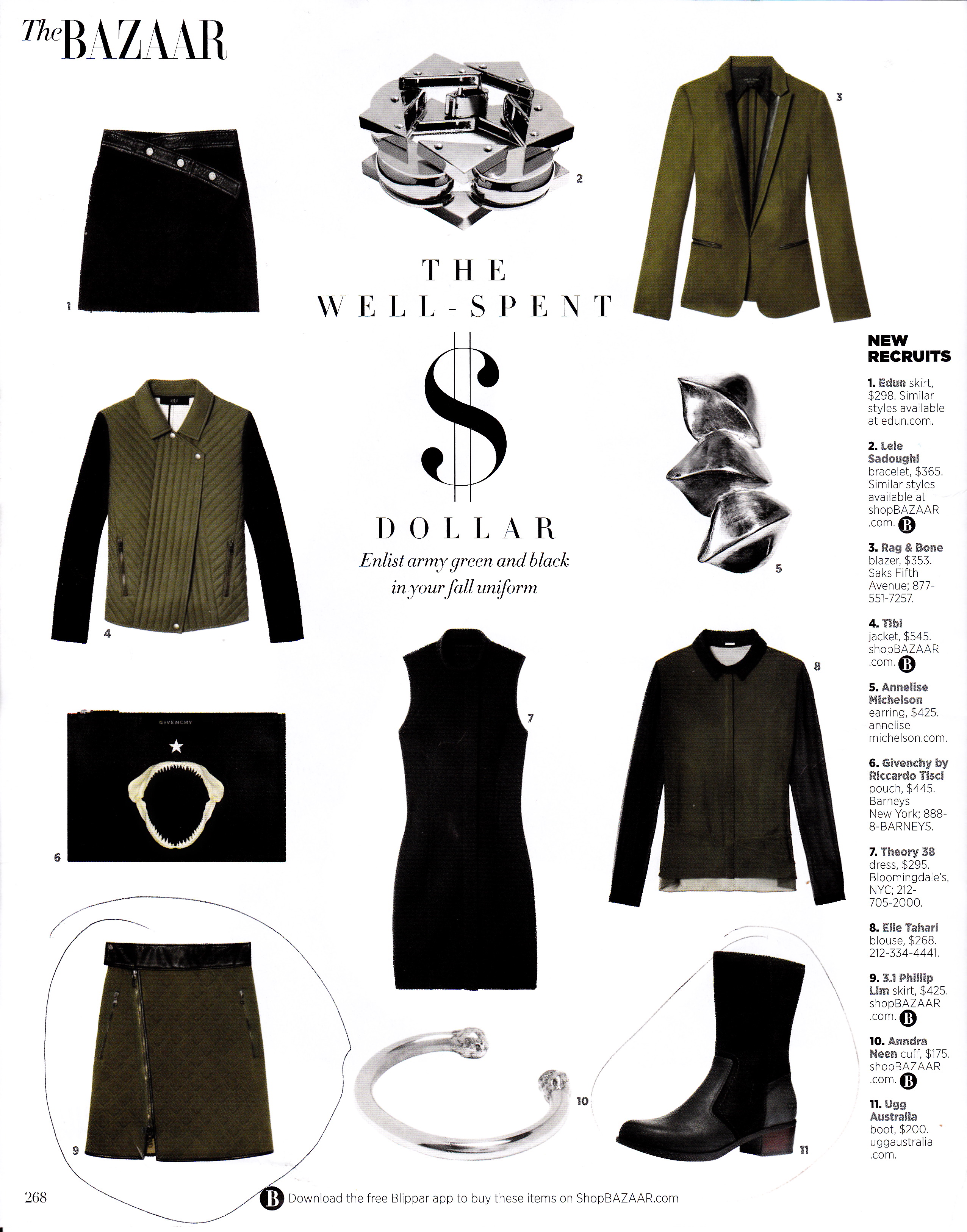
3.1 Phillip Lim Zipped Skirt
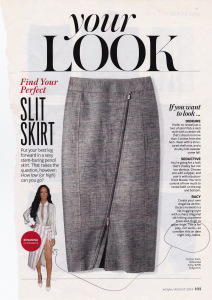
3.1 Phillip Lim Zipped Skirt

Angle Zipped Pencil Skirt

Angle Zipped Pencil Skirt


The waist is finished with wide, firm elastic topstitched over the seam allowance.  Because the skirt is fitted and has a zipper opening, there is little waist ease, thus no additional waistline bulk that could be created by ‘gathering’ the skirt to the much smaller elastic.
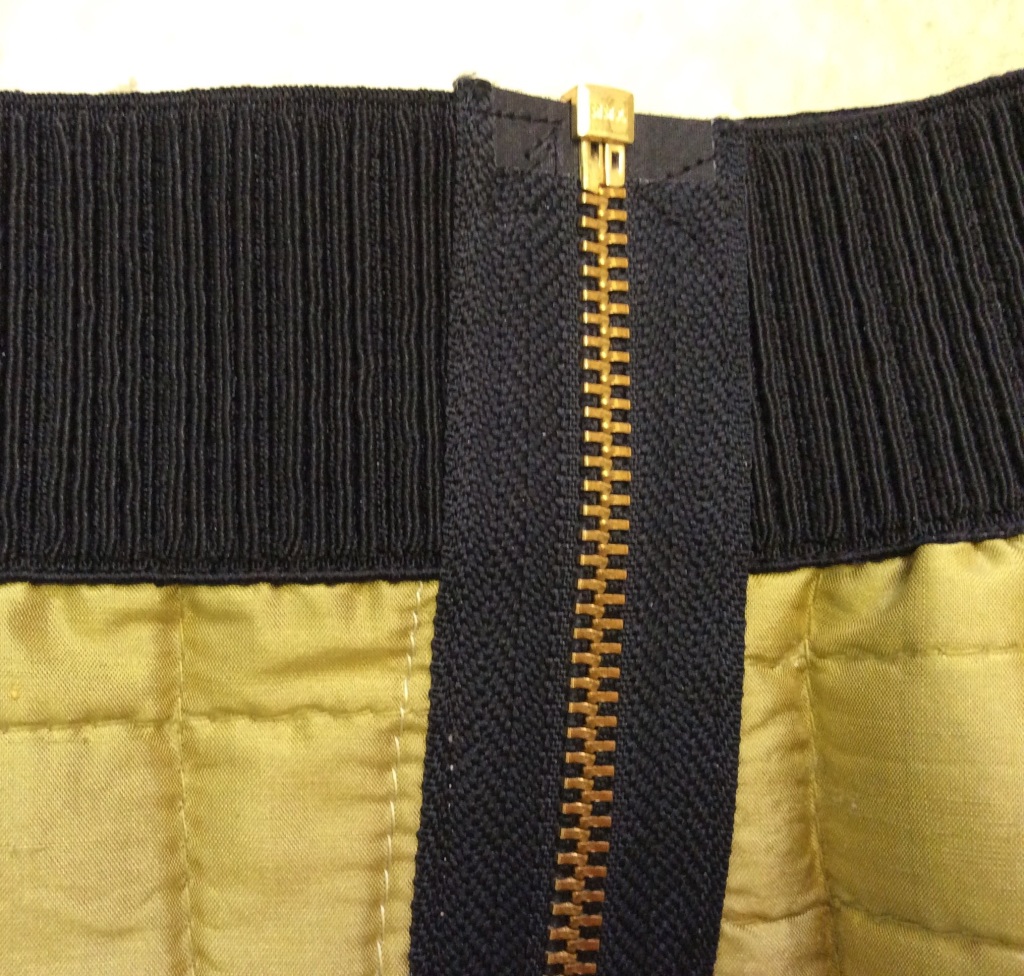
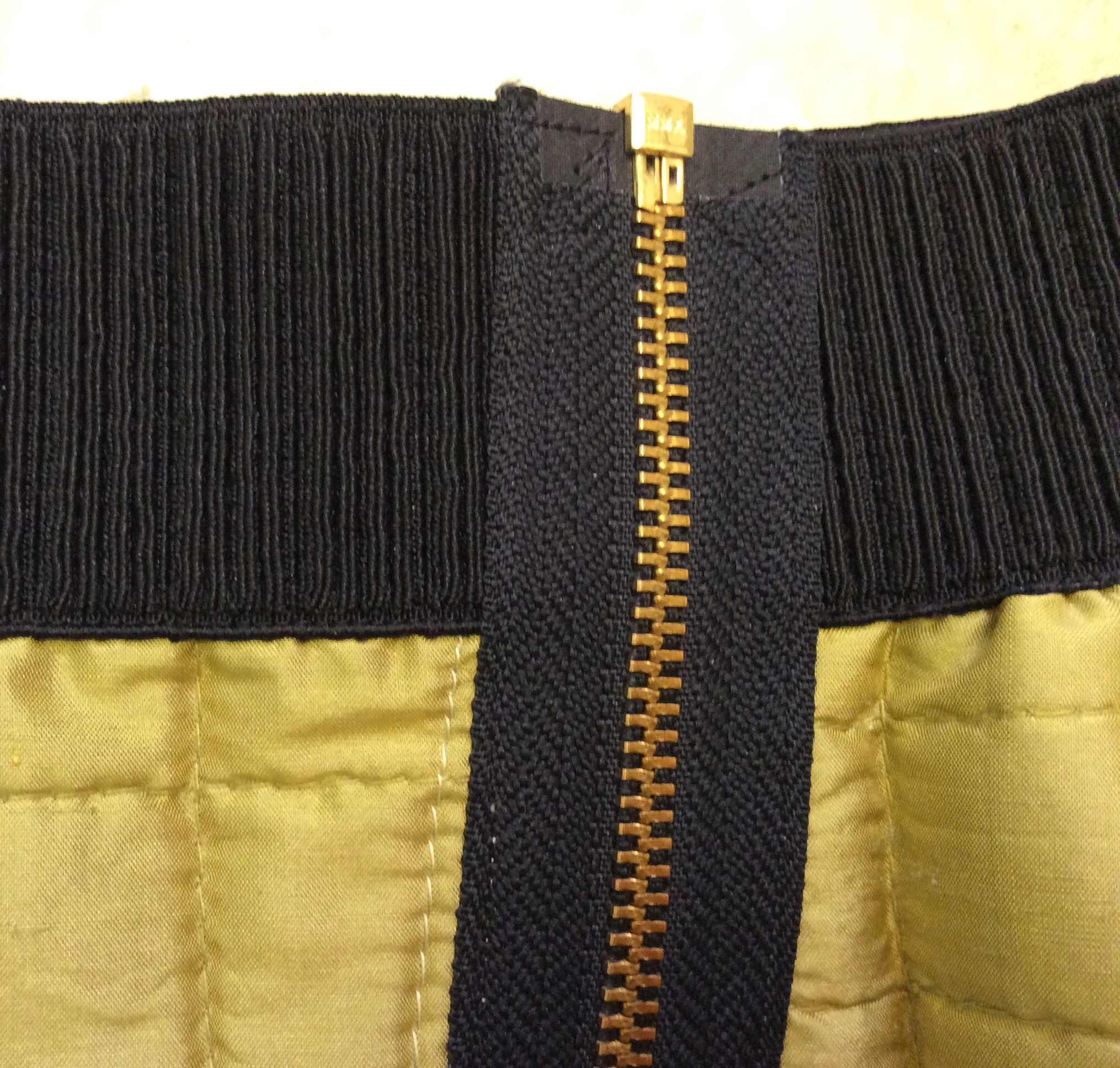
Elastic Waistband and Exposed Zip

Elastic Waistband and Exposed Zip

This elastic is applied just as any other by dividing garment and elastic into quarters and matching the pin-marked quarters.  The garment waist is stay-stitched at 1/2″ from the cut edge (if using a 5/8″ seam allowance) and is a guide for the elastic placement.  Place elastic on right side of fabric so bottom edge just covers the  stay-stitching, stretch the elastic to fit the garment and topstitch in place.

Nowadays, all of the sewing I do has an elastic waist, whether it is a covered elastic as in the previous skirts, elastic in the back and/or sides, or topstitched.  I find it much more comfortable and the fashion for wearing tops over bottoms is the perfect solution for disguising a thickened middle, as well as the waistband finish.

These skirts are meant to be worn with tops tucked in so the elastic is part of the garment design.

All that being said, here are the two versions, the Aztec print and a pea green quilted silk.
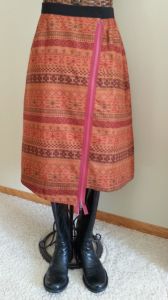
Mid-Calf Aztec Skirt
Mid-Calf Aztec Skirt


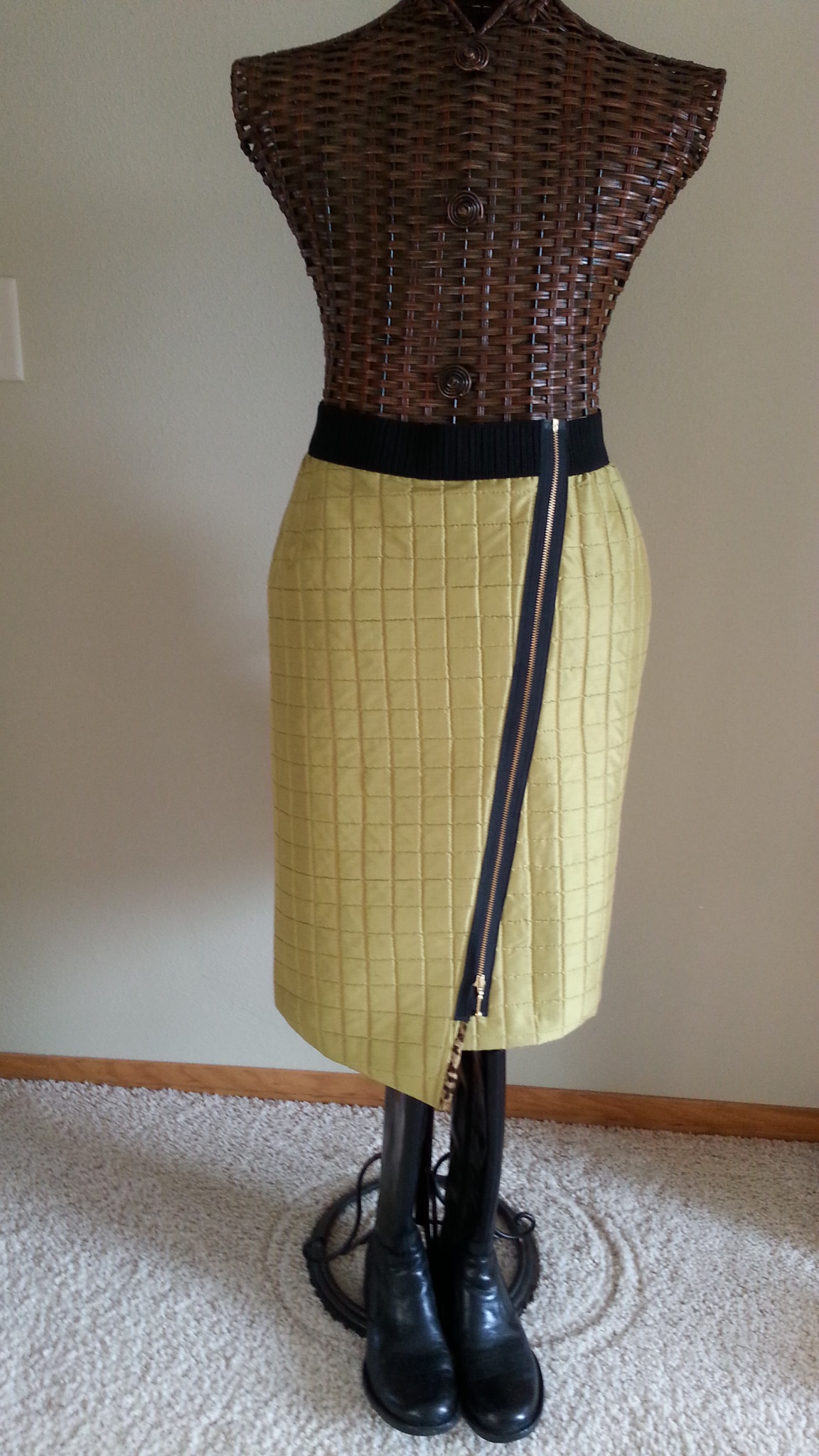
Pea Green Quilted Skirt

Pea Green Quilted Skirt


More Inspiration

The quilted version is inspired by a RTW in a Title Nine catalog.
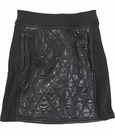
Title Nine Quilted Skirt

Title Nine Quilted Skirt

Title Nine Quilted Skirt

Title Nine Quilted Skirt


This skirt length is just below the knee and made from a quilted silk in my favorite pea green.  This color is stunning with black, brown, navy, red, brite blue, hot pink…Have worn this color for over 20 years.

The final skirt is far from the above look.  Well, it is just Inspiration!
Quilted Silk V1268
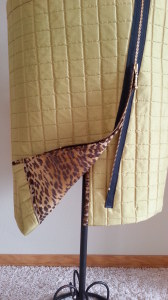
Quilted Silk V1268

Quilted Skirt and Lining

Quilted Skirt and Lining


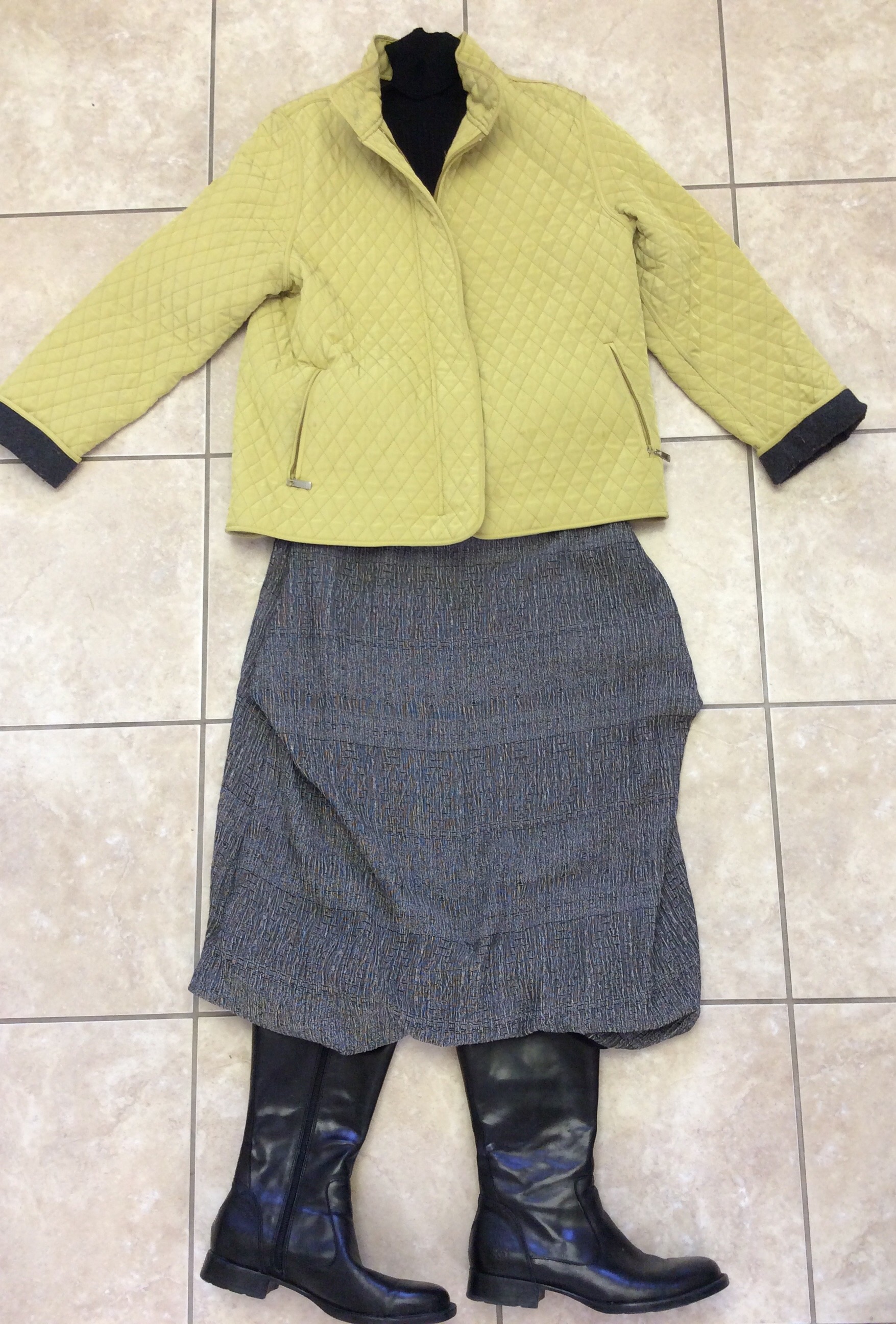
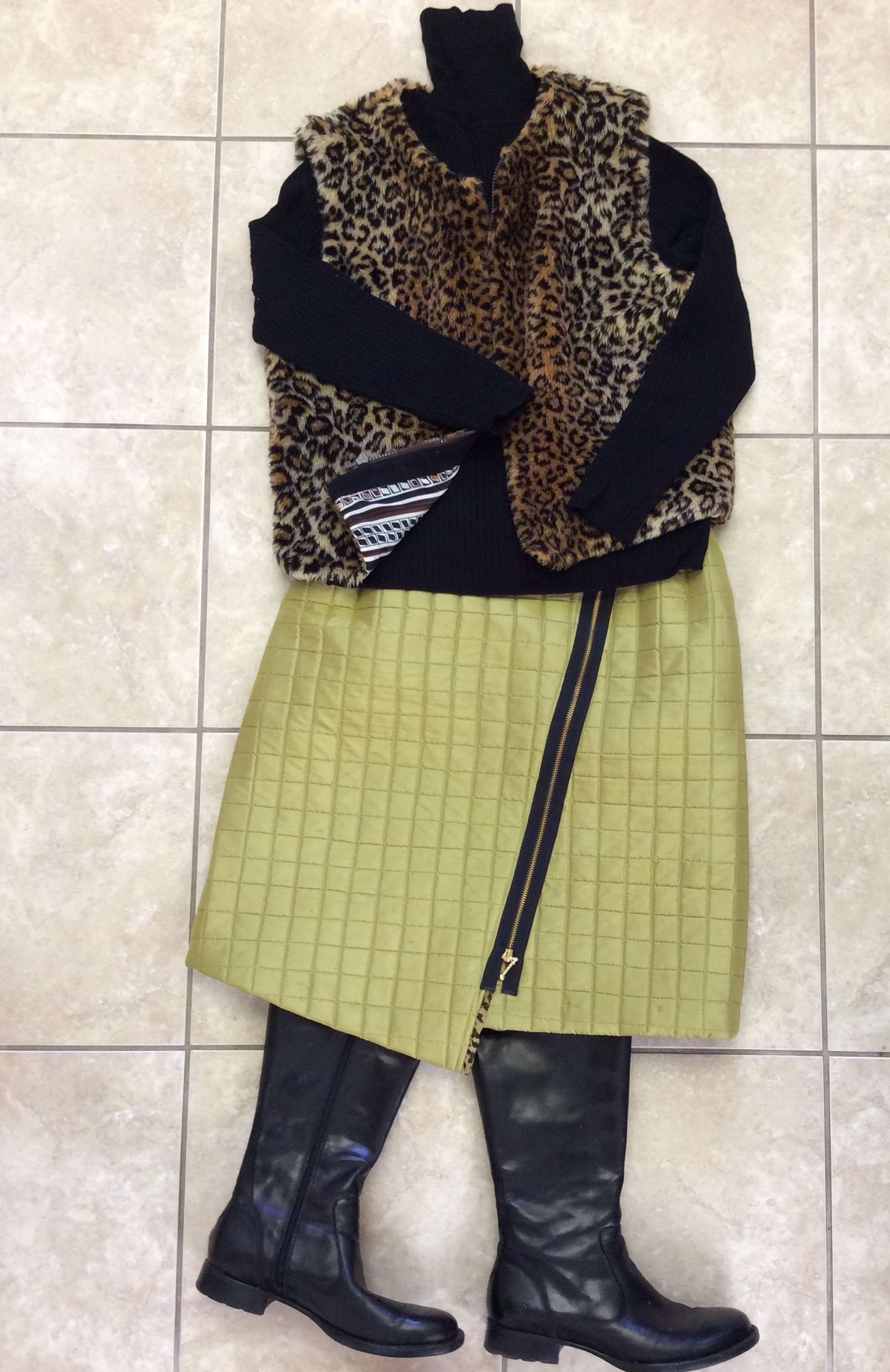
Street Looks with items already in my wardrobe

I must have a latent sense of what is in my wardrobe as I never shop with a specific color, design in mind.  Just buy what I like.  Since I am consistent in what I like, it makes sense that the closet will hold coordinating items.
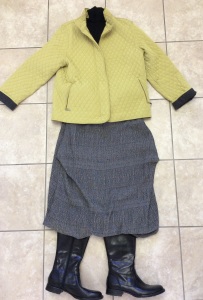
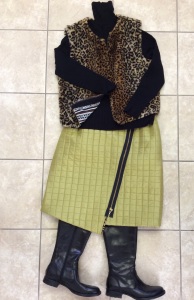
With RTW Pea Green Jkt

V8637 with RTW Pea Green Jkt

Faux Fur Vest from over 10 years ago

Faux Fur Vest made 10+ years ago

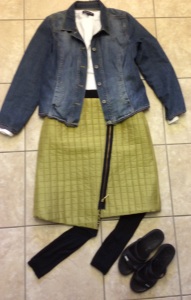
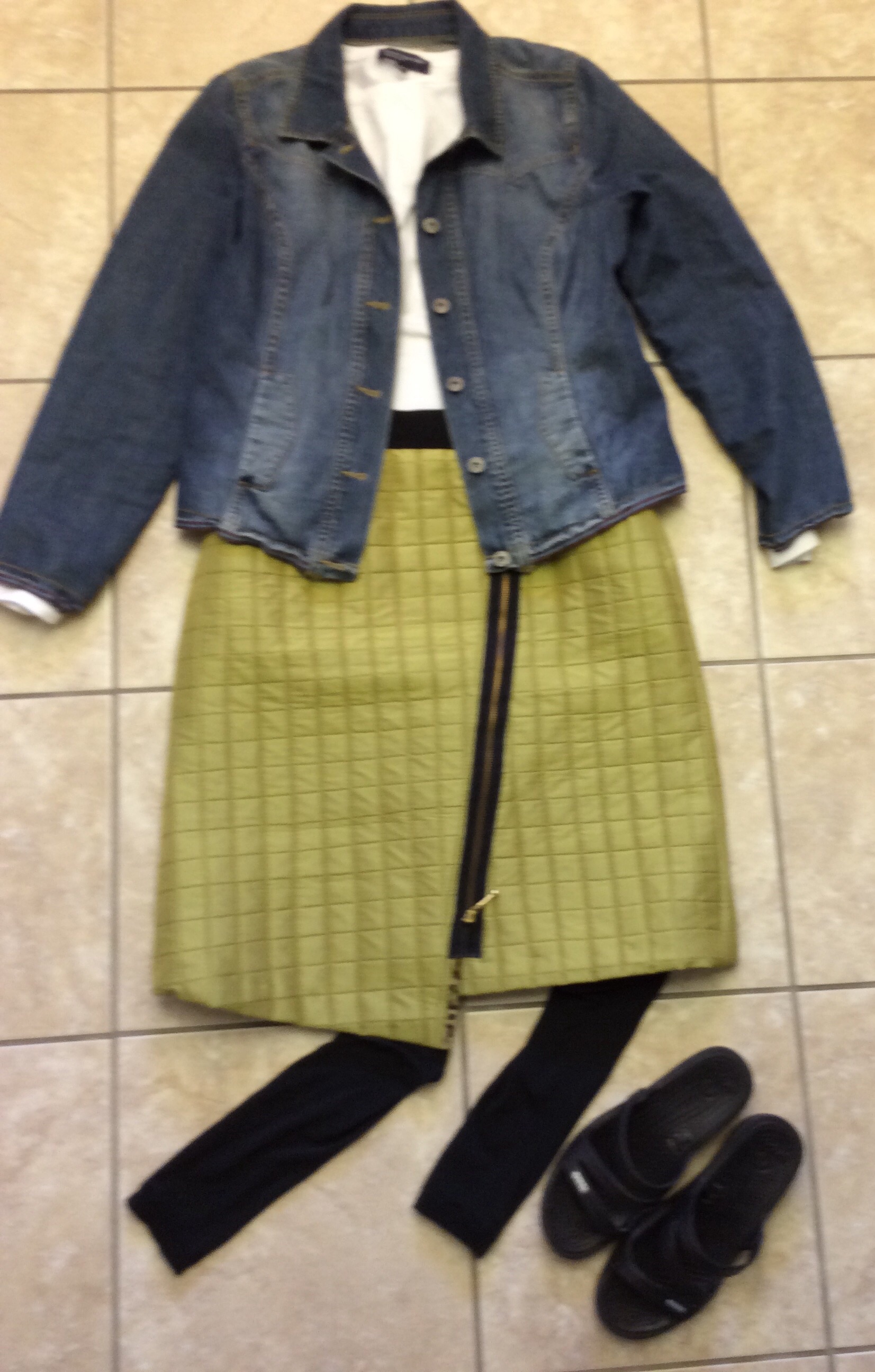
Street Look with jean jacket, capri leggings, sandals

…jean jacket, capri leggings, sandals
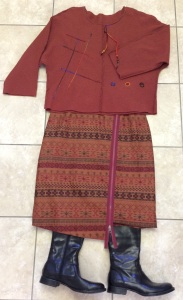


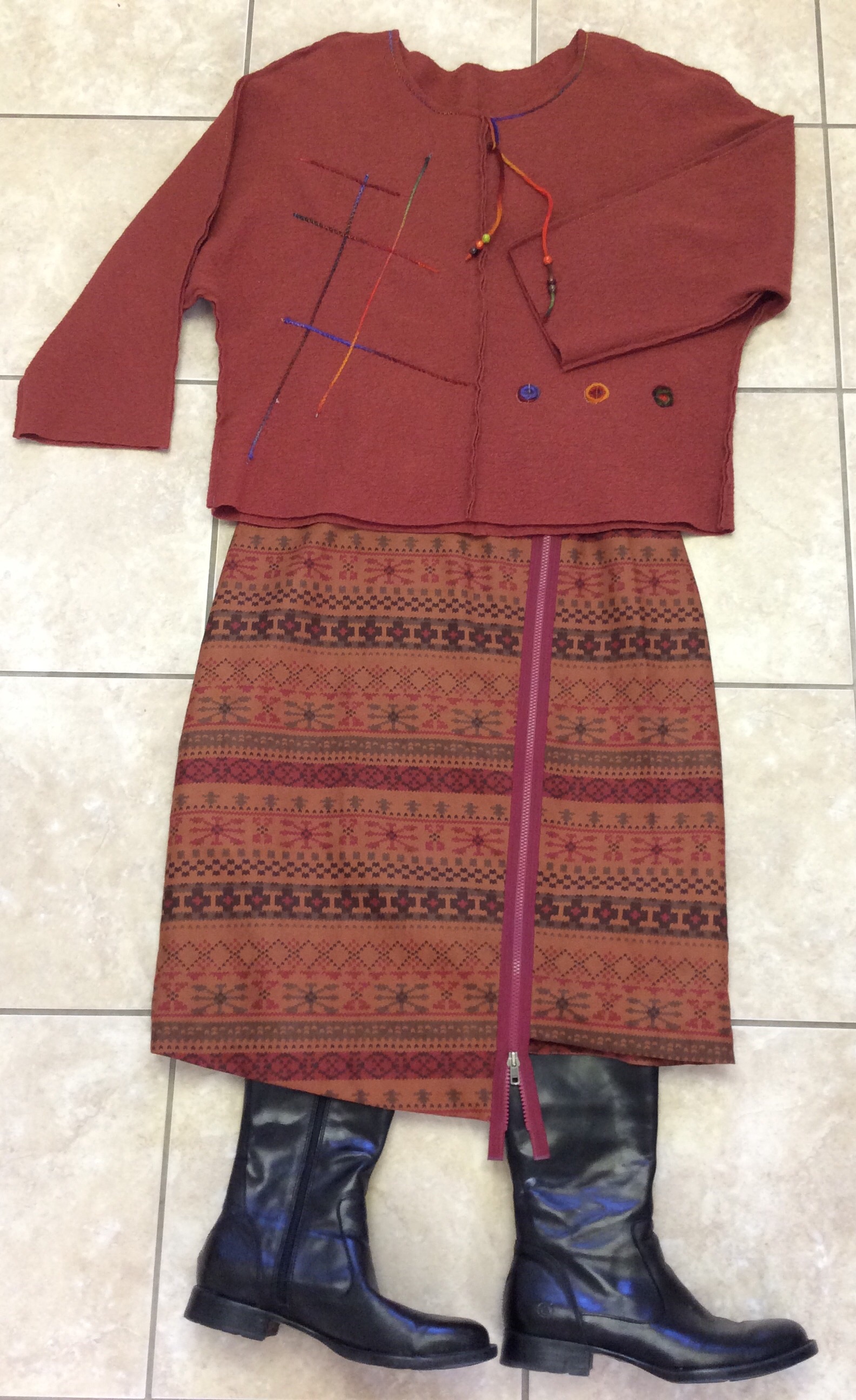
Light weight boiled wool and rayon top. Fabric from Satin Moon, San Francisco
Light weight boiled wool and rayon top. Fabric from Satin Moon, San Francisco

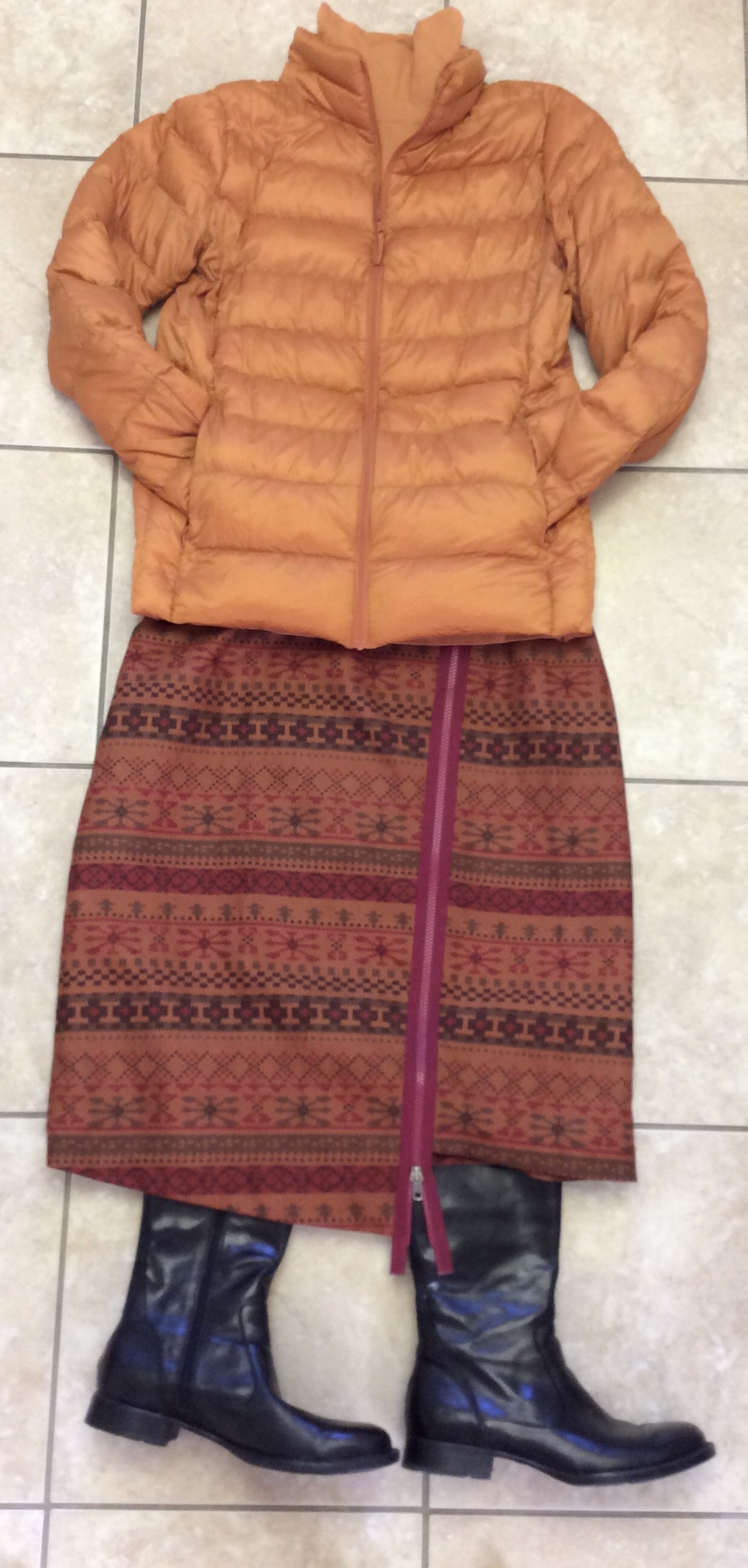
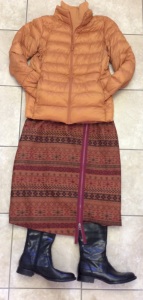
Puffer jacket and T-neck from Uniglo

Puffer jacket and T-neck from Uniglo


Until/if there is a ‘possil cue’ in my life, the photo studio will need to be the kitchen floor.  Thanx for bearing with the studio limitations,


What’s happening in your sewing room?  

Are the fabrics scurrying around behind your back to find suitable match mates?  And the tools, are they partying when you are gone and then ending up hidden under whatever is on the cutting table as you came back unexpectedly.  Mine do that all the time.  I would never leave tools scattered willy-nilly.  Well, almost never…  😉

Happy sewing!


Posted in FIBER FASHION FUN | Tagged , , , , , , , , , , | 5 Comments

Moorten Botanical Garden and Cactarium

A Palm Springs CA must see is the Moorten Botanical Garden.  It’s an excellent way to become acquainted with desert flora and fauna.  And though I’ve been many times, there is always something new to discover.

It’s a small garden, easily walkable.  And the site is available for weddings, meetings, etc.

Meeting site

Meeting site

image

Candelabra Cactus

Agave Cactus

Barrel Cactus

Giant Barrel Cactus

Sage

Purple Sage

Prickly Pear Cactus

Prickly Pear Cactus

image

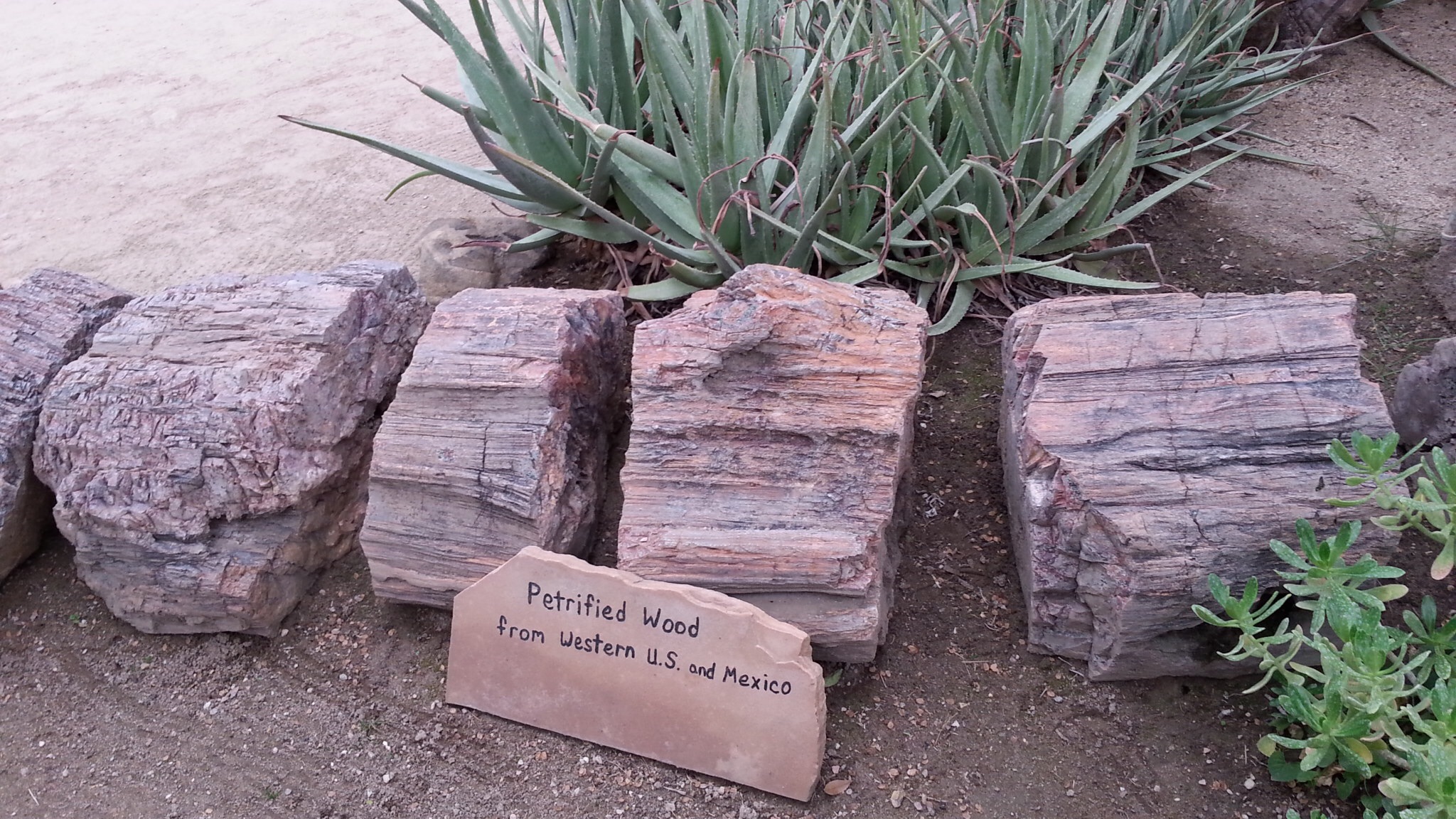
Petrified Wood

image

Green Oynx

Fossil

Fossil

Lava Flow

Lava Flow


image

Flowering native tree

Other than the birds, this is the only ‘Fauna’.

'Fauna'

‘Fauna’

Memorabilia

Memorabilia

image


Posted in OUT AND ABOUT | Tagged , , , , , , , | Leave a comment

Working with Massive Amounts of Fabric

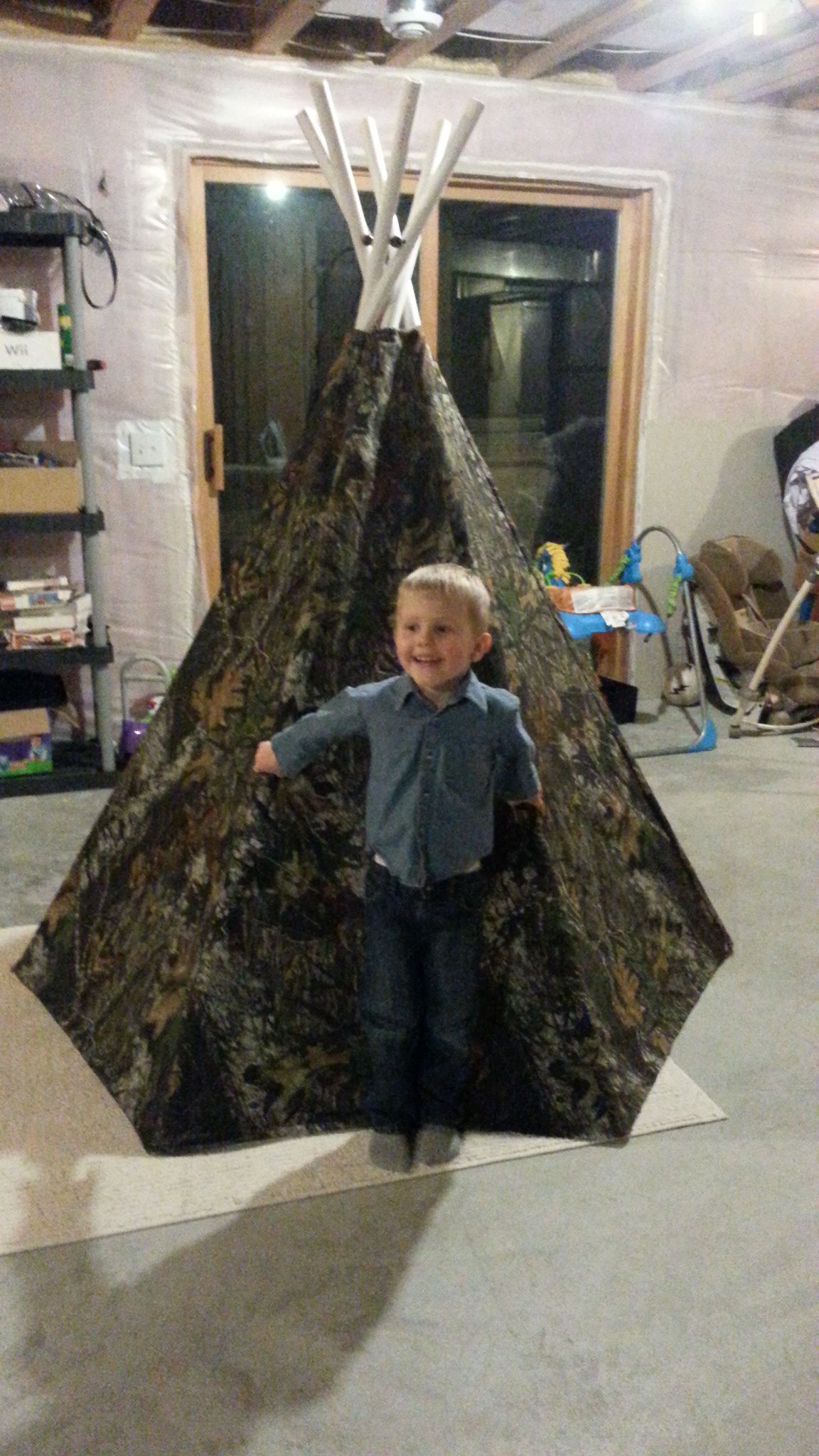
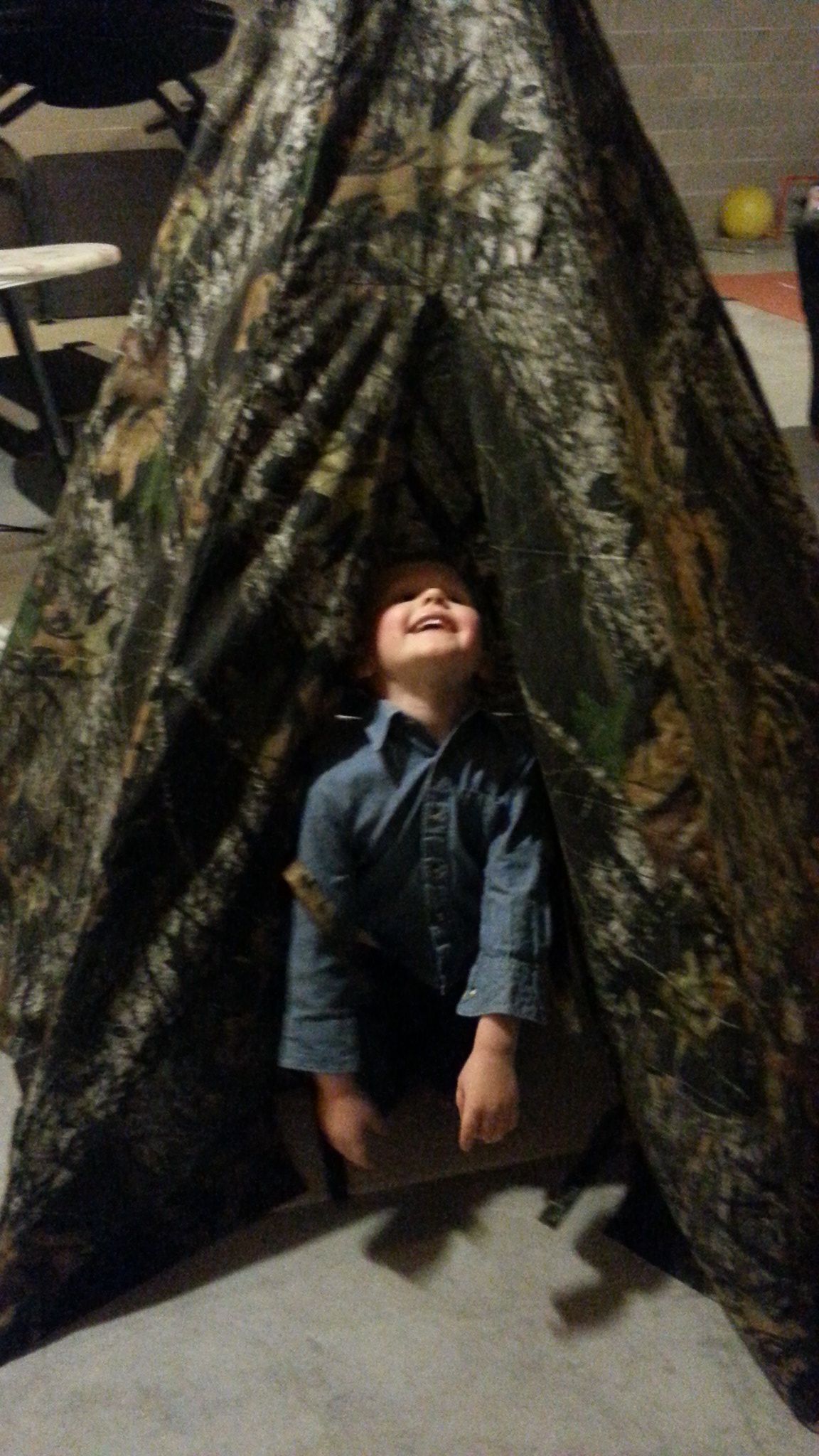
TeePee Tent

Boyz TeePee Tent

This was the 2014 Christmas present for my two Grandsons.  This is Grayden, 4, and he immediately made this his Turkey Hunting Blind.  Brother Oliver, 7, was too busy with ipad and Minecraft.

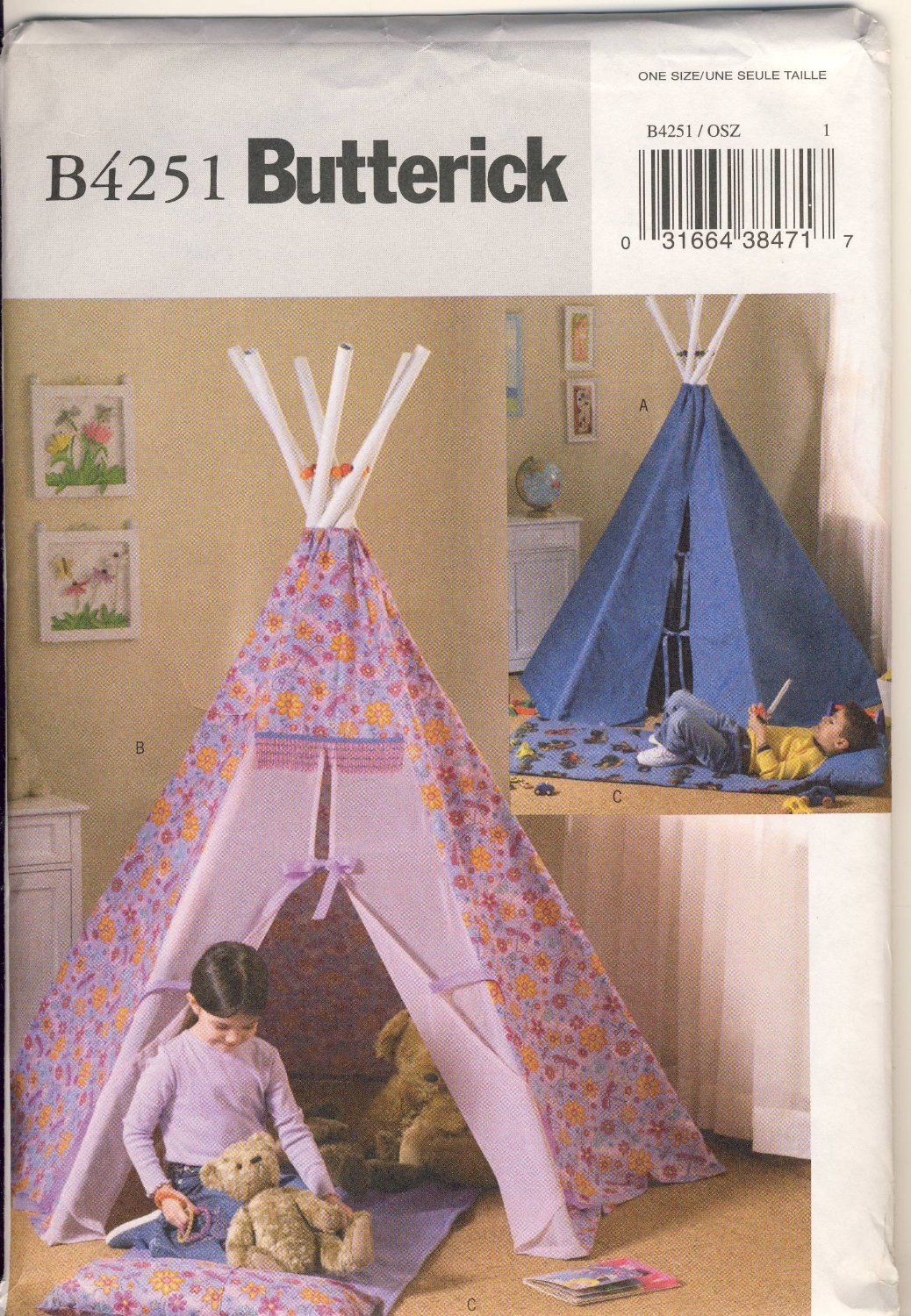
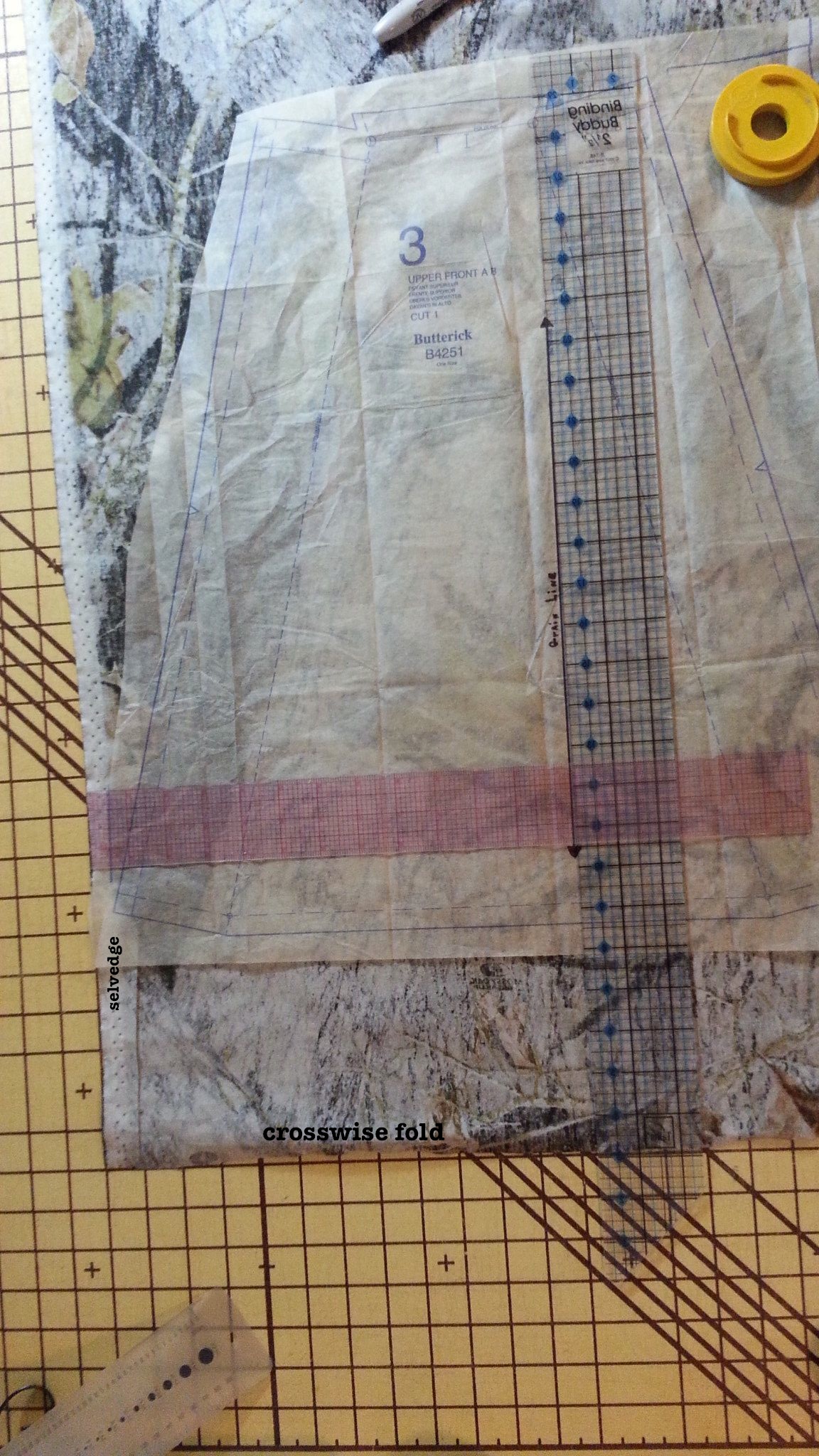
Using Butterick 4251 and 8+ yards of 60″ wide fabric, the TeePee was constructed with much bunching, folding, crunching, twisting.  The worst part was cutting it out.  I have the floor space but my robotic knee isn’t too crazy about crawling around on a hardwood floor.  The worst part was getting the pattern on the fabric in a semblance of straight grain.  Wasn’t too concerned as tent is not hanging from a horizontal support, but did need an approximation of straight grain.

For once, I was thinking ahead when I bought the fabric and chose a non-directional woodland print canvas so it was easy enough to fold on the crosswise grain and not be concerned about matching fabric designs.

Here’s a tip, with that much fabric, wait for a sale, a great sale, before buying the fabric.

TeePee Tent Pattern

Butterick 4251

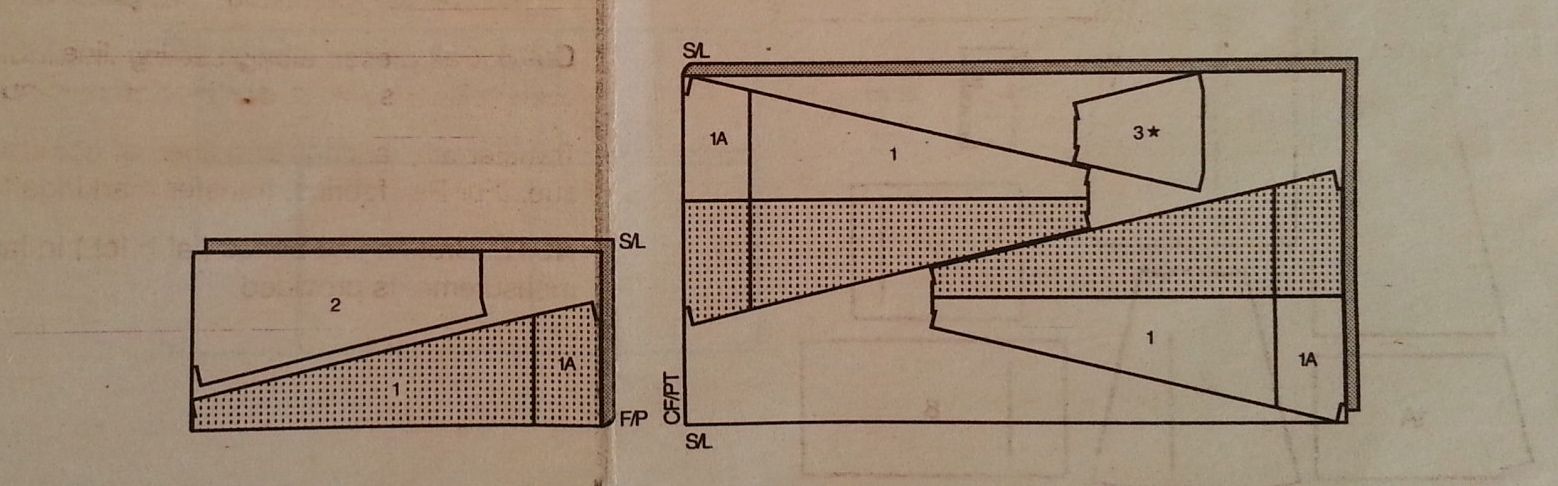
Here are some layout tips for large pattern pieces and tons of fabric.

tent pattern layout

TeePee Tent Pattern Layout Guide

There are six cut pieces’ #2 and #3 are for the front opening panel; #1 is for the other five panels, and it has an extension, 1A, to add for the extra length.  Pattern fabricators probably couldn’t make one pattern piece the desired length, and/or it was more economical to make two pieces.  Whatever, it is another piece to the puzzle.

Please note that the shaded part of the pieces indicates the pattern should be upside down.  The pattern guide will tell you this.

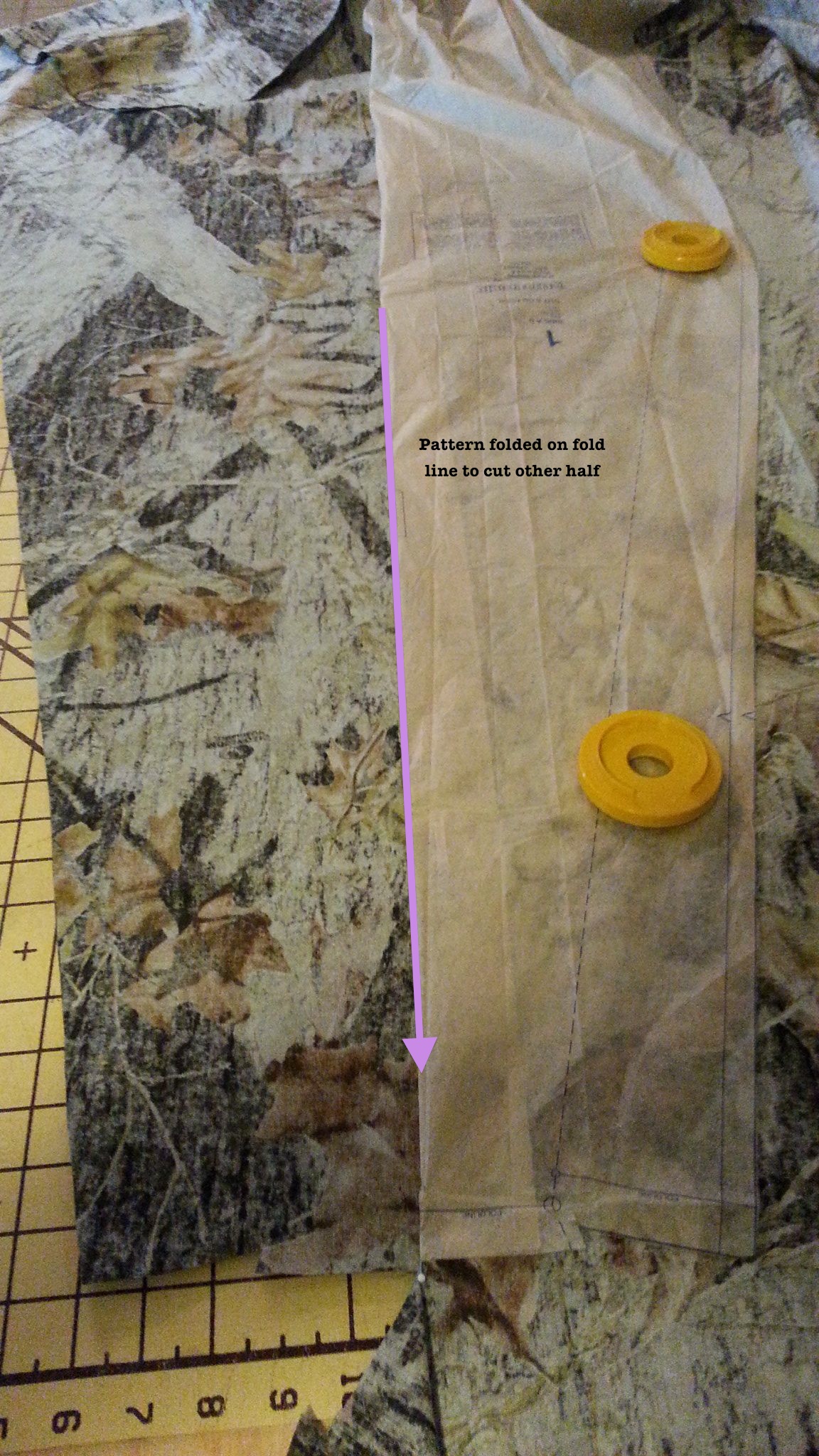
Also, piece #1 is not a full piece as diagramed above.  It’s really half of the pattern (lengthwise) and you need to lay it out and cut one side, then fold to cut other side, which will make the full panel.

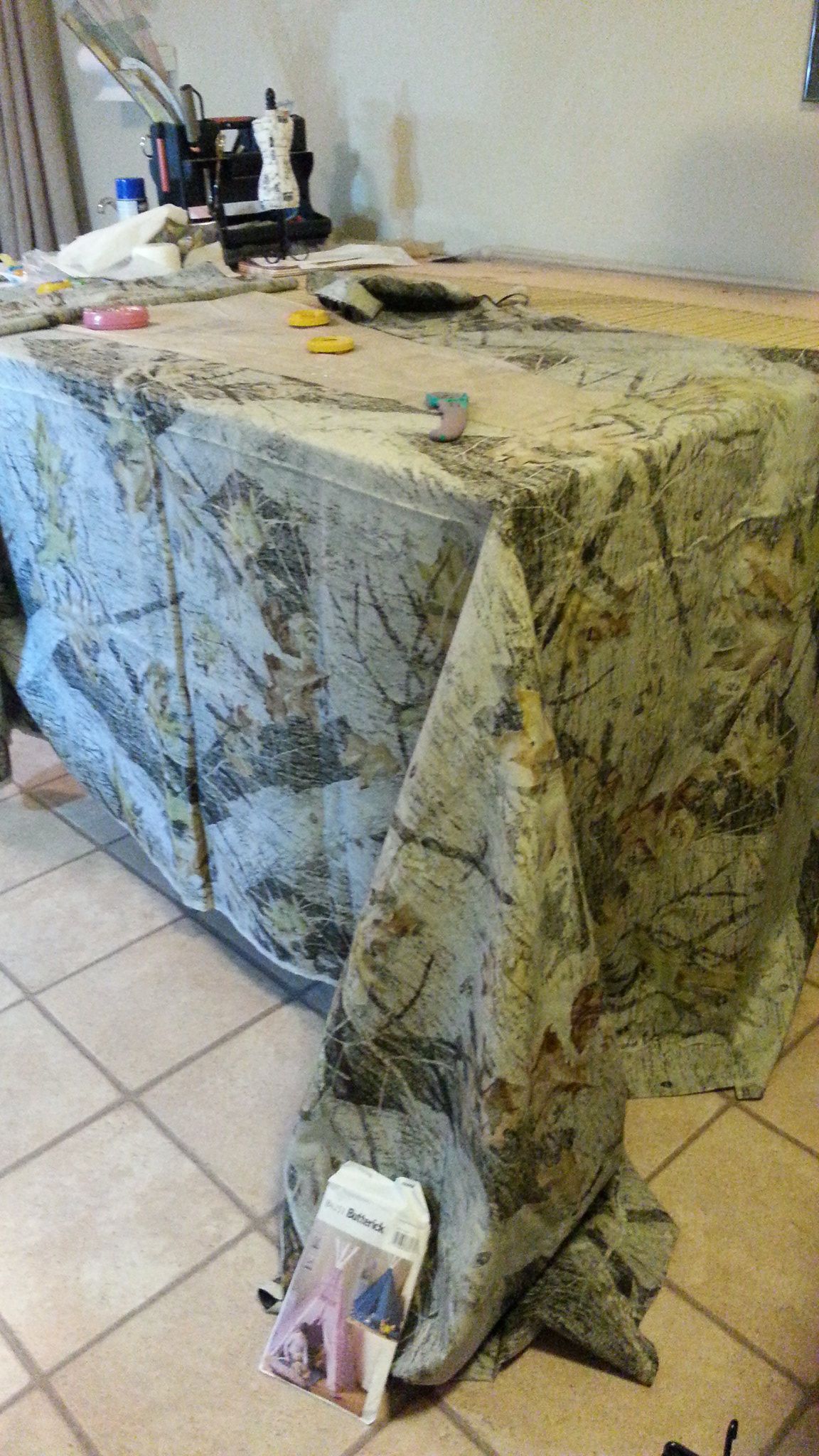
Here’s how and also how to place pattern on straight grain when working with massive amounts of fabric.

Tent Fabric Layout

Tent Fabric Layout  Massive amounts of fabric even doubled.

Placing Pattern on lengthwise grain

Placing Pattern on lengthwise grain

Folding the fabric on the crossgrain (per layout guide) and matching the selvedges was an exercise in futility; finally stood on a stool and managed to declutter everything in the room when shaking fabric into place.  That’s a quick way to clean the tabletops.

Anyway, with the fabric mostly on the cutting board:

  • match the selvedge and crosswise grain to lines on the board.
  • line up one ruler along the grain line
  • use a second ruler to measure distance from selvedge to the ruler/grainline
  • repeat above along entire length of pattern
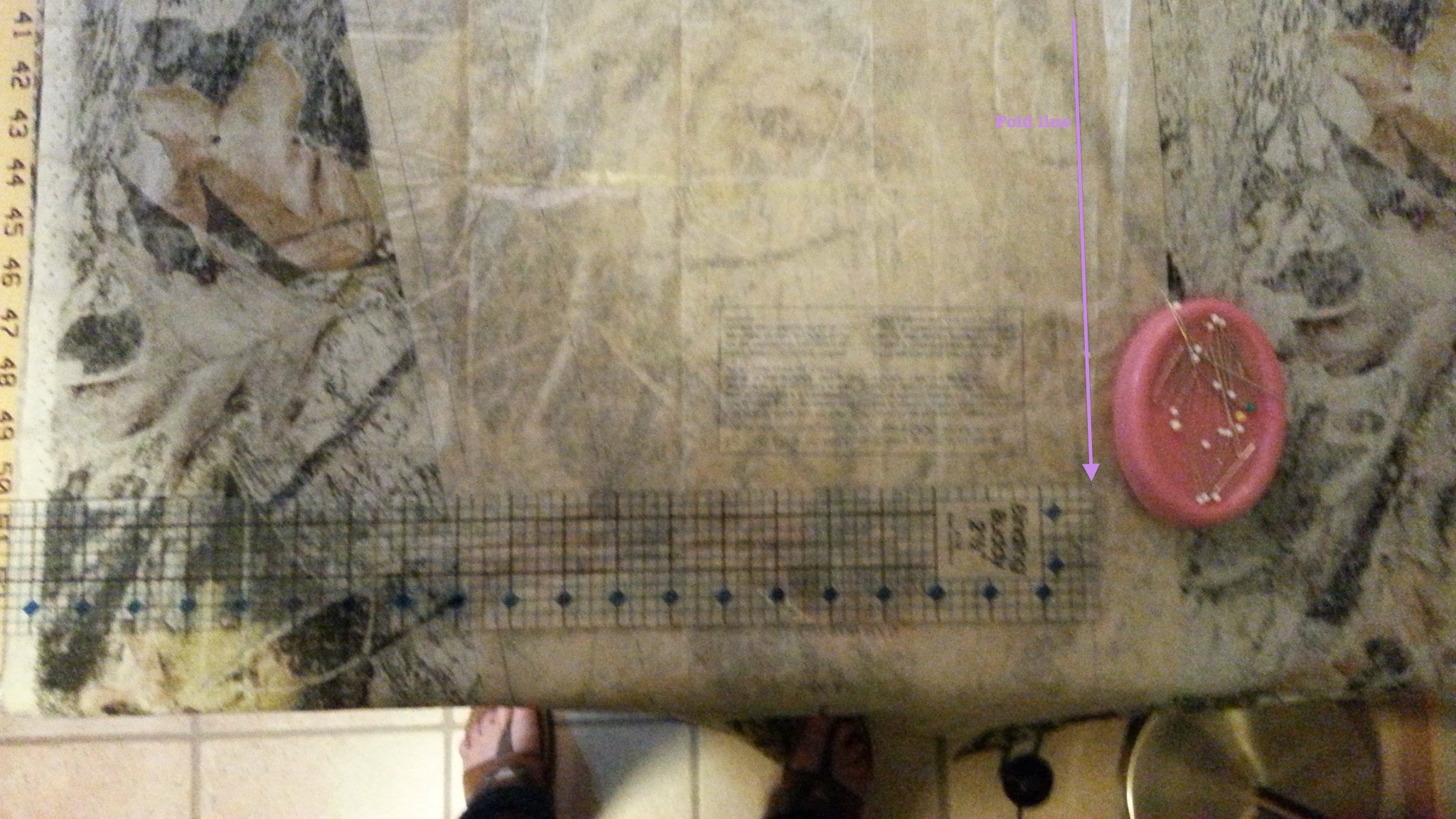
  • pin pattern to fabric by placing pins on the fold line (this is the only time I ever pin patterns)
Pin pattern along fold line

Pin pattern along fold line  (see my toes)

I said this was only half a pattern and due to size, am only showing a portion of the pattern.  The ruler is to match the foldline/grainline to the fabric grain.

Cut the first panel side  DO NOT CUT ON FOLD/GRAINLINE  See how the pin at the bottom of the photos extends?  That is to remind me not to cut down that pattern edge.

Fold pattern on pinned line.  Pattern is now upside down just like on the pattern layout guide.

Fold Pattern for other Half 2

Folded Pattern for complete panel

Really could use longer arms to wrangle fabric and pattern.  A step-stool is now a permanent accessory in the sewing room.

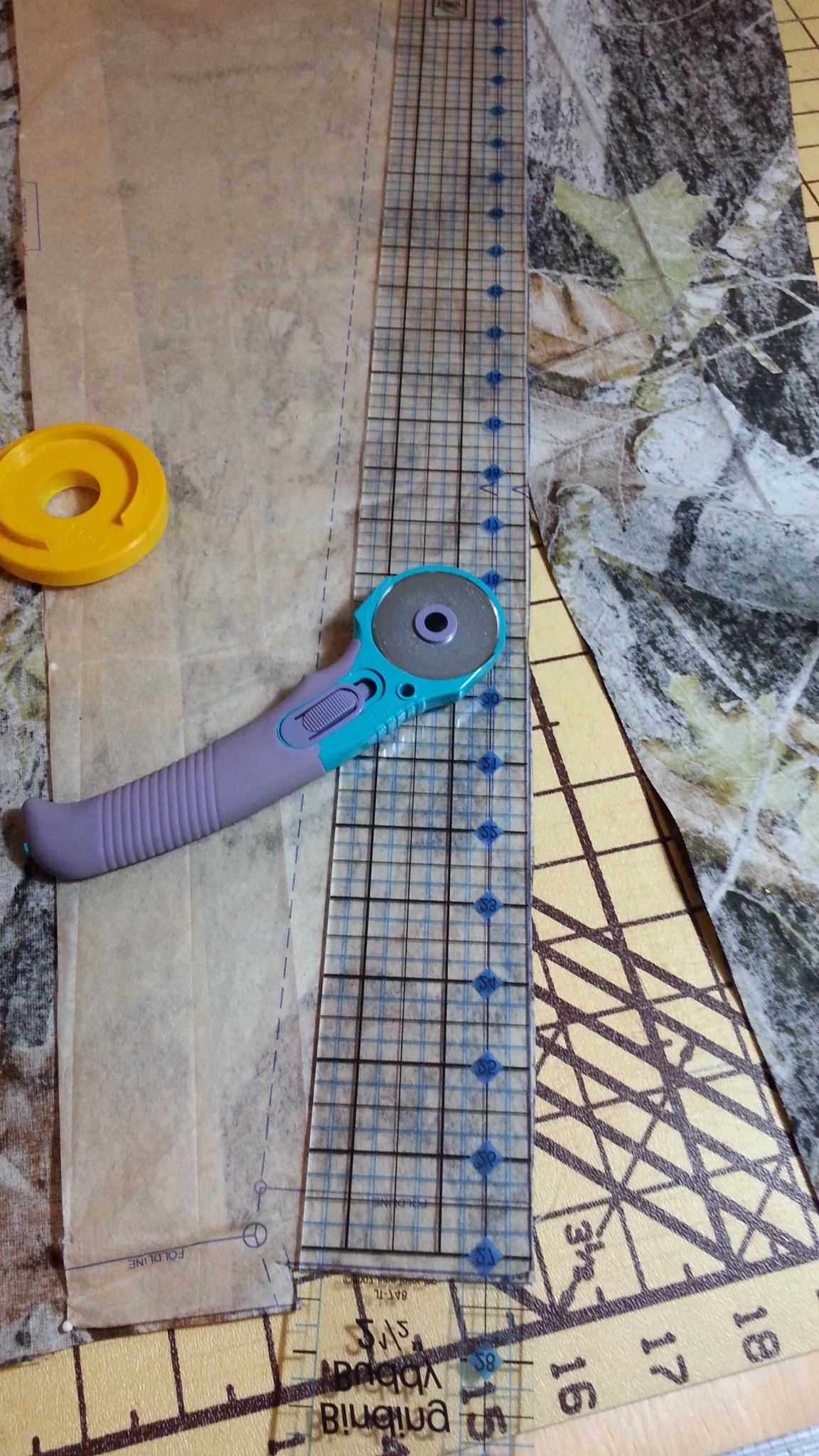
Use a ruler for a cutting guide.

Use ruler for straight cuts

Use ruler for straight cuts

This made two panels–fabric was doubled.  Had to repeat the wrangling once more; that made four panels.  The other two panels were a piece of cake as one was cut on a lengthwise fold and the other on the selvedge–see pattern layout guide again.

tent pattern layout

Diagram on left is for fifth and sixth panels

Oh yes, a key part is the PVC tent poles.  My Son picked them up (my car is too short for 8′ poles), trimmed to 84″ and drilled the holes.  Thanx Paul!
Last I heard, Oliver is still immersed in Mineworks and Gray is stalking Turkeys.

Stalking Gobblers

Stalking Gobblers

Gobbler Calls

Uploaded by mwfhunter


Posted in FIBER ARTS | Tagged , , , , | 2 Comments

More on Hydrogen Peroxide

Clorox vs Peroxide

Clorox

Hydrogen Peroxide


December 19 2014 Update


Here is a very thorough review of advantages of Peroxide.

Post by Brian Wilkinson.


Have you received an email that begins…

“My husband has been in the medical field for over 36 years.  And most doctors don’t tell you about peroxide.”

Well, I have and was compelled to research fact/fiction as that brown bottle has been under my sink ever since I moved out of Mom’s house and took the spare bottle with me.
The photo above is of a really old bottle and one just purchased ($.89/quart). Hydrogen Peroxide does disintegrate with light–hence the brown bottle–and age; the small bottle will be disposed of as it sports a Snyder Drug Store label–Snyder’s has been out of biz for over 10 years. The great news is that the contents can be poured down the drain; HP is water and oxygen and decomposes into it’s parts. So pour away, rinse and recycle bottle. I never know what to do with Clorox/bleach bottles; can diluted/rinsed contents be poured down the drain? Duh, guess so; just realized diluted bleach goes thru the washing machine and into sewer/septic. Whew, another dilemma that won’t keep me awake at night!
Essentially, the email touts peroxide over ‘Clorox’.  (FYI:  Clorox is a brand name for a company who makes both ‘Clorox’ and Hydrogen Peroxide.)  Many of the claims in the email are true and some aren’t so  much.  Review the email for yourself at snopes.

Here are some high points of what I learned:

Clorox:  a bleach/disinfectant made from sodium hypoclorite, basically liquid chlorine, that is extremely corrosive and will eat away fabric, skin, metal, etc., in its undiluted form.

Hydrogen Peroxide is also a bleach/disinfectant whose chemical composition is oxygen and water.  Both of these ingredients are non-toxic and can be washed away with water with no environmental concerns.  One caveat:  HP is a bleach and will bleach anything it contacts.  However, the common concentration of 3% available in drug stores, is mild enough to use for mouth wash and toothpaste.  HP is probably best used in the home as a disinfectant due to it’s safety and odorless composition. And, HP is the preferred hospital disinfectant.

Here’s an HP recommenation from WebMD regarding pregnancy.  “ Clean Naturally.For safer scrubbing, switch from chemical cleaners to more natural products — such as hydrogen peroxide, baking soda, and vinegar.”

Check out The Many Benefits of Hydrogen Peroxide by Dr. David G Williams. This is just one of many, many websites with similar information but liked this one due to its organization and writing.

I find the garden applications most helpful.  HP (H2OO2) occurs naturally in rainwater and this is why rainwater is more efficient than tap water; H2OO2 provides more oxygen for plants thus promoting growth.

Oh yes, highly concentrated solutions of hydrogen peroxide are used for rocket propellant.

Posted in OPINE | Leave a comment

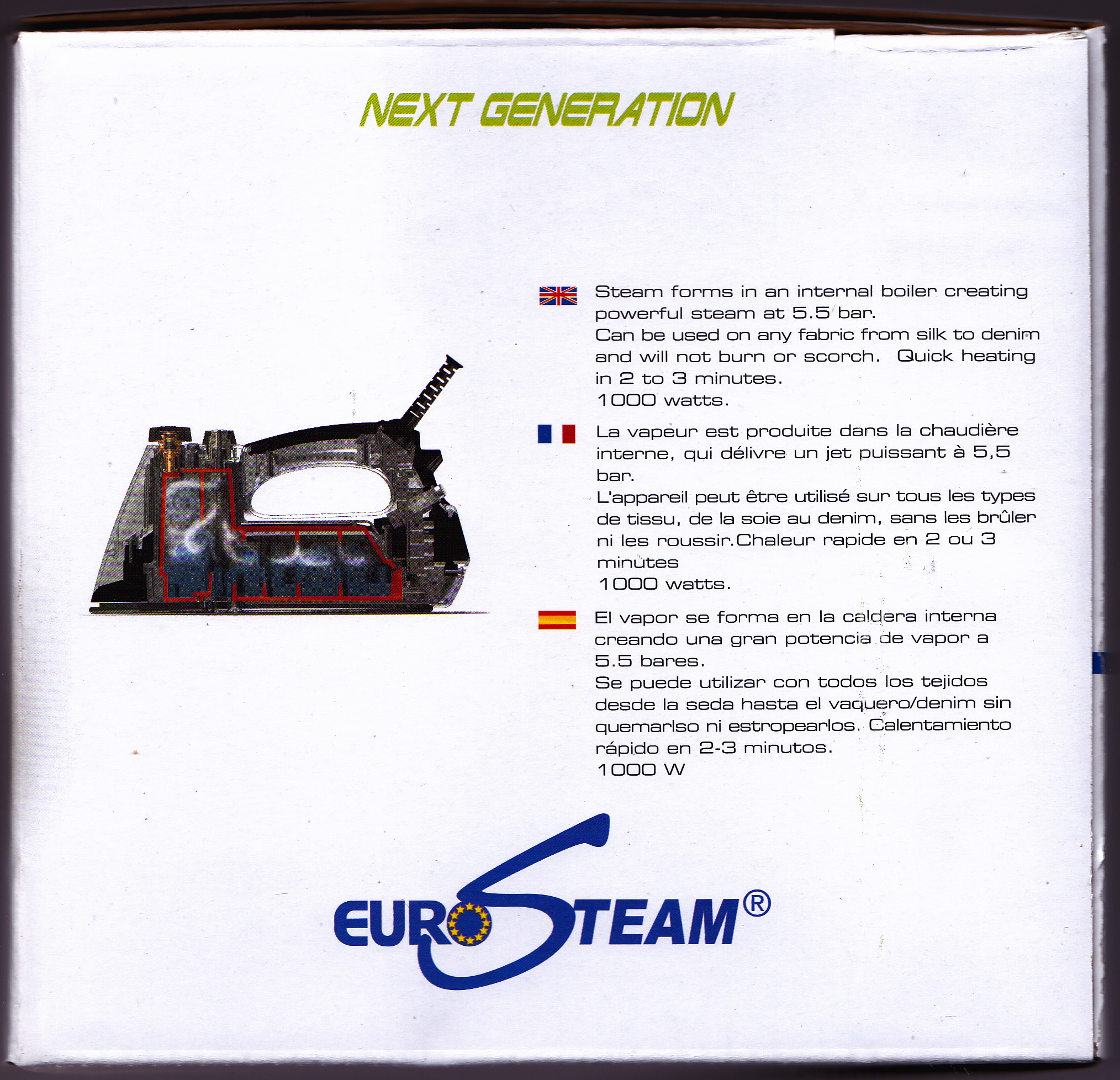
The Eurosteam Pressurized Iron; Ergonomic Rotary Cutter

Eurosteam Pressurized Iron

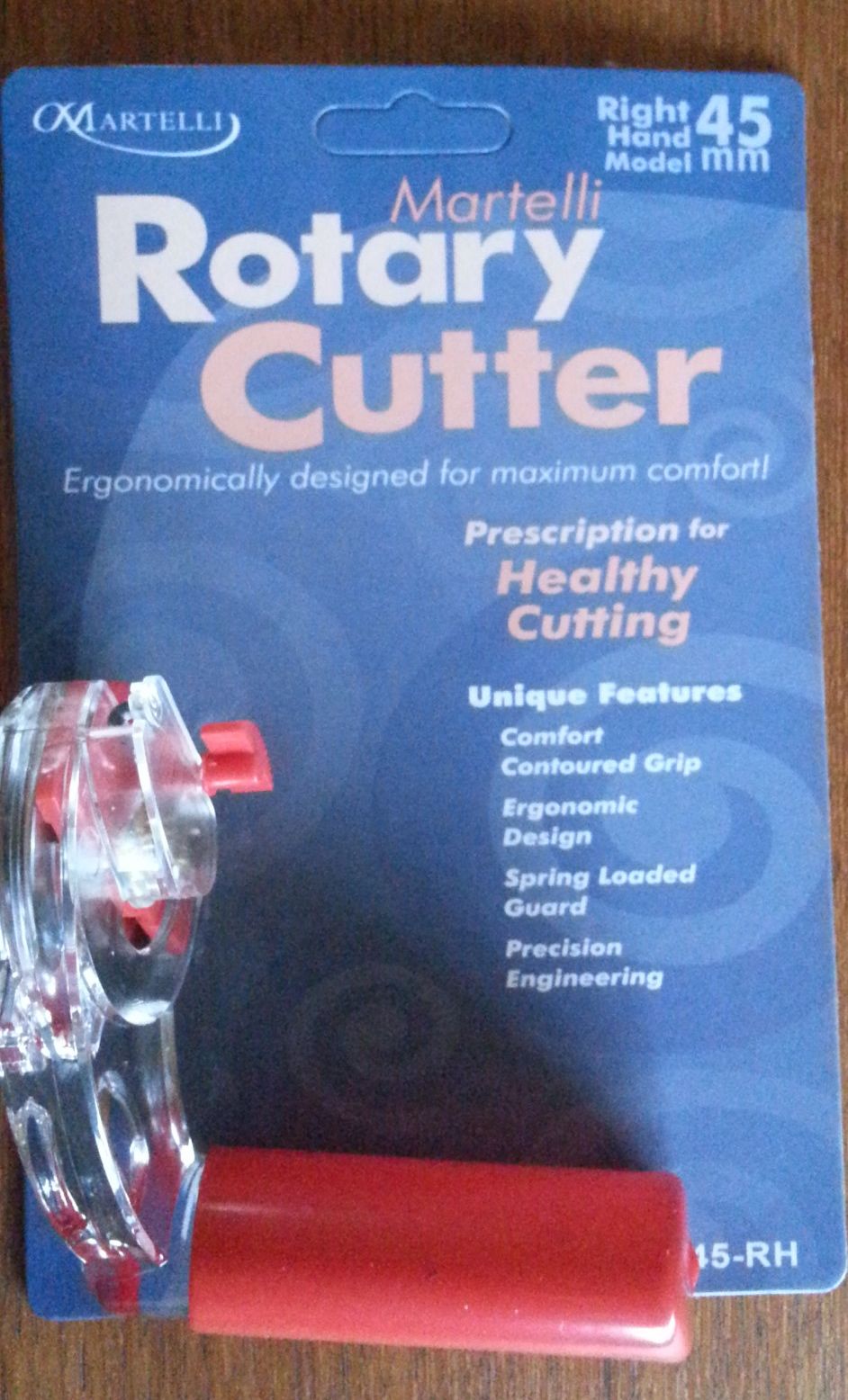
Ergonomic Rotary Cutter


For the first time in many years, my sister and I attended the Original Sewing and Quilt Expo in Minneapolis.  It was essentially a social event to catch up with old sewing friends.  Oops, ‘old’ is not an appropriate term although must admit we are all older–and better for it!  The best term is ‘long-standing’ friends.

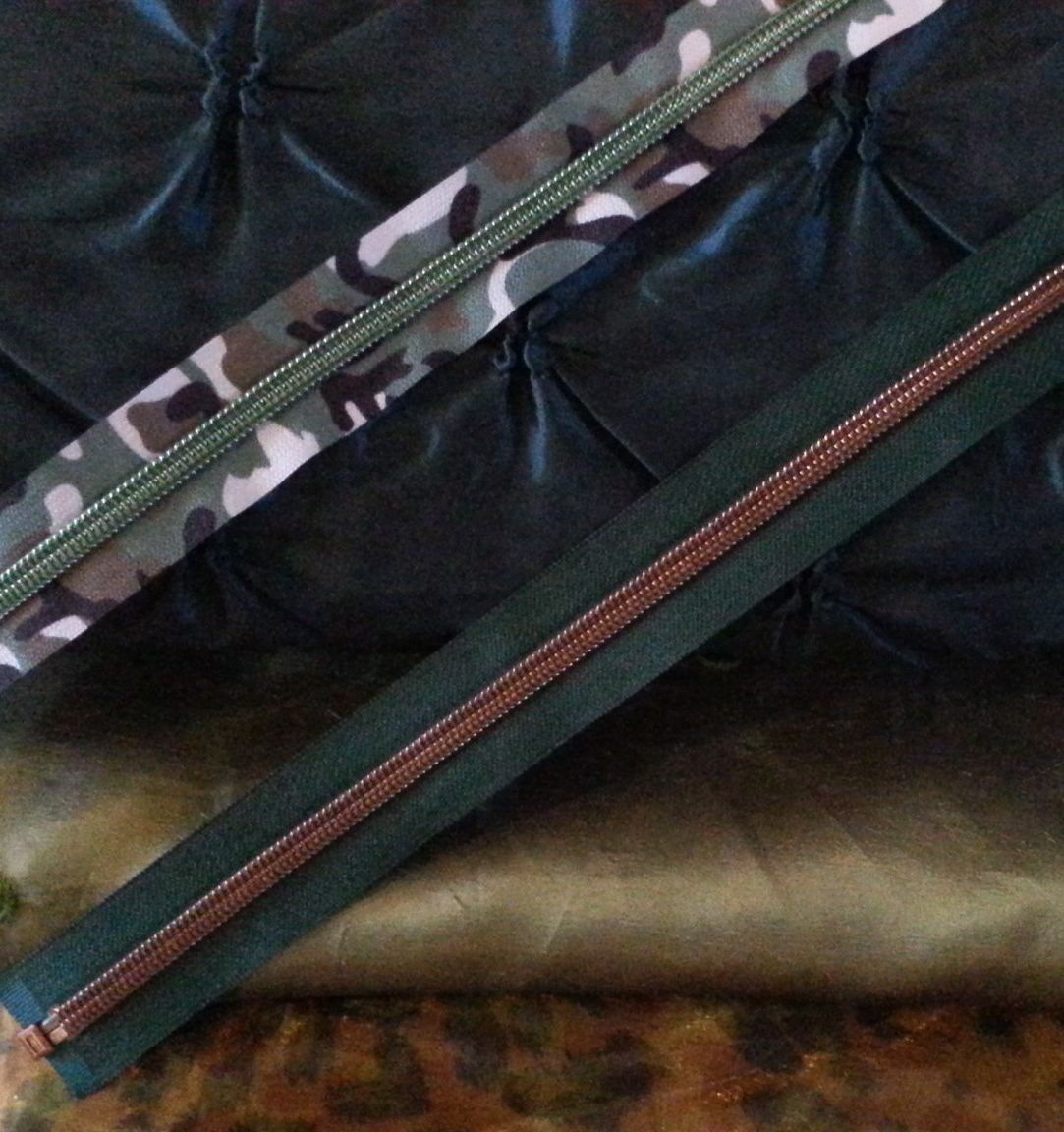
The one mission I had was a zipper for a garment in the planning and found two that will work.  One from Vogue Fabrics in Chicago and the other from Ghee’s.

Zips 2

Zip Choices: Camo tape would need to be inserted whereas green tape could be applied on top of garment.

It was a successful friend reunion–and made some new ones too.  All in all, a pretty inexpensive shopping trip–until the very end.  Here was a booth of irons, strategically situated where you practically walked into it.  The man in charge was clearly a State Fair hawker, in the best of all possible ways.  We had fun with him until his counterpart returned from lunch and got into her spiel.  Then we were hooked as she knew ironing.  The husband standing next to us quickly bought one (he does his own ironing) before even asking the price.

Sidebar here:  Why are men never concerned about price?

Sis and I were next in line as we immediately recognized the advantages and quality of this pressurized iron.

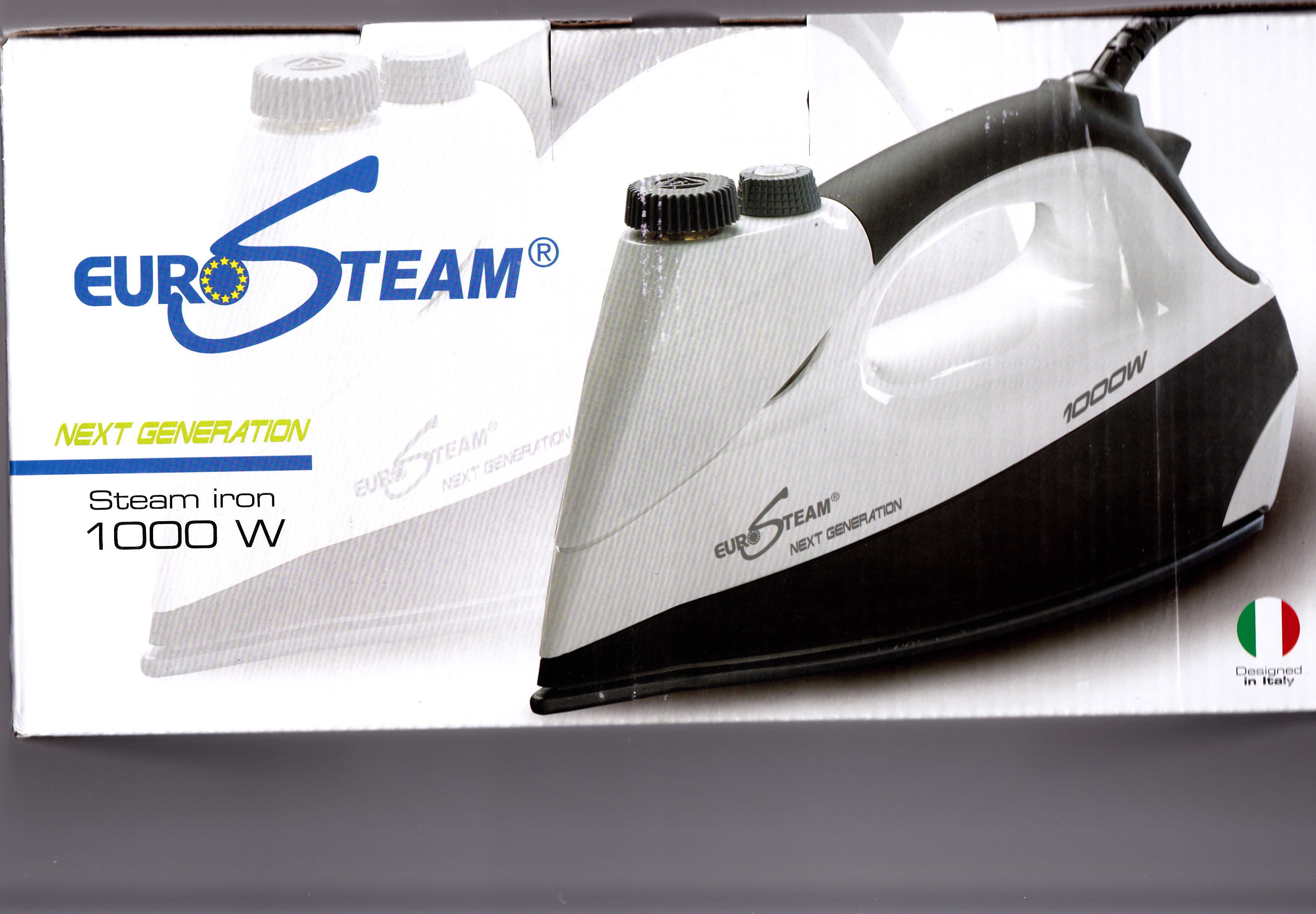
Eurosteam® Next Generation Iron.

Euro Steam box front.jpg

Eurosteam Pressurized Iron

I have used the gamut of home and professional irons.  Home irons are not heavy enough nor do they produce enough steam for sewing projects, and they invariably ‘spit’, leaving ugly water spots.

Professional, gravity feed irons are great but you need to hang a water container from the ceiling (that’s why it’s called gravity feed).  It takes up space, I always seem to get tangled up in the water tube, and climbing up and down to refill the water container is an issue.

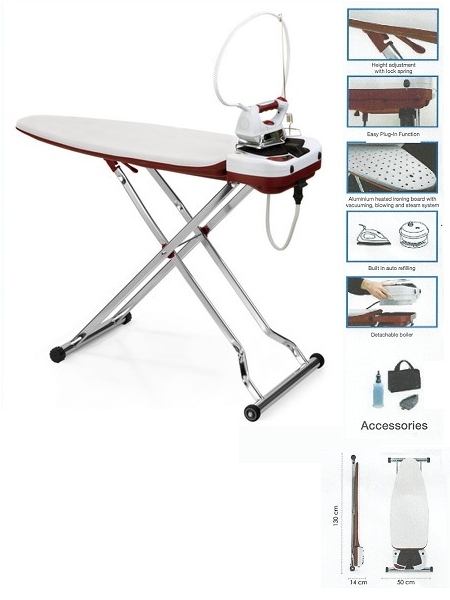
Many years ago, I discovered a Pfaff Steam Generator iron similar to the picture.  Apparently Pfaff is not making these irons so link is to a similar Rowenta iron.

Pfaff Steam Generator

Pfaff Steam Generator Iron  Photo courtesy of http://www.ironingsupplies.co.uk


Unfortunately, after nearly 20 years, it died and parts were unavailable.  I wasn’t enamored with the water tube connecting the iron to the tabletop tank, although the tank was certainly more convenient, so didn’t purchase a new model.  Have been using Walmart home irons and chucking when they start to spit.  And this has worked as haven’t been doing any tailoring which requires copious steam.

By the way, do have the Integrated Ironing Board (see above) with a vacuum and blower.  Plan to put it to good use when I get to my Chanel-style jacket.

And this is where the Eurosteam comes in–for the making of that Chanel-style jacket.  Now, haven’t had a chance to do a test run but based on the demo at the Expo and product manual, this will be a terrific, all-purpose iron.

2016 Update

Use it, Love, Love, Love it!!

Eurosteam

Eurosteam Interior

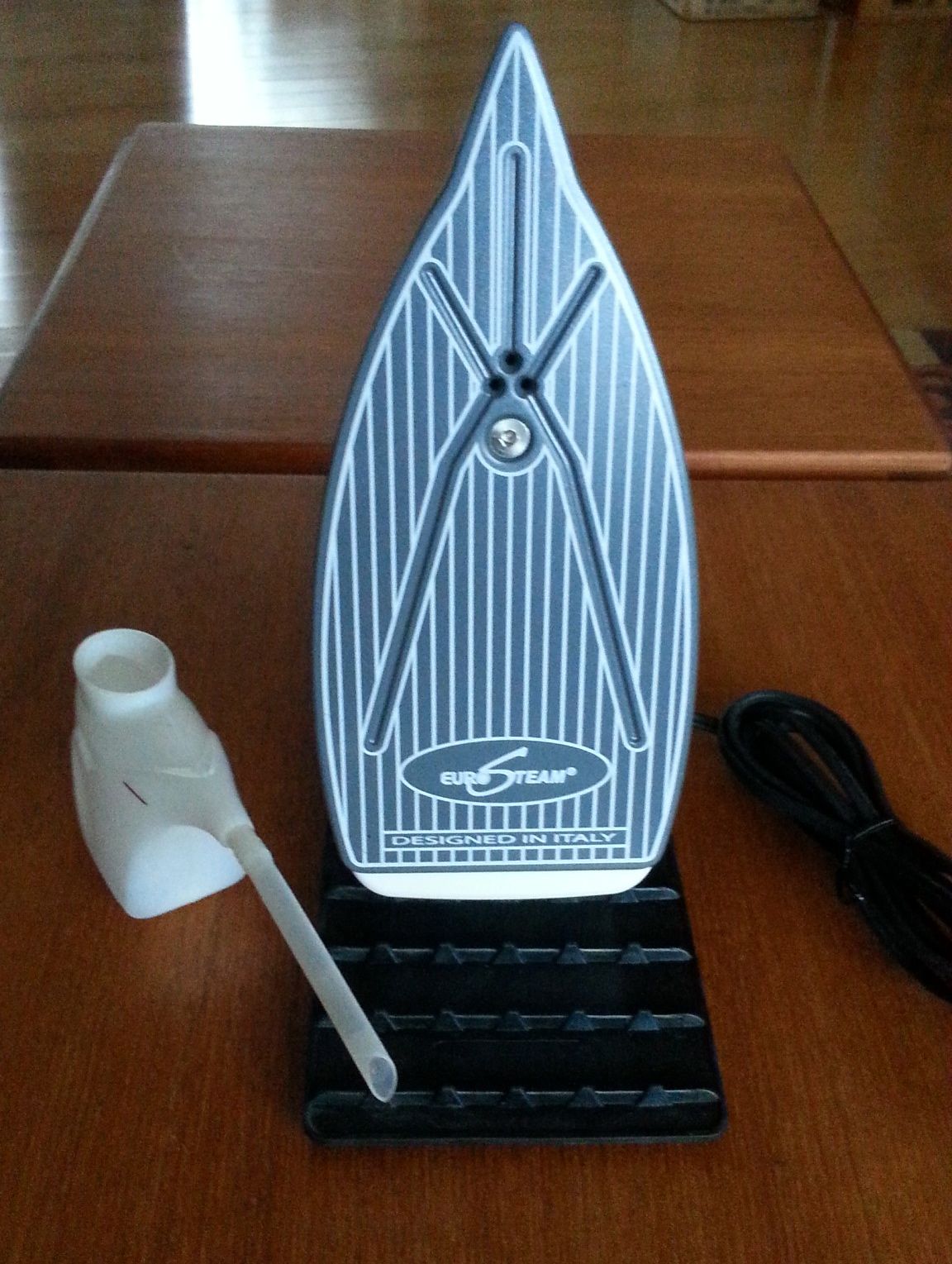
Ceramic Sole Plate

Ceramic Sole Plate and Rubber Mat

Eurosteam® Next Generation Iron will change the way that you iron and decrease your chore time by using the power of steam.”

Specifications

  • Power: 1000W
  • Ceramic Soleplate
  • Pressure: 5.5 bar
  • Steam emission: 50 G/min
  • Heating time: 3.5 minutes
  • Boiler capacity: 210cc (7oz)
  • Shot of steam 120 g/min
  • Steam Regulation
  • Vertical Steam
  • On/Off switch
  • Steam Ready Light
  • Limestone free technology
  • More than double pressure of a traditional iron
  • Power Cord: 2 m


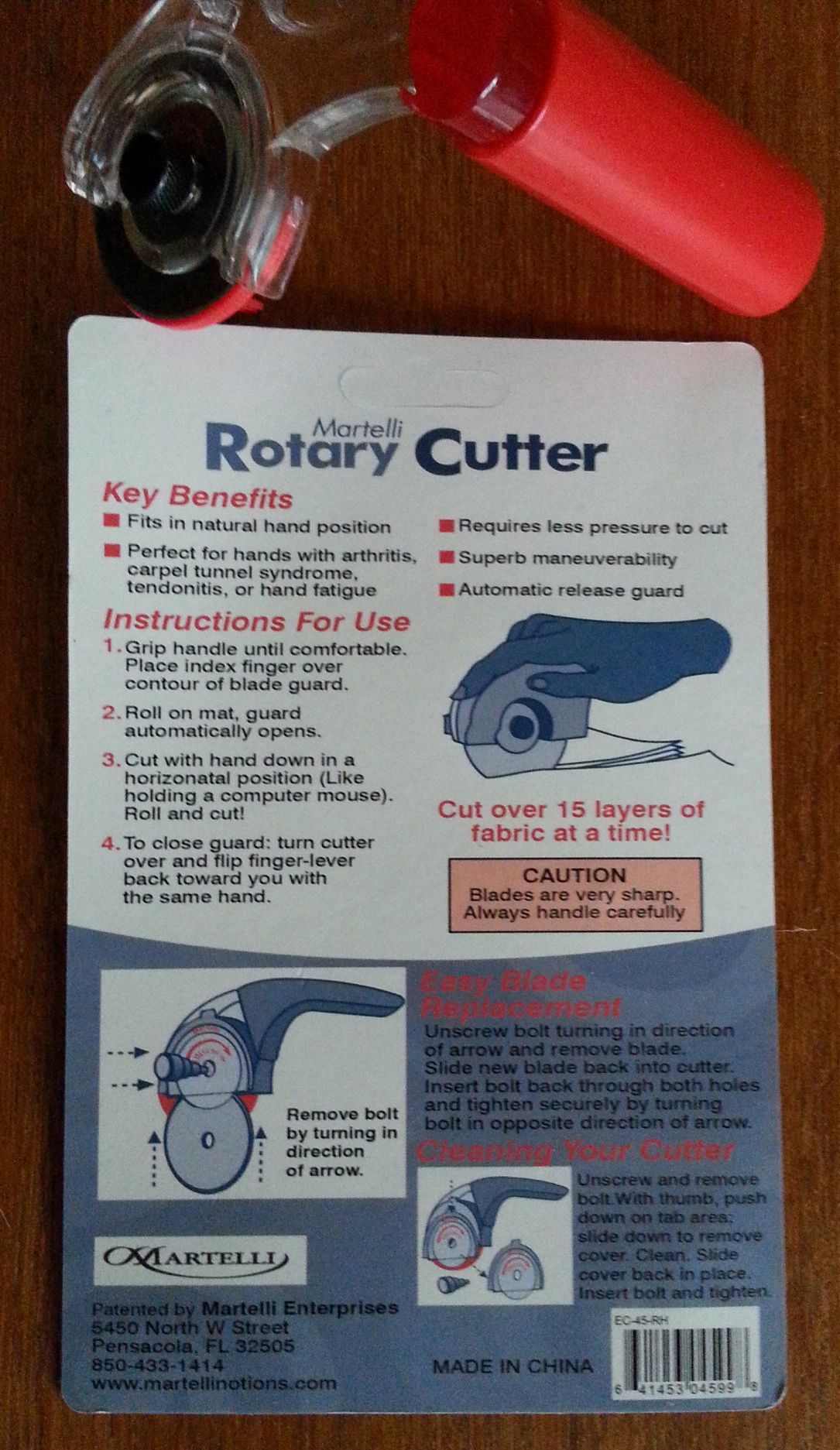
Ergonomic Rotary Cutter

The other item I purchased is an ergonomic rotary cutter, designed for right- or left-hand.

Rotary Cutter FrontRotary Cutter BackI don’t have hand issues(yet) but was attracted to the cutter’s ability to cut many layers at once.  Believe it may be the answer to cutting thick polar fleece.   Another plus is that it uses Fiskar blades which are locally available.  Don’t you hate it when you run out of blades in the middle, or even the beginning, of a project!

Notice the hand position and the fact that the guard opens automatically.

PS:  This product was hawked by the distributor, Martelli, and they are more suited to a Fair than a sewing expo.  However,  they were much fun and you can always get better deals when you start to walk away.  Then they go into overdrive with the, “Woe is me; got to meet a sales quota.”  Maybe they do and maybe they don’t; it’s great entertainment.

Remember: the tool and it’s quality will go far in helping the sewist achieve professional results.

What is  your favorite sewing tool?

More

[lptw_recentposts layout=”thumbnail” post_type=”post” link_target=”new” category_id=”3,5″ space_hor=”10″ space_ver=”10″ columns=”2″ order=”DESC” orderby=”date” posts_per_page=”4″ post_offset=”0″ reverse_post_order=”false” exclude_current_post=”false” override_colors=”false” background_color=”#4CAF50″ text_color=”#ffffff” show_date_before_title=”false” show_date=”false” show_time=”false” show_time_before=”false” show_subtitle=”false” date_format=”F j, Y” time_format=”g:i a” no_thumbnails=”show”]
Posted in FIBER FASHION FUN, GREAT IDEA | Tagged , , | Leave a comment

Children’s Christmas Fat Quarter Skirt Redux

Still time to stitch up some Christmas fashion for the little Girls on your list.  They’ll love you for it.

All it requires is a package of Christmas print fat quarters.  It’s prepackaged so eliminates the fabric selection dilemma; how easy is that!

Christmas Fashion from Fat Quarters

FAT QTR
At a Christmas in July sale, the Fat Quarters on an end cap caught my eye and triggered a memory of a Fat Quarter Toddler Skirt from Pinterest.  Couldn’t quite remember the details (that’s why there is Pinterest) but knew/thought my two Girl Grands would need some Christmas fashion.  Whether they will wear it remains to be seen, as apparently, definite fashion ideas are bred in with all Girls from birth.

Bought two ‘on sale’ Fat Quarters packets with four cotton fabrics 18″ X 21″.  A Fat Quarter is a quilter’s term for a quarter of a 36″ X 44″ piece of  fabric.

Diagram below courtesy of Janet Wickell.

Fat Quarters are 1/4th of a yard of quilting cotton

Luckily, remembered them in the stash and proceeded to cut and stitch two of them in three days–with time out for nail appointment, a meeting, etc.  This also included time calculating tier measurements.

Here are the two finished skirts–size 4 and 6.  Had a package of Christmas Tree buttons on hand so added them to the skirt

Tree button tacks up overskirt to reveal tulle ruffle

Skirt 2

One 'tree' tacks up overskirt to reveal tulle ruffle

Turns out the skirts look nothing like the Fat Quarter Toddler Skirt (below), but did have just a vague memory which happened to be a tiered skirt.  Now where did that come from?

TODDLER FAT QUARTER SKIRT http://www.lifeincleveland.com/2010/06/3-fat-quarters-2-toddler-skirts.html

Once I decided on the order of the fabrics, each fabric was cut to size per the calculations below.  The cut strips were joined into a circle then gathered and stitched to the preceding tier using a 1/2″ SA (seam allowance).

A tier width of one and a half times the previous tier width is minimum but that is all the fabric I had–none left for matching.  In the end, it turned out to be plenty of fullness.

Divide the finished skirt length by the number of tiers you want in the skirt; I did four   tiers.  This is the length of each tier; total length of all tiers equals finished length of skirt

1.  Tier 1=1 tier length + 1 SA + 1.25″ elastic (3/4″) casing allowance by hip circumference plus 4″

2.  Tier 2= 1 tier length + 2 SA by 1.5 X width of tier 1

3.  Tier 3= 1 tier length + 2 SA by 1.5 X width of tier 2

4. Tier 4= 1 tier length + 2 SA  by 1.5 X width of tier 3

A tulle ruffle was added under the last tier to add fluff, and to make the skirt more appealing to the Princess Grands.

I recommend using nylon tulle as it is softer than netting, and cover the raw edges as the gathered edge can catch in tights and is rough on bare knees.  Serging provides thread coverage for the gathered edge; hem edge does not need finishing.

Inside of finished skirt

Non-roll 3/4″ elastic is used in the casing. Cut it 4″ shorter than waist measurement.

Wrong side of elastic casing


Posted in FIBER FASHION FUN, GREAT IDEA | Tagged , , | Leave a comment

Choosing Fabric Design Direction

Winter has come early–a whole lot early–so while not actually stuck, am not that interested in being outside.  Plus, nothing to do in the yard, except spread salt!

Luckily, did get the winter greens up on the last day before 8″ of snow arrived.

Winter Greenery

Winter Greenery

The sewing room is nice and warm and do have a Christmas gift to make–a teepee for the Grands.  Will post a photo later.

Then there is the stash calling me and this outfit is definitely a cool weather garment so it best get made now.  However, there is a dilemma; which direction should the fabric design run?  Horizontal, vertical or both?

Fabric Design

Faux Suede with satin back

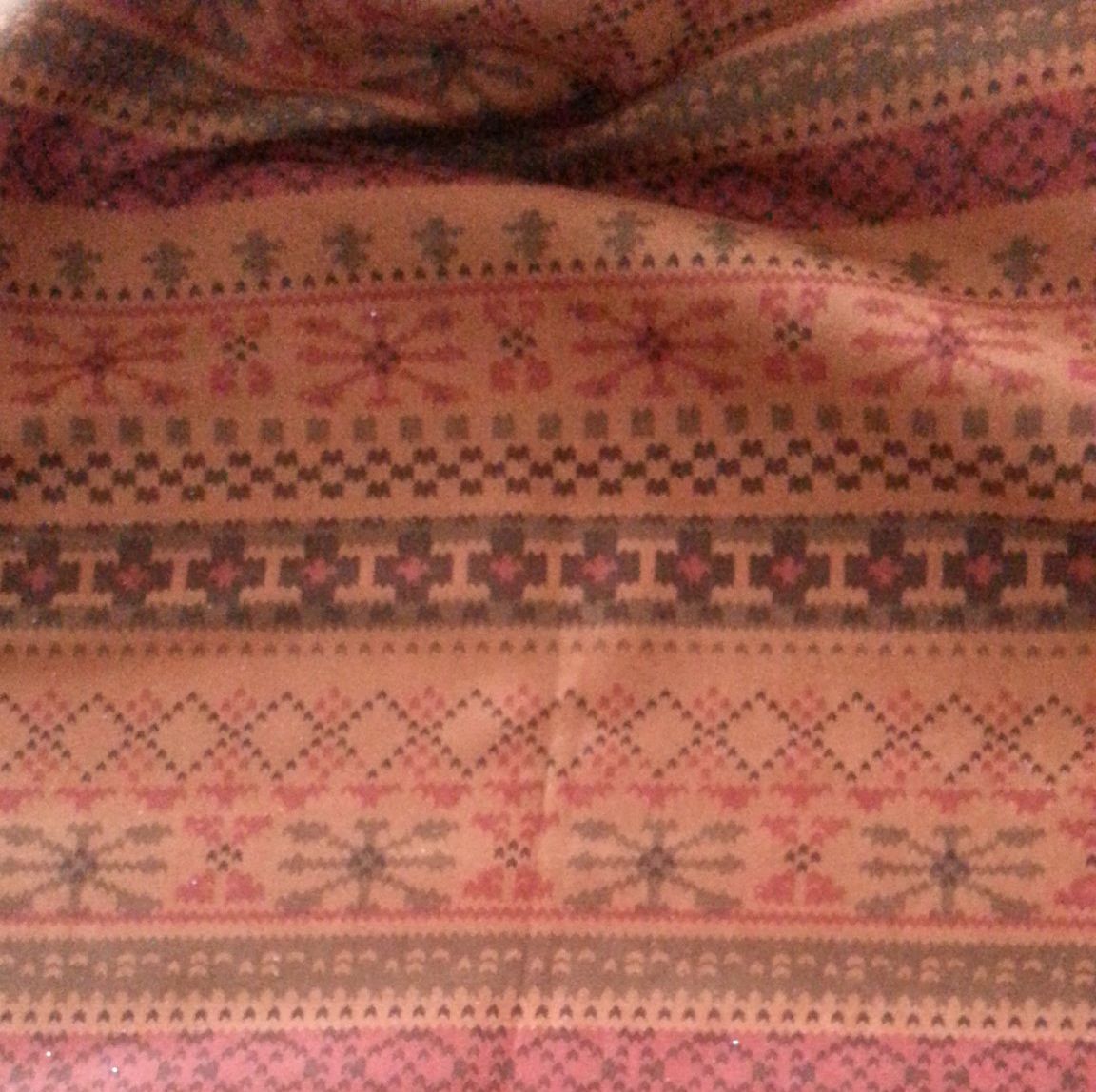
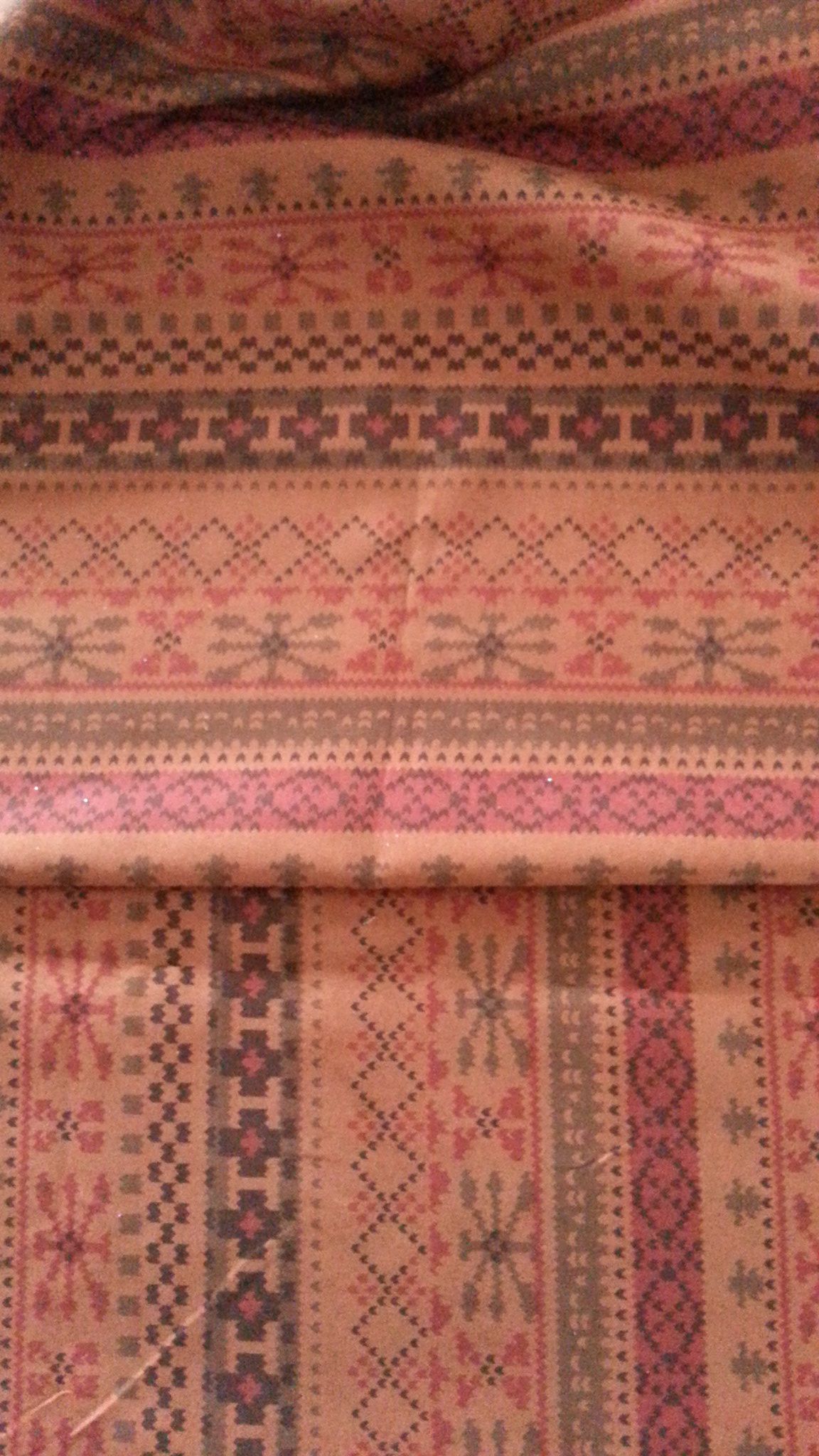
The fabric is a faux suede with a shiny, satin back and a horizontal Azetec-like design.

 Should the design run horizontally?

Horizontal

Horizontal

  Should design run vertically?

Vertical

Vertical


Or, top horizontal, skirt vertical?

Both

Both

What do you think?  What you would do if it were for you?

Thanx for the help.

Posted in FIBER FASHION FUN | Tagged , , , | 5 Comments

Sew Accurate–Continuous Stitching

The Devil is in the details and, in this case, the details are continuous topstitching.  Even an expert sewist can get bedeviled by details.

I usually blog about advanced/expert sewing but this blog reviews some basics that were brought home to me while sewing an apron for a gift.

It’s an easy-peasy project–no fitting, no curves, no seams, just pressing and topstitching–lots and lots of topstitching.

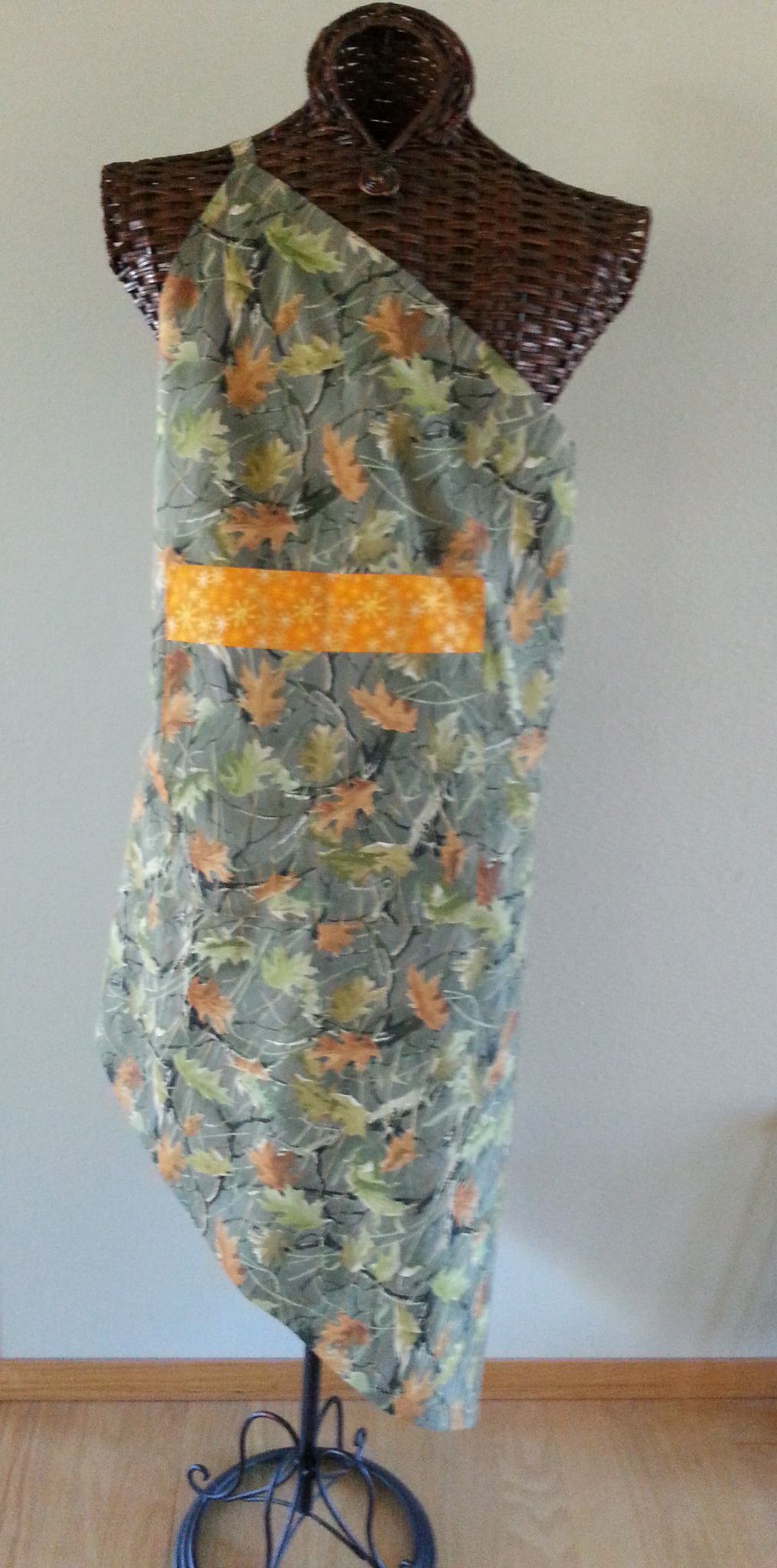
Above is the finished Tamari apron, a The Sewing Workshop pattern.                                Looks good, right?  A good press job and a little distance makes any garment look good–a maxim to remember.

Seems I can always find fault with anything I sew and know it’s a common fault among sewists.  A little perfectionism can go a long way but perhaps you can learn from my mistakes.  I know I will.

This problem is not with sewing skills, but not thinking ahead, nor  taking the time to thoroughly read the pattern instructions.

My issue is with the topstitching which is on all four sides, the pocket, and the ties.

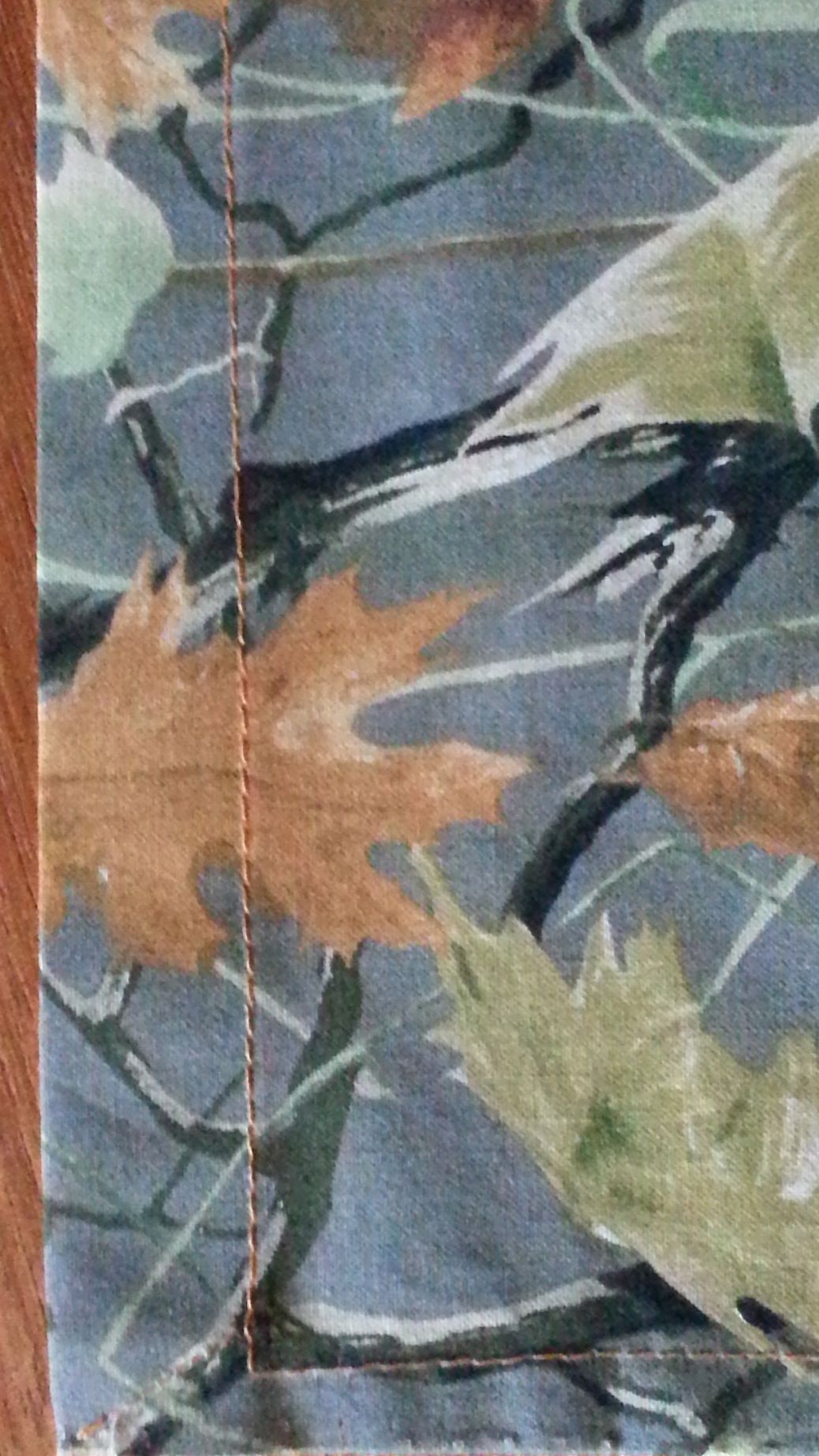
continuous topstitching

Continuous Topstitching

Now I know the key to topstitching is accuracy:

  • straight stitching
  • a straight edge to follow for the stitching
  • correct machine tension
  • continuous stitching

The first three are just fine.  Where I messed up is in not thinking ahead; I topstitched all the hems before attaching the ties.  So, I had to  open up the topstitching, insert the ties and loop under the hem and then restitch.

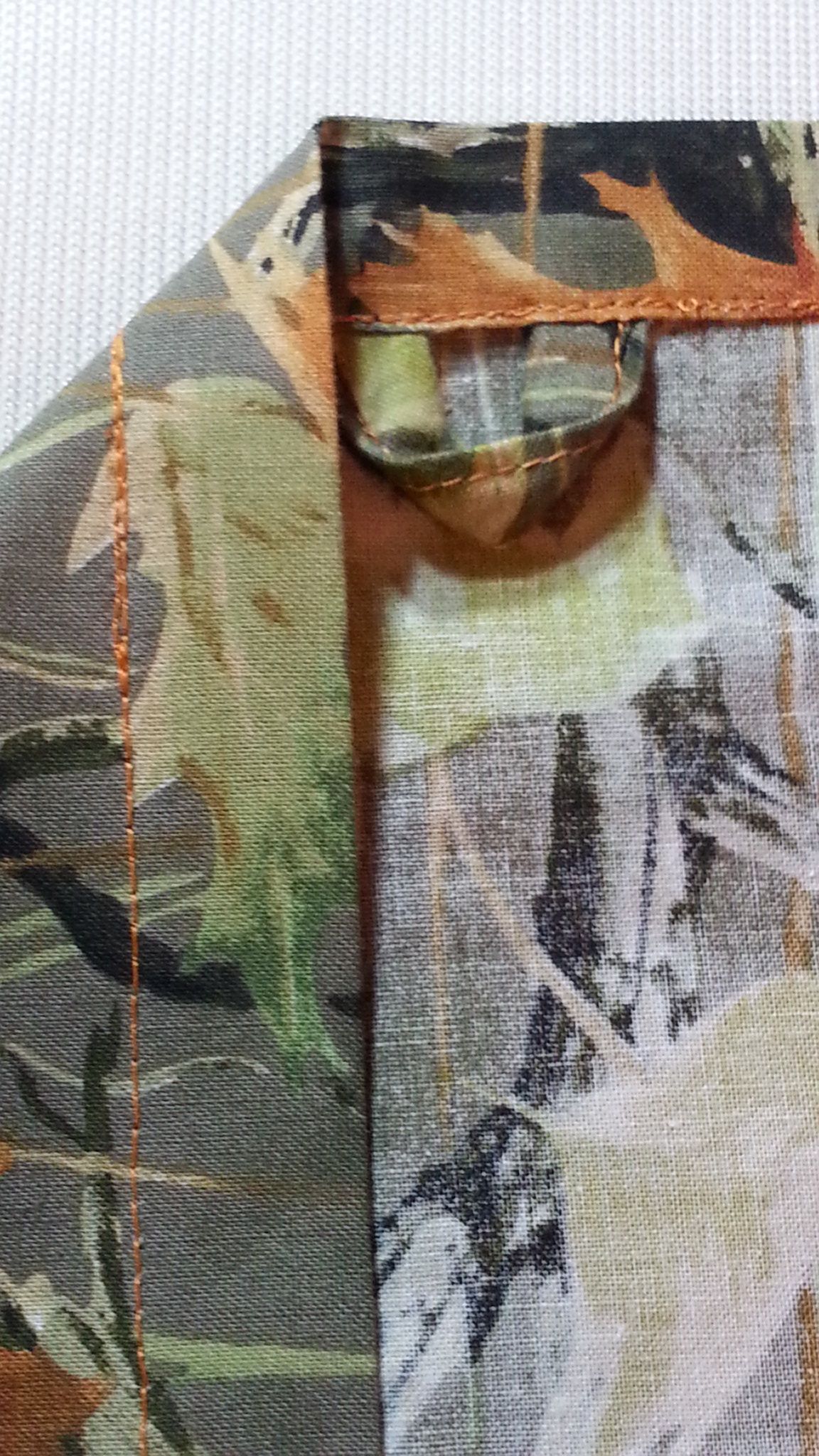
There is no disguising overstitching and it is not a pretty sight.  Yes, I know, from a distance it is not visible, and if anyone is that close to inspect the stitching, they are invading personal space.  That said, the lack of fore sight resulted in a break in continuous stitching and the overstitching fix is ugly.  Not to mention the extra time and wear to the tooth enamel–much gnashing of teeth!

The overstitch results in double stitch rows at both ends of the repair–not pretty.  This is why backstitching is not a good idea and is one reason why it is NEVER used in couture sewing.

continuous stitches

Repaired broken continuous stitching

Short of removing all the topstitching, I overstitched, but began and ended the repair in an exact needle hole of the original stitching.


Steps to Correct Broken Continuous Stitching

  • Remove stitching.  From wrong side, on both ends of repair, tug threads until loop of other thread appears, insert a pin into loop and pull thread end to wrong side (left).
  • Begin repair by inserting machine needle into exact needle hole of original stitching; stitch to end of repair, ending with last stitch in exact needle hole of original stitching.
    Redoing break in continuous stitching

    Redoing break in continuous stitching


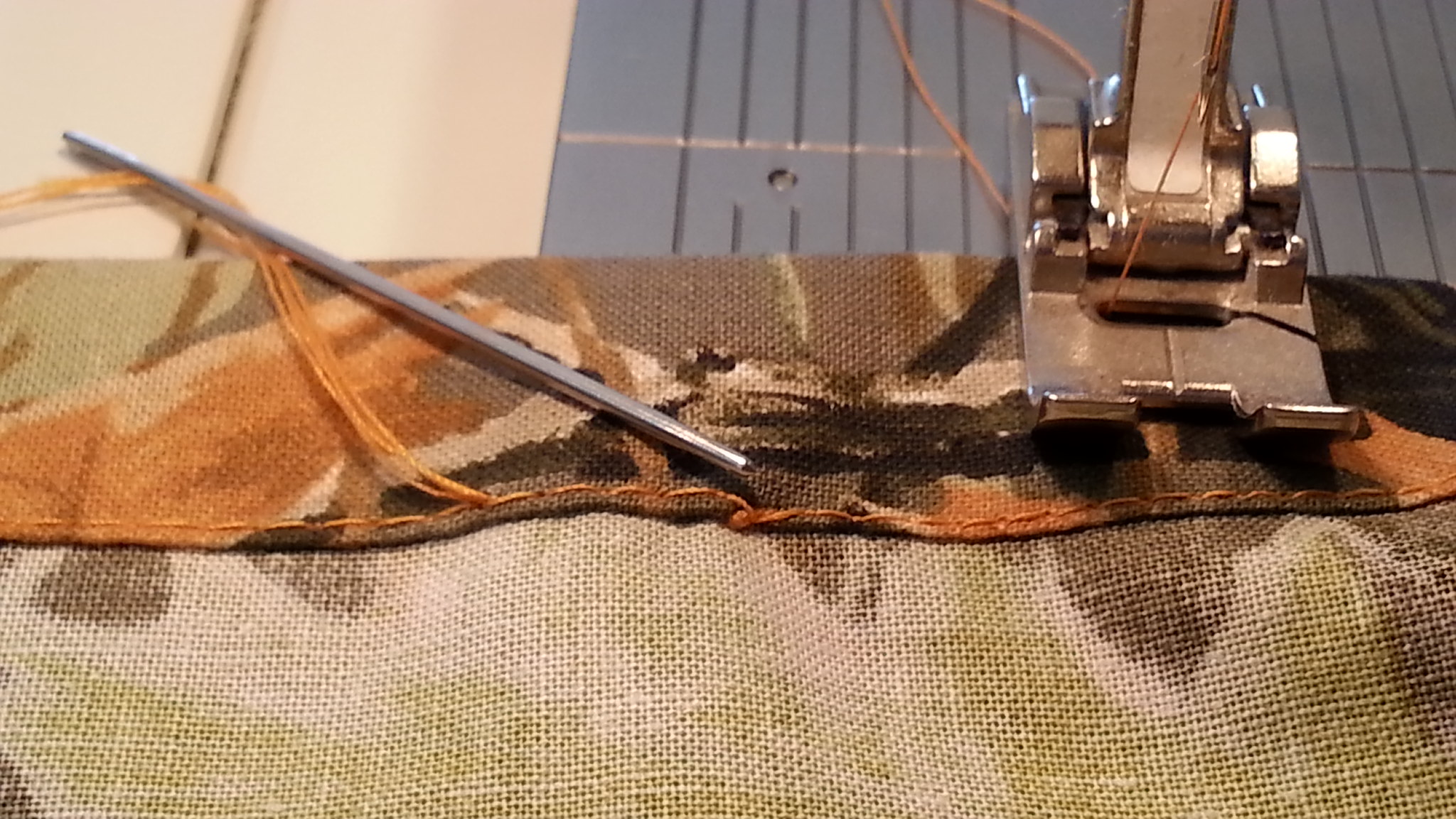
  • On the wrong side, knot all four thread ends and then bury in hem using an embroidery needle.  Needle points to the knot.
  • Press to lock threads together.  May seal knot with Fray Check.
  • continuous stitching repair

    Finish back of repair

    Finished Continuous Stitching Repair

    Completed Repair; pins point to beginning and end of repair


The gift is done and it is just fine, just not as fine as I know I am capable of.                    Now, when effusive thanks are received, I will not say, “Oh, but you should see how I messed up.”

Pocket Edgestitching

Pocket Edgestitching

If you have another/better fix, please let me know.

Till next time!

Posted in FIBER FASHION FUN | Tagged , , , , , | 1 Comment

Cocoon Wrap/Shawl

I love large wraps/shawls but am usually frustrated when they invariably slip off the shoulder and go missing in terminals and malls.

A shawl is so practical for traveling as it can have so many lives:

  • garment for warmth, decoration
  • airplane blanket
  • TV blanket
  • bed blanket

A very good thing– it’s worn on the plane and doesn’t take up precious suitcase space.

The shawl is also an excellent shopping accessory.  It’s stylish and is an extra layer of warmth in air conditioned malls.  I live in MN and winter is brutal, requiring a heavy coat which is always stifling once in a store.  I can wear a lighter  coat plus a shawl and be comfortable in the parking lot and shopping.

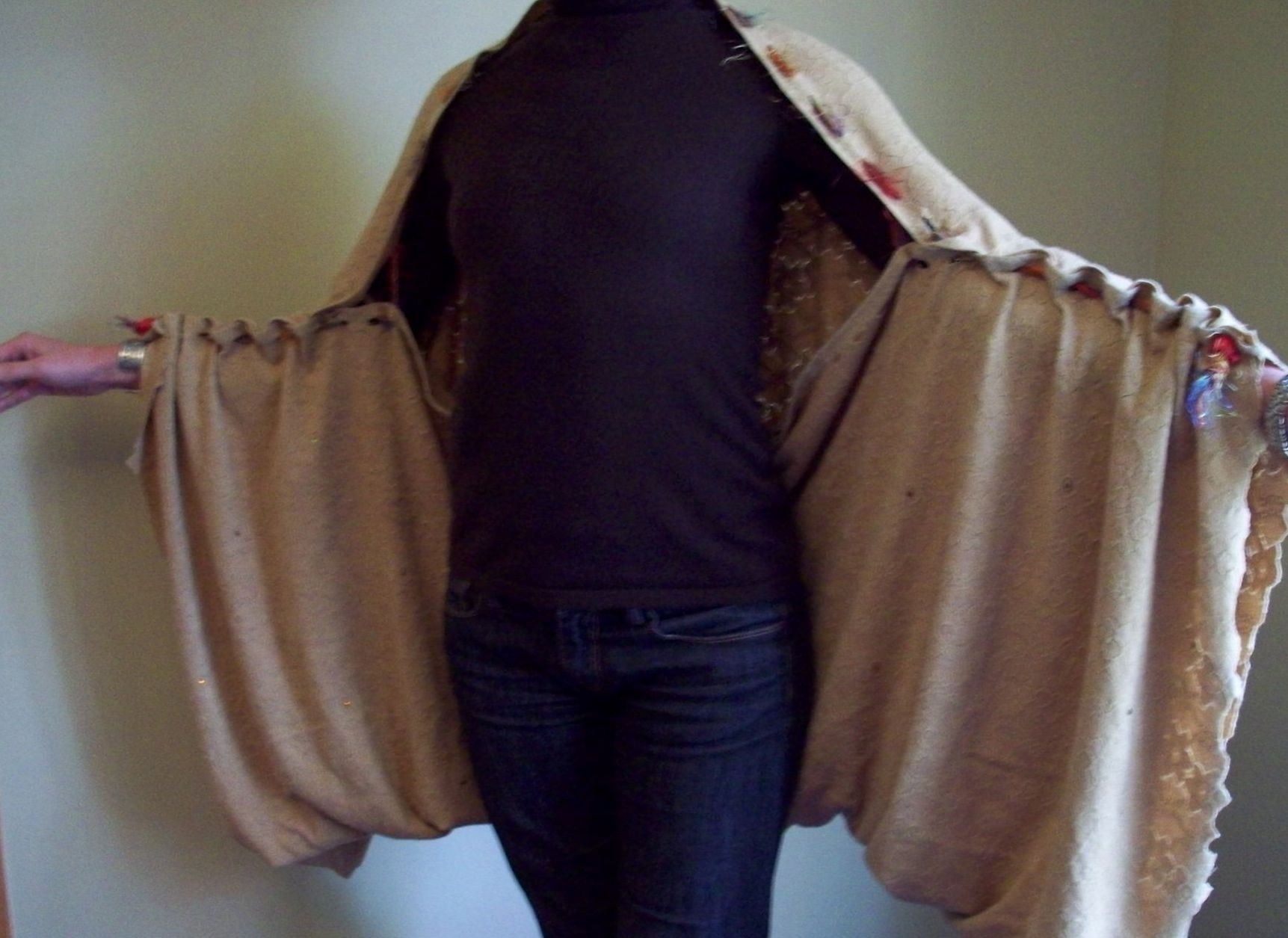
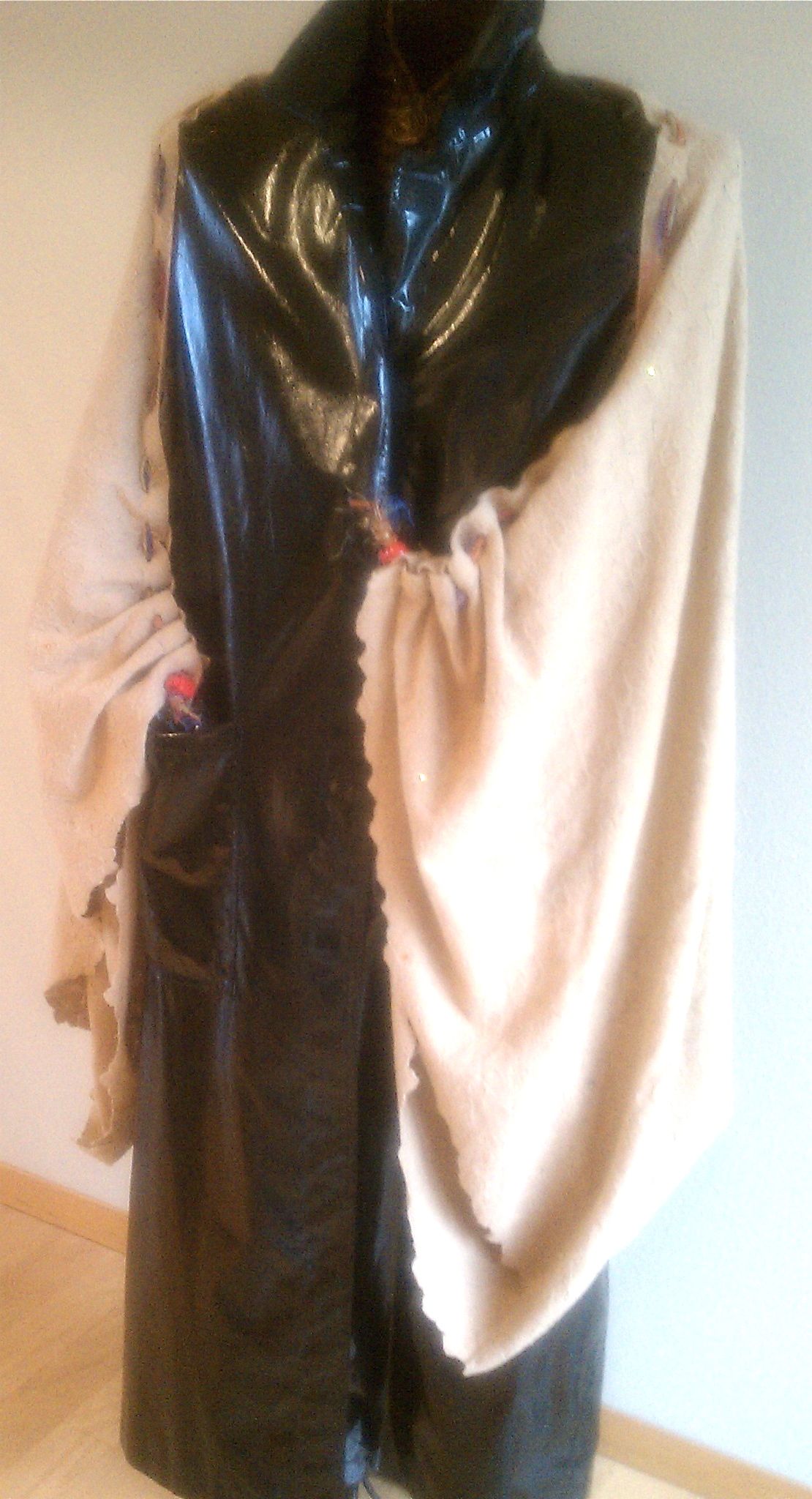
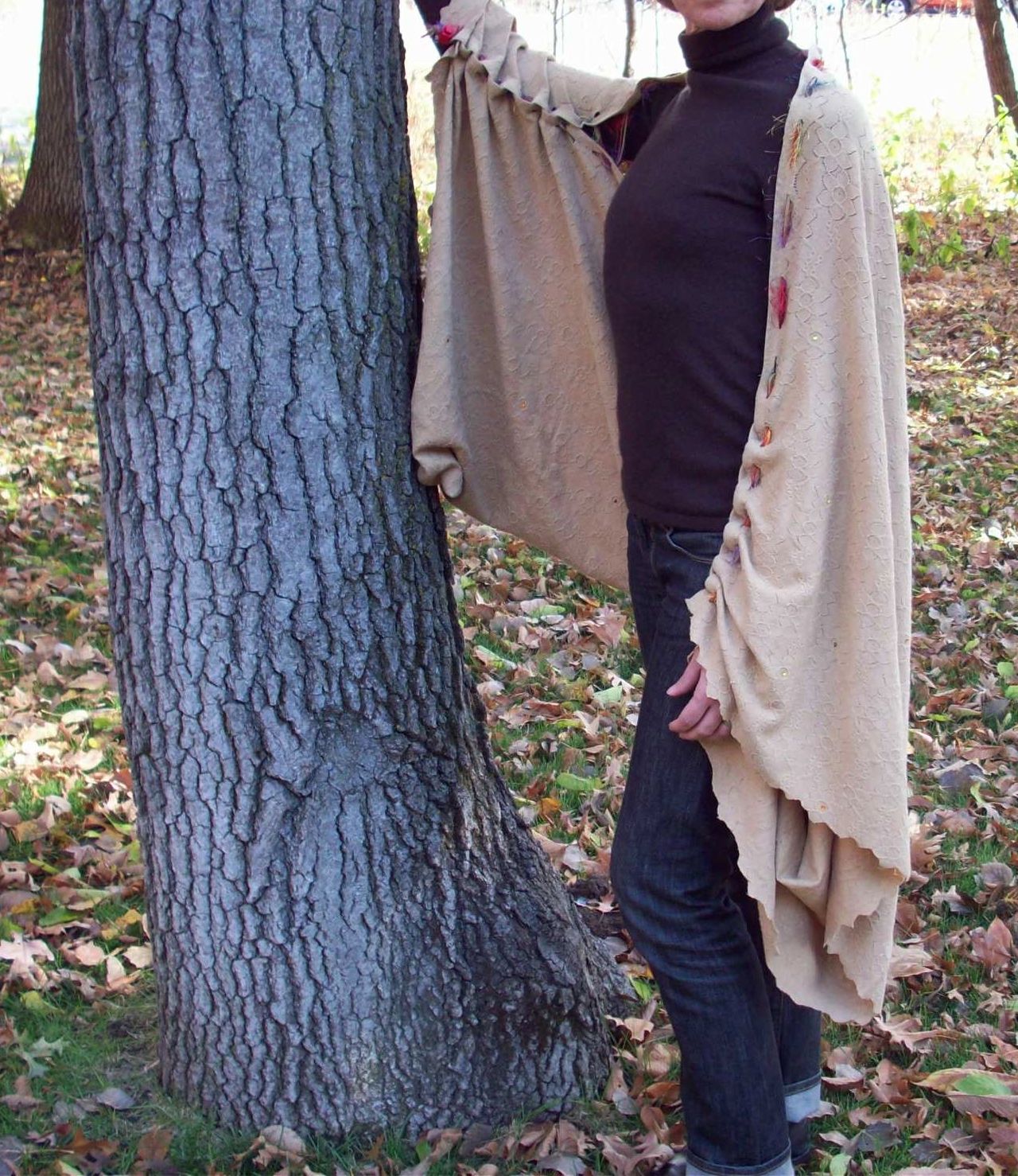
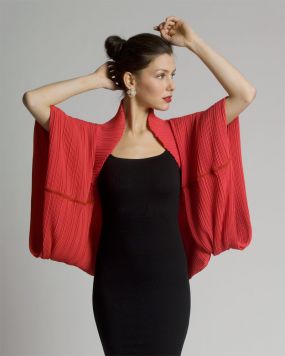
However, a fix is needed for the constantly misbehaving shawl, and I finally found one solution in a no-sew cocoon shawl that has sleeves and can be easily reconfigured into a blanket.  The design is inspired by a Pin from a 2013 The Row Collection.

The loose, drapey fit and the sleeves were appealing.  An ‘A Ha’ moment connected sleeves and drapey fit with A Shawl, A Cocoon Shawl.  Of course,  I had the perfect fabrics in my stash.  They had been purchased specifically for shawls but had been wasting away as I knew when worn, the shawl would slip and soon be tangled in my arms, purse, or worse, legs.

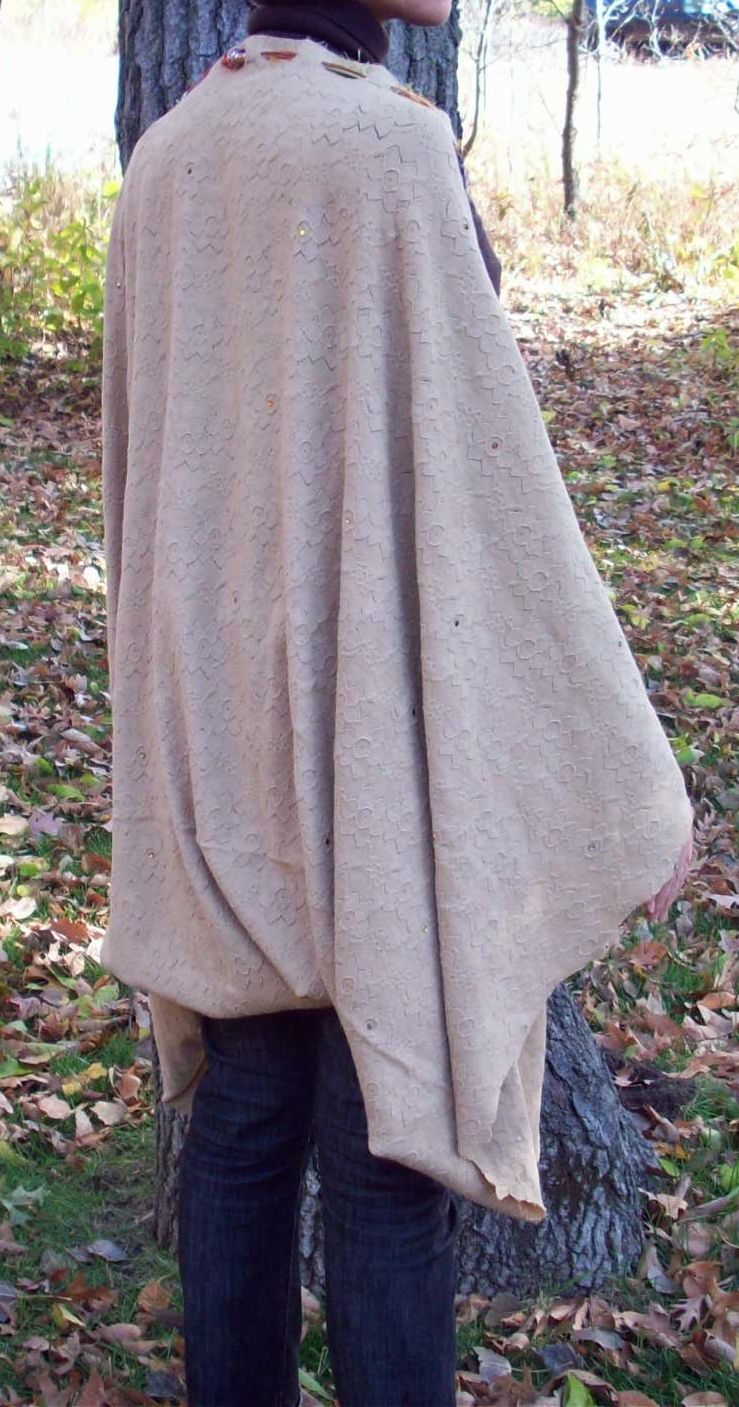
The fabrics are two pieces of a soft, knit lace (flower motif), in black and kakhi.  Although the fabric is a bit clingy, I knew it would never be secure on my raincoat which is a perfect travel coat–rain and wind proof, and a good layering piece.  So, if sleeves could be added, even if it slipped, arms would keep it on the body.

I began to have an elusive idea on how to accomplish this and it finally emerged with the help of my daughter, the Curator.  She provided the body for the draping, pinning, twisting, wrapping…until it all ‘Came out Right’.

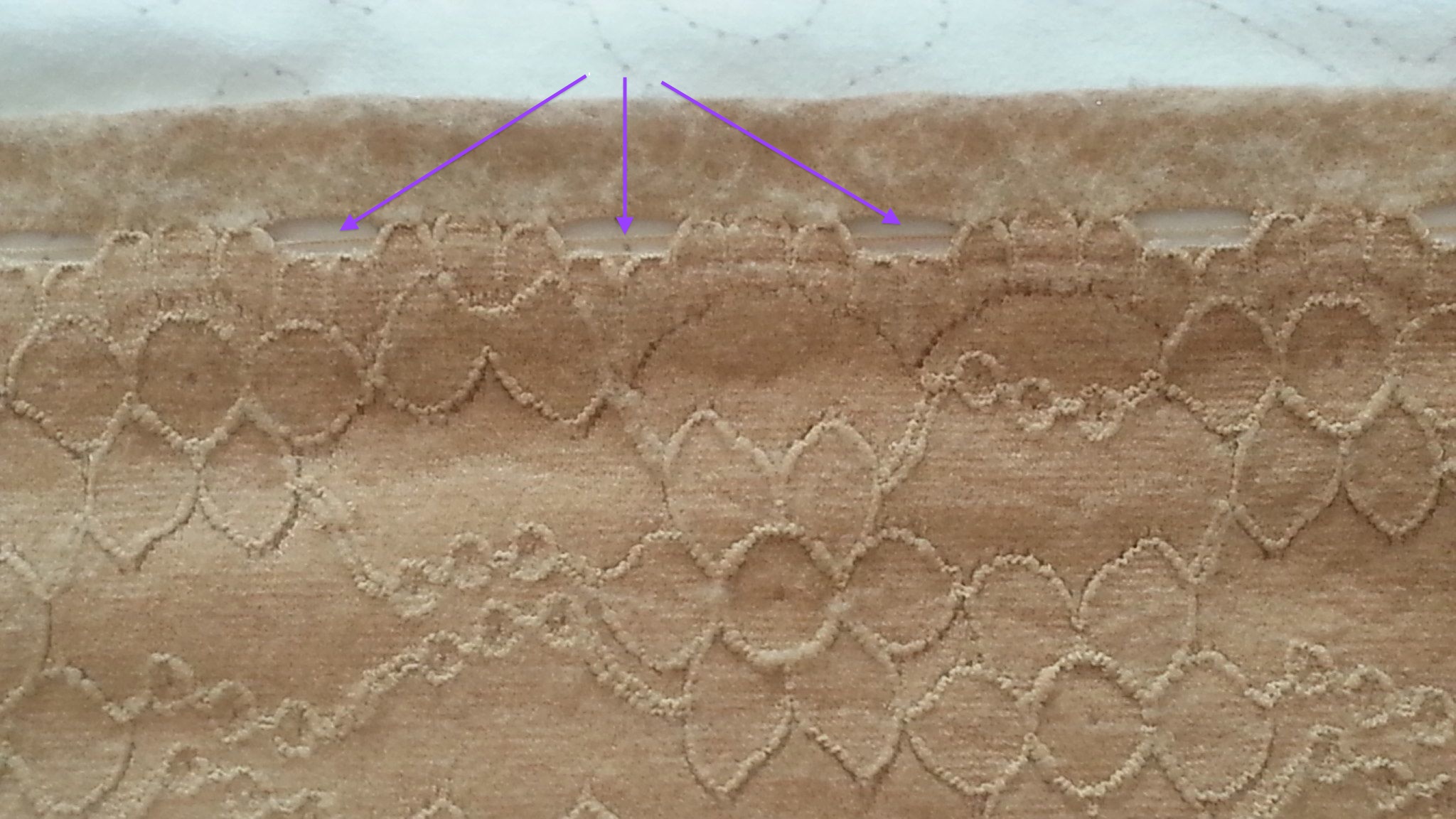
What made it work, is the fabric selvedge–the lengthwise fabric edge that is attached to the loom.  This one has large openings just begging for string, cord, something to shape the fabric without actual stitching.

Selvedge openings formed when yarns looped on loom

Selvedge openings formed when yarns looped on loom

So, the sleeves and ‘cocooning’ were solved by lacing the two selvedges together and leaving an opening for arms by lacing through one layer over shoulder and neck.

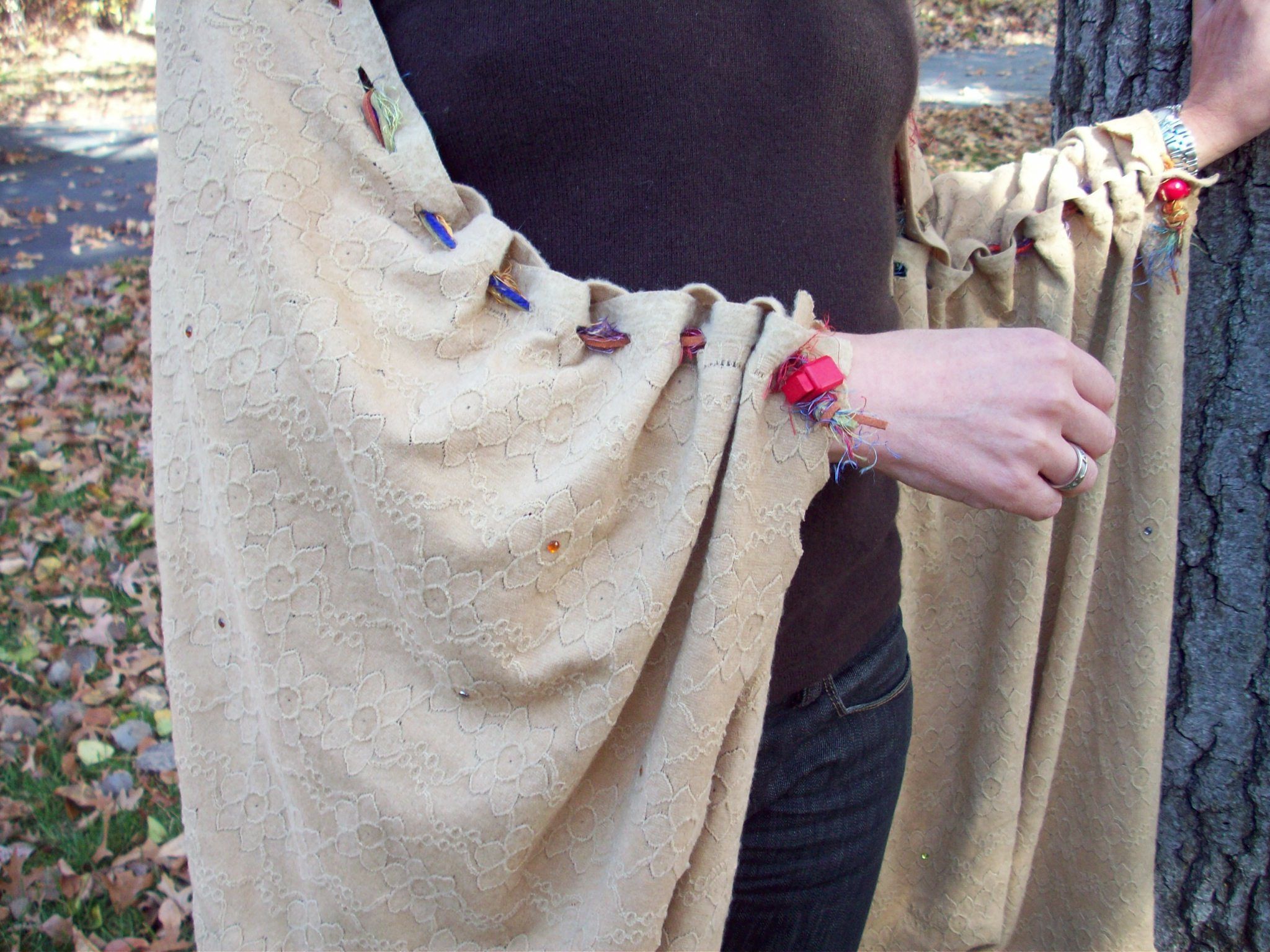
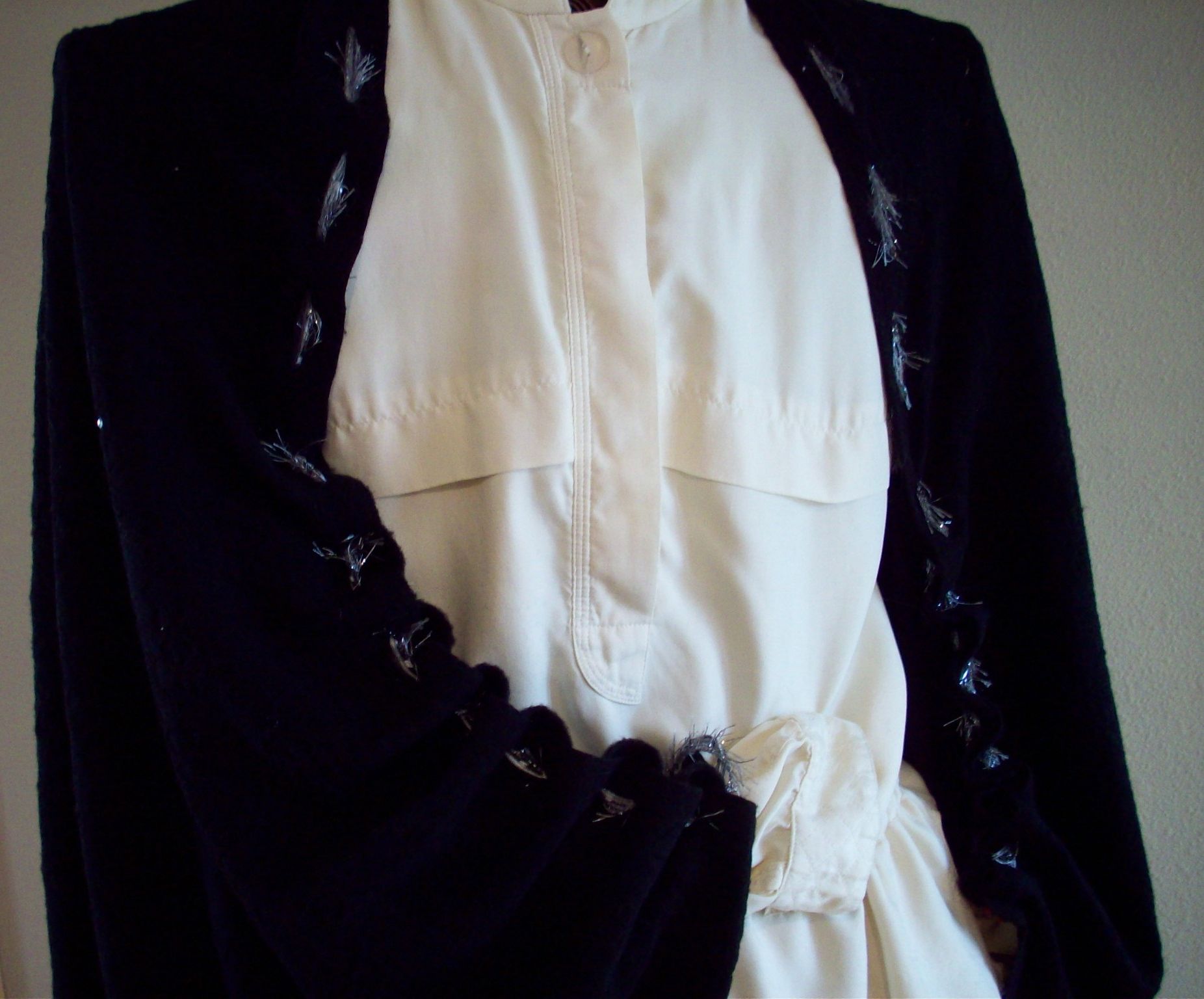
Multiple yarns, threads, leather were combined for the lacing cord and are secured at the wrist by toggles that allow for sleeve length adjustment.

Lacing of two layers forms sleeves; lacing thru one layer at neck

Lacing of two layers forms sleeves; lacing thru one layer only at neck

Toggle secures sleeve length

Toggle secures sleeve length

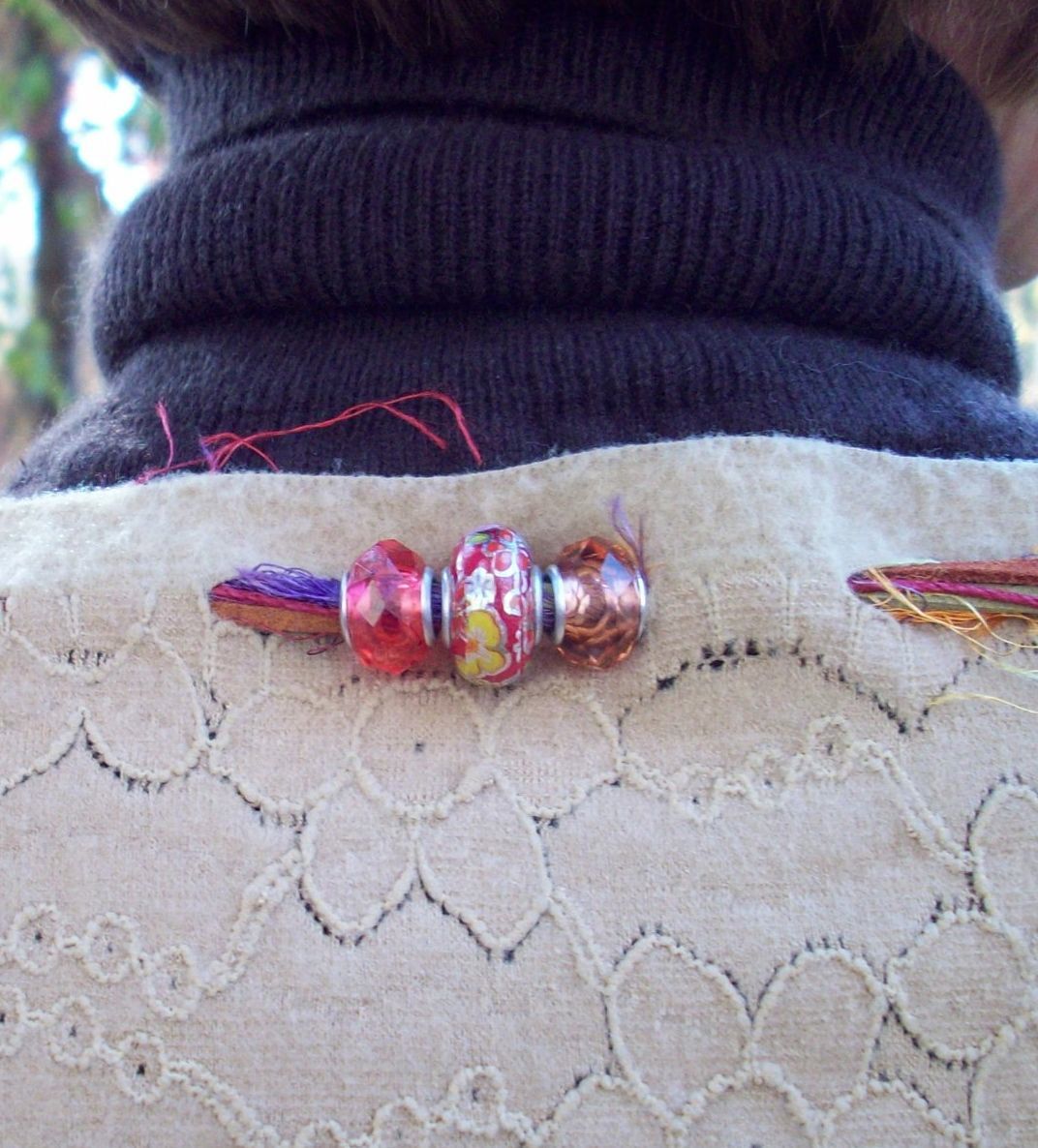
Beads add interest at neck

Beads add interest at neck

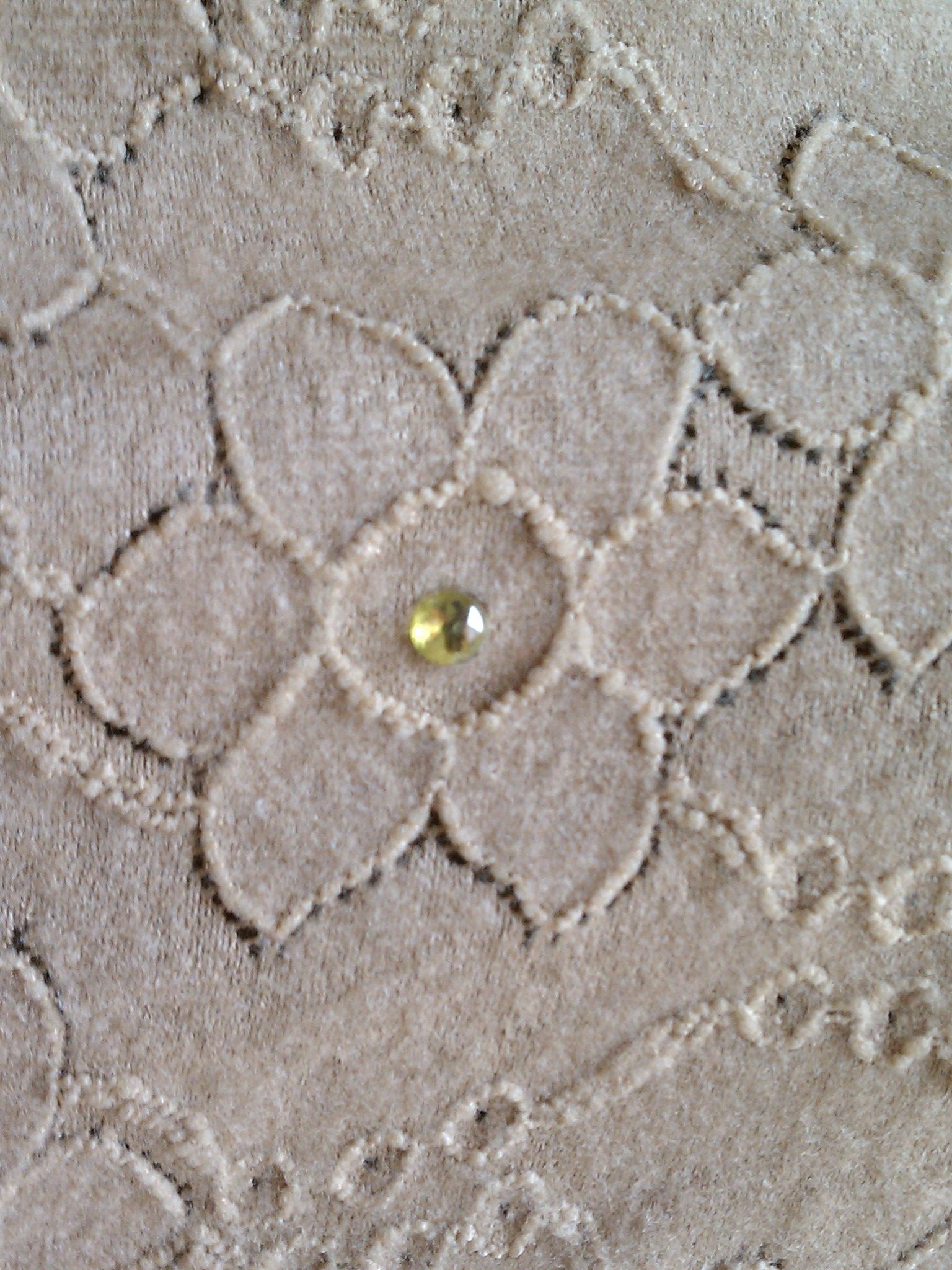
Fabric flower motif with crystal embellishment

Fabric flower motif with crystal embellishment

Cocoon Wrap Instructions

1.5 – 2 yards fabric, 55″+ wide

Fold in half lengthwise, wrong sides together, matching selvedges

String lacing cord(s) through selvedge openings in both layers to form sleeve; continue lacing through one layer for neck and then two layers again for other sleeve.  Sleeves should be equal in length.  Add decorative beads as desired.  Finish with toggle at each wrist to adjust sleeve length and prevent cord from pulling out.

Notes:

  • Wrong side will show
  • Openings for lacing can be made using gromments or making button holes.  Punched holes may work if fabric won’t stretch or ravel.
  • 45″ wide fabric will make a much shorter cocoon shawl; experiment.
  • Sleeve hem is trimmed around lace motif and left raw as the knit will not ravel.
  • Laces can be removed for use as single layer blanket.
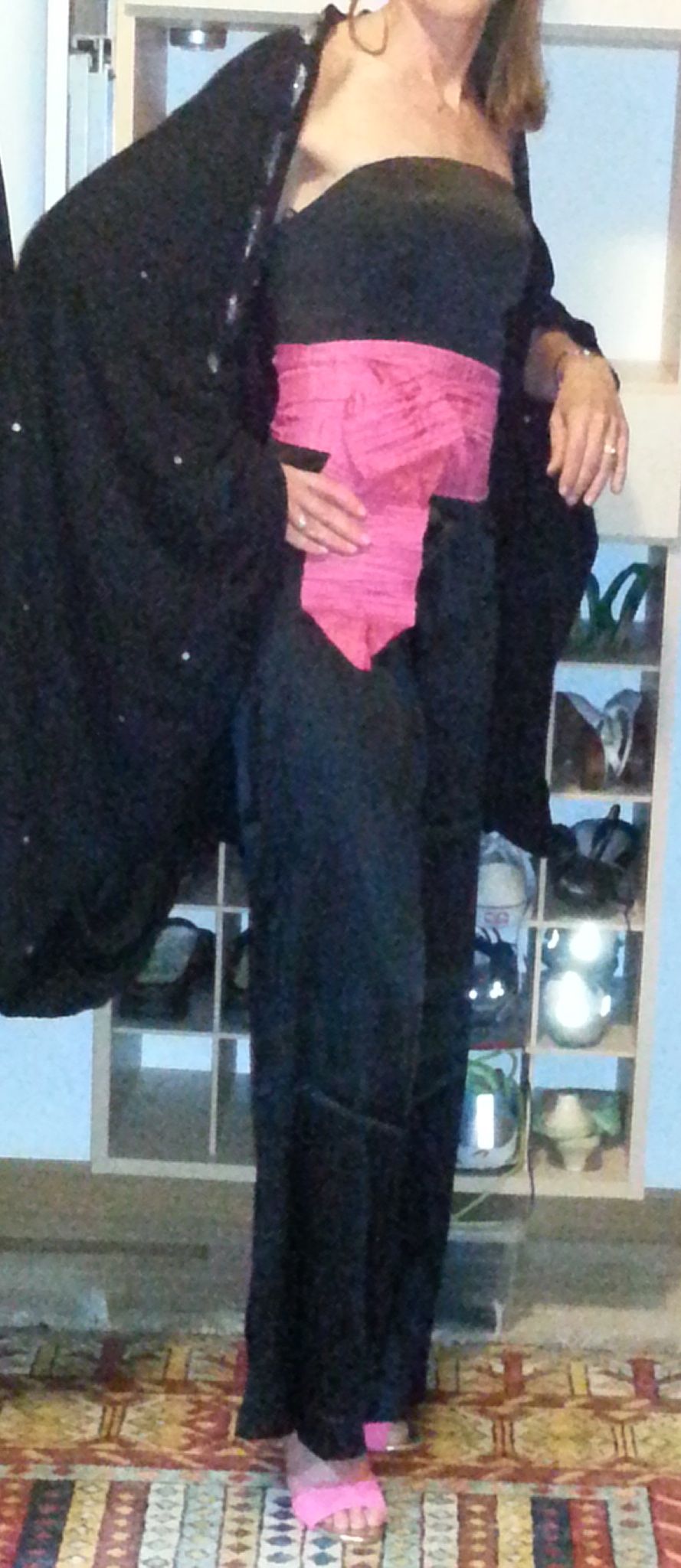
Cocoon Shawl over RainCoat

Cocoon Shawl over RainCoat

Even though the shawl slips off the shoulders on this raincoat, the sleeves/arms keep it secure.

More photos

Ohh LaLa

Ohh LaLa

Fall Ramble

Fall Ramble

Both the black and kakhi Cocoon wraps are available on Etsy.

Related Articles:

Now, here is another very similar (in technique) version from Threads Magazine, September 2014, Number 174.

Pleated Wrap

Pleated Wrap


Let me know your experiences with making a cocoon shawl.


Posted in FIBER FASHION FUN | Tagged , , , , , , , , , | Leave a comment

RTW Ideas for the Sewist

I went snoop shopping today…well, actually, I went shopping at the local department store’s season end sale to stock up on essentials and saw some great sewing ideas.

Here’s what I found.

T-shirts

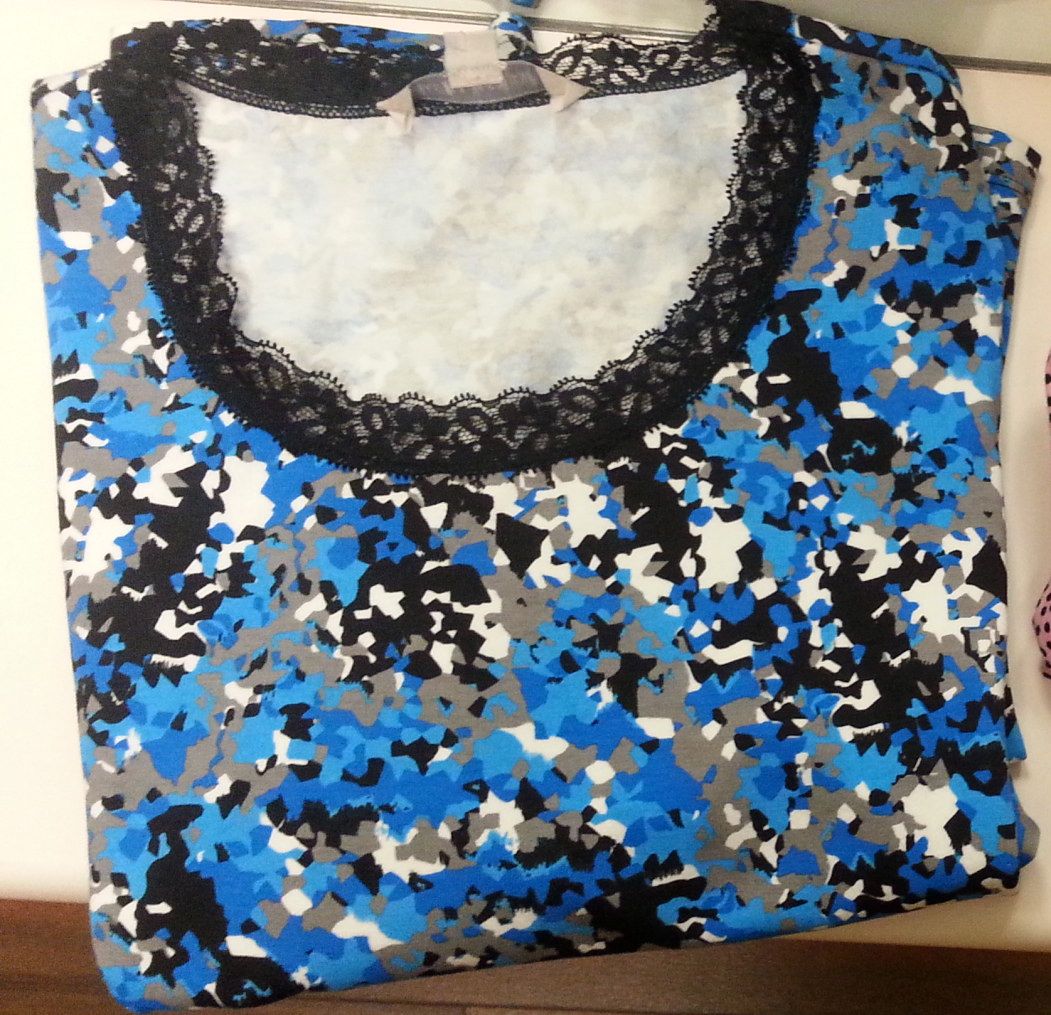
Stretch lace neck finish

Stretch lace neck finish

Stretch lace applied like ribbing on a popular print knit fabric.

Neckline Finishes

Neckline Finishes

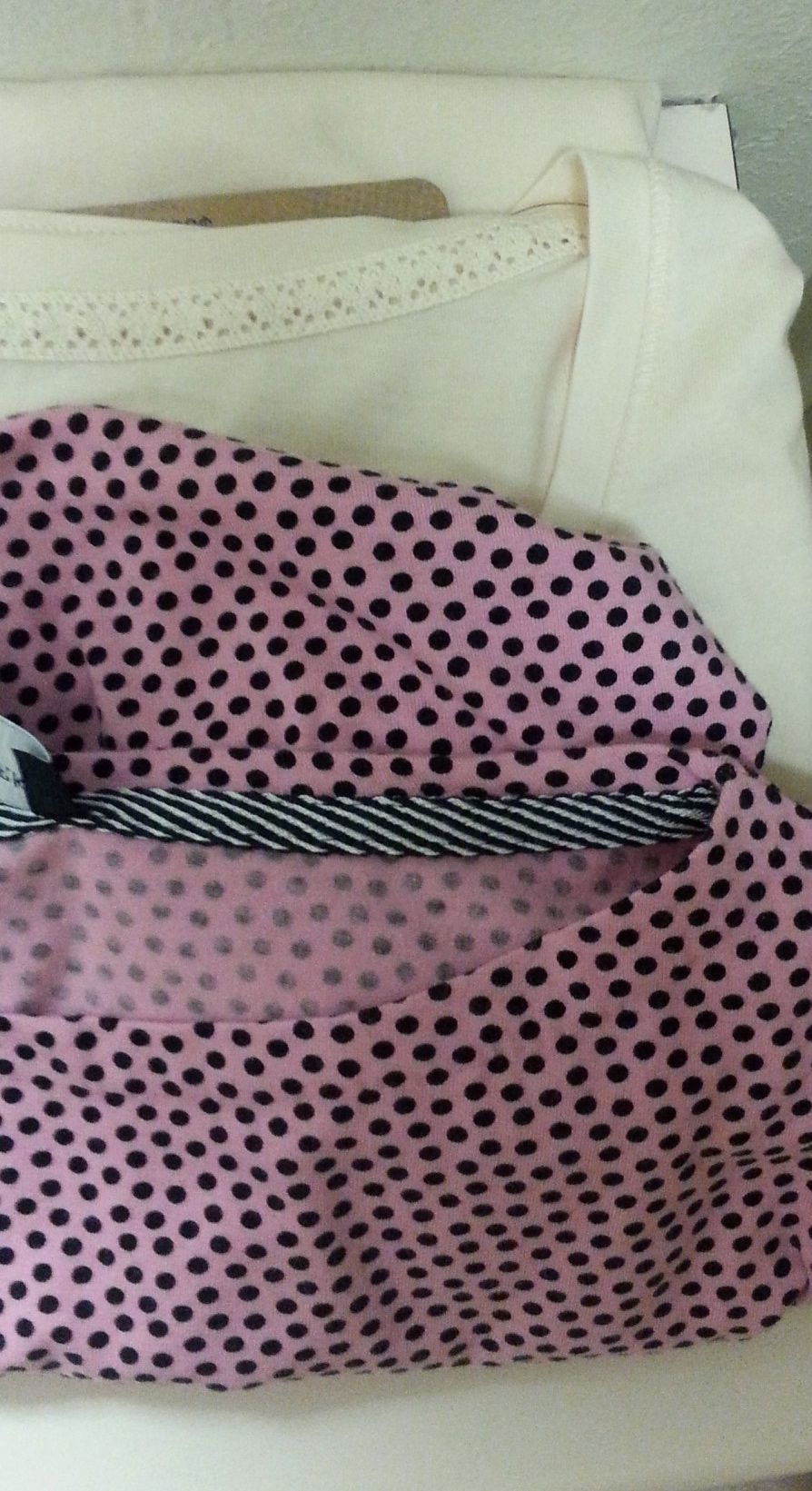
Here, the inside back neck seam is covered with a contrasting trim; only the back (from shoulder seam to shoulder seam) is finished making it a quick, upgrade.                                   The white T has a henley front placket with same trim applied to button side–only shows when unbuttoned.

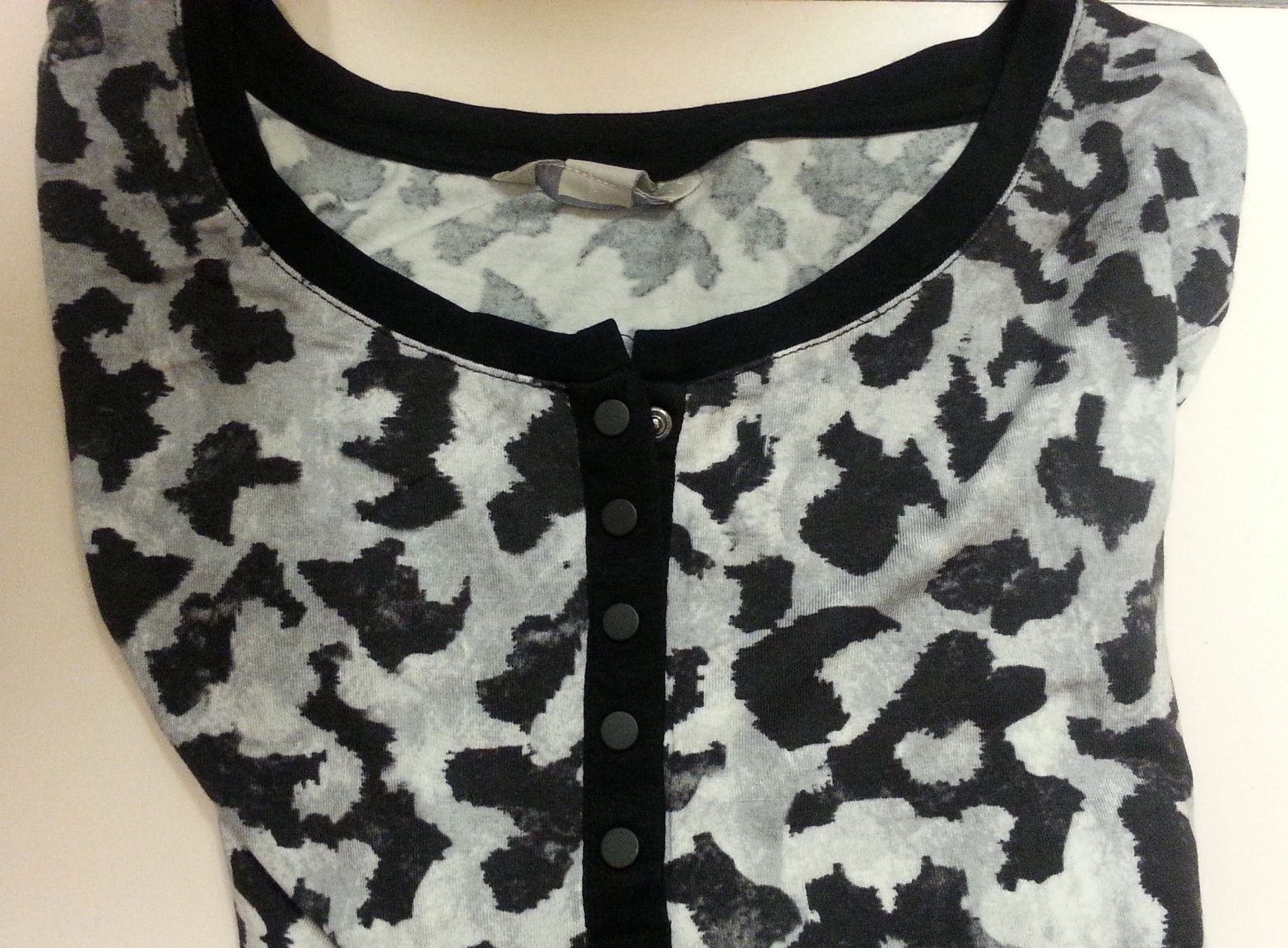
Light weight nylon ribbing

Light weight poly ribbing

This light weight poly knit is finished with contrast, light weight, fine-rib ribbing, closed with snaps, a perfect choice as buttonholes in ribbing/knit are tedious.

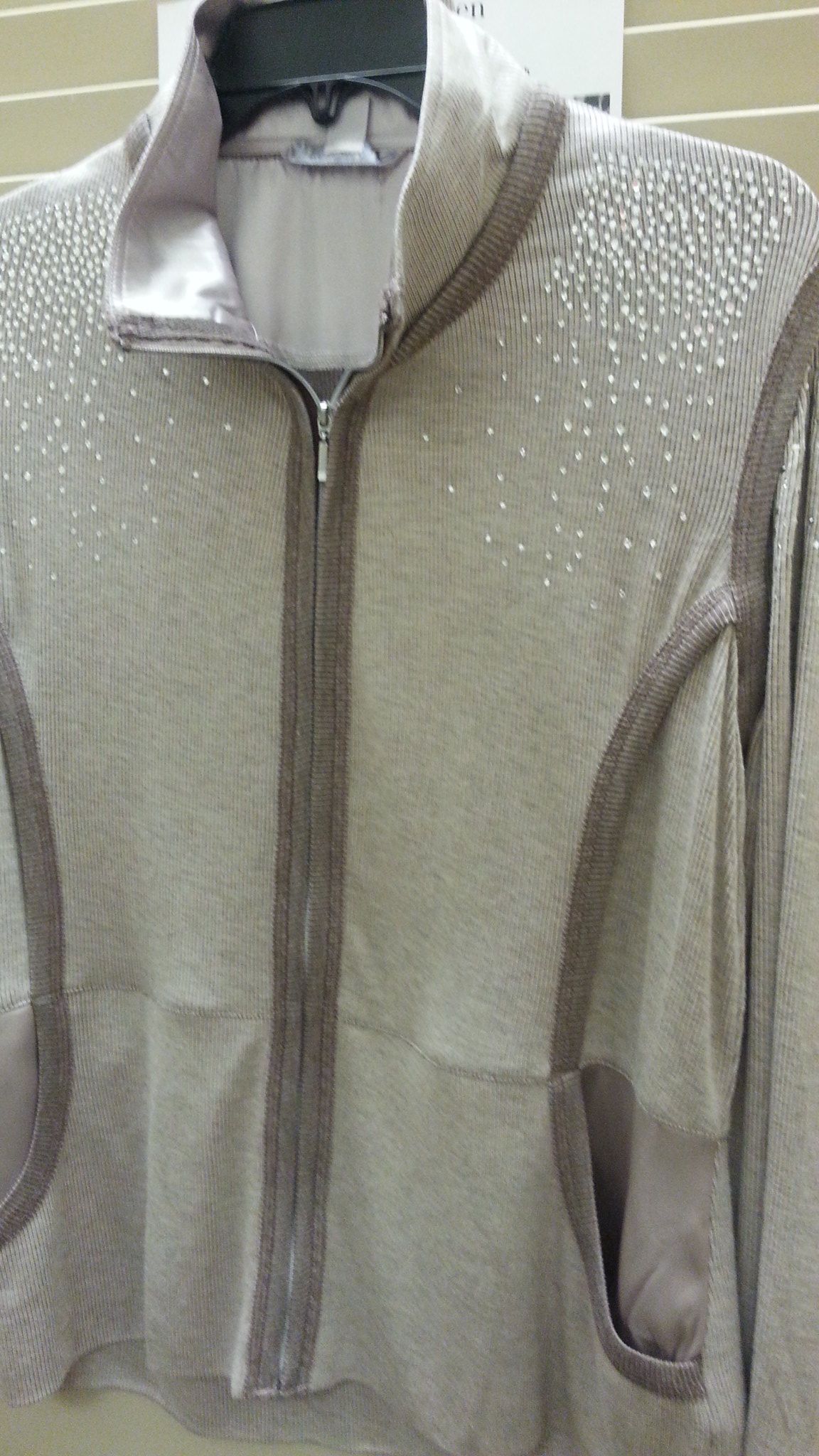
Mixed fabric

Mixed fabric

Satin woven fabric contrasts with the matte knit.  Because the satin fabric is used for the inside collar, it doesn’t affect the stretchability of the garment.                                             Also note the contrast color ribbing used to accent seams and provide a neat zipper finish as well as providing additional structure to support the weight of the zipper.

Disclosure:  none of the above followed me home although the jacket was a candidate–except the glitz on a casual garment really turns me off.

Shirts

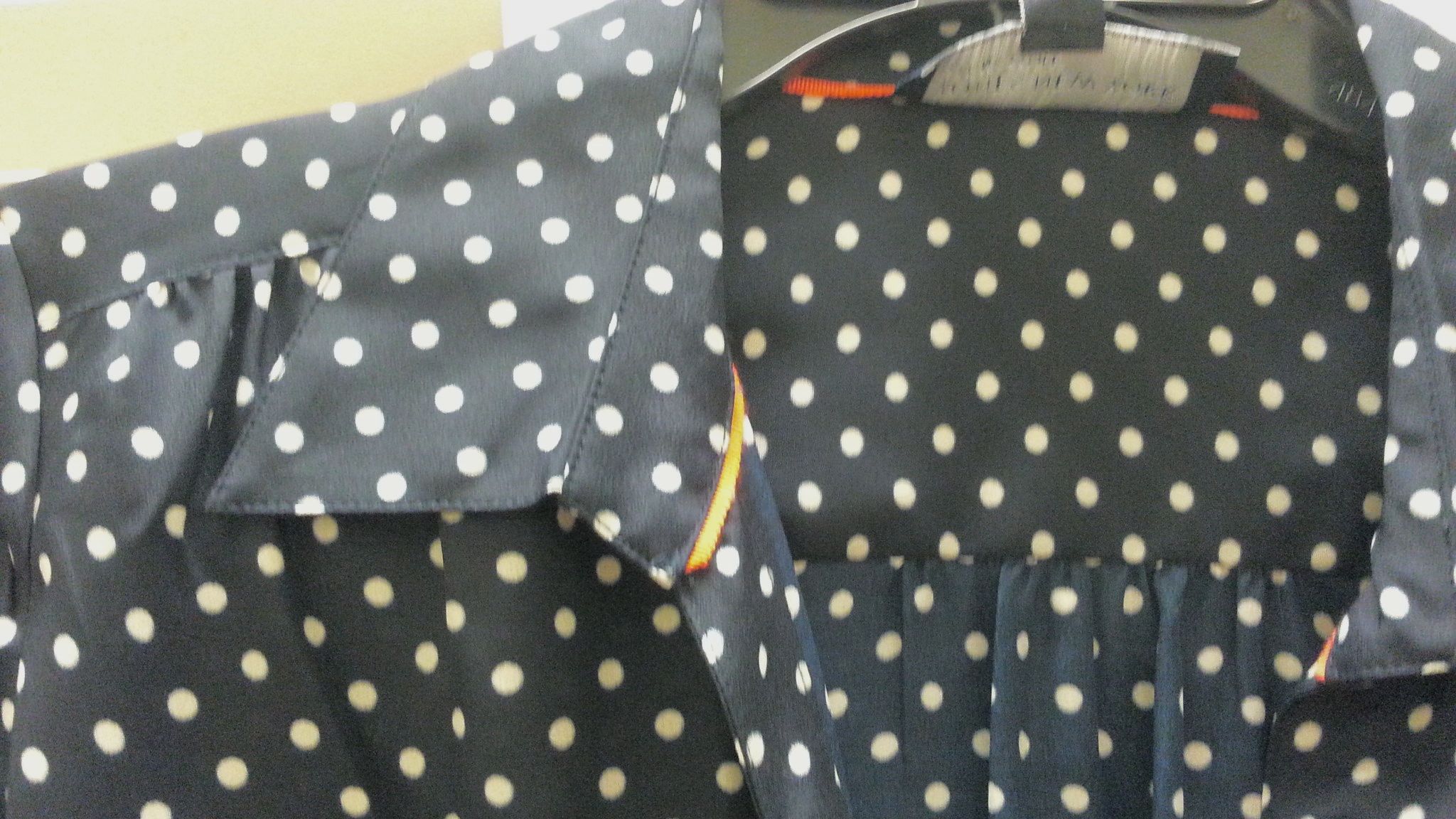
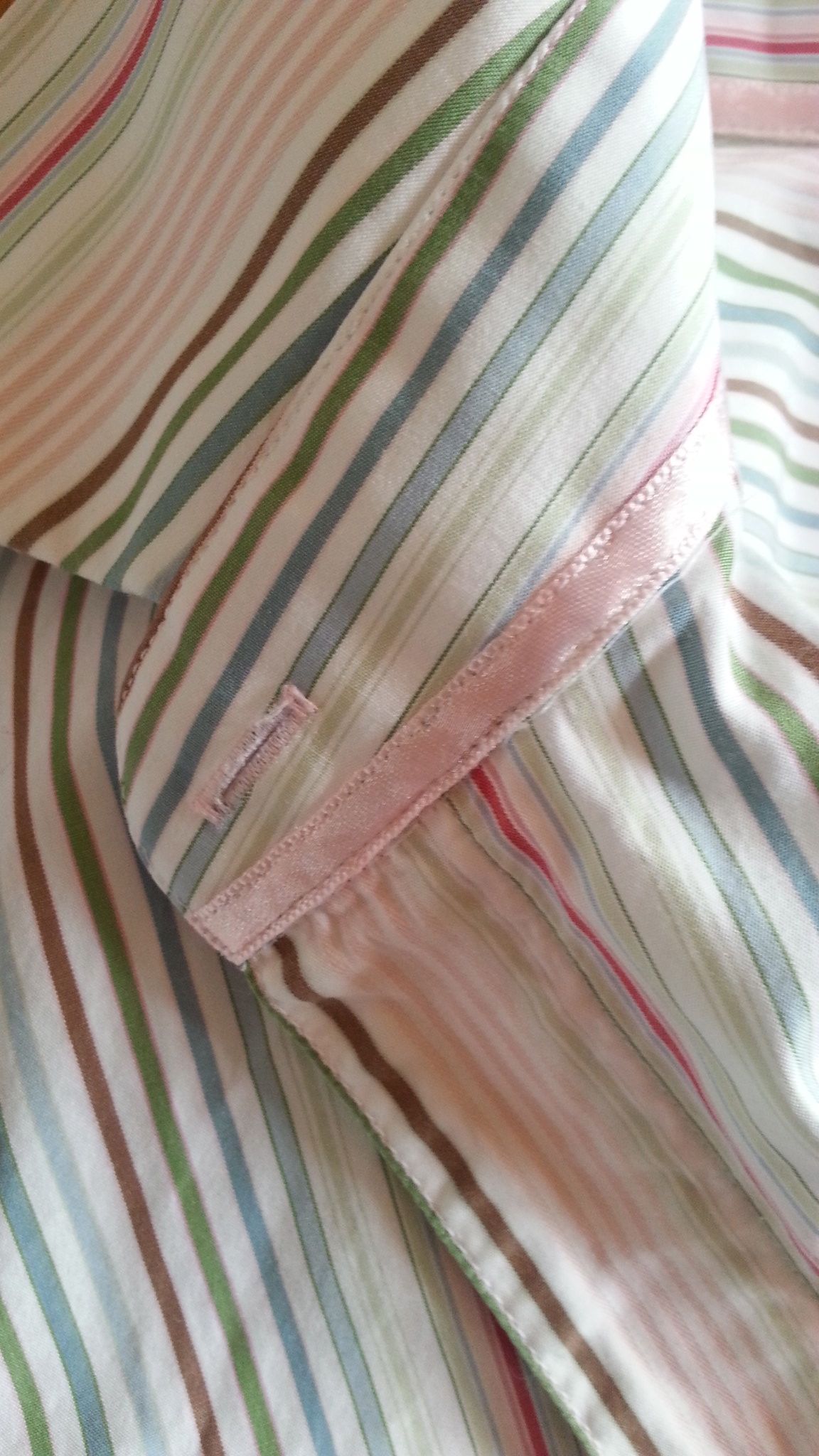
Collar stand ribbon trim

Collar stand ribbon trim

Grosgrain ribbon is inserted in the collar stand just for fun and pop of color.  The ribbon is bright orange; the yellow portion is due to lighting in the dressing room.                                 Note the ribbon is turned under on the diagonal at the center front encasing the raw edge.


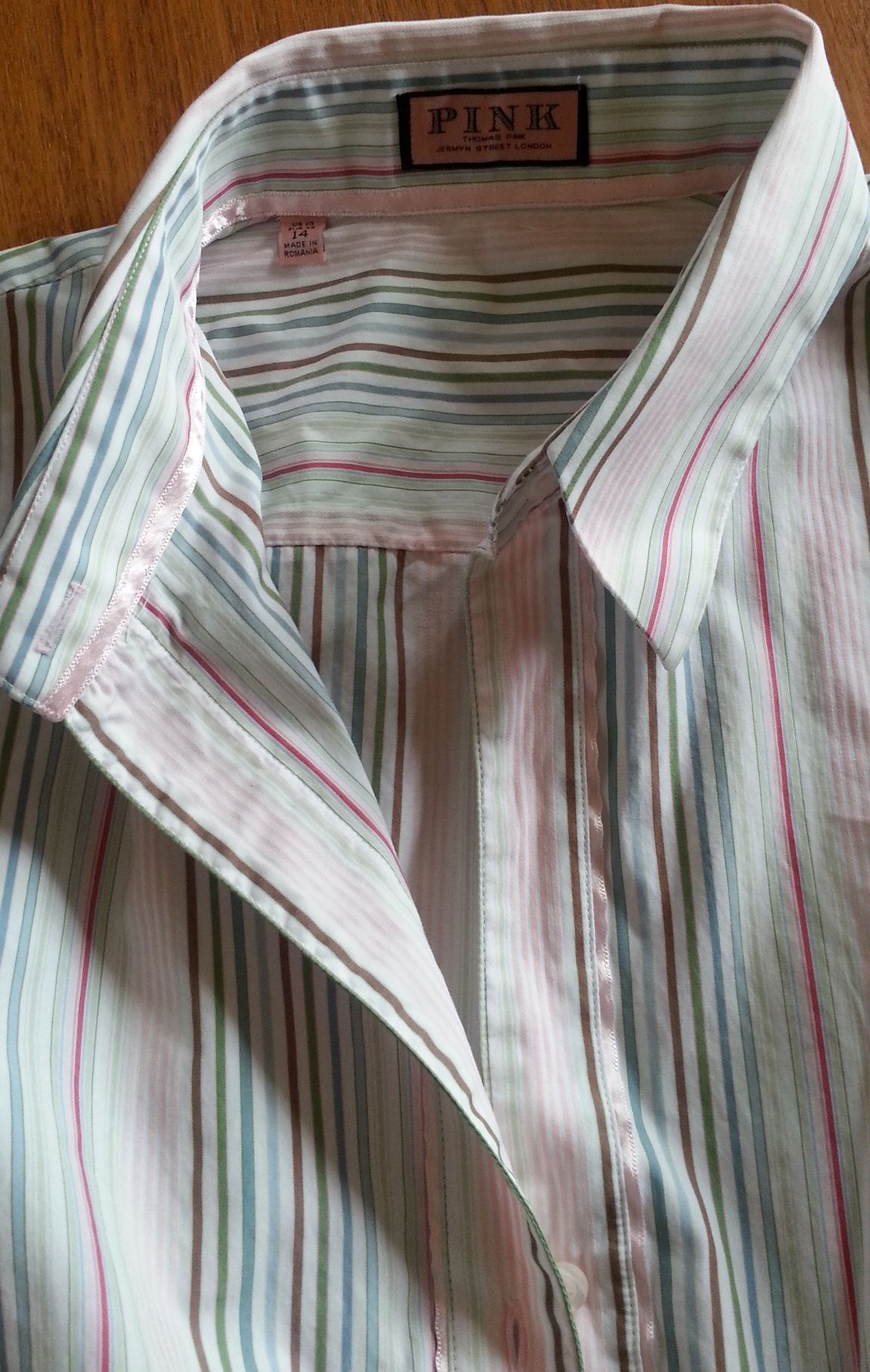
Thomas Pink

Thomas Pink Shirt with satin ribbon

This is from my closet, a Thomas Pink shirt with narrow, satin ribbon trim on collar stand, front bands and cuffs.  Isn’t this a luxurious, subtle touch?

Ribbon stitched on collar stand

Ribbon stitched on collar stand

In this example, the ribbon is topstitched onto the band with the lower ribbon edge on the stitching line.  The final topstitching, finishes the lower edge of the band as well as topstitching the ribbon–there is only one row of stitching on the opposite side of the band.  In practicality, I would glue the ribbon onto the band; glue the band and topstitch through ribbon and both sides of the band using a twin needle.

Dresses

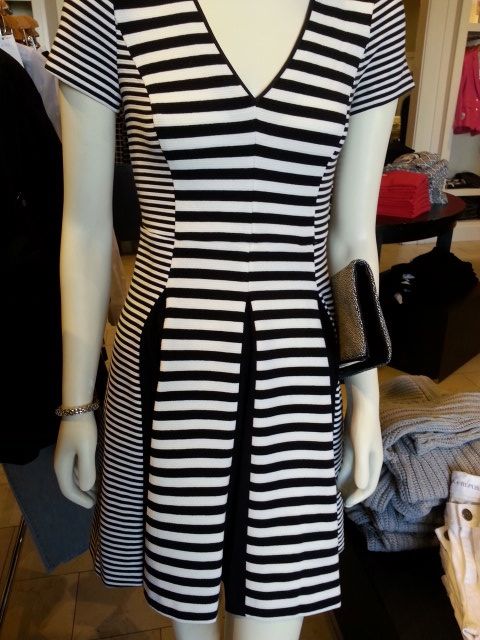
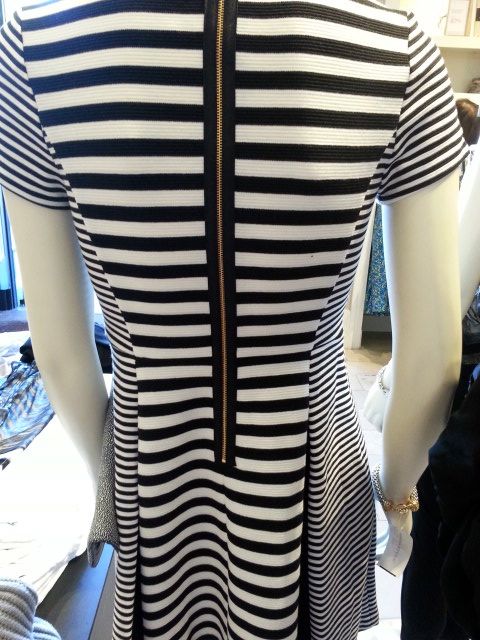
The last two photos of a RTW dress incorporate coordinating stripes plus an exposed zipper and solid color gore inserts.  This would be easy to duplicate using a princess seam dress pattern.

20140221_103941

STRIPES, stripes, gores

STRIPES, stripes, exposed zipper

STRIPES, stripes, exposed zipper

Please share your snoop shopping ideas with a comment.

Posted in FIBER FASHION FUN, GREAT IDEA, Uncategorized | Leave a comment

Make a Baby Receiving/Swaddling Blanket

My ‘go-to’ baby gift is the receiving blanket and it is  always one that I make.  It satisfies three gift giving rules:

  • Need–every baby needs more than one
  • Use–it will get used
  • Love–made with

The blanket also has many lifetimes as it morphs into a blanky, binky, Gee Gee, and then finds its way to the Baby Doll wardrobe.  The favorite ones even get saved, no matter how matted, tattered, to be brought out again for visiting Grands, “Here’s Momma’s/Dada’s”.

Receiving/Swaddle Blanket

Receiving/Swaddle Blanket

Before I began having a gift stash of blankets, the baby gift I bought was outgrown before a) I got around to shopping (Babies always wear 3 month size for the first year, right?) and, b) found the address and wrapping paper, and a card, and a shipping box and got to the post office.

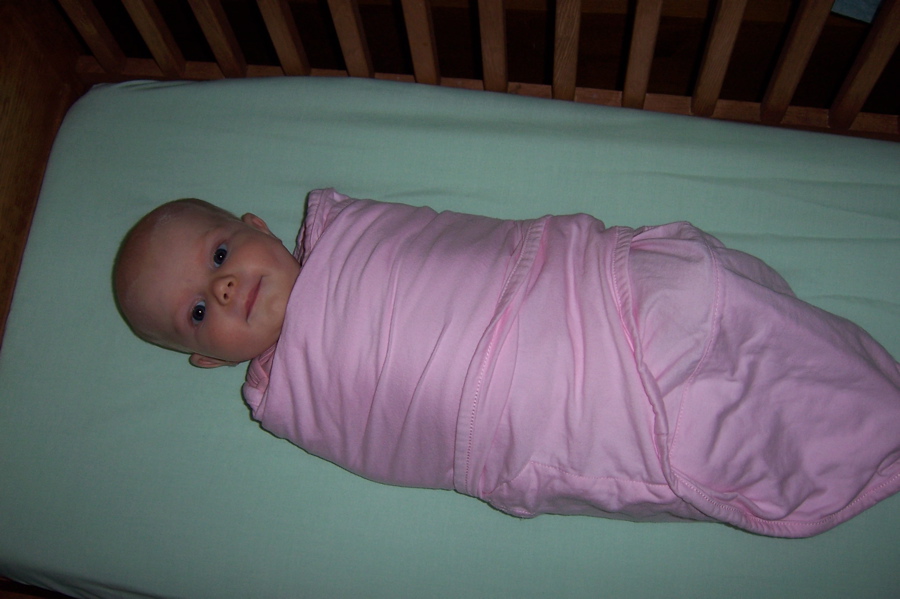
Happy Camper at 4 months

Happy Camper at 4 months

My first Grand exhibited colic at 3 weeks and the pitiful rag masquerading as a receiving blanket sent home by the hospital was so inadequate on several levels.  Mainly, it was too small (probably 36″ x 30″) for even a newborn.  And once the baby begins to grow out of the fetal position, a larger blanket is needed.  As you can see from the above picture, E-Bear is perfectly content to be swaddled, firm around the upper body and looser around the lower body.  Keeping the arms confined is important as muscle spasms will cause the arms to jerk, fling and wake the baby.

My children never had colic other than for a night or two so never swaddled them, although my mother was suitably appalled.  My recollection of receiving blankets from the 60’s is a 3-pack flimsy flannel that drastically shrank, faded and pilled when just getting near water.  I used them for burp cloths and the girls later adopted them for their dolls, eventually they became dust cloths (how archaic is that!).

Once I saw the need for a receiving/swaddling blanket, I knew I could make them for less, with quality fabrics, and in personally selected, attractive colors/designs.

My fabric of choice is 100% flannel, although knits and gauze are also used.  Most mothers prefer all natural fibers so I stay away from synthetic fibers.

Flannel is a hard-working fabric.

  • It’s durable.
  • It’s washable.
  • It’s absorbent.
  • It’s comfortable.
  • It breathes so is warm without being hot.

The blankets are quick and easy to make, actually a great learning-to-sew project.  Learning anything is more fun if the end result is a useable product.  Everyone is bound to need a baby gift at some point.  And, if you don’t sew, and not interested in learning, that’s OK too; they are available on Etsy.

The instructions are for two blankets  The first blanket is the learning project; the second one is to perfect just learned skills…’practice makes perfect!’  And, now you have an extra blanket for that unexpected baby gift.


Receiving/Swaddling Blanket How-to

Supplies:

  • 2.75 yds** of 45″ wide 100% cotton flannel for two blankets,
  • finished size about 44″ X 44″
  • coordinating/matching thread

Equipment:

  • sewing machine
  • iron and ironing board
  • hem gauge

1.  Fold fabric in half lengthwise; snip through selvedge about 1/2″ and tear the rest of the way.  Trim any loose threads resulting from the tear on both pieces.  Prewash* per washing instructions for the fabric  to preshrink and to wash out any manufacturing products. I know you are loath to wash and lose that nice firm manufactured finish, but do you really want unknown chemicals on you or a baby?  Plus, washing softens the fabric and fluffs flannel’s appealing nap.

Another benefit is that washing and drying will shrink the torn edges back into shape as tearing will slightly stretch the fabric.  So why tear?  Because it is quick and easy and a ‘tear’ is always along one of the woven threads, thus the blanket piece will be on-grain and the fabric ‘square’.  Note:  fabric will never be ‘square’ like a piece of paper because of it’s flexibility/stretchability; the goal is to get it as close as possible.

Drying tip:  cotton flannel can wrinkle into a balled mess in the dryer.  I never dry flannel (or kitchen towels, placemats).  I shake the item and air-dry by hanging over a horizontal kitchen cupboard drawer pull, at which point, I tug the edges taut to straighten the edges.

2.  Hem both selvedges by folding and pressing the edges to the wrong side about 1/2″.

3.  Hem crosswise edges (torn edges) by folding and pressing 3/8″ to wrong side.  Fold again another 3/8″ encasing the raw edges.  Selvedges do not need to be double folded as they don’t ravel.

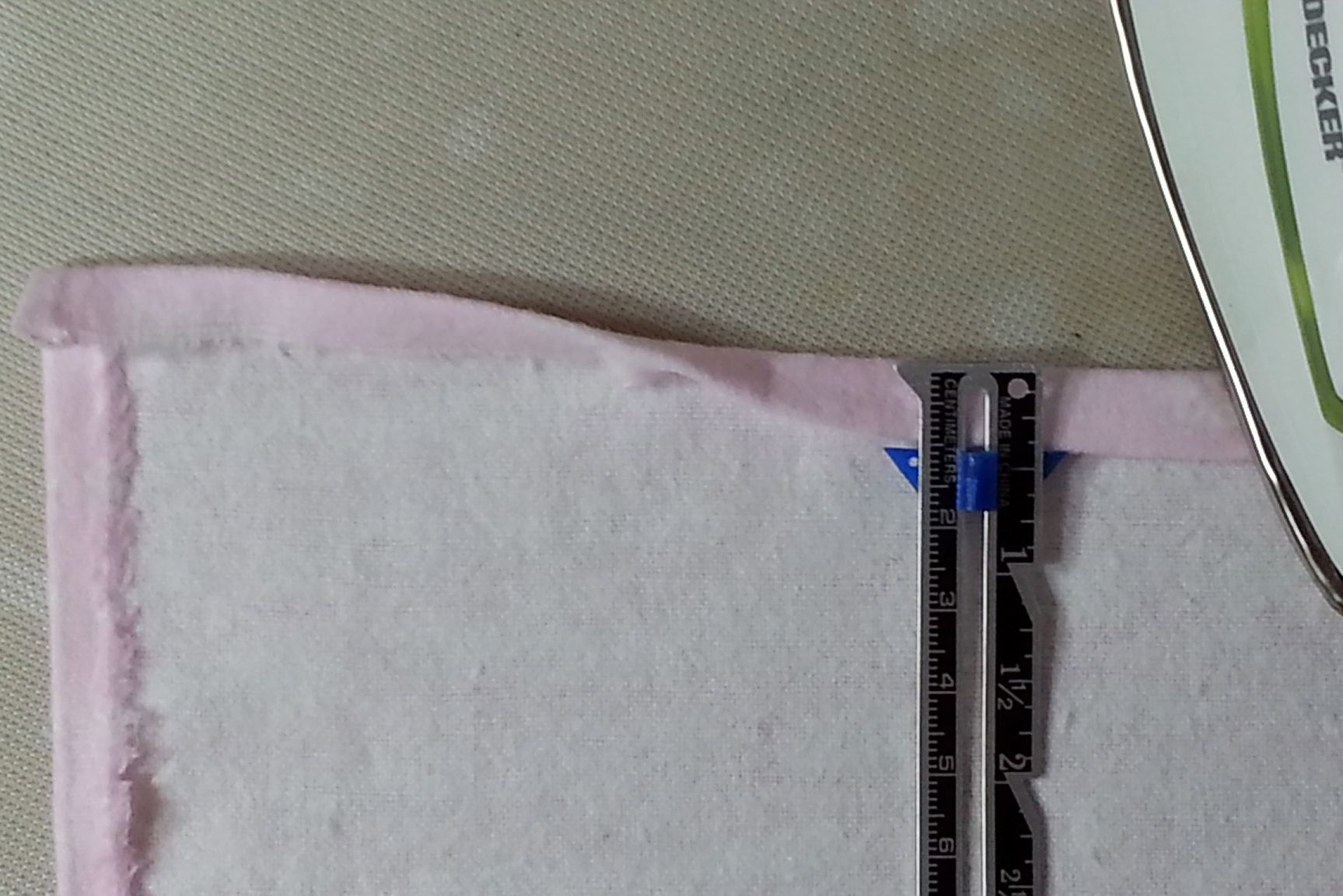
Using hem gauge

Using hem gauge

Use the gauge’s tab (blue) to push against the fold and nudge to the correct width.  I leave iron on hem while positioning the next fold–about 3-4″ at a time.

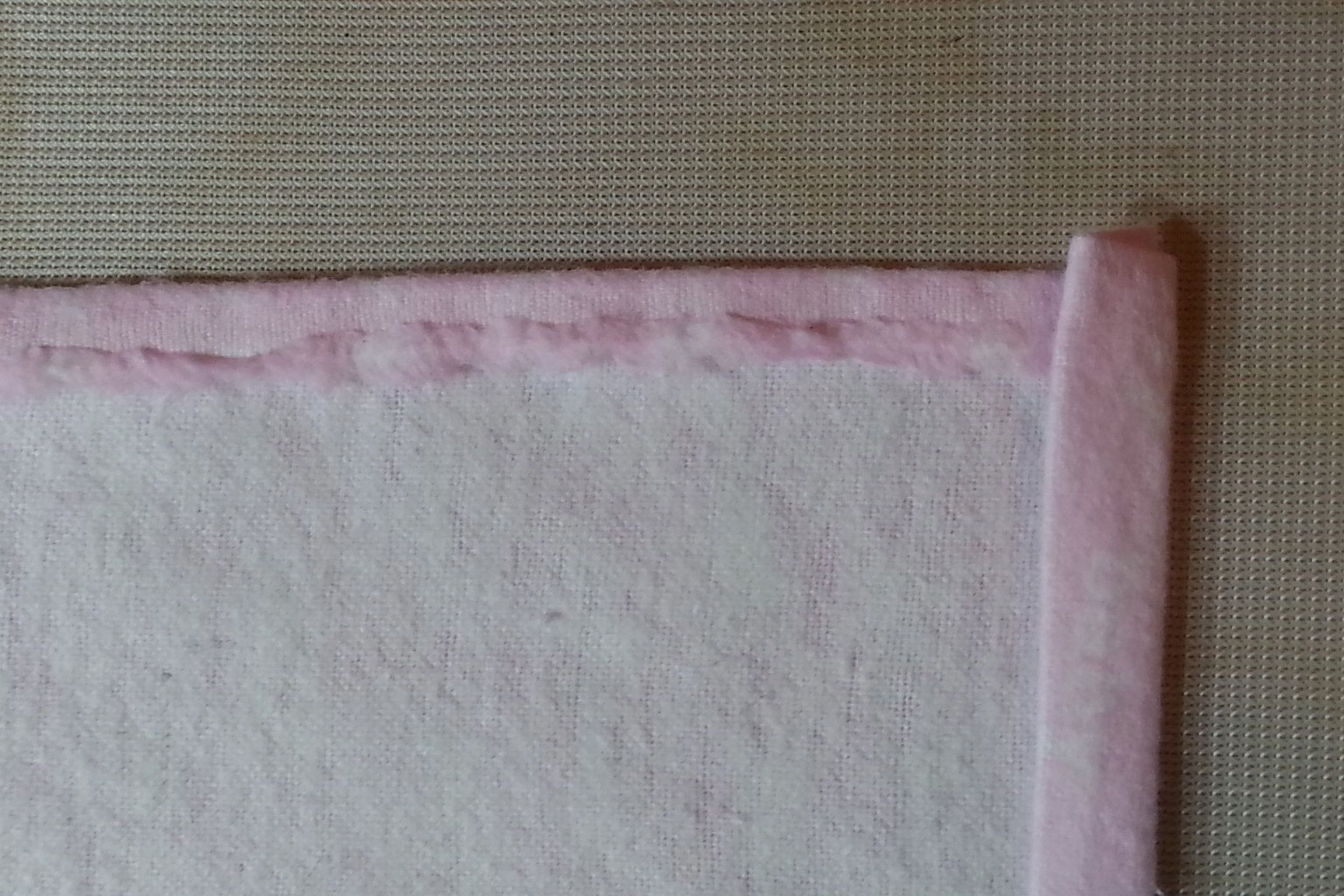
Pressed blanket hems; Selvedge at top; cross grain at right

Pressed blanket hems;
Selvedge at top; cross grain at right

Notice in the above photo how the cross grain hem extends beyond the adjoining edge.  This is due to a property of weaving that causes the cross grain to have more stretch/flexibility and the action of folding and pressing stretches the hem.  Not attractive and a sign of a BEGINNER; horrors!  Never fear, the next step is Corners, easy enough for a sewer with a learning permit.

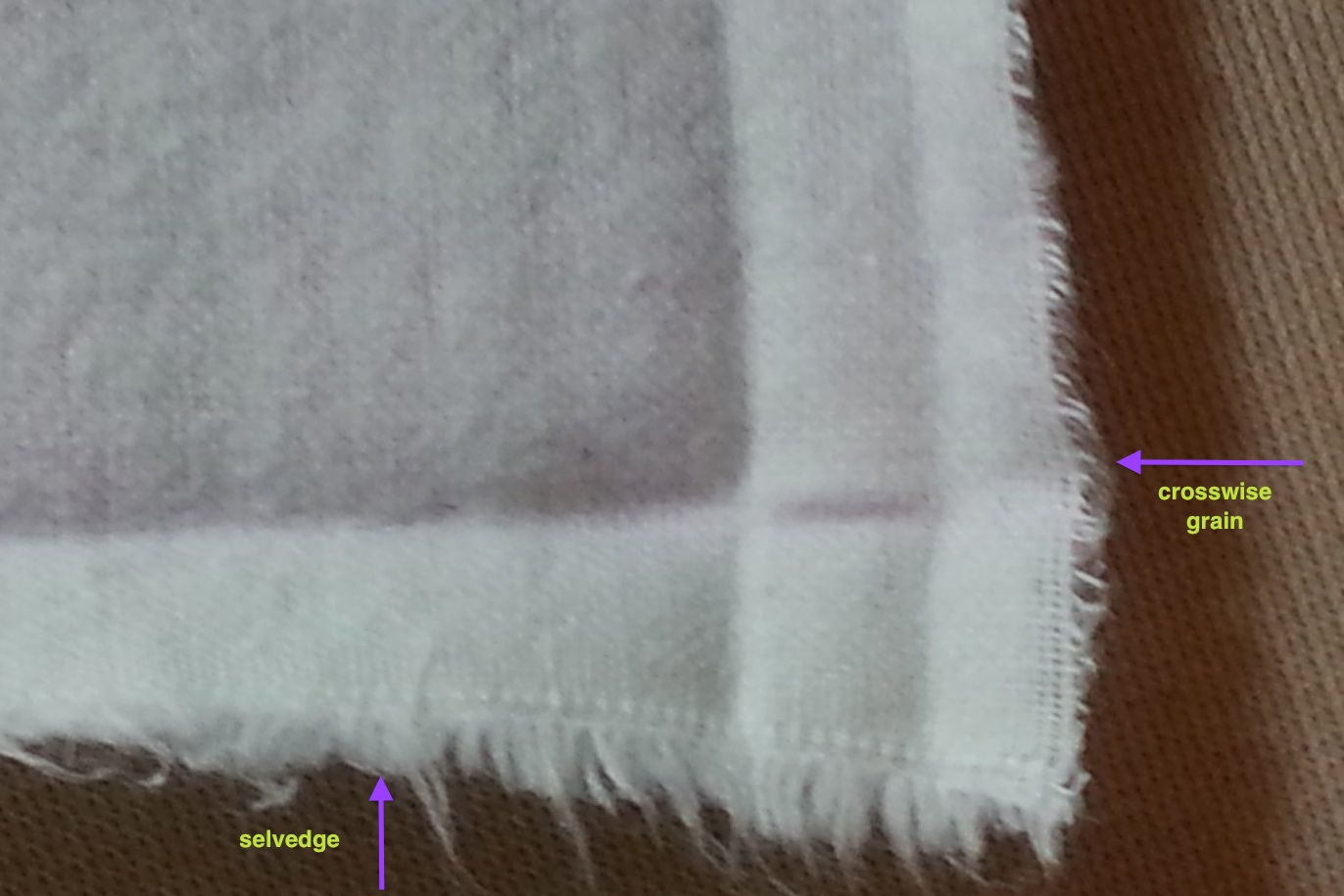
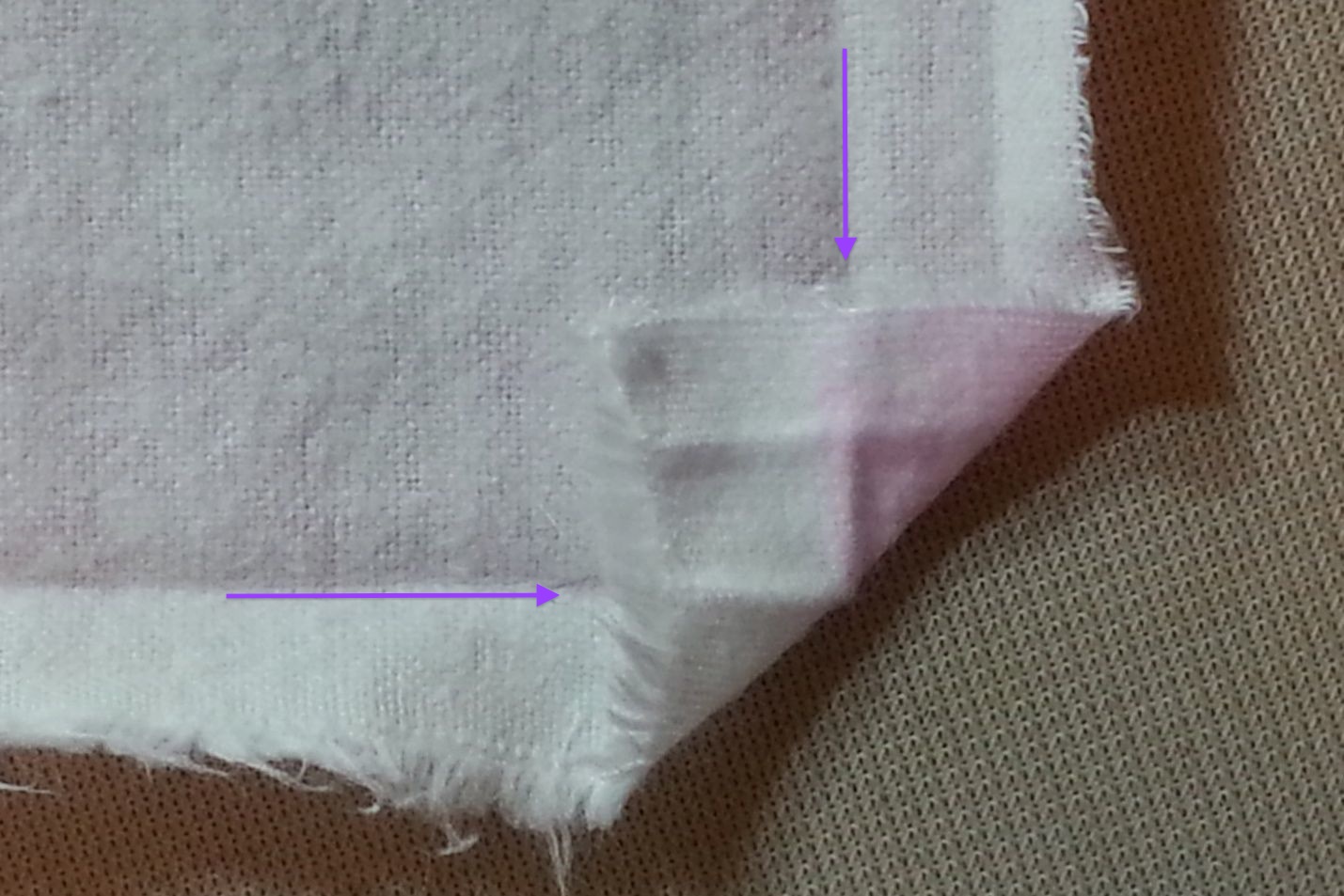
4.  Mitered Corners Step 1  Open out pressed hems at each corner.  Note the selvedge has fuzzy threads; not to worry, the selvedge will not ravel and it’s a perk for a soft, appealing texture for babies.  Also note how the corner is not a perfect 90 degrees due to the stretching of the grain.  The mitered corner will alleviate this problem.

Step 1 Mitered Corner

Step 1 Mitered Corner

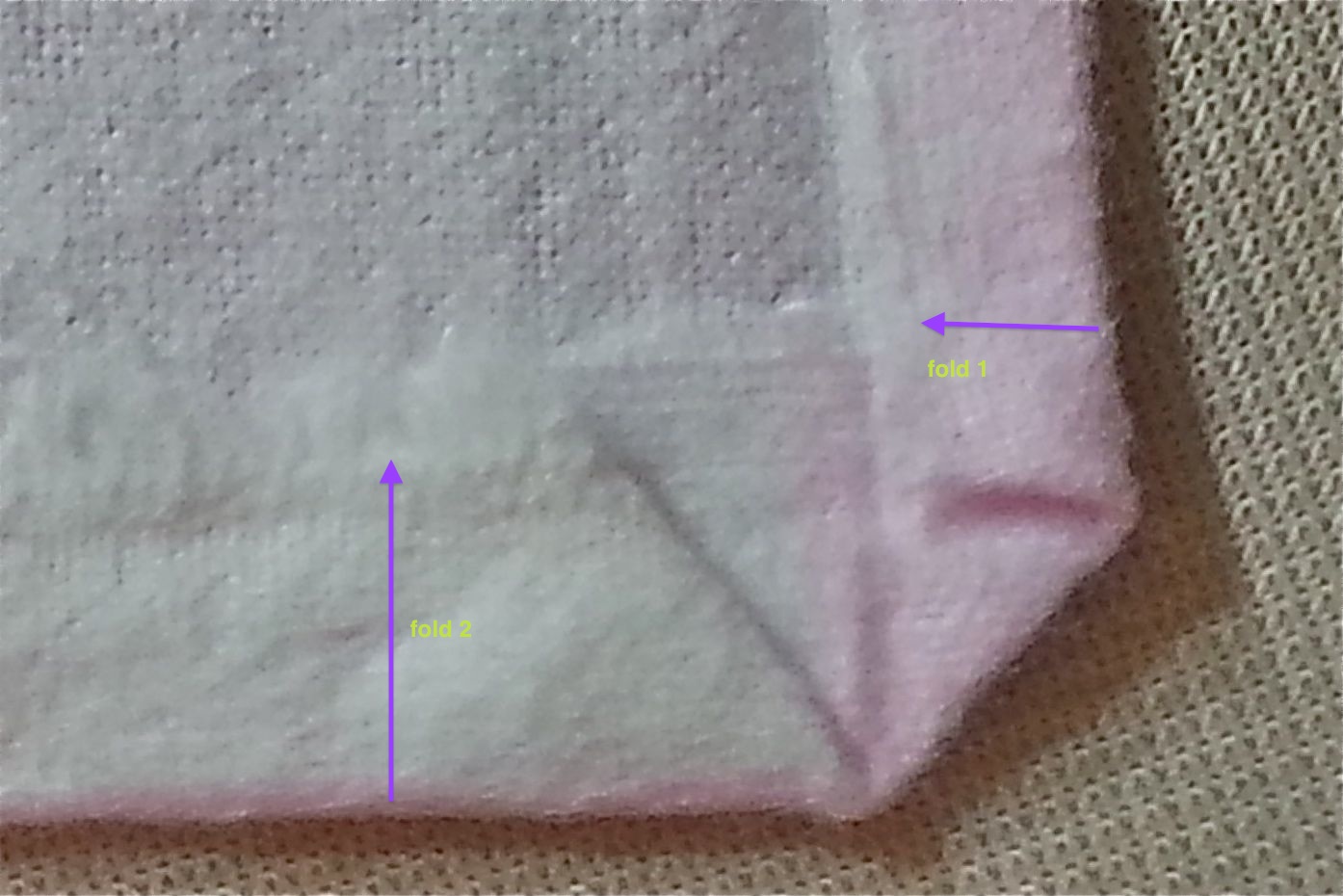
5.  Mitered Corners Step 2  Fold corner diagonally matching pressed lines (see arrows)

Step 2 Mitered Corner

Step 2 Mitered Corner

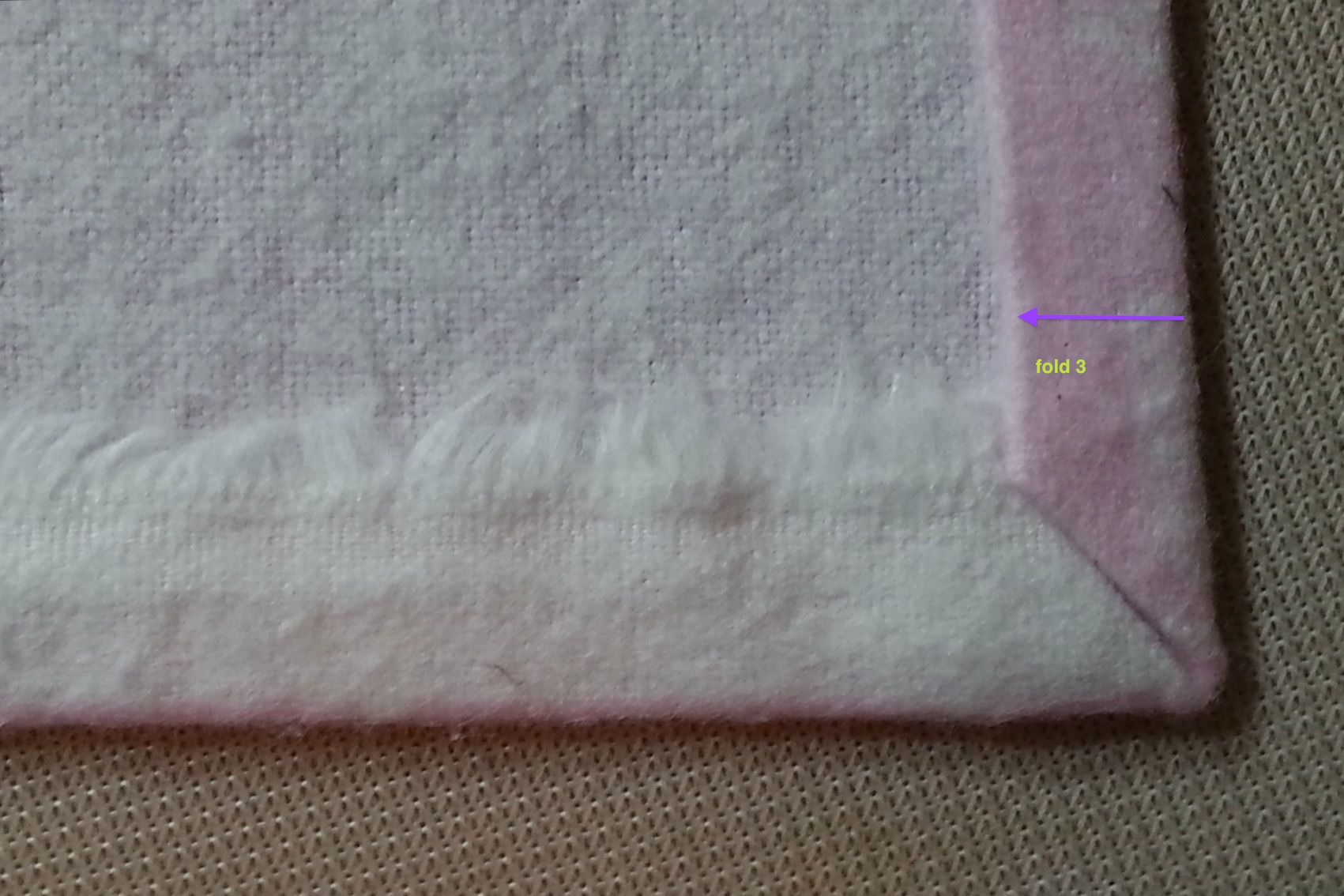
6.  Mitered Corners Step 3  Refold hems to original position forming point at corner.  Press and repeat on other corners.  Once you have done several mitered corners, you will be proficient enough to fold each corner while sewing the hem; stitch to within 3-4″ of the corner, fold and finger press the miter and continue stitching the hems in place.

Step 4 Mitered Corner

Step 3 Mitered Corner

Finished Mitered Corner

Finished Mitered Corner

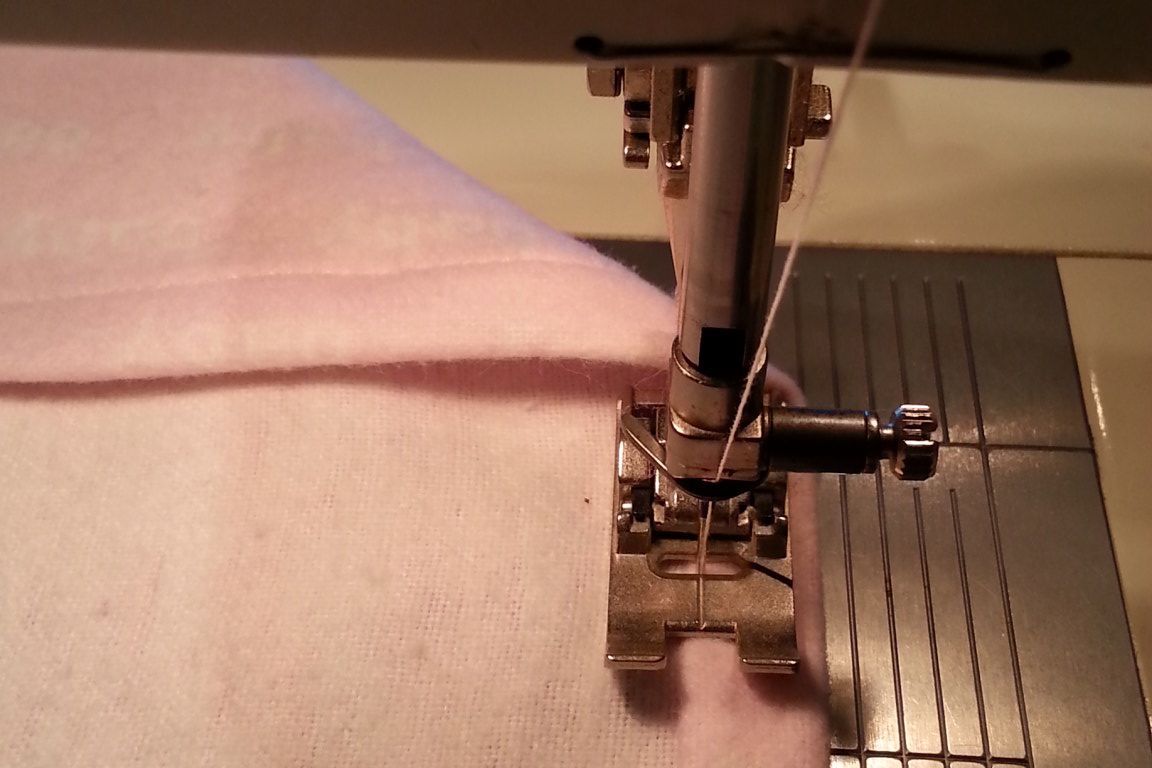
7.  Machine stitch hem from wrong side using the stitch guides on the pressure plate.

Tip:  even though the hems are carefully measured, just following the fold may not make for a nice straight stitch line from the right side.

Machine Stitch Hem

Machine Stitch Hem

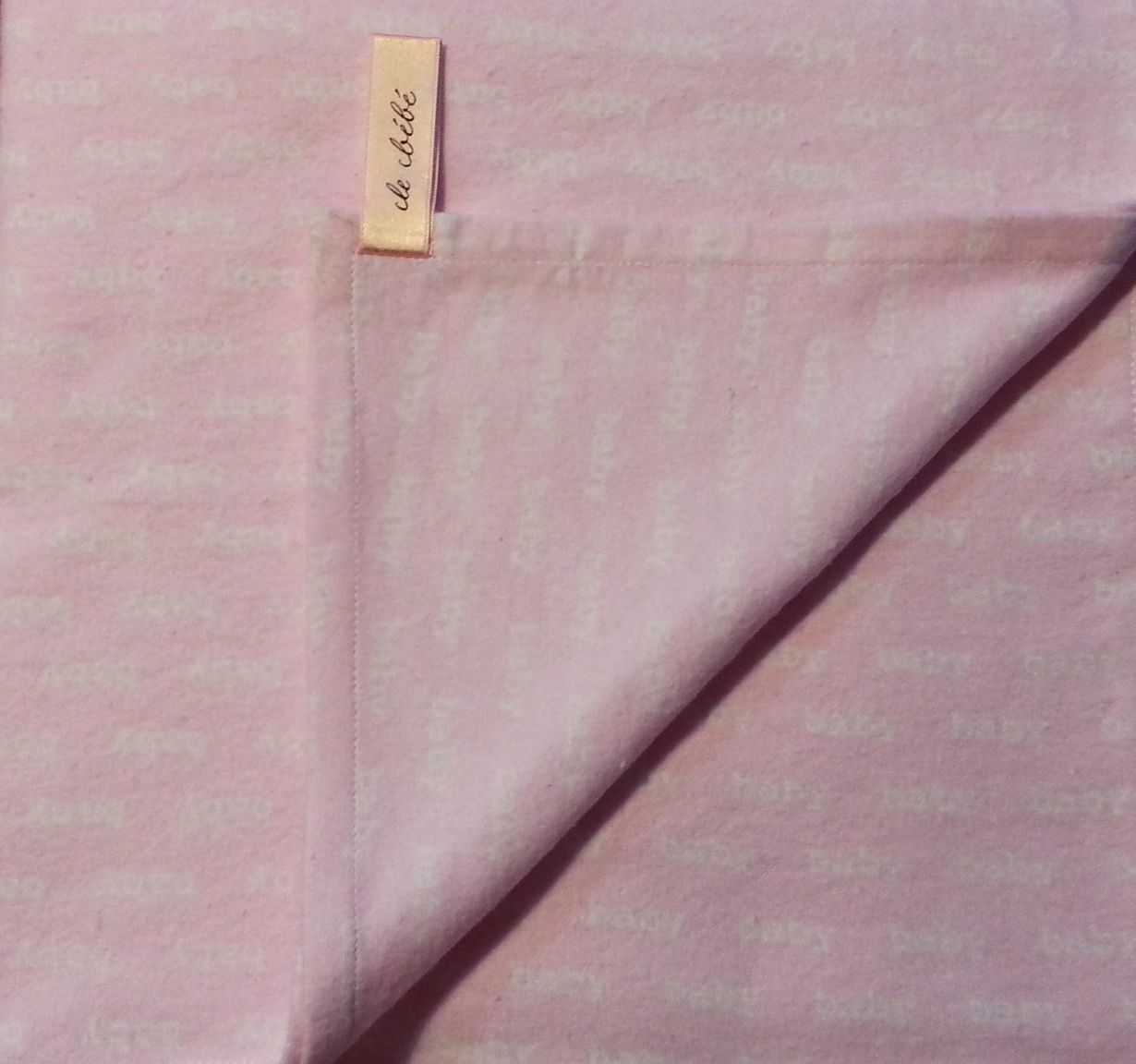
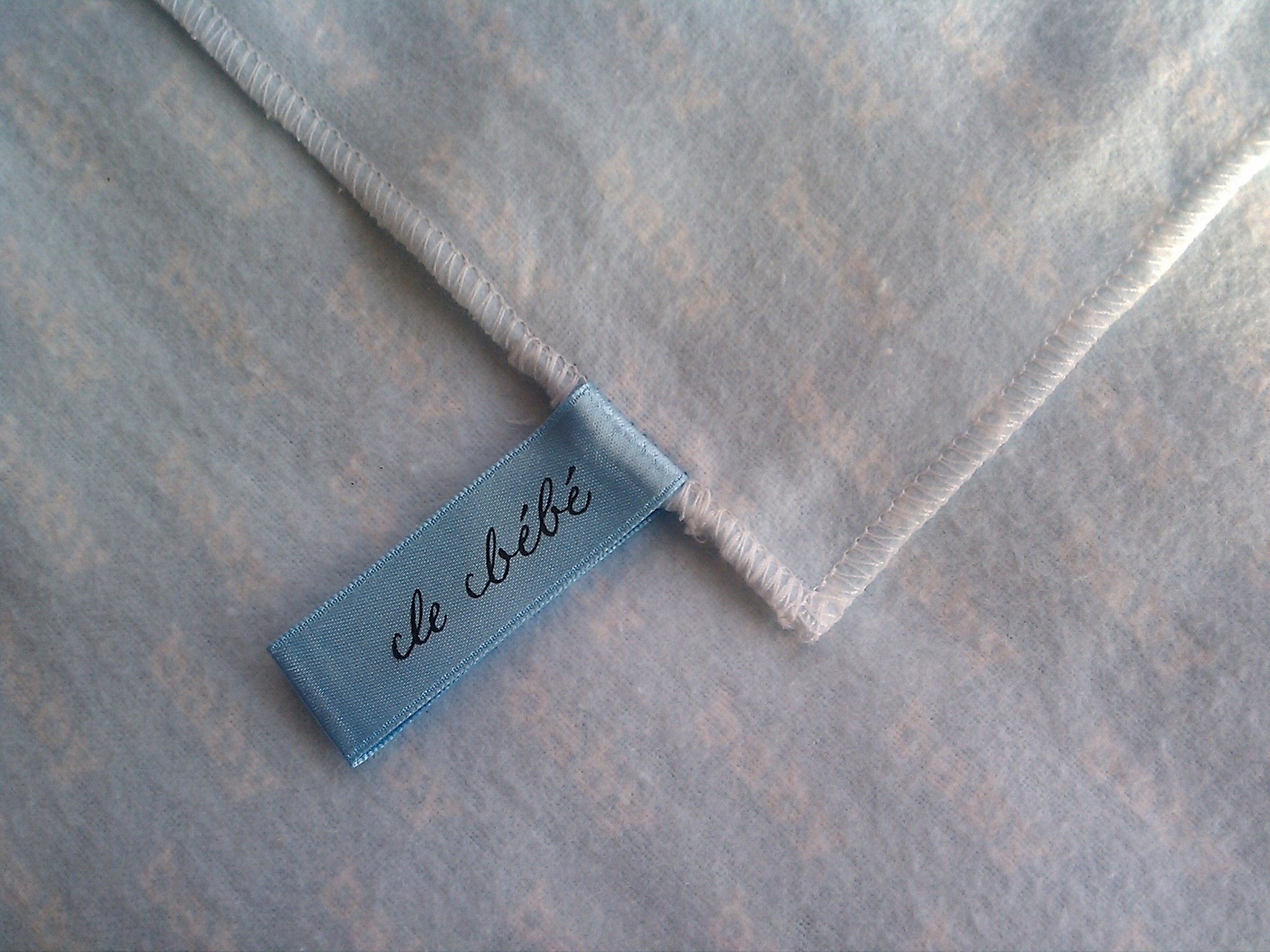
Now finish by sewing on one or more ribbon tags; babies/kids love the texture and the youngest baby will amaze you at how they search for a favorite.  Save tons of money by making the small square ‘blankies’ with multiple ribbon tags.  Good way to use up ribbon odds and ends too.

Ribbon tag

Ribbon tag

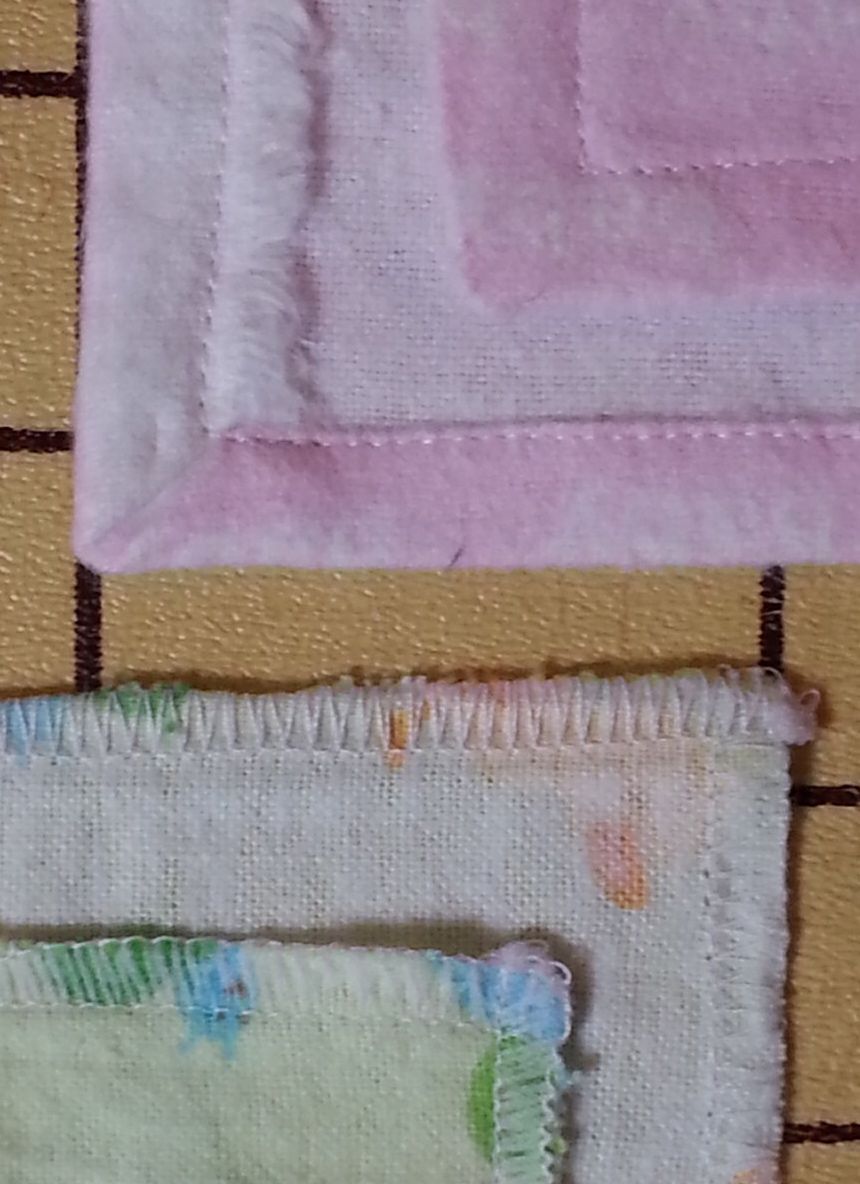
I used to just serge blanket edges as it is so quick and easy, but then decided it really looked ‘cheap’.  It may take a bit longer (this took me about 45 minutes, including time to set up and thread machine and clear off the ironing board) but, to me, a much more satisfying, professional result.  What do you think?

Hems--folded vs serged

Hems–folded vs serged


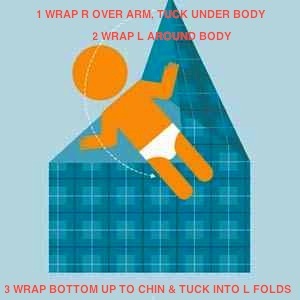
 A swaddle wrap graphic #

ss_Quick_Wrap_Fig2

Wrap a Swaddle Blanket

# Courtesy of Parents.com


*Final words:  Prewash is really an oxymoron as the prefix ‘pre’ means before.  So you are washing before washing??????  However, it is an accepted term in the sewing world and just means to wash away manufacturing residue and preshrink (there’s that oxymoron again why not just shrink something; oh well…) the fabric.  Fabrics will shrink during laundry, especially cotton fabrics.  This is why I recommend buying extra fabric to make 2-44-45″ X 44-45″ blankets.

**Here’s the math:

  • 1.25 yds of 45″ wide fabric is needed to make a square 45″ blanket.
  • Twice 1.25 = 2.5 + .25 = 2.75 yds; the extra .25 yd is shrinkage allowance

Hems will decrease the actual size but the result is a nearly square blanket; I don’t get hung up on whether the completed blanket is 44″ X 44″ or 44.5″ X 44″, or…And, neither should you.

Related Links

How to Sew Mitered Corners–several techniques.                                                                    While on the website, sign up for the weekly sewing tips:    http://www.coletterie.com


baby baby baby baby baby

baby baby baby baby baby

Posted in FIBER FASHION FUN | Tagged , , , , , , , , | Leave a comment

Making Seed Tape

Remember seeing a Pinterest DIY on seed tape and having used the retail seed tape, know it is one of the myriad ‘greatest thing since sliced bread’!   Unfortunately, seed tape is not available in a lot of seed varieties and it is expensive.  Also, you need to plan ahead if you will be buying it, as it needs to be ordered–have never seen it in a retail store.

After months of Winter (through April) and a cold, wet May, it is now Summer and planting needs to be done like Right Now!  Had the seeds (bought on an optimistic March day) and with a vague recollection of the Pin, set to work.

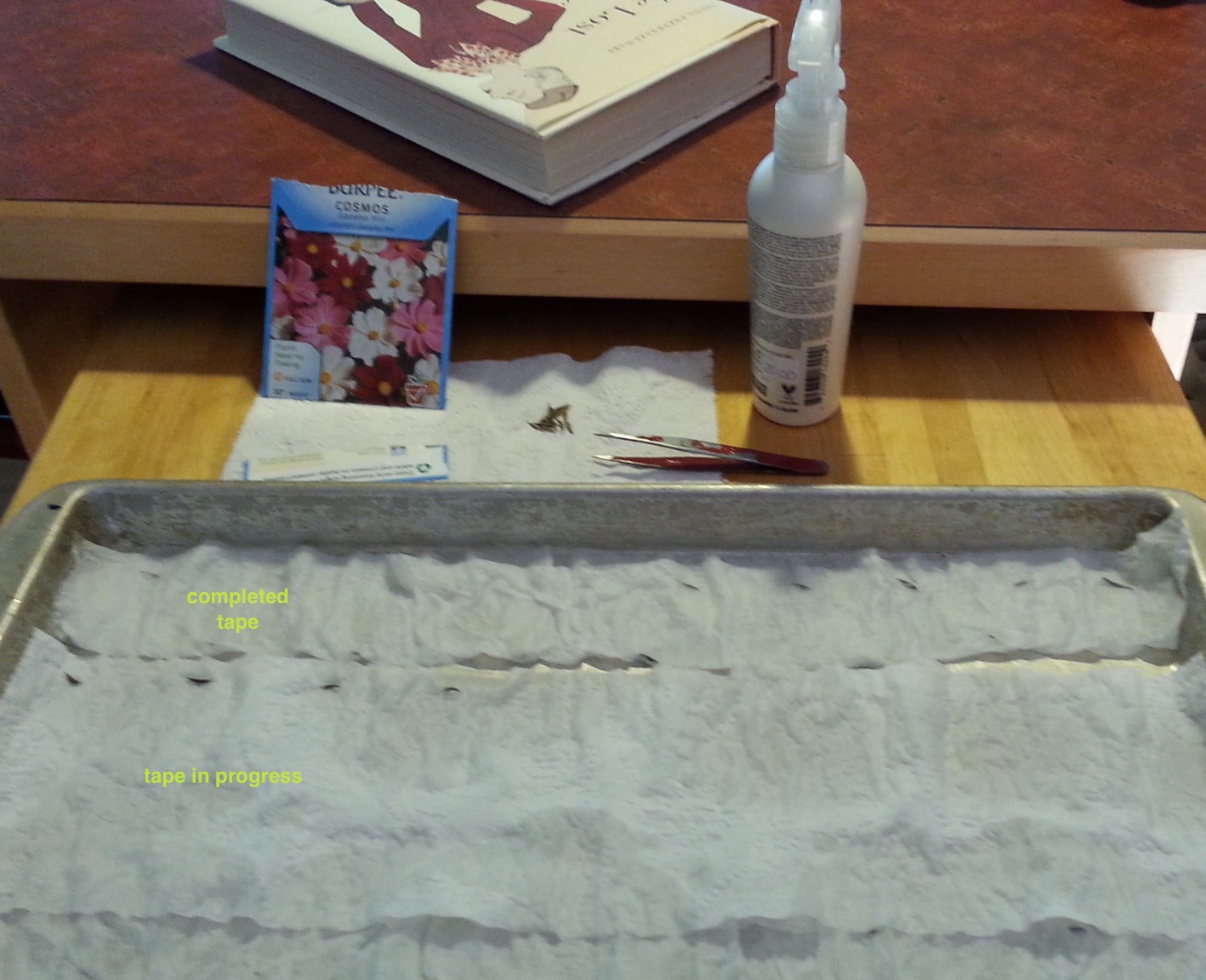
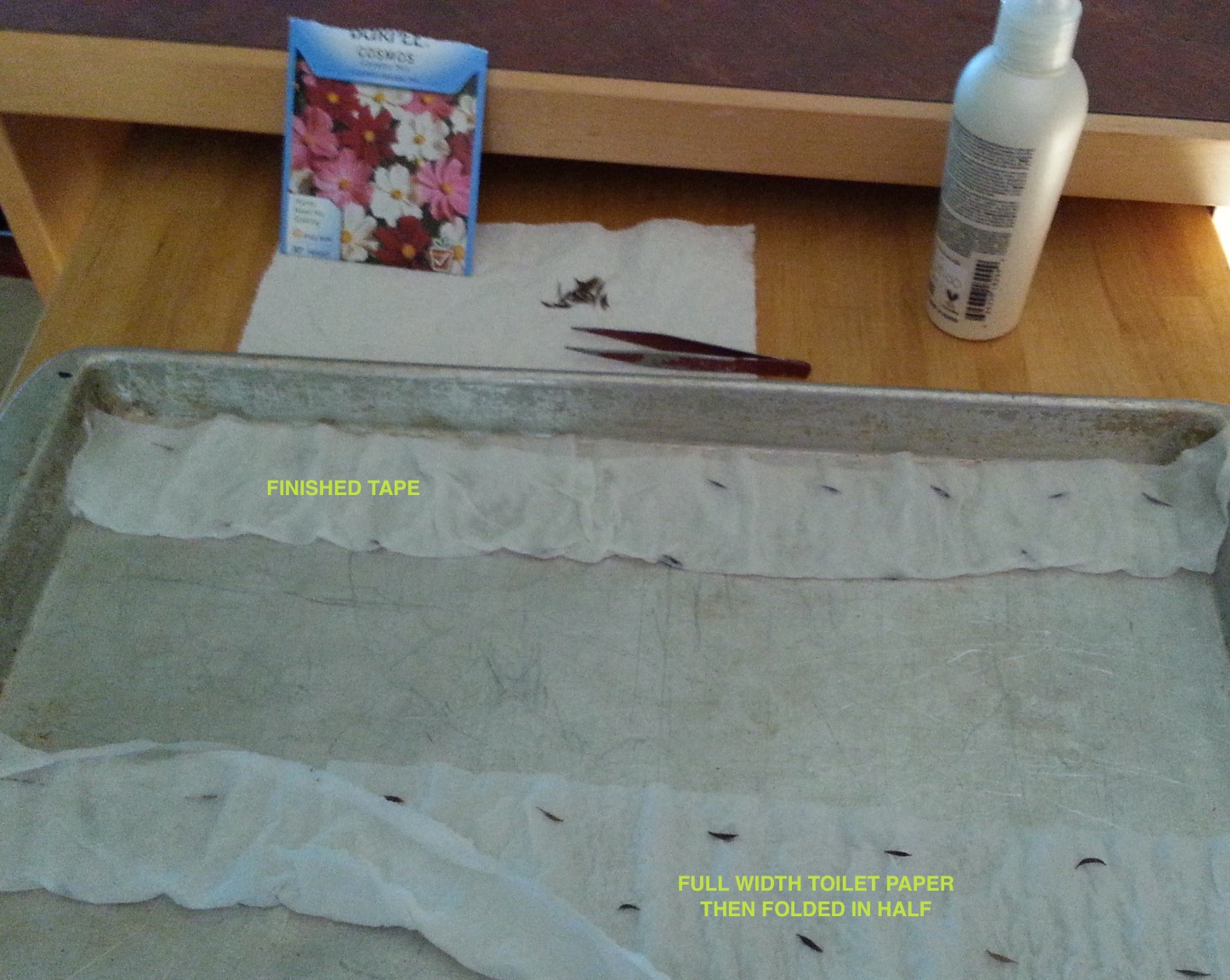
DIY SEED TAPE

DIY SEED TAPE

DIY SEED TAPE IN-PROGRESS

DIY SEED TAPE IN-PROGRESS

These are the tools/equipment I used:

  • large flat pan
  • spray bottle filled with water
  • tweezer
  • toilet paper

Procedure:

  • place toilet paper in pan and spray with water
  • place seeds on paper, spacing according to packet directions, on half the paper
  • fold paper over seed and spray again.
  • allow to dry

Once dry, use at once or store in a moisture-proof container.  This is where a reuse of the silicon pouches found in purchased items makes sense, as wet tape will allow the seeds to sprout, and eventually  mildew–not pretty, and all that hard work for naught.

When I was done, I looked up the Pin and found I had the basic premise correct but hadn’t used the flour paste, nor measured, marked, cut, etc.  The measuring and marking is, in my opinion, overkill as the sewist I am can automatically gauge inches, even the standard 5/8″ seam allowance (have checked my ‘eyeballing’ ability and it is amazingly accurate; bet any sewist has developed this ability).

That being said, the flour paste may be a good idea if storing the seed tape.  Am thinking the paste may protect from inadvertent moisture/sprouting.

Am off to the garden to plant the seed tape; tear apart on the toilet paper perforations or cut in sizes to fit your planting space.  Check my Facebook page for updates.

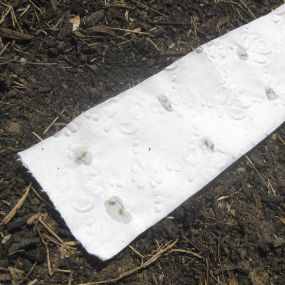
Here is the link to the blog the Pin is based on if you would like the excellent original instructions.

IMG_9448_sm2_lg

http://www.vegetablegardener.com/item/14221/make-your-own-seed-tape


Posted in GREAT IDEA | Tagged , , , , | Leave a comment

Issey Miyake Part I

Every Spring I sort through my clothes for donate and consign candidates.  The Spring Cleaning coordinates well with Herberger’s Goodwill Sale (Herberger’s is a Midwest department store under the Bon-Ton umbrella) as every donation garners a 20% coupon for the Spring sale event.  After many years of doing this, I can report that the clothes collection is finally down to a manageable size; manageable is defined as ‘fits in all closets and drawers with nothing in tubs on highest shelf in garage’.

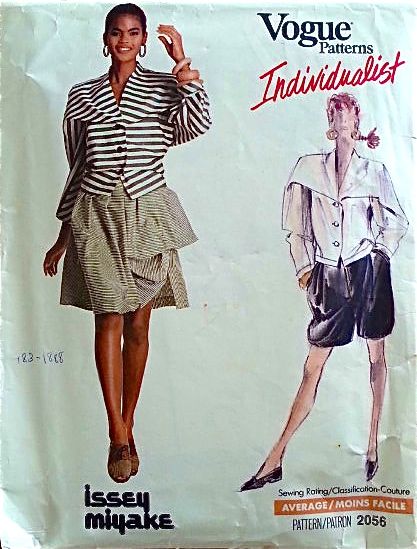
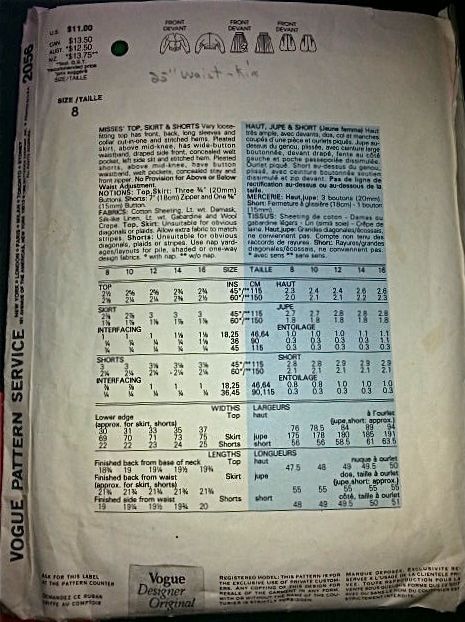
This year I rediscovered three Issey Miyake blouses made from V2056.  V2056 is from 1984/1985, one of the first Miyake patterns.  In 1984, Vogue launched ‘Individualist’ patterns and Issey Miyake was a part of this designer group.  I was immediately taken with the Issey designs and have a large selection.  The Individualist patterns are now highly prized and sold on Etsy, eBay, vintage patterns sites, etc.  Googling ‘Issey Miyake Vogue Patterns‘ brings up images of all the patterns mixed in with Issey’s couture and RTW.

Another site is Miyake Maniacs with photos of all Miyake Vogue patterns published through 2000.  Unfortunately, the site is inundated with pop-ups and the promised ability to access pattern number and date is not available.

V

V2056

V2056 ENVELOPE BACK

V2056 ENVELOPE BACK

The first version was made in 1985 for my daughter–see the 25″ waist note above; not quite Scarlet O’Hara measurement but more reasonable and no corset enhancement!  The dressform doesn’t even have that small a waist circumference so the bottom button is open on photo below.   Another note about the dressform:  the shoulders are broad but this pattern and 1985 is suitable for shoulder pads.  In fact, the lamé blouse does have soft shoulder pads.

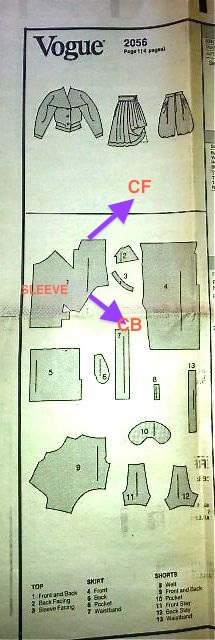
V2056 PATTERN SHAPES

V2056 PATTERN SHAPES

The blouse only has three pieces; cut two of #1.  CF has attached facing and is on crossgrain; CB is on bias hence the interesting back view.  Have no clue how/if this could be altered; I avoided the issue by buying two patterns in needed sizes.

The other pattern pieces are for the skirt and shorts.  Made the skirt out of a Leiter’s Designer Fabric (out of business) with a woven-in plaid (sorry, garment no longer available); worked well even though plaids are not recommended.

The shorts pattern is back in style and reminds me of Peter Pilott0 2014 collection, especially some shorts from the Target collection.

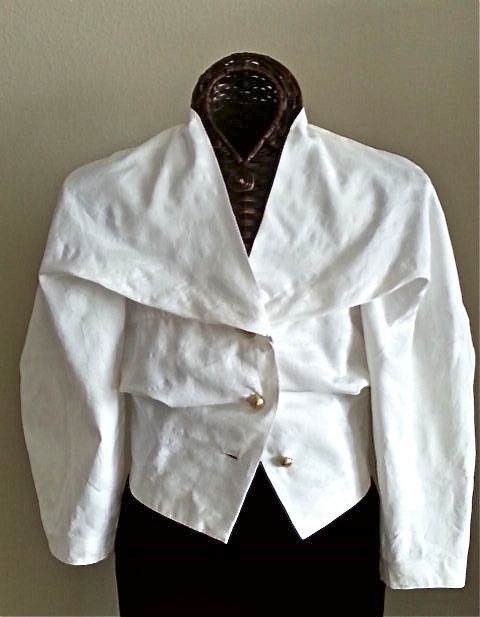
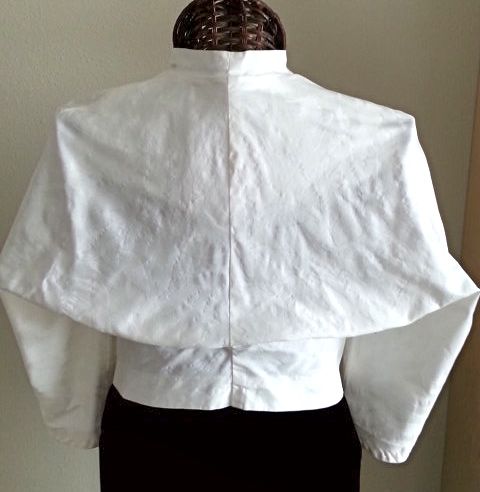
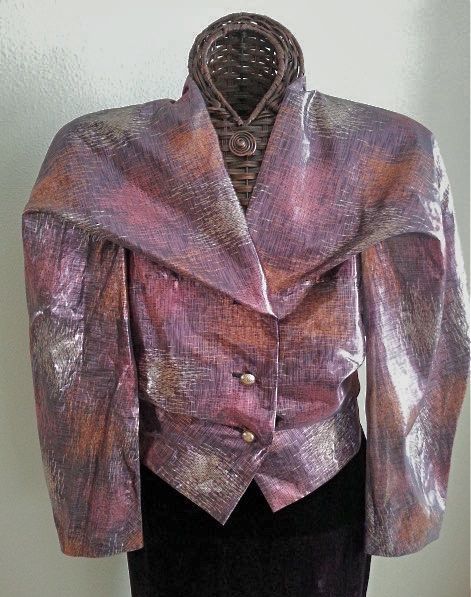
V2056 Cotton Damask

V2056 Cotton Damask

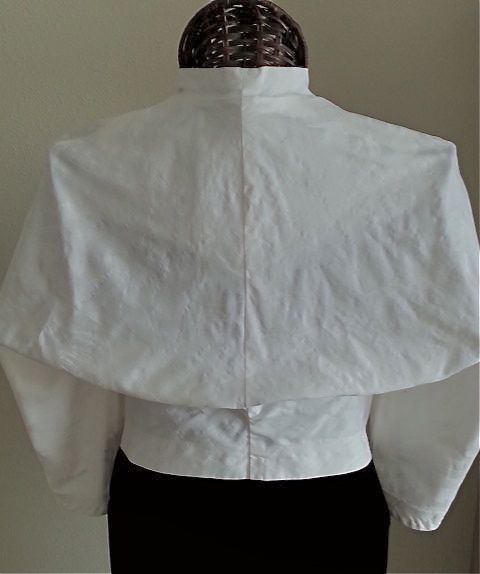
V2056 Cotton Damask Back

V2056 Cotton Damask Back

V2056 Cotton Damask Back

V2056 Cotton Damask Back


The blouse above is a hefty cotton damask, also from Leiter’s Designer Fabrics.  Unfortunately, photographing it is a challenge above and beyond my limited editing skills.  It looks like a wrinkled mess but, trust me, it looks just fine in real time.  Due to the complicated construction, this is a difficult piece to iron.

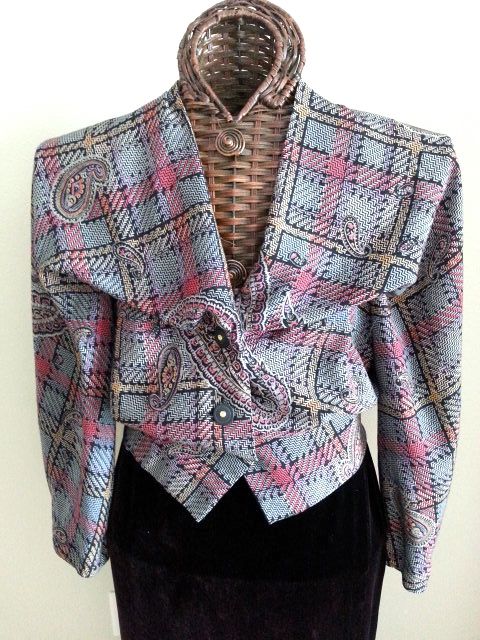
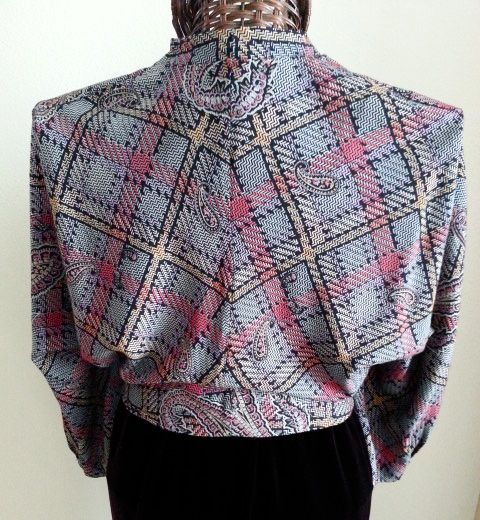
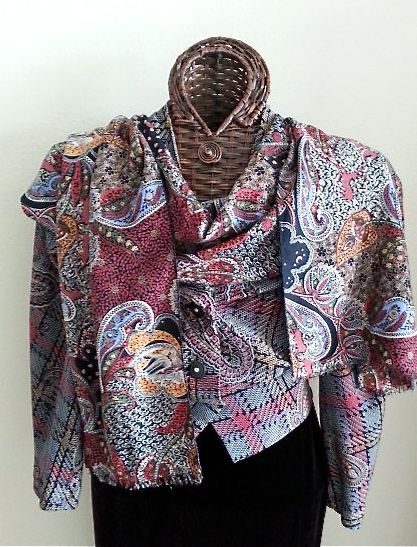
The next version was made for myself out of a rayon challis with a coordinating print as a scarf.  Here you can see the interesting bias centerback.  The challis drapes beautifully and can even be worn under a loose jacket.  Please be amazed at the matched paisley motif at CB neck; I know I am!

V2056 Rayon Challis

V2056 Rayon Challis

V2056 Rayon Challis Back View

V2056 Rayon Challis Back View

V2056 with coordinating scarf

V2056 with coordinating scarf

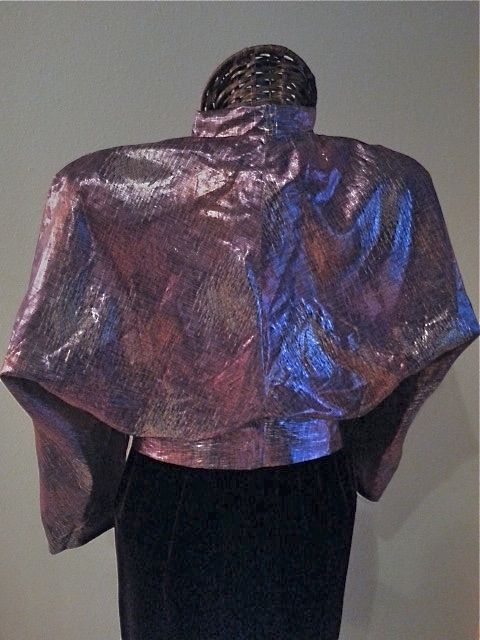
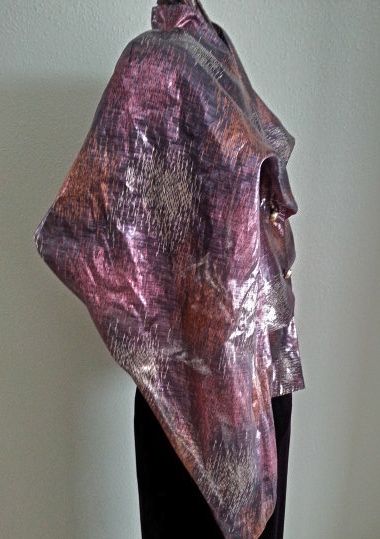
The final version is in a lamé that is quite crisp but also works well.

V2056 Lamé

V2056 Lamé

V2056 Lamé Back

V2056 Lamé Back

V2056 Lamé Side

V2056 Lamé Side

A fashion note:  the full sleeves disguise a sway back (which I have) and the high-hip length does not emphasize a full-hip figure.

Now that I review this pattern, believe I have a knit in my stash that would work beautifully.

Would like to hear from other “Miyake Maniacs”, especially if you have sewn this particular pattern.


Related Sites:

The Concepts and Work of Issey Miyake

Vintage Fashion Guild

Hello Miyake Maniacs


Posted in FIBER FASHION FUN | Tagged , , , , , , | 1 Comment

Honey Bon-Bons in St Paul

An April weekend in St. Paul, MN, has been an annual event for the past 20 + years,  ever since the American Craft Council moved a craft show to the River Centre in St. Paul.

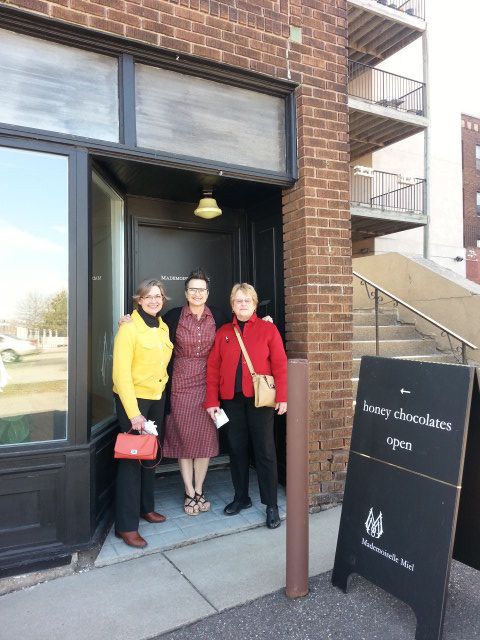
For the first time, a stay at the St. Paul Hotel kept us downtown for the entire weekend so we had time to explore more than just the ACC Show.  Google turned up Cathedral of St Paul and Minnesota History Center.  But we were interested in shopping–something within walking distance of the hotel.  This led us to Mademoiselle Miel at 342 Kellogg Boulevard W., the kitchen/workroom for very delectable honey chocolates.

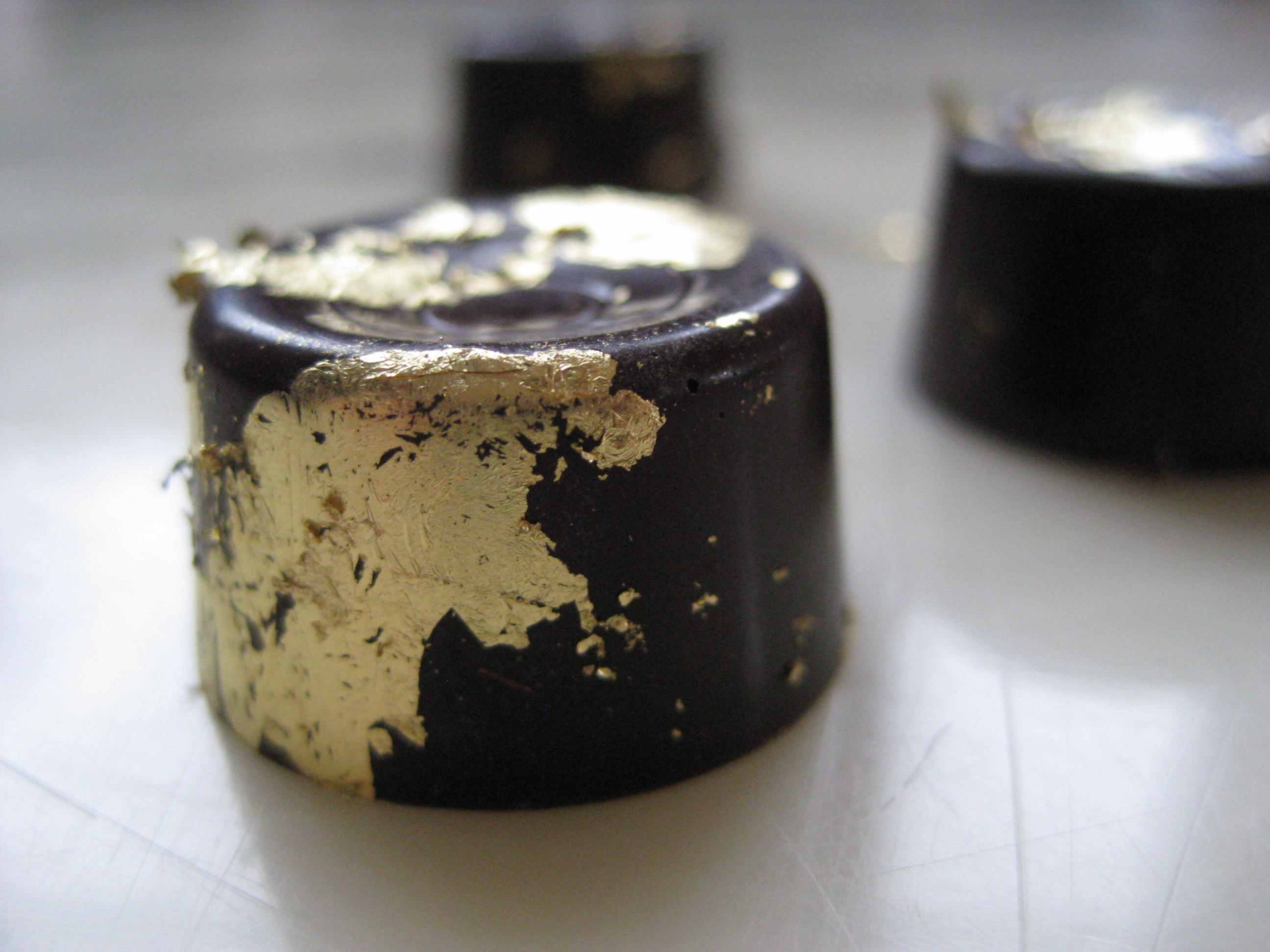
Honey BonBons with 23k edible gold leaf

Honey BonBons with 23k edible gold leaf

The honey is gathered from hives located on rooftops all over St Paul from bees who collect nectar from parks and flower pots around the city.

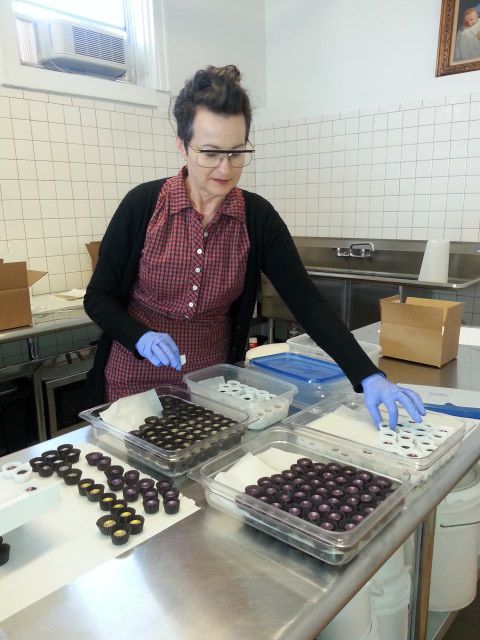
In the kitchen, the honey is transformed into a creamy filling and covered with Italian chocolate and edible gold leaf–very elegant.  There are several fruit and herb flavors but the most popular are honey and the smoked honey with Laphroaig scotch–perfect finish to any meal.

The bon-bons are available at several retail stores throughout the Twin Cities.  However,  a visit to the workroom is where you will meet the delightful Mademoiselle Miel and sample the honey products. You will be charmed and entertained by Mademoiselle Miel (she is from WI) and learn from this beekeeper and chocolatier.

Welcomed by Mademoiselle Miel

Welcomed by Mademoiselle Miel


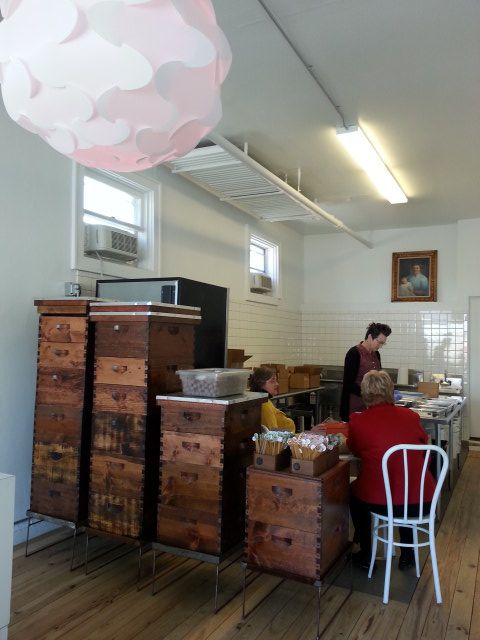
Workroom

Workroom


Mademoiselle Miel

Mademoiselle Miel

The workroom at 342 Kellogg Blvd W is open only on Friday’s from 3:00 – 9:00 PM.  It is on the right side of Kellogg when heading East into downtown St. Paul.  The closest parking is up the hill in The Cathedral parking lot, or call ahead for a parking pass.

If you park at the Cathedral, be sure to tour this crown jewel in the St. Paul skyline.

The Cathedral

The Cathedral


St Paul skyline from The Cathedral

St Paul skyline from The Cathedral

Posted in OUT AND ABOUT | Tagged , , , , , | Leave a comment