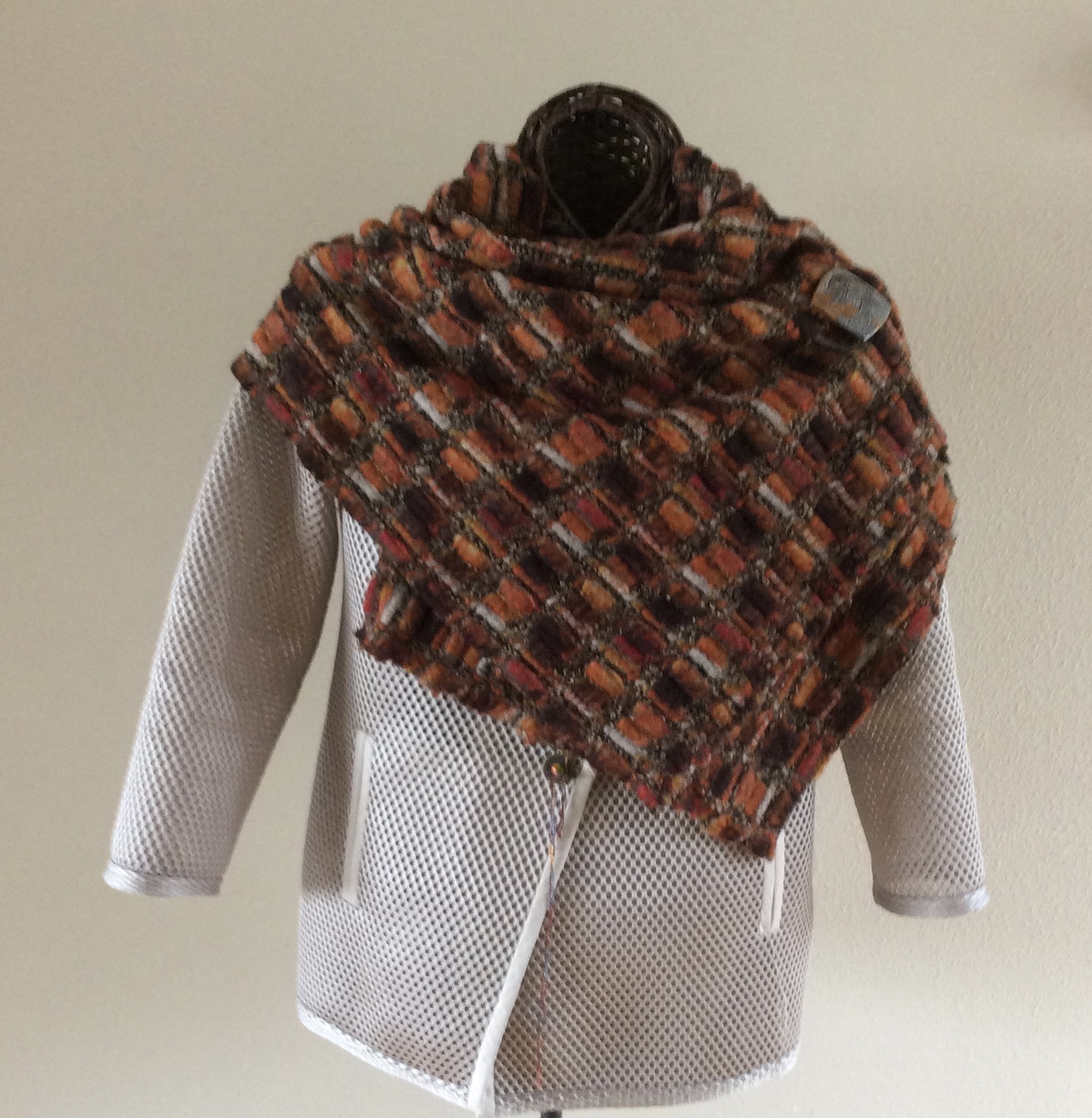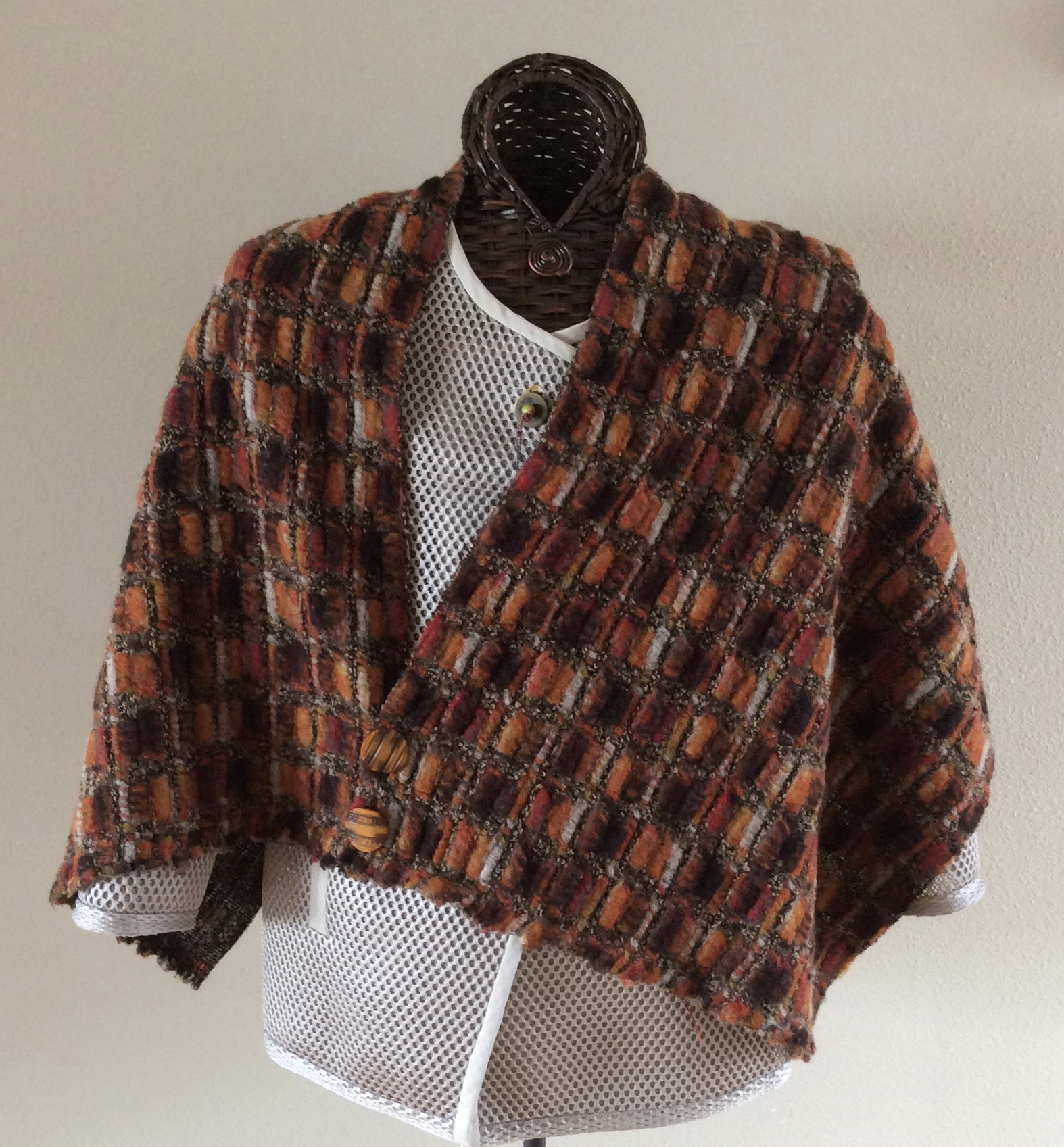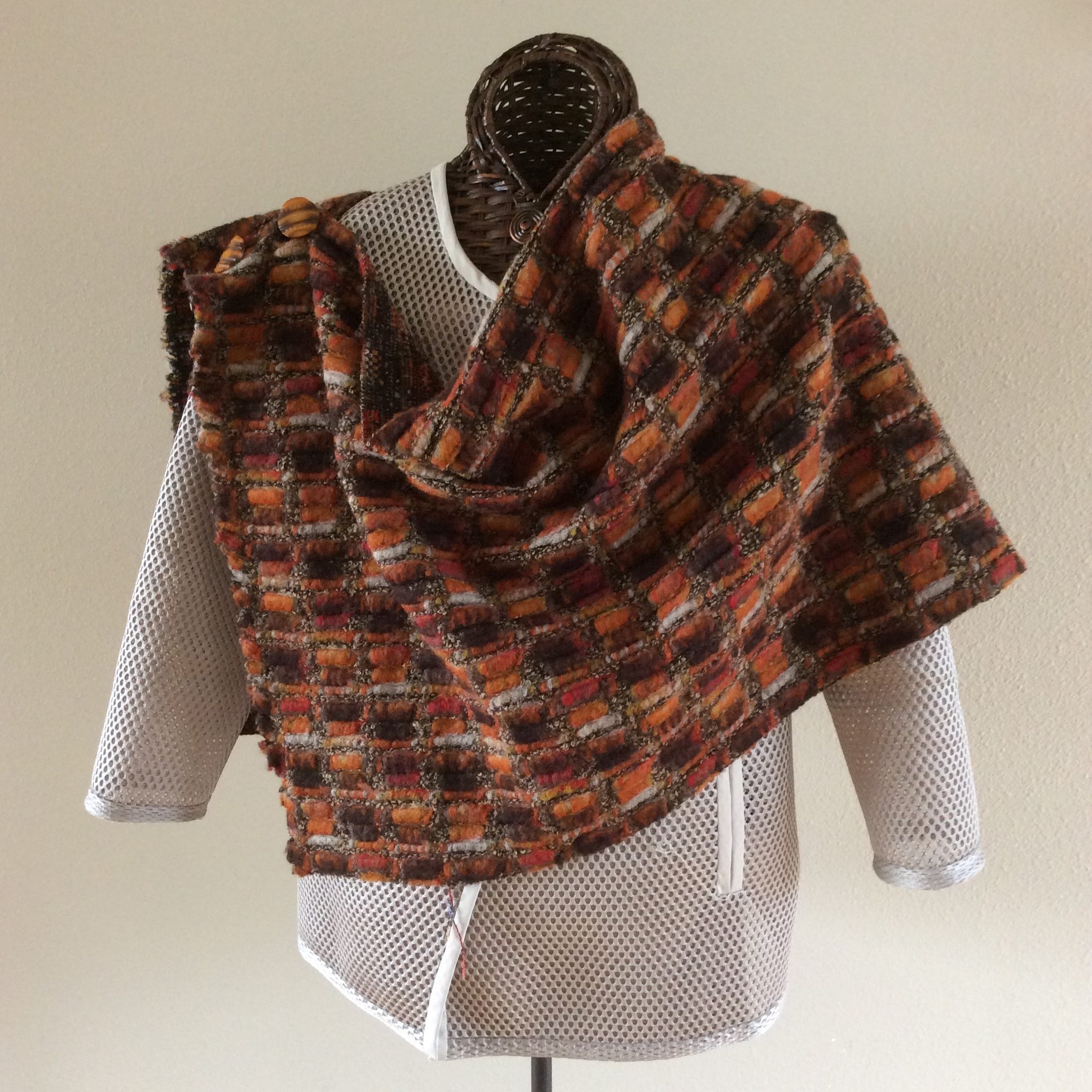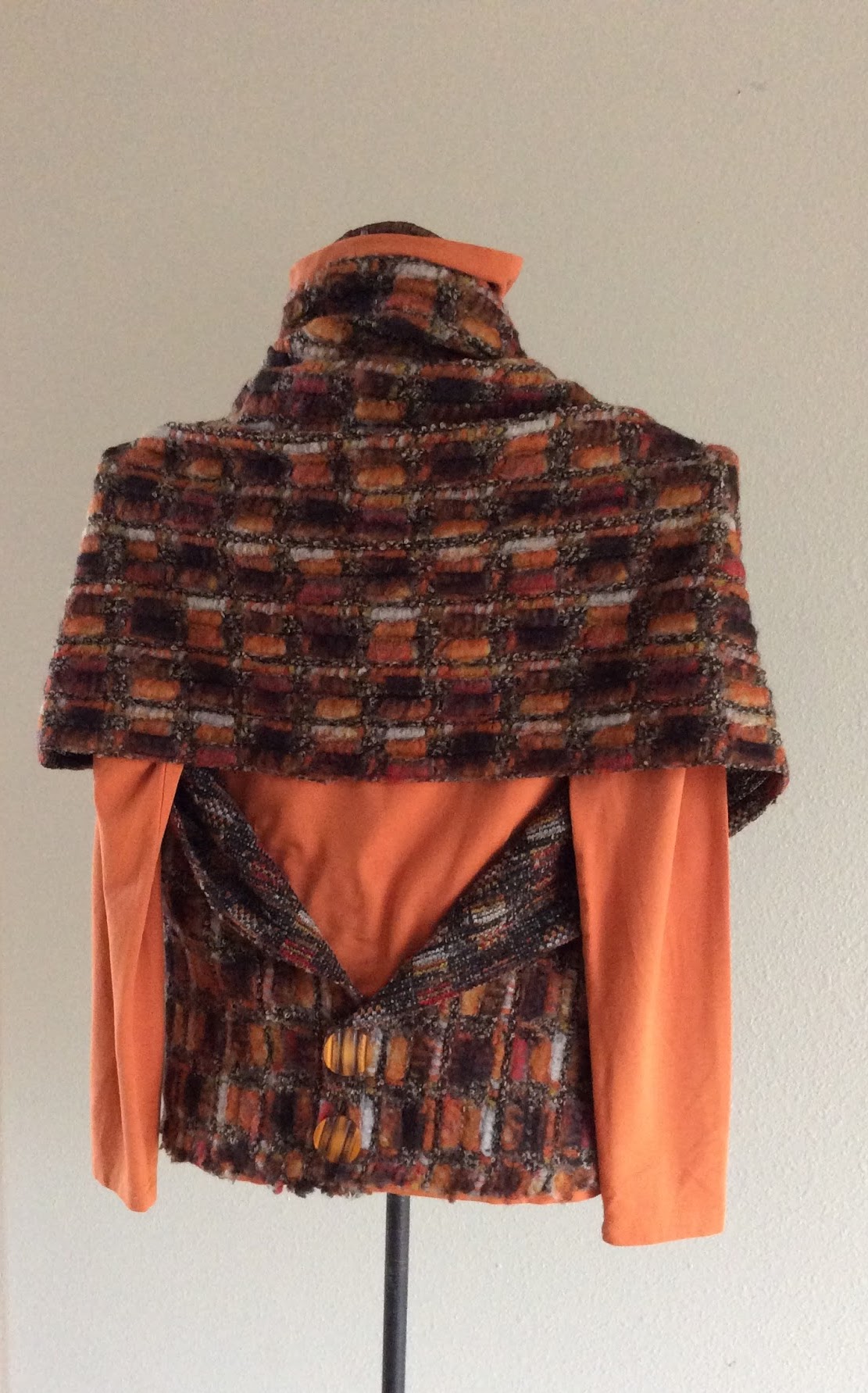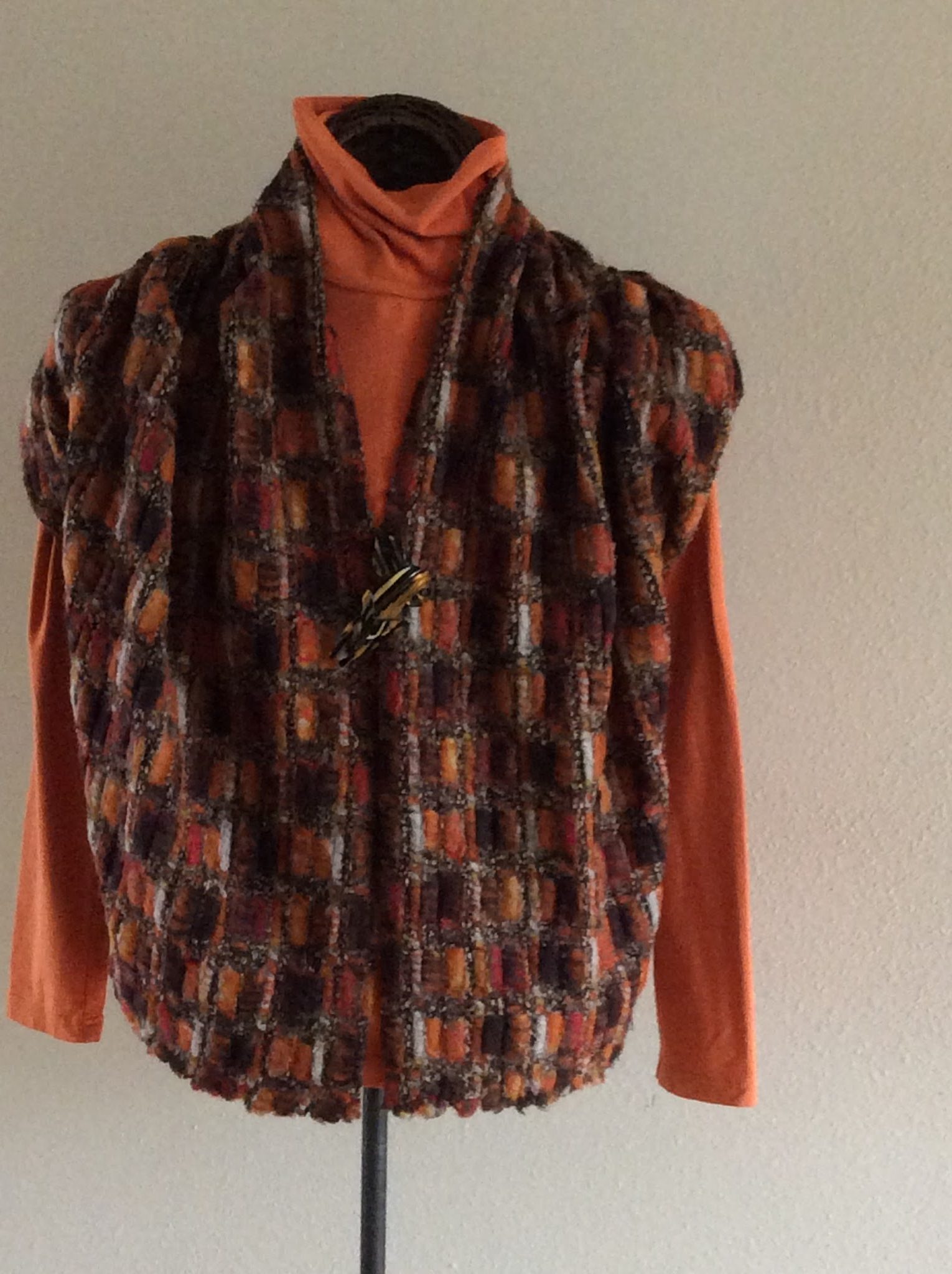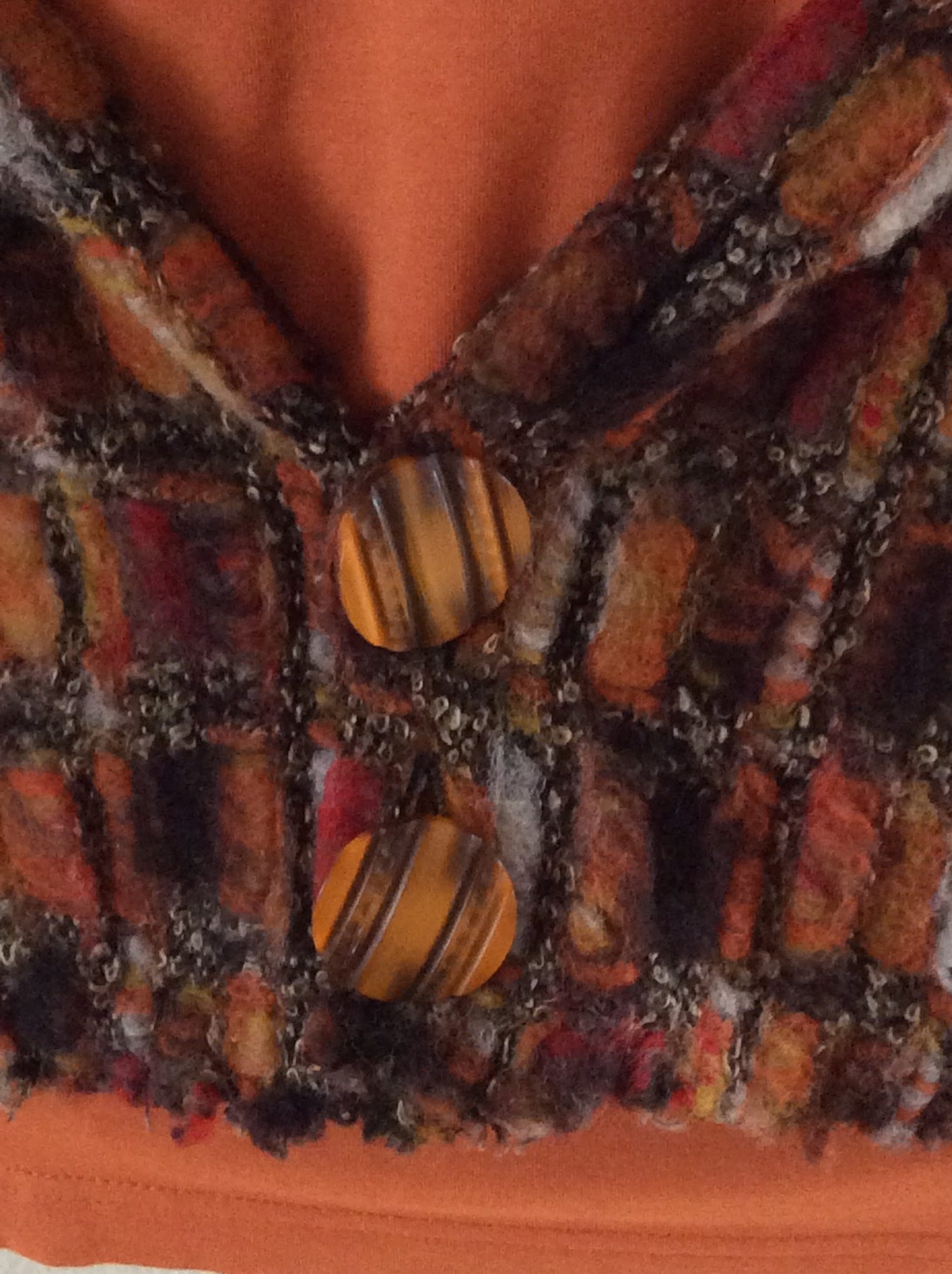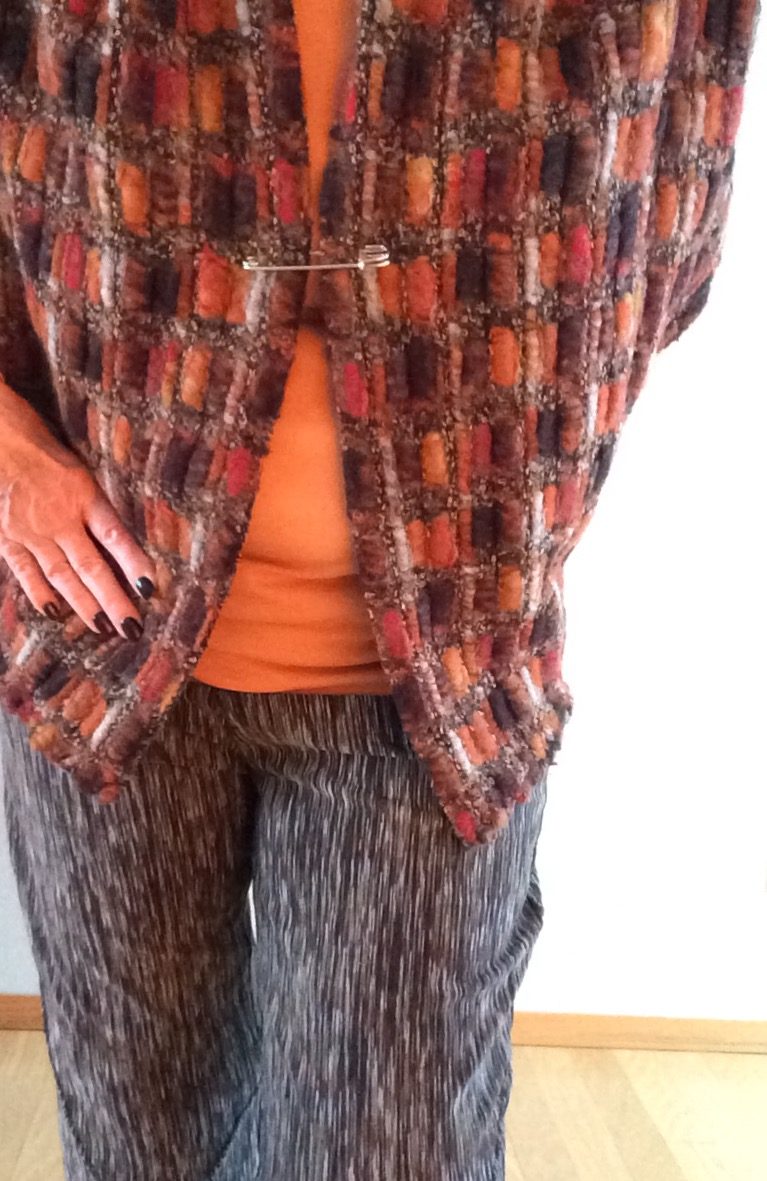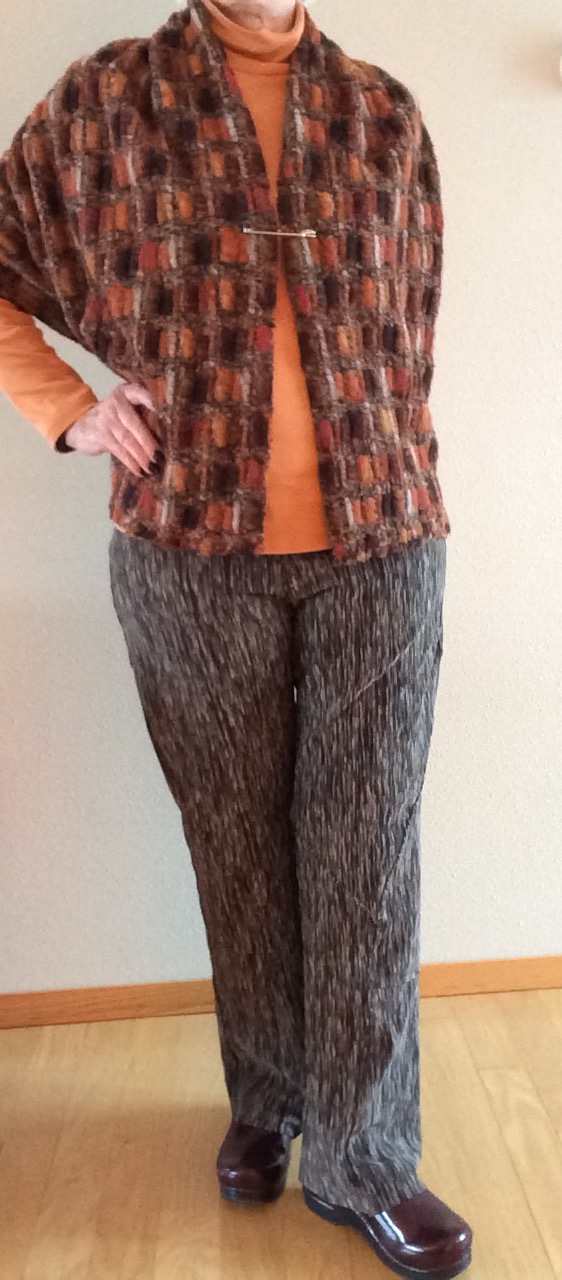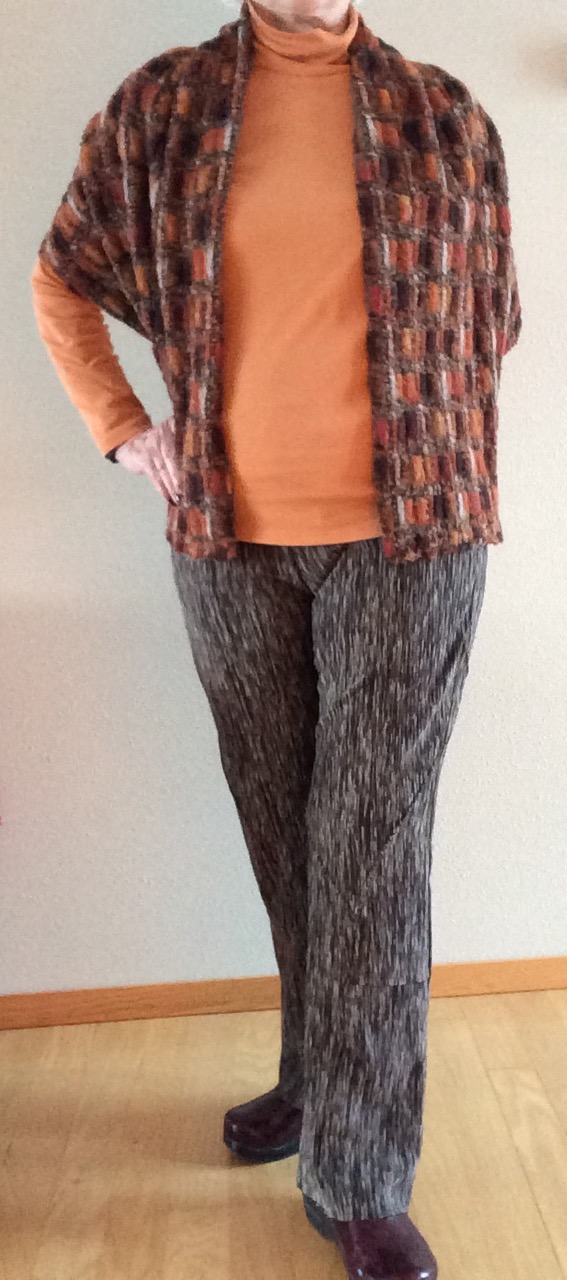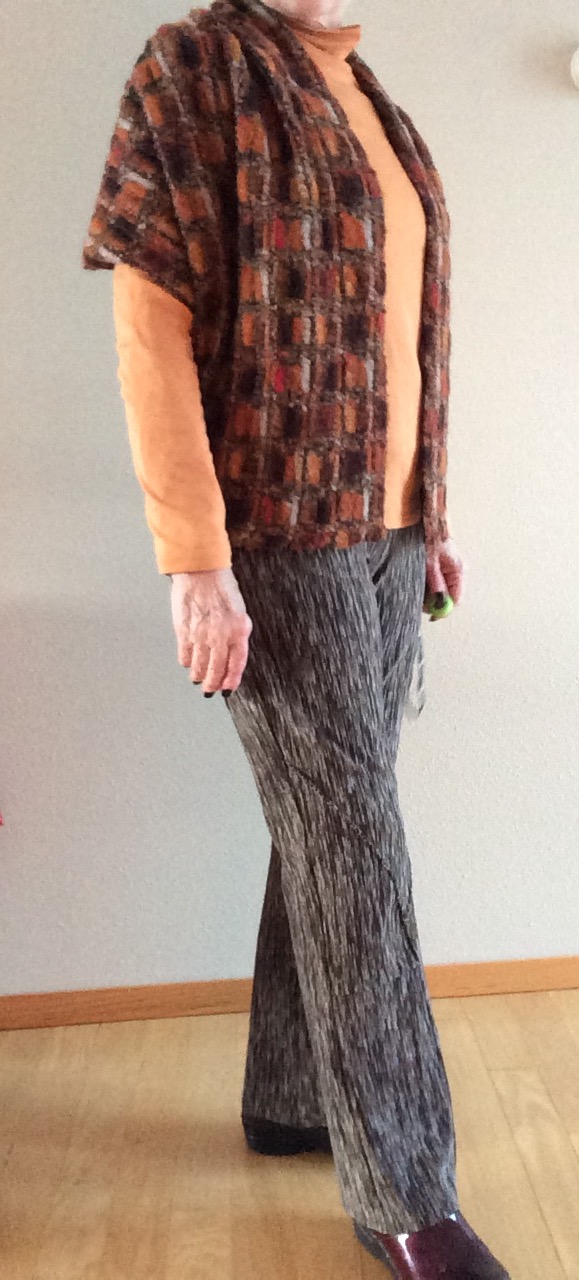
Sewing with 3D Spacer Mesh Fabric

3D Spacer Mesh

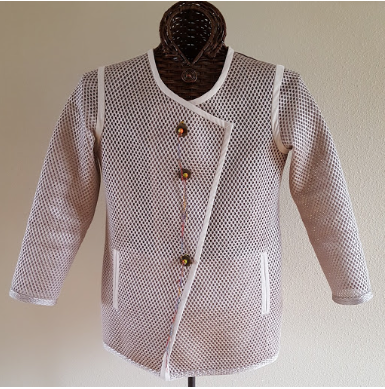
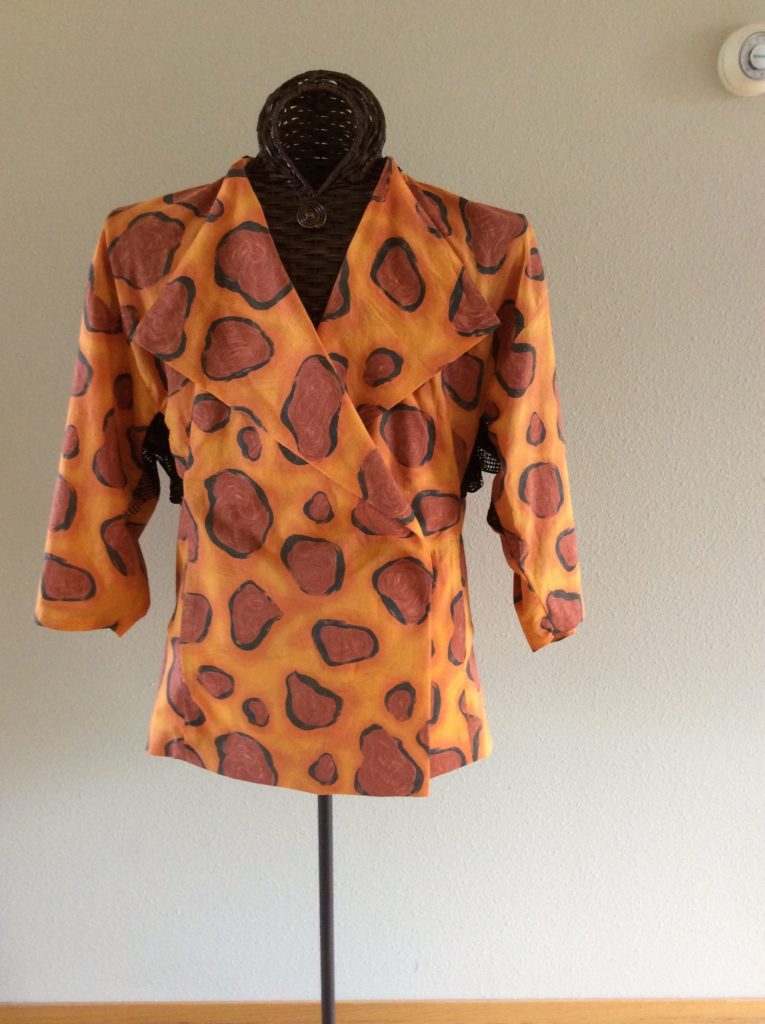
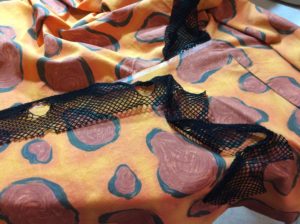
3D Spacer Mesh is a double layer of a smooth polyester knit with open ‘holes’ backed by a lattice open weave.  It’s 3D (dimensional) –scant 1/8″ thick, has a slight stretch in both directions, and is quite firm as was probably intended for laptop, iPad covers.  Have also seen it used in shoe uppers.

3D spacer mesh

3D Spacer Mesh


3D Spacer Mesh Jacket

3D mesh

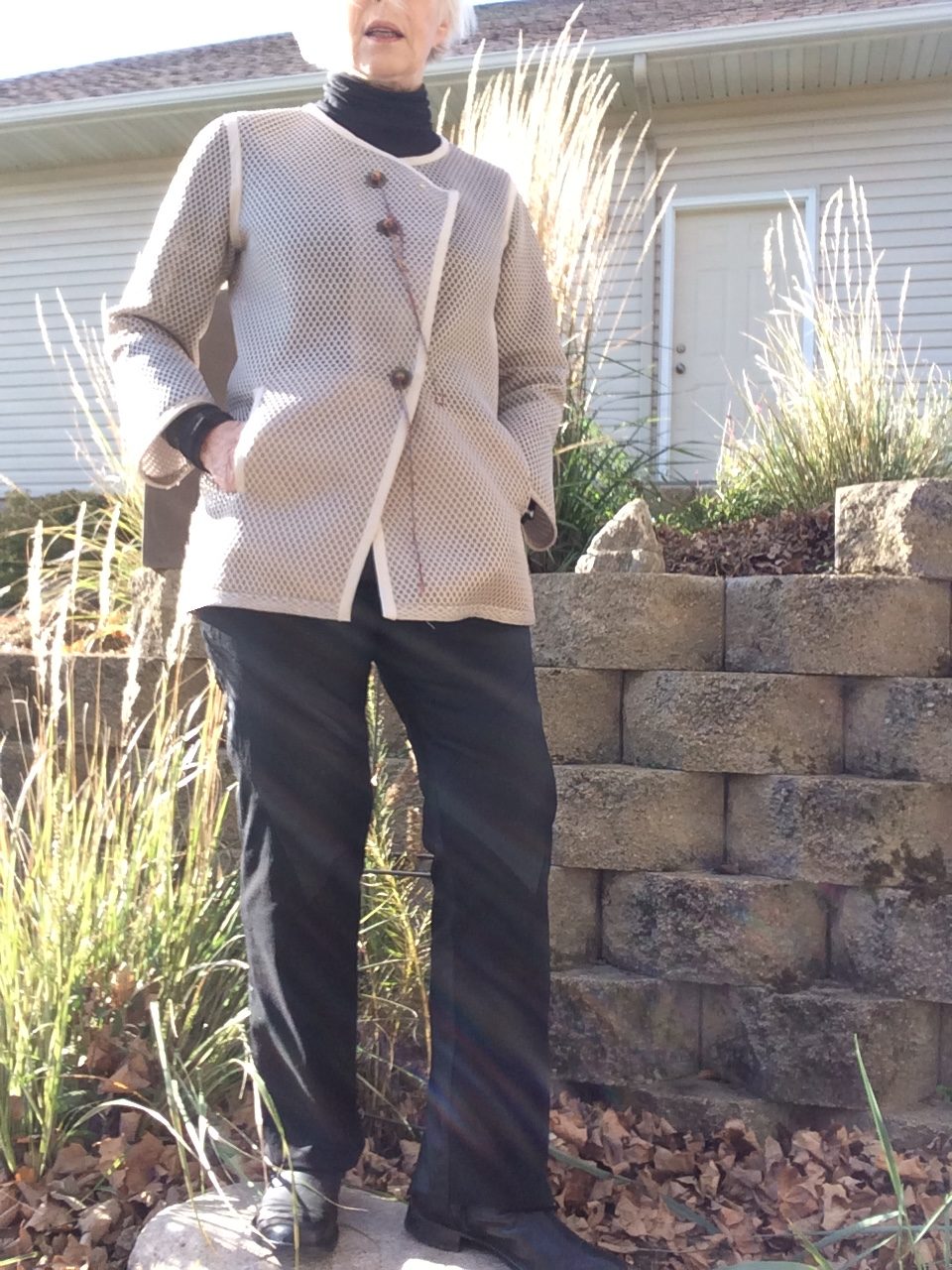
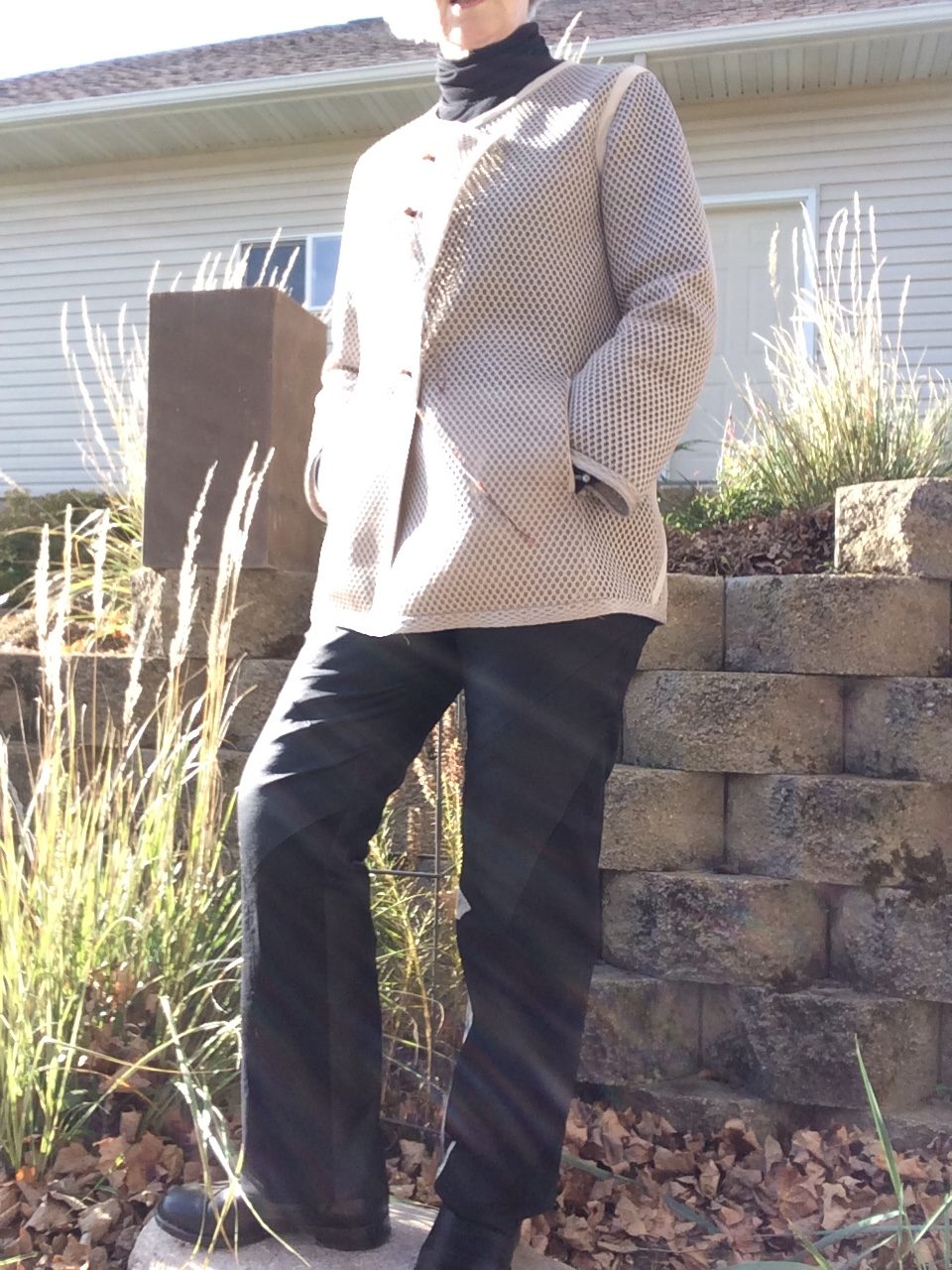
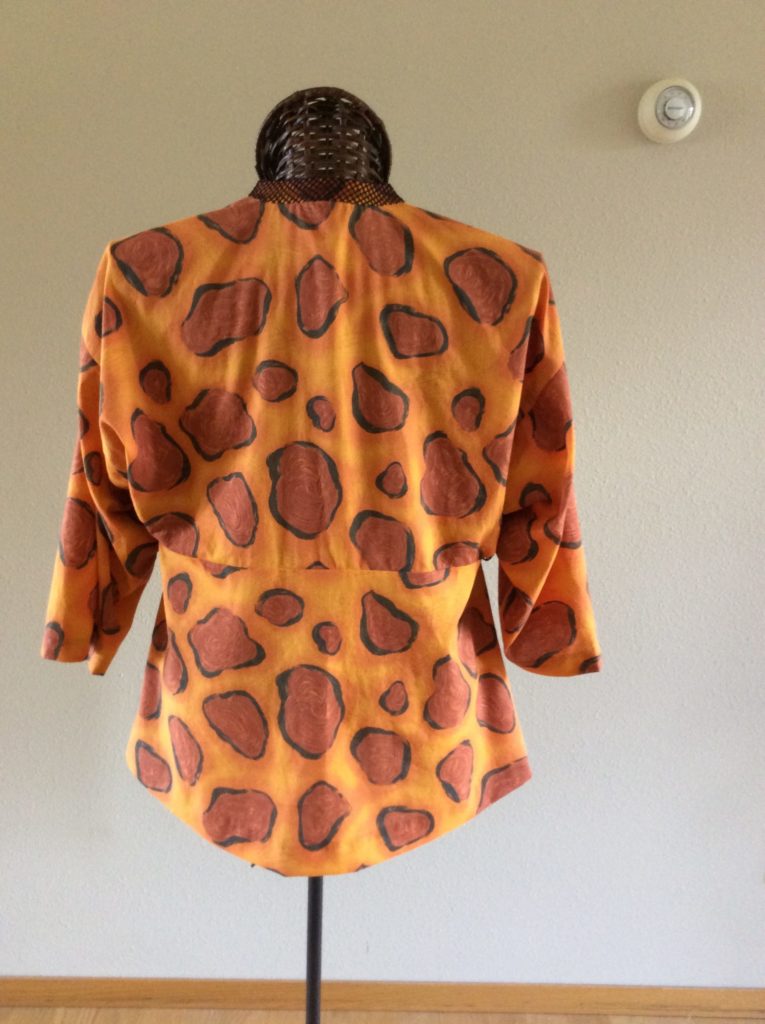
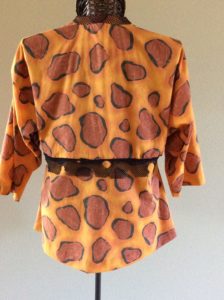
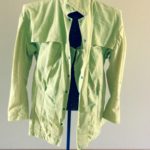
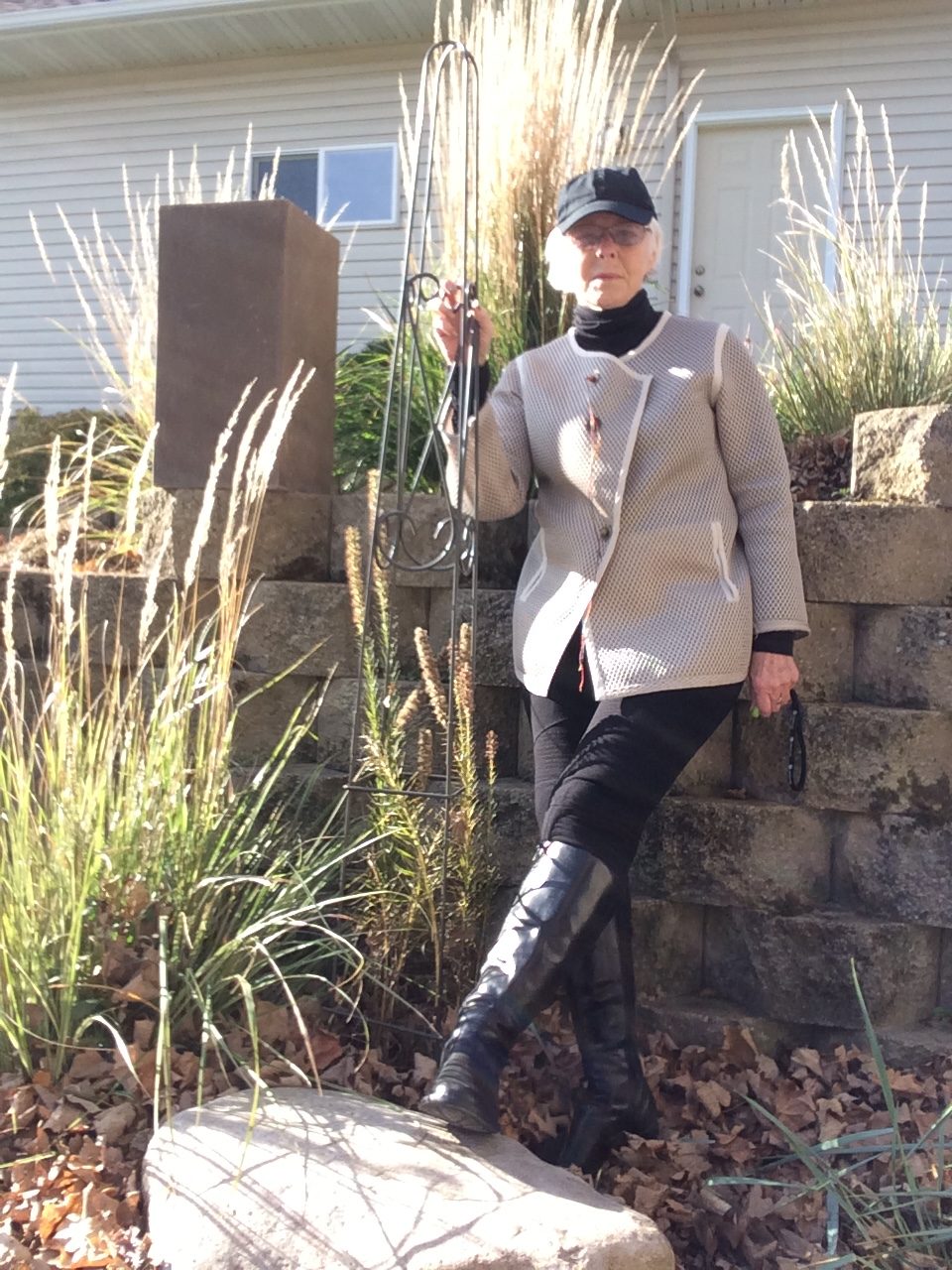
Neucarol’s 3D Spacer Mesh Jacket


I spotted the fabric at Mood Fabrics and instantly recalled a RTW I had just seen at Saks Fifth Avenue.  The link to the Mood Mesh is similar to what I bought, but don’t see the exact fabric online.  This link is to a slightly different spacer mesh fabric.


3E spacer meshEven at Saks, the RTW wasn’t that well made, but was intrigued by unusual use of the fabric.  So, the mesh and a coordinating nylon fabric for binding came home with me.

The binding fabric is a very smooth microfiber–nylon or poly.  It is so firmly woven, considered leaving the binding inside edge raw.  In the end, did a double-fold.


Sampling

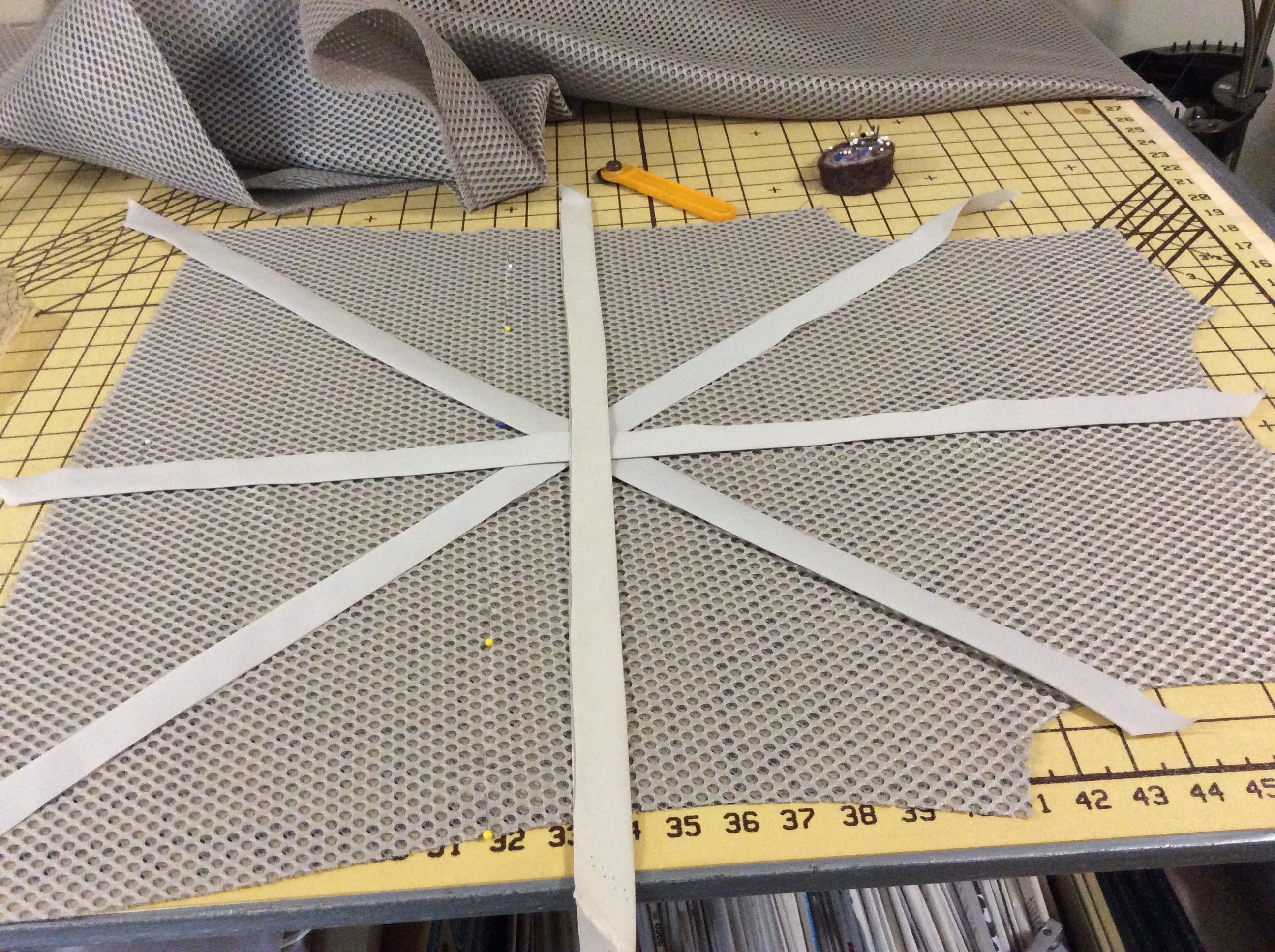
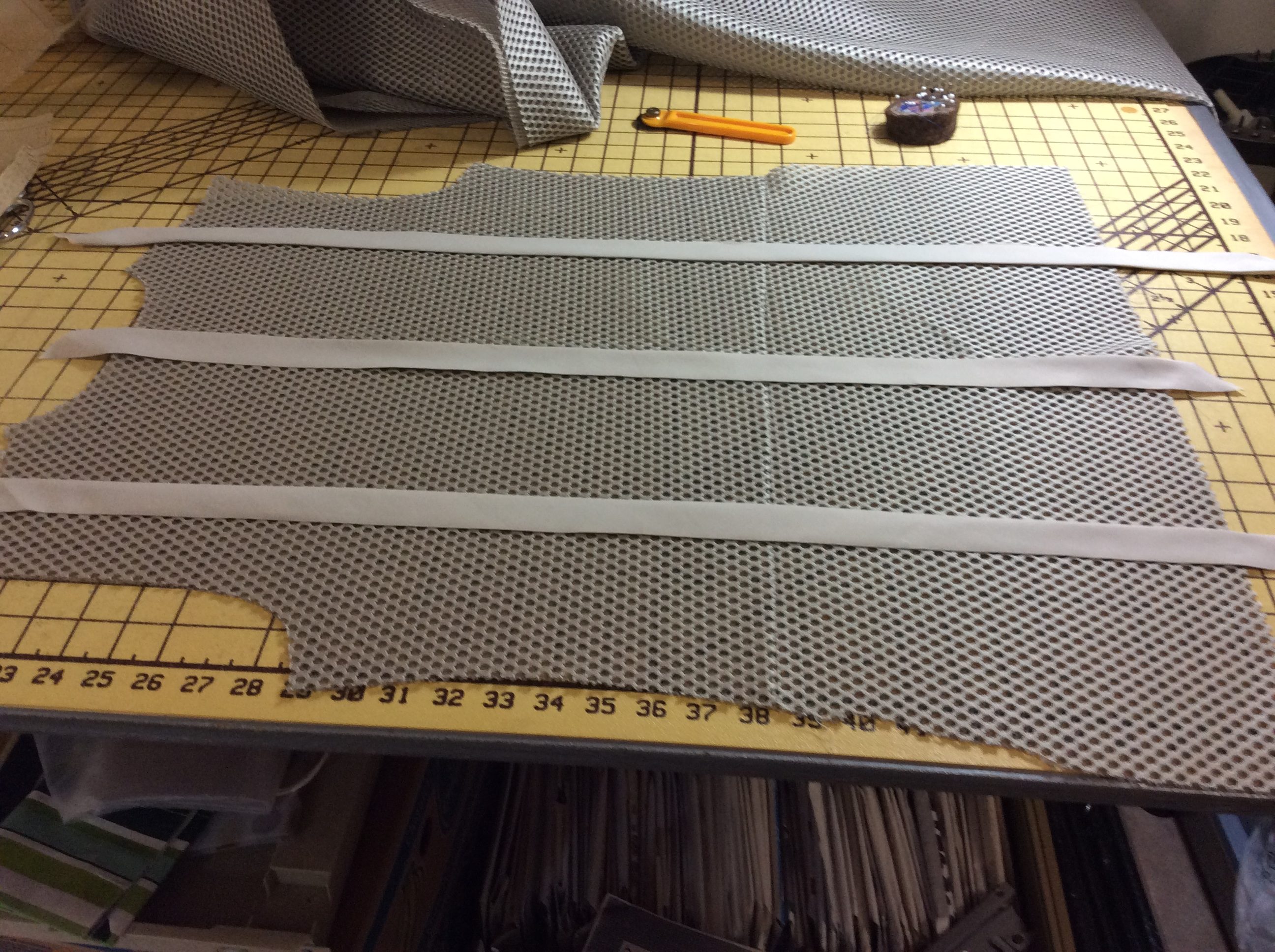
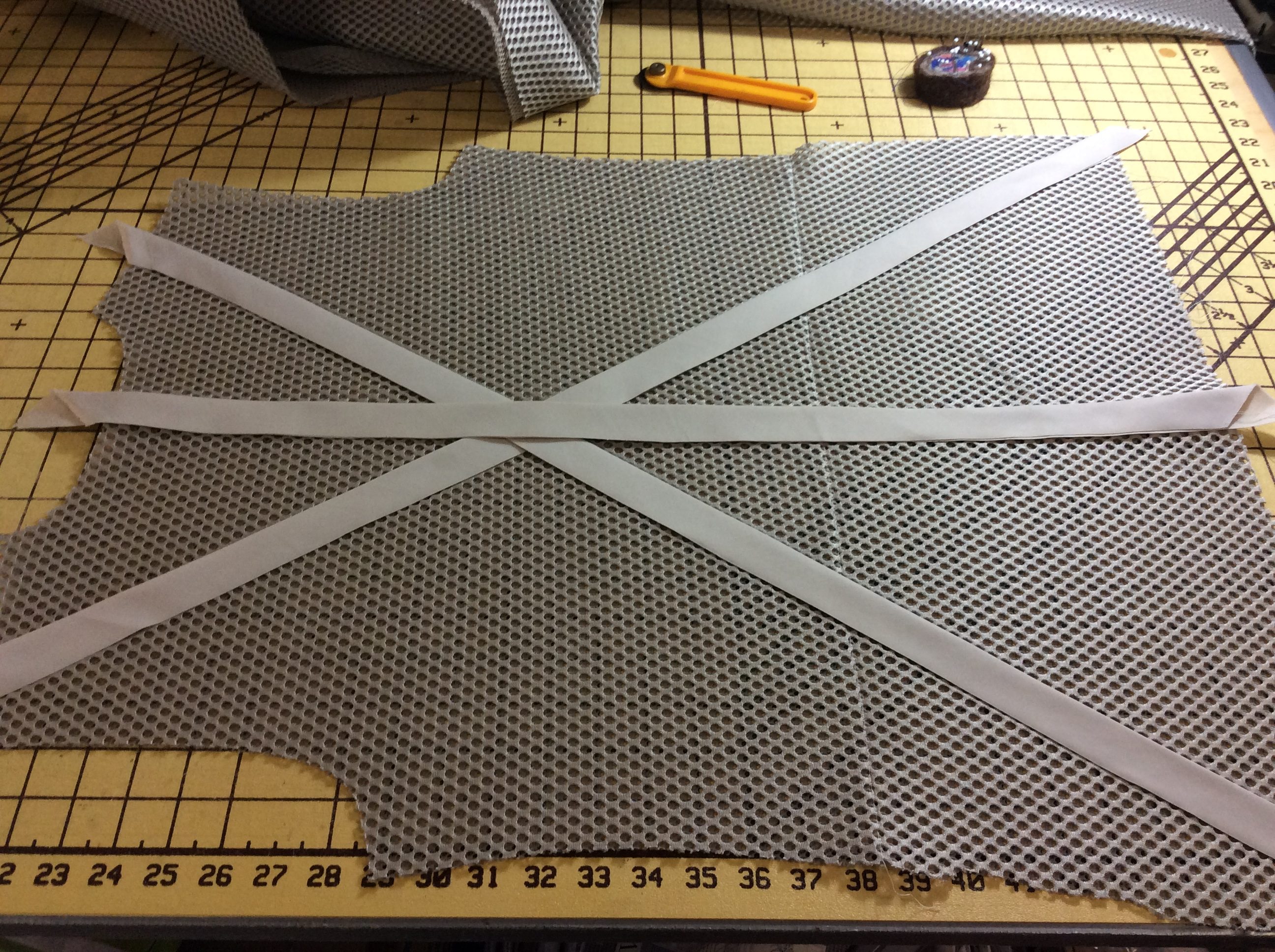
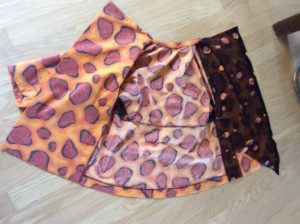
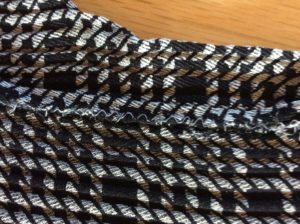
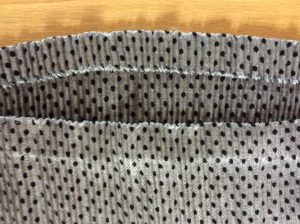
This is the sample testing a butted seam and several binding options.

A butted seam eliminated bulk and covered it with double-fold bias strip.  The strip is folded right sides together and the raw edge machine stitched to the garment.  When folded over the seam, the trim is centered over the butted seam and covered the raw edges.

Tested top-stitching the trim but preferred a simple, plain finish. Therefore, the folded edge of the trim is glued in place with Steam-a-Seam.

The edges were bound in the same double-fold binding and glued on the inside of the garment.

3d spacer mesh

Sample right side

3D spacer mesh

Sample wrong side

Design

The jacket is based on OOP Vogue 8676 and Simplicity 1499.  Had used the Vogue pattern and liked the fit–especially the high armholes and the slight waistline shaping at the side seams.
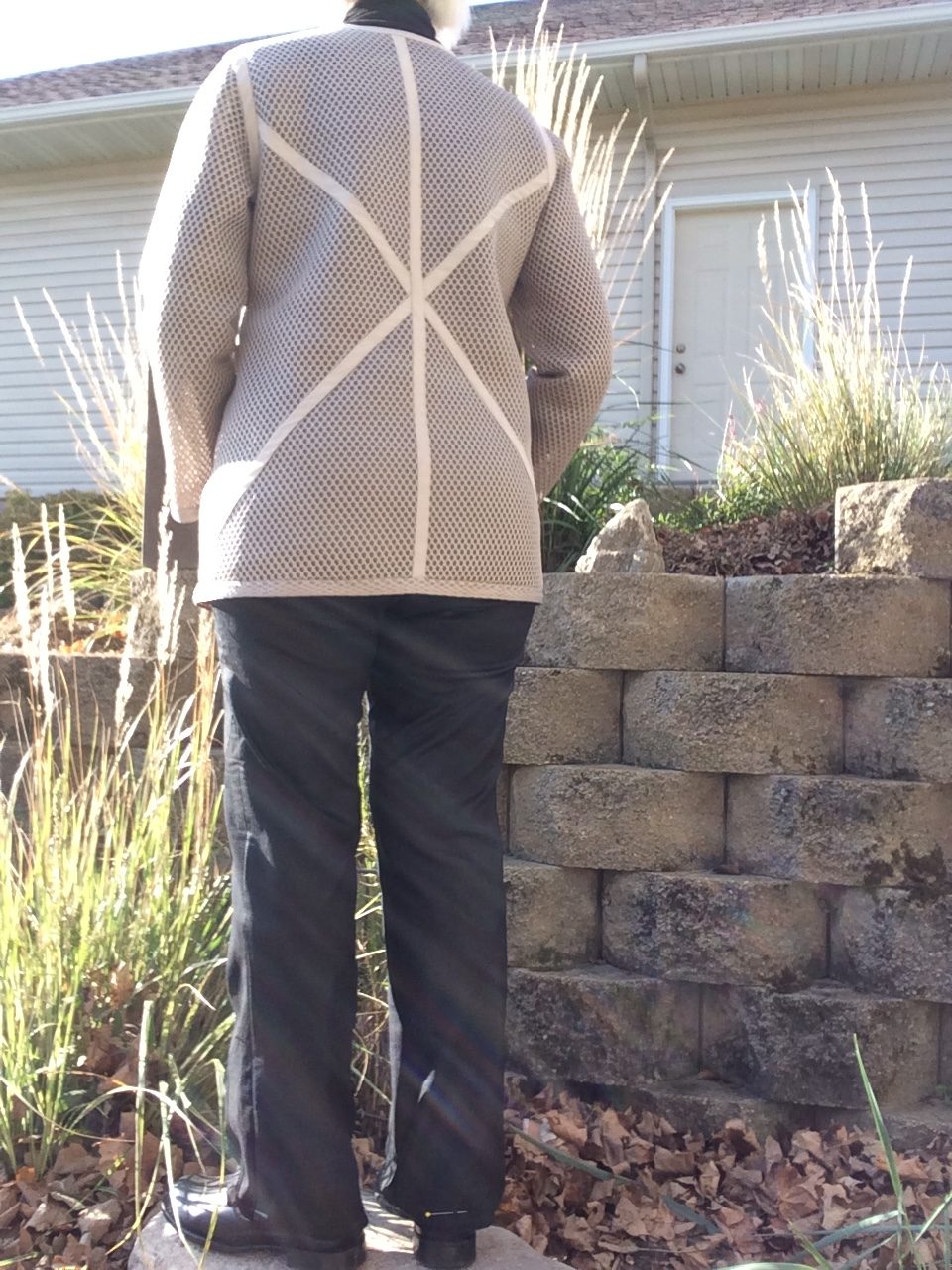
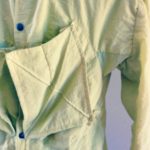
The side seam shaping is readily seen in the finished garment.


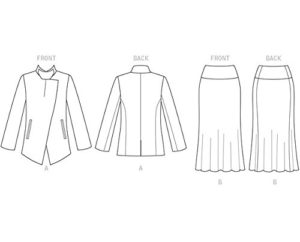
Simplicity 1499 was used for the asymmetric zipped front.3D spacer mesh


The rest of the design was influenced by the RTW design.
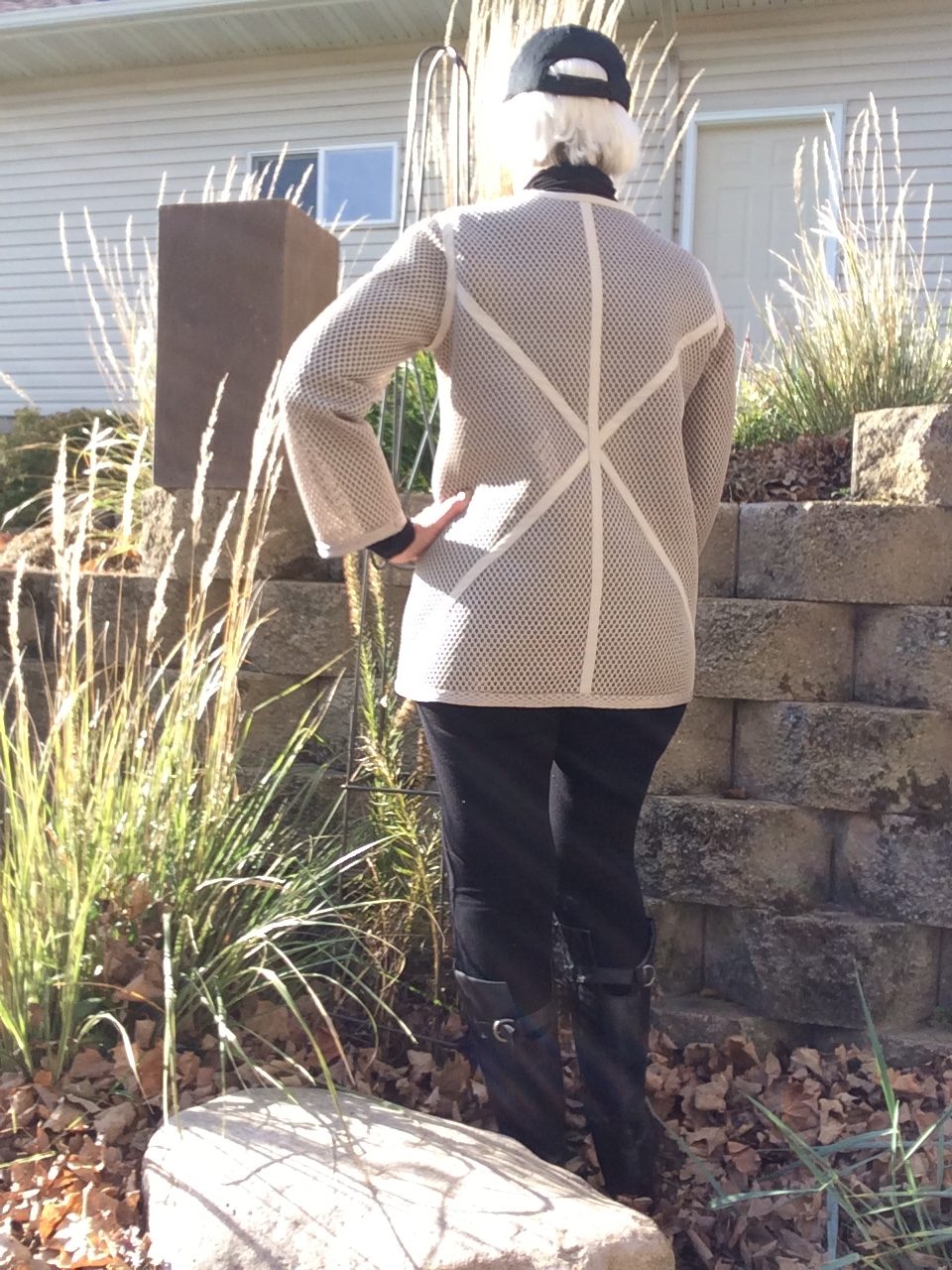
 

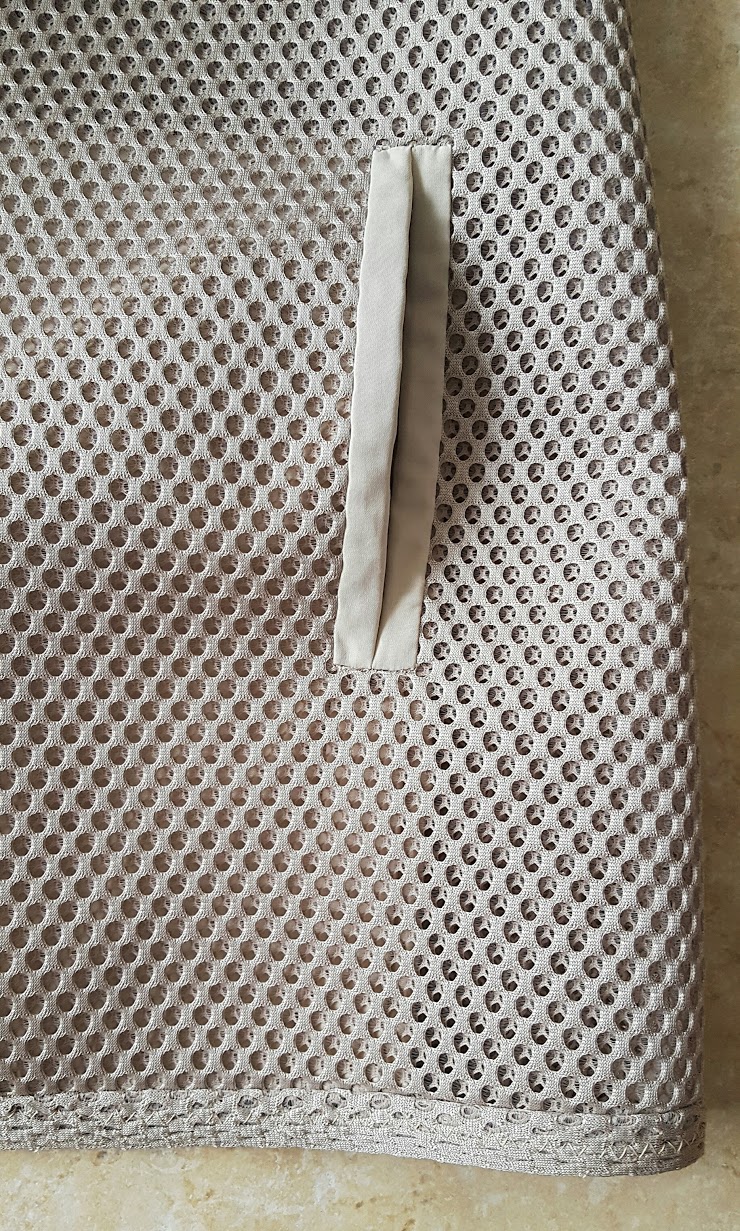
The RTW Princess seams were eliminated–didn’t need the fit nor the extra trim work.  It would have provided an in-seam pocket space; in the end, a welt pocket worked well.


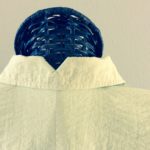
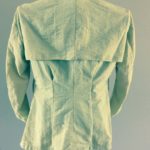
The back is one piece–simple–trimmed in strips of trim.


Pockets and Selvedge Hem Finish

The 3D Mesh is more opaque than the RTW so there is less show-through of pocket bags and trim–a Good Thing.

Welt pockets worked extremely well as the mesh was firm enough to provide a substantial fill for the binding.

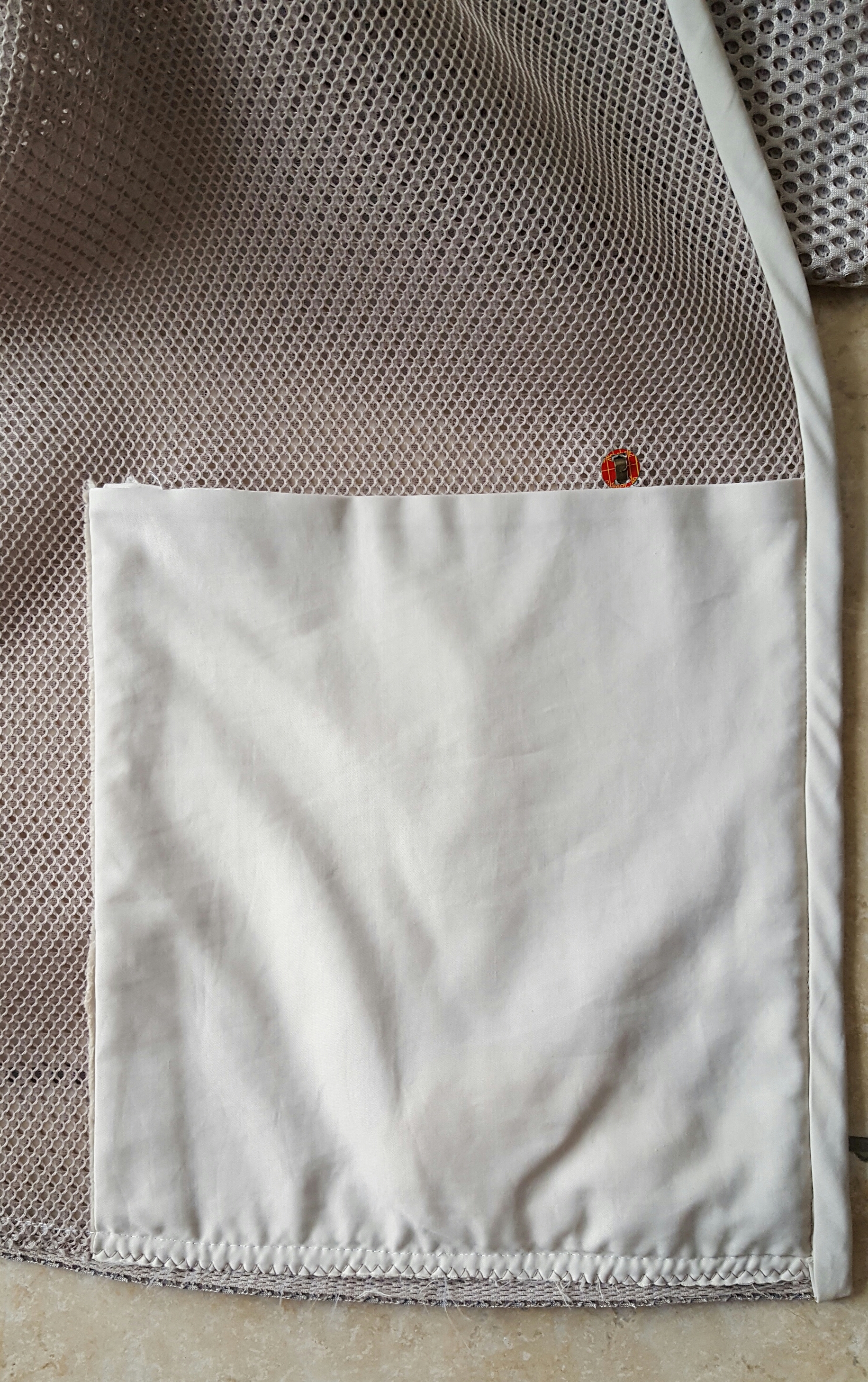
The pocket bag is a rectangle finished on two sides with a french seam.  The bag extends to the center front and is enclosed in the binding.  The bag bottom extends to the hem and is caught in the zigzag stitch that secures the jacket lower edge to the selvedge used as the hem finish.

(The red dot above the pocket bag is the snap backing.)

Closure

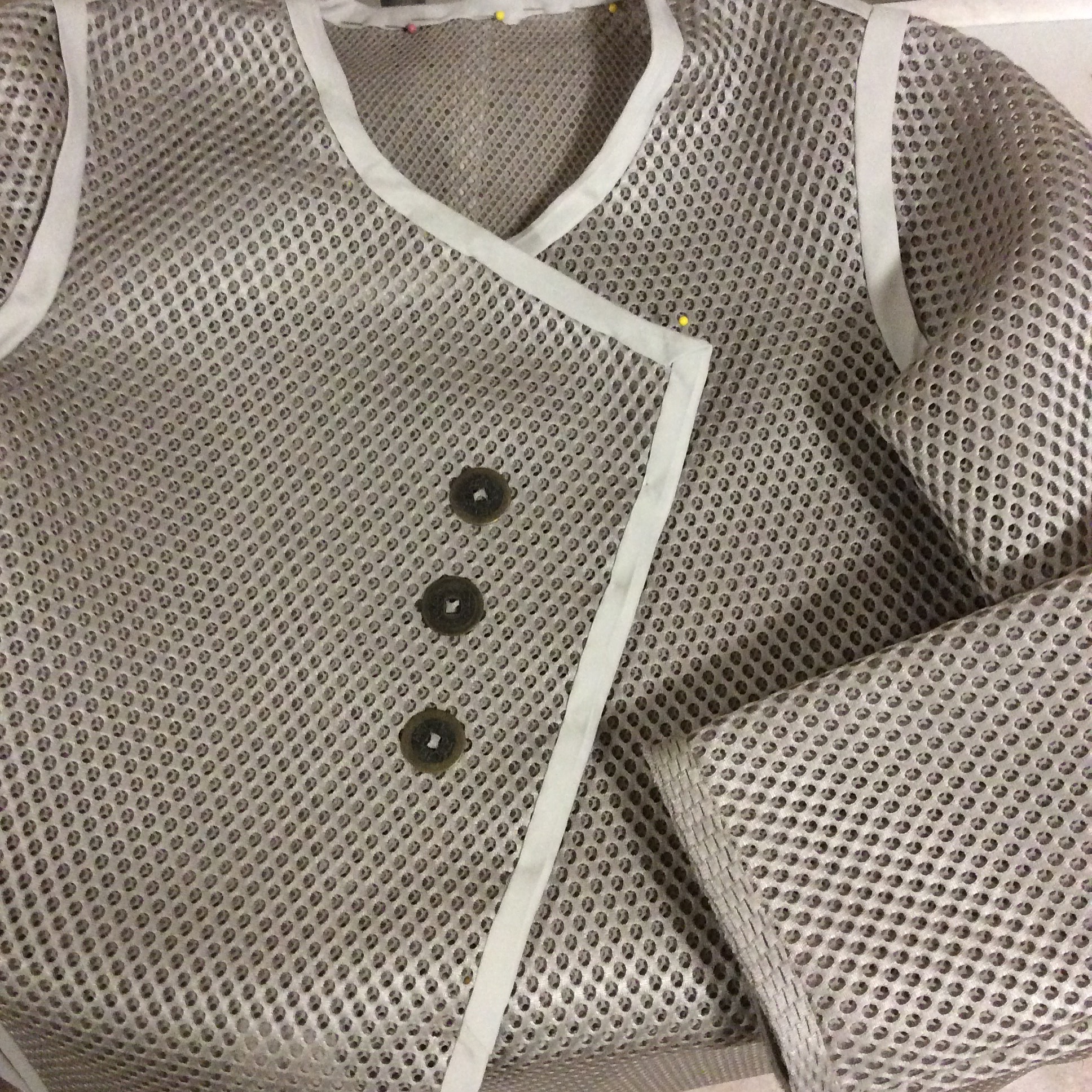
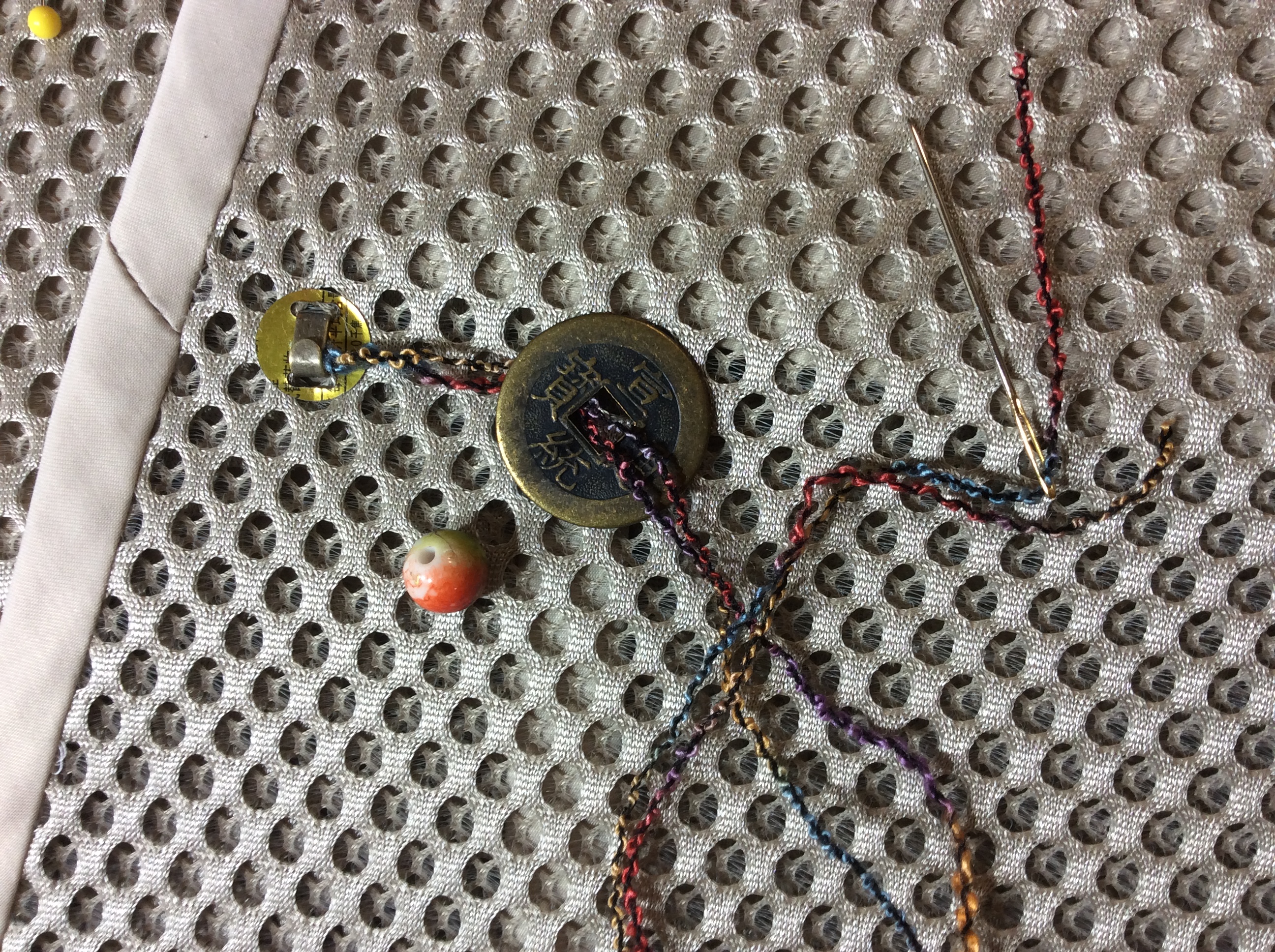
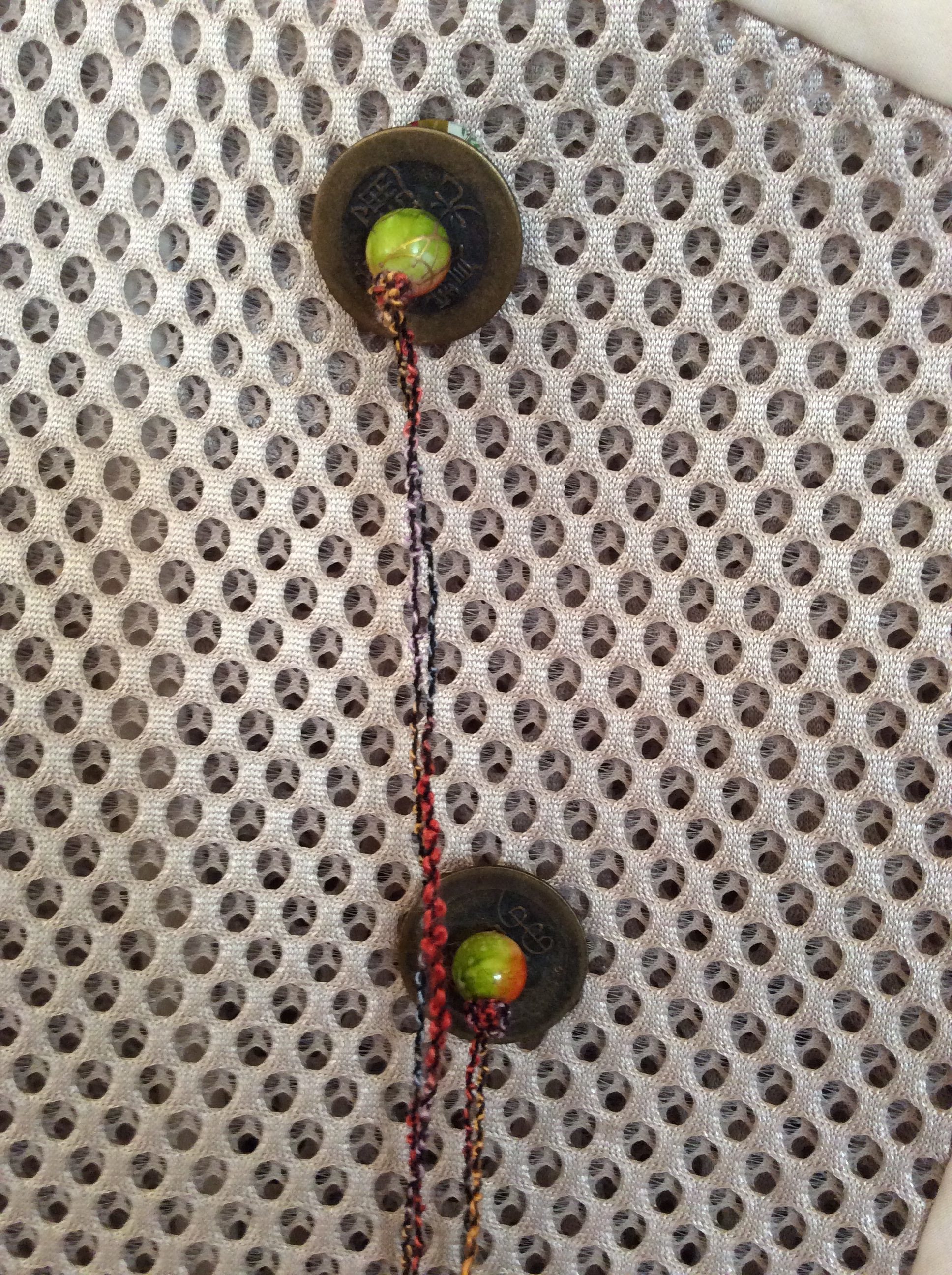
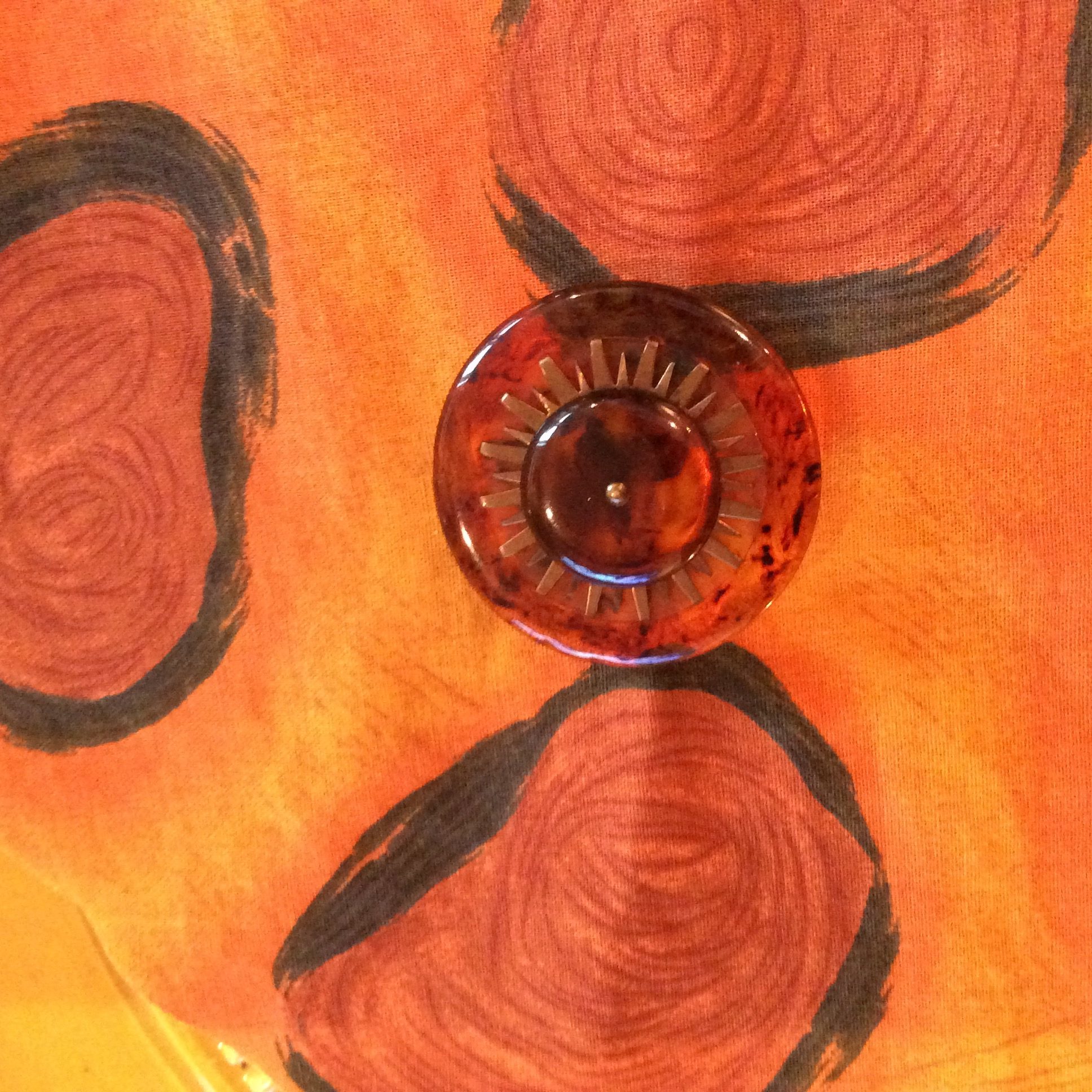
Initially, planned on a zipper, but couldn’t find one to suit my demanding ‘look’.  Am now glad that I was forced to scrounge from my stash. as the button/bead/yarn closure added just the right amount of pizzazz.

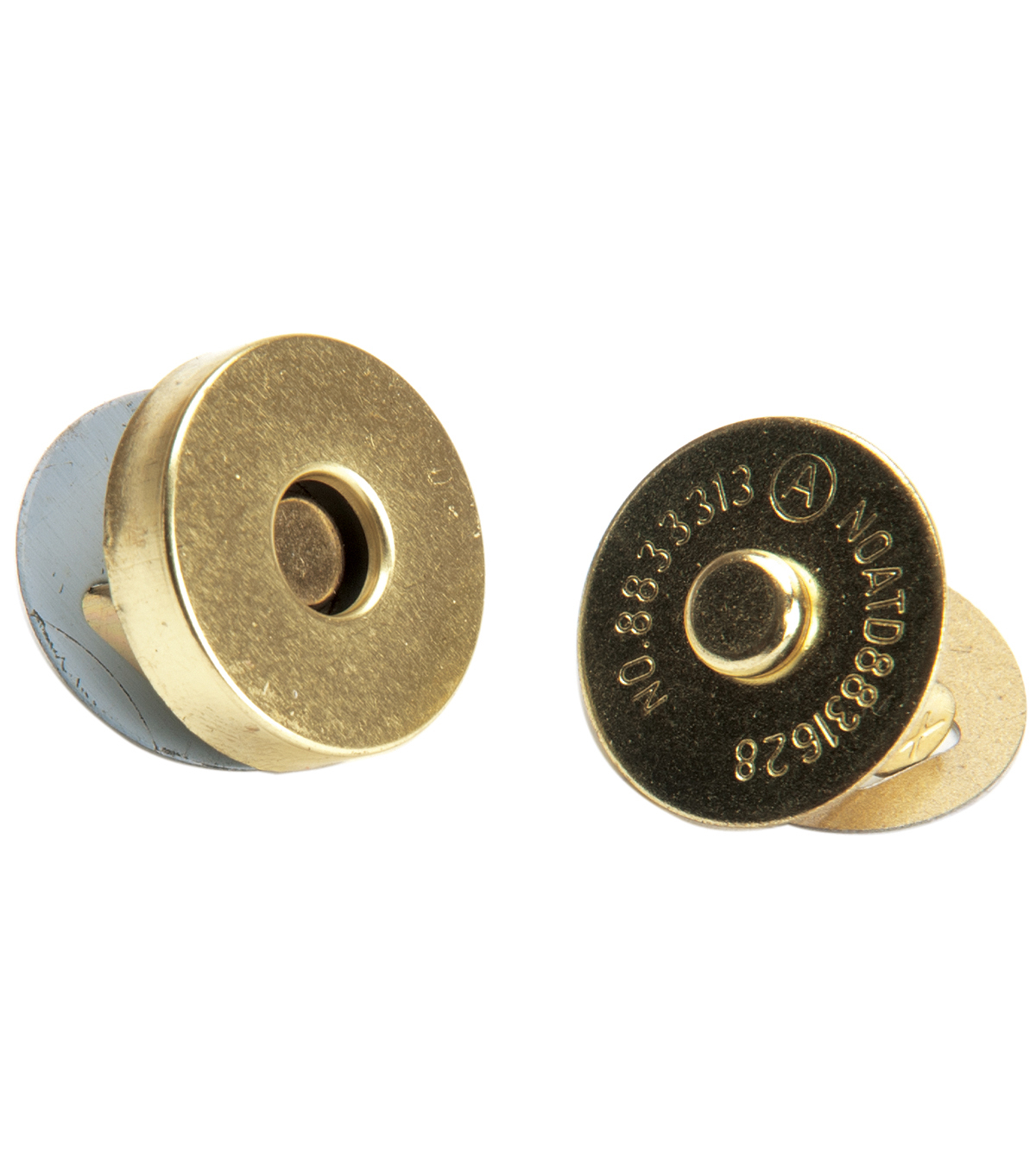
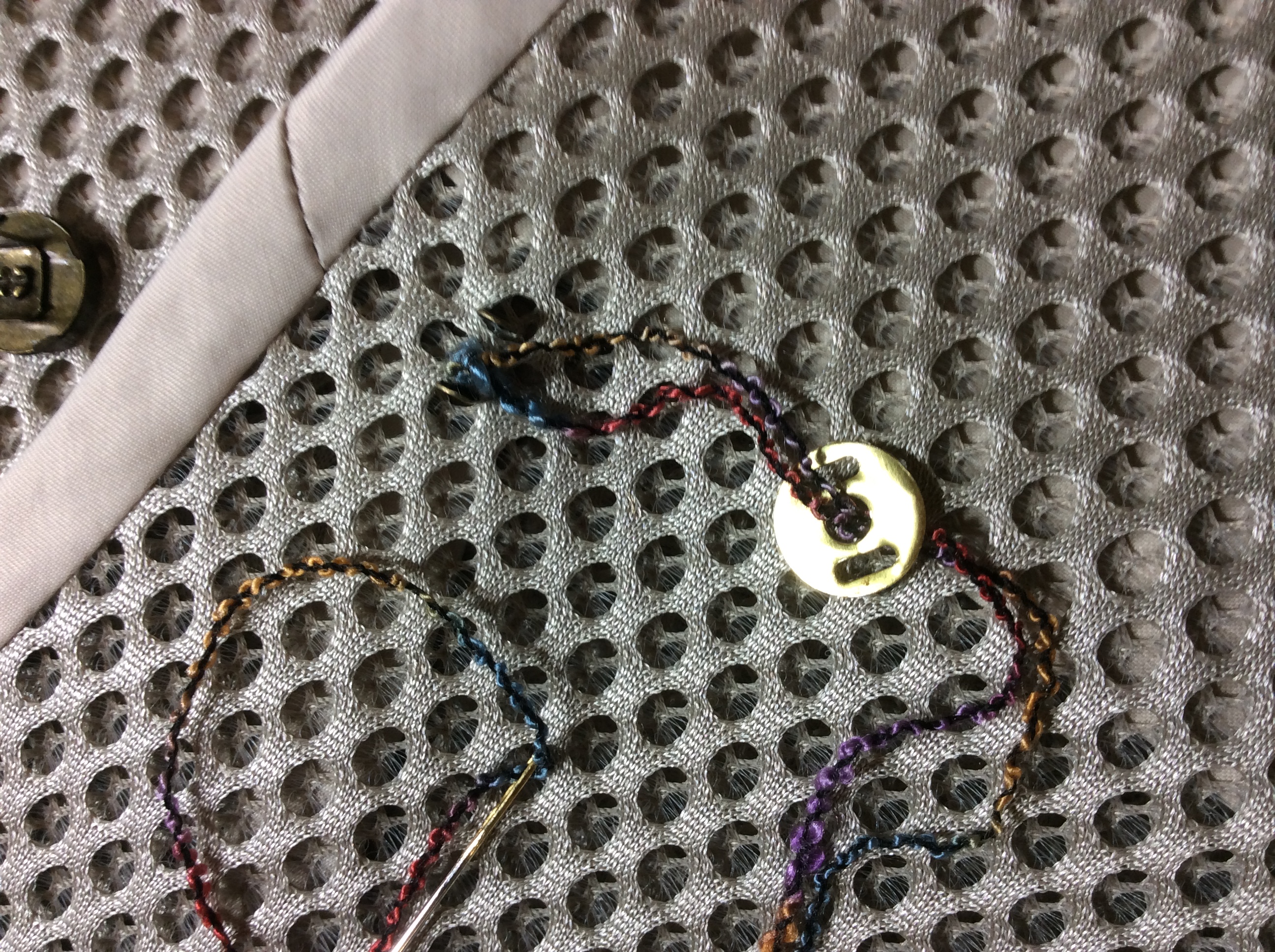
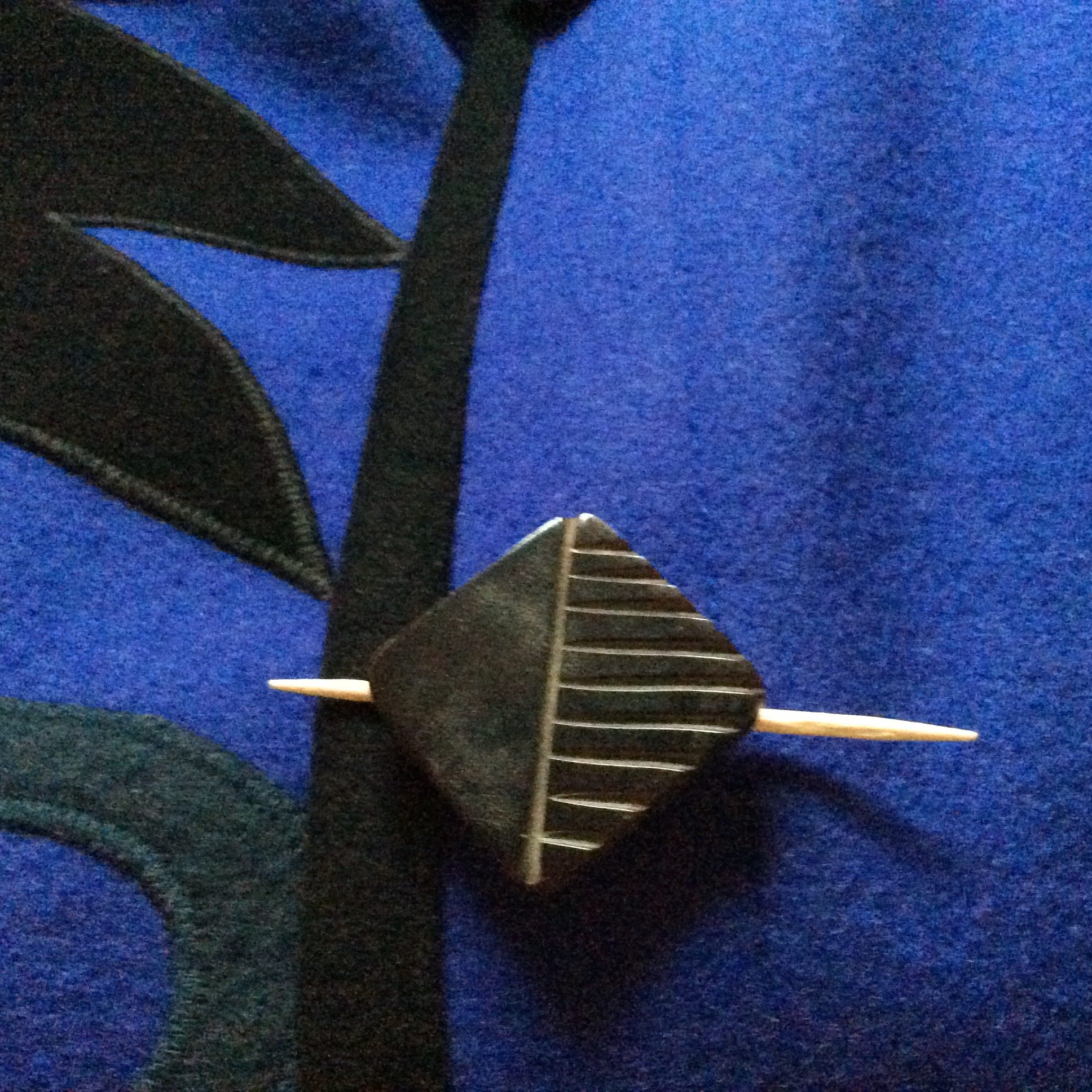
Instead of button holes, the Chinese coin and bead are attached over a snap–a magnetic purse snap–that has prongs.  The prongs were easily worked through the fabric openings and securely clamped in place.


Other Details

The selvedge was trimmed and applied to jacket hem and sleeves in lieu of repeating more bias trim.

Attaching selvedge trim


Selvedge Trimmed Sleeve


The underarm+sleeve seam are sewn as a conventional seam; sewing a butted seam would have been near impossible in the narrow sleeve.  Plus, trim would need to cover the seam.  Am finally getting smart; I didn’t even attempt it.  The conventional seam was easily pressed and remains in position through many wearings.

The sleeve is inserted with a butted seam prior to stitching the underarm seam.                   It eased in perfectly.

3D Mesh

Conventional underarm seam and armhole butted seam


Wearability

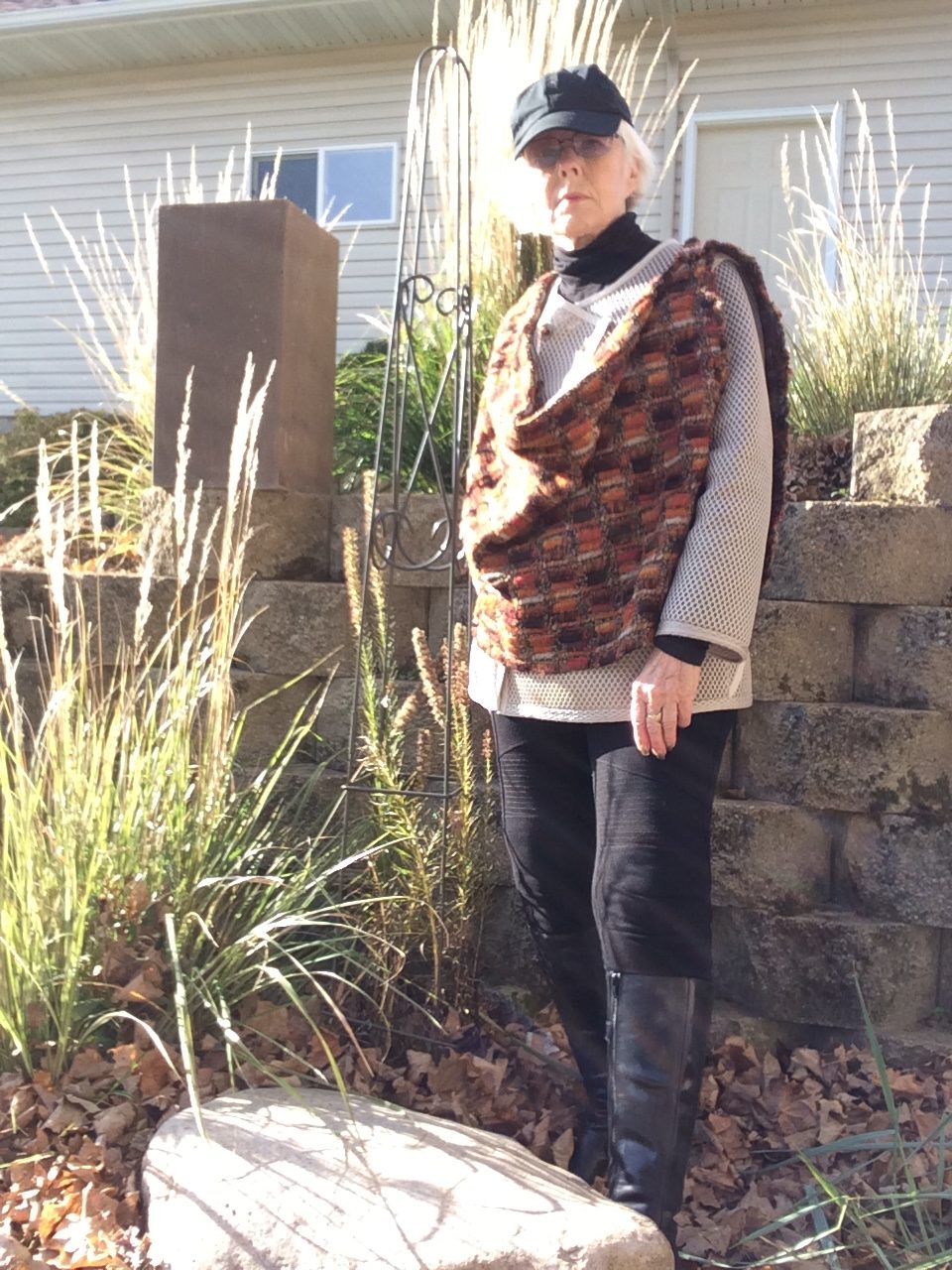
I find it quite comfortable to wear.  The open fabric spaces makes for breathability.  It’s a good Spring and/or Fall garment, also to wear anytime the wind comes up or the temperature drops.  And scarves are a good accessory.
Posted in FIBER ARTS | Tagged , , , , , , | Leave a comment

Snowbird Sewing Projects

Snowbirds Head South for the Winter

Come January 1st, there is a steady stream of traffic from the Northern tier of States and Canada as snowbirds head South.   Central and Eastern States make Florida their destination.   Those remaining behind only see a steady stream of tail-lights on 35W exiting the Upper Midwest.

It is a 2.5 day drive and very doable.  It worked so well, am back for a second year.

Snowbird

Why we are Snowbirds


Florida Panhandle

Last year I stayed on Cape San Blas; this year am on Mexico Beach–about 10 miles West of Port St Joe .

snowbird


Sewing Projects That Made the Cut

Since I am gone two months, snowbird sewing projects are a must.  Can get a lot done as am not distracted by cleaning, cooking, the deplorable condition of the sewing room, etc.

I choose to drive so I can take my sewing machine, serger, and sewing supplies along.  It is a challenge to choose which sewing projects will make the cut.

The rest of my sewing room is distraught–especially as the house temperature is set at 53°.  They are so lonely  😰.

snowbird

This made the cut.

All fit into the tote–except for the cutting mat, knitting and the small supply tote.


The Cut

The election process was influenced by:

  • the tote size–had to fit in the car along with other totes
  • ease of sewing without a full complement of sewing tools/supplies
  • priority–what I need most

Mizono Shirt

This came to Florida last year.  Have made the this shirt before so knew it would be an easy project.  Unfortunately, discovered the collar and facing pattern pieces were missing.  But, it available pieces did get cut.

It returned home with the idea of copying those pieces from the finished shirt.  Well, that didn’t happen!  Serendipitously, the pieces turned up while looking through possible vacation projects.  This lucky project got to come to Florida again.

The fabric is a cotton flannel, more suitable for Fall than Spring, but now I’m ahead of my FW 2017 sewing; always a good thing.

snowbird

Mizono Shirt  OOP


Donna Karan Skirt

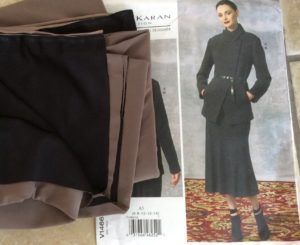
Vogue 1466, OOP, is a Donna Karan design.  The jacket is partially constructed and stayed home.  Will explain later in the post.

The pattern is a pull-on skirt, fitted through waist and hip with self-lined yoke; front extends to back–no side seams, raw-edge hem.

This will be a quick and easy project to wear whenever.

The fabric is a double-faced poly–black reversing to coffee-with-cream.


San Francisco Coat

The last project is the most complicated but brought it as know I will have time to ruminate and play with the fabric collage combinations that will make up one side of this reversible San Francisco coat.

Heaven knows I don’t need another coat!  BUT, was in San Francisco last June and…”the coldest winter I ever spent was a summer day in San Francisco.”  It was in the 50’s°, foggy and drizzly.  Decided right then and there, I needed a San Francisco Coat.

One side of this reversible coat will be a collage of fabrics inspired by a RTW that caught my eye.  The reverse side is a water-resistant black, smooth fabric.

snowbird

Collage Fabrics for Vogue 8934


Sewing Room in a Vacation Rental

Setting up a sewing area takes some jockeying.  Last year there was a patio table I moved inside to an unused bedroom.

snowbird

Folding Table–not the sturdiest–but anything in a pinch!

This year the only option is the dining table; OK until guests come, then have to move everything.  Off to Goodwill to see if I can find a foldable table.  Last resort is Wal-Mart.  Will take table home (if it fits in car) or donate to Goodwill on the way out-of-town.

The other issue is a cutting table.  The best of all possible worlds would be to cut out garments at home on the 60″ cutting mat.  Unfortunately, that doesn’t seem to happen.

snowbird

18″ X 24″ cutting mat most convenient for travel. Will lay flat in car trunk and can fit several small pattern pieces/one main body pattern piece.

Last year, purchased a 18″ X 24″ cutting mat that is large enough for one main body pattern piece or several small pieces.  The dining tables are large enough for most hunks of fabric; just slide the cutting mat from pattern piece to piece.

Posted in FIBER FASHION FUN | Tagged , , , , , , , | 13 Comments

Moschino Fall 2017 Mens/Womenswear Collection

Moschino 2017 Collection

[ictt-tweet-inline]The Collection is a Military Fight theme with camo for both men and women.  Hints of Storm Troopers–fatigue pants bloused over calf-high marching boots.  Lots of camo green webbing as trim–or bindings?  And then military combined with fun, bright, and sometimes pastel graphic prints to tone down the implied reference to Syria, Middle East, terrorists.[/ictt-tweet-inline]

Jeremy Scott is one Angry man… “My country is in the toilet. And when my country is in the toilet, the world is in the toilet,” he stated. “We have to fight for everything we believe in. That’s the expression I wanted to use.”


Can’t decide if this is a ‘tongue-in-cheek’ response to what is going on in the World or is it a Call-To-Action?  Or some of both?


View the Collection both in live stream and slide show.

Click on   in upper left of slideshow to view all 71 outfits.


Posted in FIBER FASHION FUN | Tagged , , , | Leave a comment

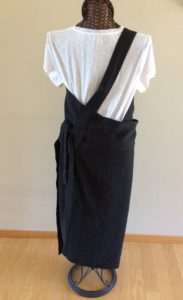
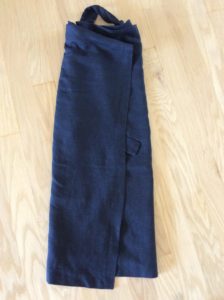
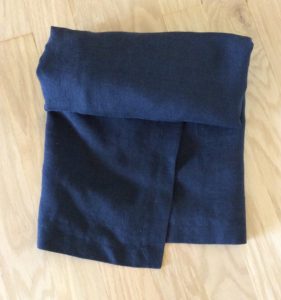
Make a Rectangle Vest

Make a Vest from a Half-Yard of Fabric

A Rectangle Vest


 Somewhere–probably Pinterest–I once saw a knitted wrap that was essentially a rectangle that could be worn multiple ways.  Nice…but same old, same old.


It’s a Shawl; It’s a Wrap; It’s a Vest.

What caught my attention is the unexpected way the rectangle is manipulated to form a vest–a Rectangle Vest.

rectangle vest

Rectangle Vest Back

Rectangle Vest

UFO Home


Was all set to whip out the knitting needles when I noticed the finished size was 18″X59″.  That gave me pause as, knowing myself as I do, I’d lose impetus halfway through.  And there would be another UFO in the knitting jar.


Sometime later, when browsing  Marcy Tilton’s online fabrics, I fell in love with a striking orange/brown/black/gold loosely woven fabric.  Daily visits didn’t prompt any garment ideas and eventually  only 1/2 yard  was left.  Then the knitted vest pattern popped up in my mind.  This fabric was 55″  wide and would be a perfect replacement for the knitted rectangle.

Making the Rectangle Vest

As with most great ideas, the vest is really simple.

Choose a loosely woven and/or stretch/knit fabric that will stretch a bit around the shoulders.  Or, you could knit, even crochet, a rectangle of similar size.

Fold rectangle in half and attach buttons to long edge at the selvage.

A reversible fabric will provide more options for a fold-back shawl collar.


rectangle vest

Lap selvage ends for closure placement


  • One half yard of at least a 55″” wide fabric.  The half yard  can be increased/decreased for various amounts of coverage.
  • FYI:  45″ wide fabric will require a seam to produce a rectangle long enough to wrap around the body; longer than 55″ will make a longer vest.
  • Buttons or snaps.


Subscribe to Fiber Fashion Fun newsletter and receive the FREE Rectangle Vest instructions pdf download.

[email-download-link namefield="YES" id="5"]

Wear      Enjoy

Posted in FIBER FASHION FUN | Leave a comment

Shopping Surprises at Sewing Expo

What you May Find Shopping a Sewing Expo

Superb shopping for fabric, patterns, notions, trims…

Nothing makes me happier than being in a crowd of sewists.  Shopping a Sewing Expo qualifies.  Here I gather superb sewing finds and divine inspiration for Fiber, Fashion, Fun!

This is what I found at a recent expo with links to websites.  Hope you’ll find these sources useful and that you’ll stop by their booths when next you visit an expo.


shopping sewing expo

Shopping Loot

Had a productive shopping experience exploring all the vendors–some prior acquaintances, some new.

Yes, can shop all these vendors online but at sewing expos, you have a chance to touch & feel. The best part is turning garments inside out to explore the sewing techniques, interfacings, notions.


I only had a couple hours and my specific search was for a zipper–a WUNDERFUL zipper.  This year the bag and zipper vendors weren’t there but found kits, yarn and ribbons, a few notions, etc., to fill gaps in my supply.

The best part of shopping at expos is that vendors often bring products not on their website–like small fabric yardage or discounted/discontinued items–to clear out their inventory.  It’s a bonus for both shopper and vendor.


Sewing Expo

Original Sewing Expo

I’ve been attending this Sewing Expo since it’s inception in 1995.  The birth of American Sewing Guild (ASG) opened an entrepreneurial opportunity and Original Sewing and  Quilting Expo (aka Sewing Expo) was the first to fill the niche.  Until then, there wasn’t such a thing as a ‘Woman’s’ expo/convention.  And, oh, how we all embraced it.

Sewing Expo now has events in several US locations.  Click here for cities and dates.  It’s a destination for both locals and travelers.

This is where I met and learned from people who are now nationally recognized sewing experts.  Was happy to see several from those early days, successfully presenting and selling patterns, fabric, products.

Hello to these Sewing Experts

Have many of her distinctive patterns, and her fabric selection is superb.  She is now carrying Made in USA organic cotton knits by Alabama Chanin.  Have followed Alabama Chanin but been reluctant to purchase.  Linda had a couple of kits–bought both–that will permit me to try it out without a huge investment.  And, Alexa was wearing an Alabama Chanin skirt; there’s nothing like seeing ‘in the flesh’.


shop sewing expo

Cynthia Guffey Skirt


Cynthia is another sewist whose fashion sense and sewing expertise is impeccable.

Many of her patterns reside in my pattern drawer(s).

This skirt is in her signature silk noil fabric.


  • Kathy Ruddy celebrated 50 years in the sewing industry in 2011.

Kathy wasn’t in her booth when I stopped by.  Below is a photo of a t-shirt developed from one of her videos.

shop sewing expo

Kathy Ruddy T-shirt


  • Laura Murray is a surface designer.  I always pick up small pieces of her fabric to use for embellishment.
    sewing expo

    Laura Murray hand-dyed Burma silk batik and hand-made buttons.

    Photo above is deliberately over-exposed to show the delicate detail.  This piece may be used in conjunction with the yellow suiting–or, maybe not.

shop sewing expo

Buttons and Batik from LM; yellow suiting from Vogue Fabrics.


Laura makes the buttons which will definitely go with the yellow suiting.   The Best Part:  they are washable.  Most handcrafted buttons are not washable.


The ribbon is a 3-yard piece by Renaissance Ribbons sold by a vendor who I don’t recall, ☹️

Link is to RR clearance site.  Lots of Christmas theme ribbons here.


  • Vogue Fabrics loads up a trailer and makes the trip from Evanston, IL

Magnificent fabrics and customer service plus a mail order swatch club.  Have happily ordered from the swatch catalog.

The blue selvedge attracted me to the yellow cotton suiting.


Stopped for a chat with Roberta and met Michele and Jennifer.  Glad to have the time for a visit about what they are sewing.  A new friend I had bumped into (literally) at another booth, was making a purchase so we all had a most serious discussion about the fabric, possible patterns, interfacings….Sewers are the friendliest people!

shopping sewing expo

Jennifer from Treadle


Jennifer, of Treadle, models her grey velour pants.  Notice how straight the legs hang.  No knee bagging and sagging.

Velour is a knit velvet.  Didn’t check the fiber content on the bolts of several colors in the booth, but guessing spandex is included.  Spandex contributes to recovery, hence no baggy knees or seat.  I love it!


sop sewing expo

5/10 yard yarn cards


Always look for these yarn/thread cards.  These are from Mary Lue’s yarn store.  Never know when a small amount of decorative yarn/thread will be the perfect garment embellishment.


Am eager to hear of your expo experiences.  Please leave your comment even if it is just a ‘Hi”.


Disclaimer:  There are no affiliate links in this post.


Posted in FIBER FASHION FUN | Tagged , , , , , | Leave a comment

Couture Beading and Embroidery Workshop

Am happy to promote:

Couture Beading and EmbroideryBeginning Couture Beading and Embroidery Workshop

Dr. Theresa Alexander & Dr. Lalon Alexander

Are you looking expand your possibilities with garments? Start to learn about professional beading and embroidery! This is a beginning level course in professional style beading and embroidery for garments or textiles. Tambour embroidery (also known as crochet beading, hook embroidery, French beading or Luneville), is used extensively to embellish fashion, bridal, costume, interior, and art pieces. Professional embroidery and beading generally uses a mix of techniques and tools. However, it can be very difficult to learn from the limited number of books available on the topic. This class is intended to help learners jump the hurdle of acquainting oneself with the basics of tambour work, incorporating a little basic needle embroidery in the process. The result will be a beautiful beaded heart applique that can be applied to practically any item.

Register

See registration information is the attached PDF.

[pdfjs-viewer url=”http%3A%2F%2Fwww.neucarol.com%2Fwp-content%2Fuploads%2F2016%2F10%2FBeginning-Couture-Beading-and-Embroidery-Workshop.pdf” viewer_width=100% viewer_height=1360px fullscreen=true download=true print=true]


Disclaimer:  have no association with elephant embellishments or Theresa or Lalon Alexander; just want my sewing friends to know about their excellent work.


Posted in FIBER FASHION FUN, PDF | Tagged , , , | Leave a comment

Celebrating Mid-Century Modernism

Mid-Century Modernism in my Backyard

Docomomo US MN sponsors an annual Mid-Century Modernism (MCM) tour in the Twin Cities of Minneapolis/St Paul every Fall.  This is a housing tour not to be missed.  And it comes around every year.  It includes MCM homes designed by MN architects, many who are internationally recognized.

The tours offer a chance to be immersed in a space and ‘Feel’ the building.  I, for one, am greatly influenced by my surroundings, especially when it comes to buildings.  I can appreciate other house styles but only MCM related designs make me feel comfortable; it’s like having great art around me all the time.

The tours also provide an opportunity to explore and become acquainted with the neighborhoods hosting these remarkable mid-century modernism homes.

midcentury modernism

Ralph Rapson designed home


My Personal Favorite


Ralp Rapson midcentury modernism

The house on the Tour Day brochure (above) is designed by Ralph Rapson, a local architect also known internationally.  Locally, he is best known for his design for the original Guthrie Theater. 


The back of the home is all glass overlooking a breath taking lake-view through trees that were just beginning to change color at the time of the tour.

This is a true minimalist home.  It exemplifies the ‘less is more’ axiom.  Even I, with my sewing stash, could fit everything in the well-designed storage and still maintain that clutter-free minimalism.

Sothebys Realty has this house listed for sale.  Take the tour.


mid-century modernism


mid-century modernism


House of Tomorrow

midcentury modernismThis was a Domomomo popup house tour in July 2016.  Built in 1935, it is just ahead of mid-century modernism.  The house utilizes design and products that would be featured in mid-century modernism homes of the 1950s.  The house has been occupied by the son of the original owners since the 1950s and has been carefully maintained.  Features are Marmoleum Floor, Vitrolite Tile, and metal exterior, a precursor of the Lustron homes.

“House of Tomorrow”! Located  in St. Paul, this all-metal Art Moderne house is one of a kind.   The house is for sale and may be viewed here.


WHAT IS DOCOMOMO 

Docomomo is the international working party for the documentation and conservation of buildings, sites, and neighborhoods of the modern movement.

Docomomo International was established in the Netherlands in 1988 and is now located in Lisbon.

“In the last decades, the architectural heritage of the modern movement appeared more at risk than during any other period. This built inheritance glorifies the dynamic spirit of the Machine Age. At the end of the 1980s, many modern masterpieces had already been demolished or had changed beyond recognition.

DOCOMOMO

ABOUT DOCOMOMO

“Docomomo International’s missions are to:

· act as watchdog when important modern movement buildings anywhere are under threat

· exchange ideas relating to conservation technology, history and education

· foster interest in the ideas and heritage of the modern movement

· elicit responsibility towards this recent architectural inheritance.

Since its creation, Docomomo International has experienced a rapid growth, establishing itself as a major player not only in the realm of conservation, but also in the broader field of architectural culture. The pluralist, interdisciplinary nature of Docomomo International, due to its ability to bring together historians, architects, town-planners, landscape architects, conservationists, teachers, students and public officials, has been a strong asset.

At present, Docomomo International includes 69 chapters and more than 3,000 members, in Europe, America, Asia, Oceania and Africa. In their variety of cultures and experiences, the chapters represent the true richness of Docomomo International.”


Follow Docomomo US MN on Facebook.  You will be ready for the next tour.

Posted in MCM | Tagged , , , , , , | Leave a comment

Outerwear Apparel Fabric for Made Garments

[ictt-tweet-inline hashtags=”#made garments,#utility garment fabrics”]YES, You Can You Make Your Own Outdoor Recreation Apparel[/ictt-tweet-inline]

outwear apparel

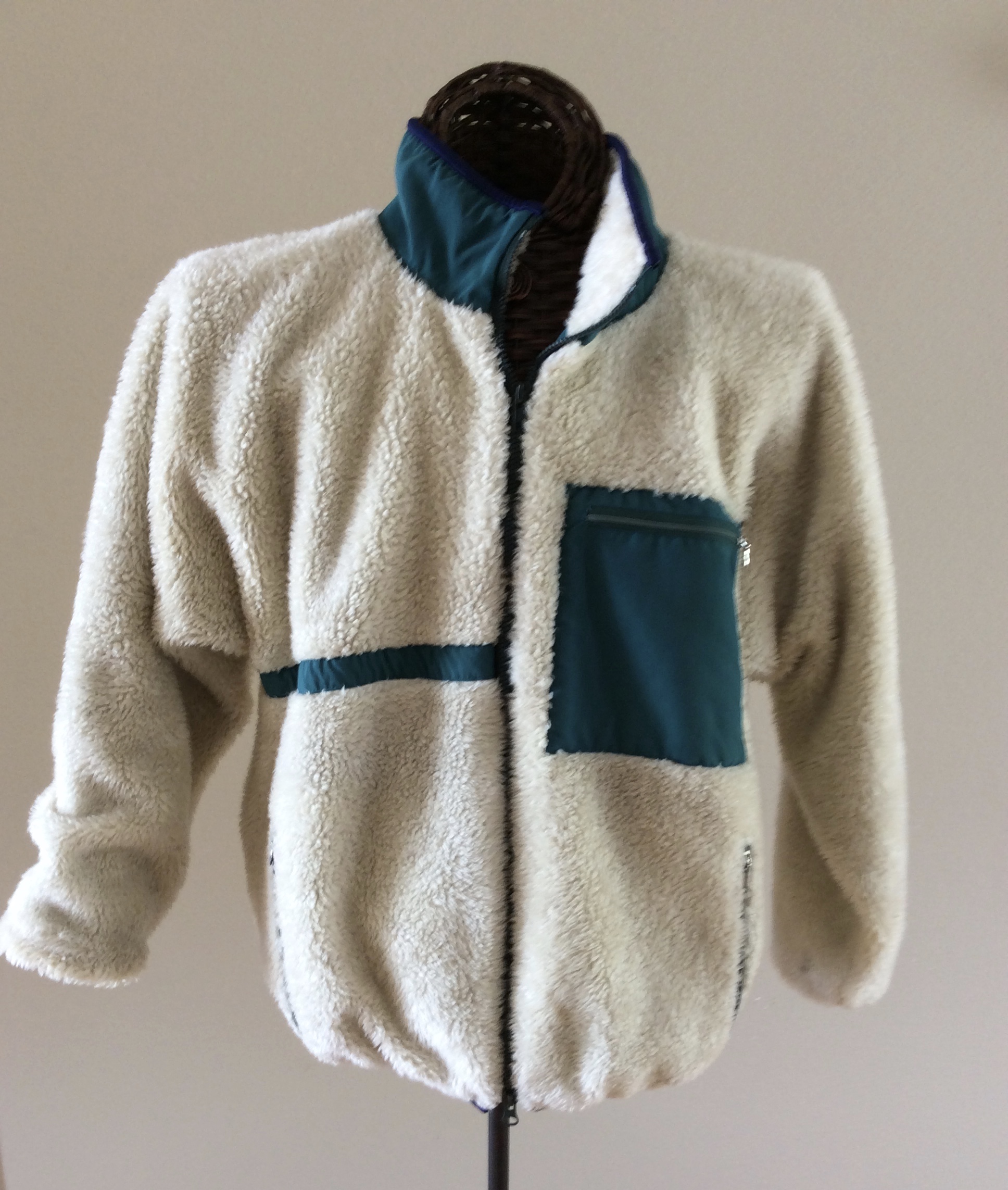
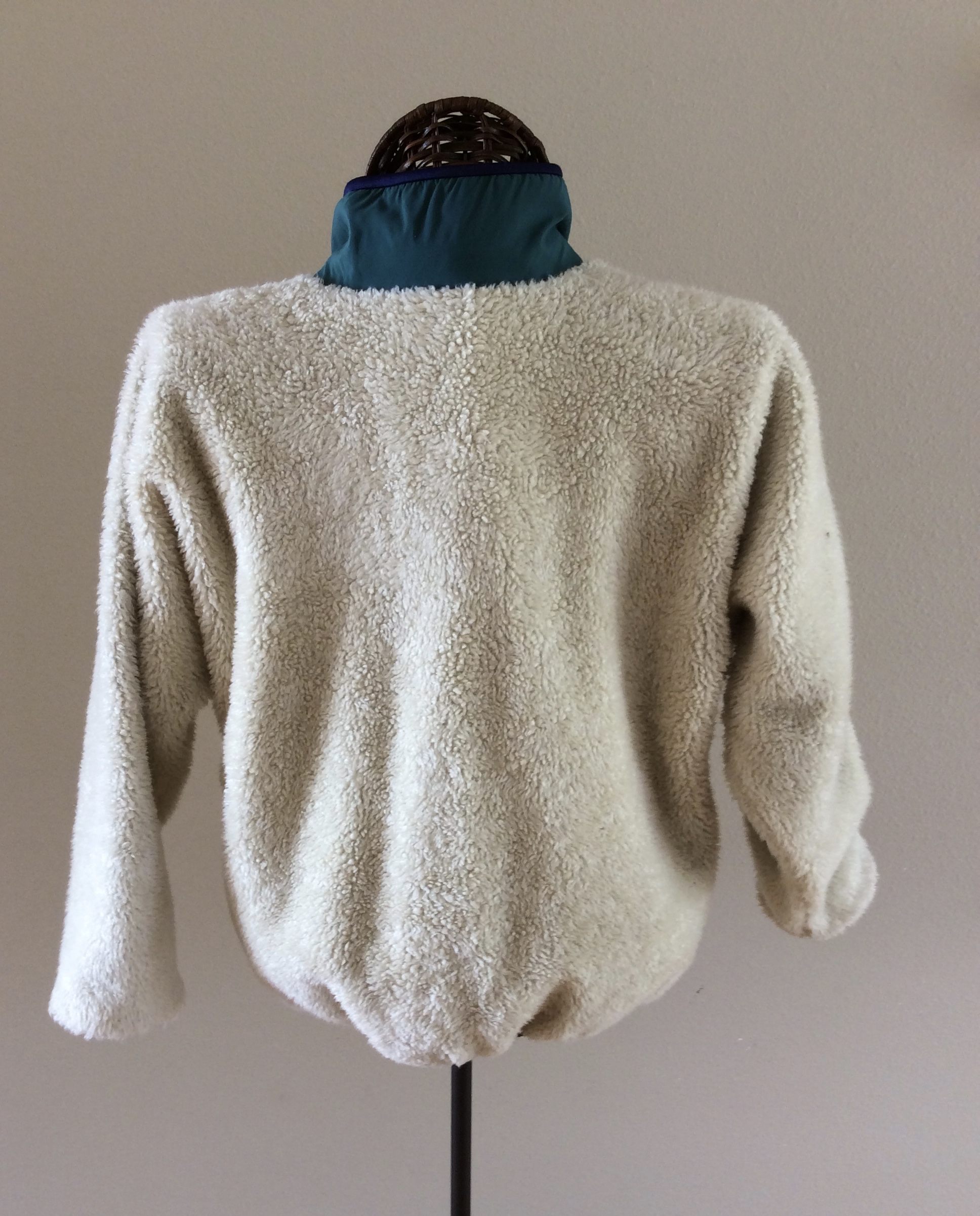
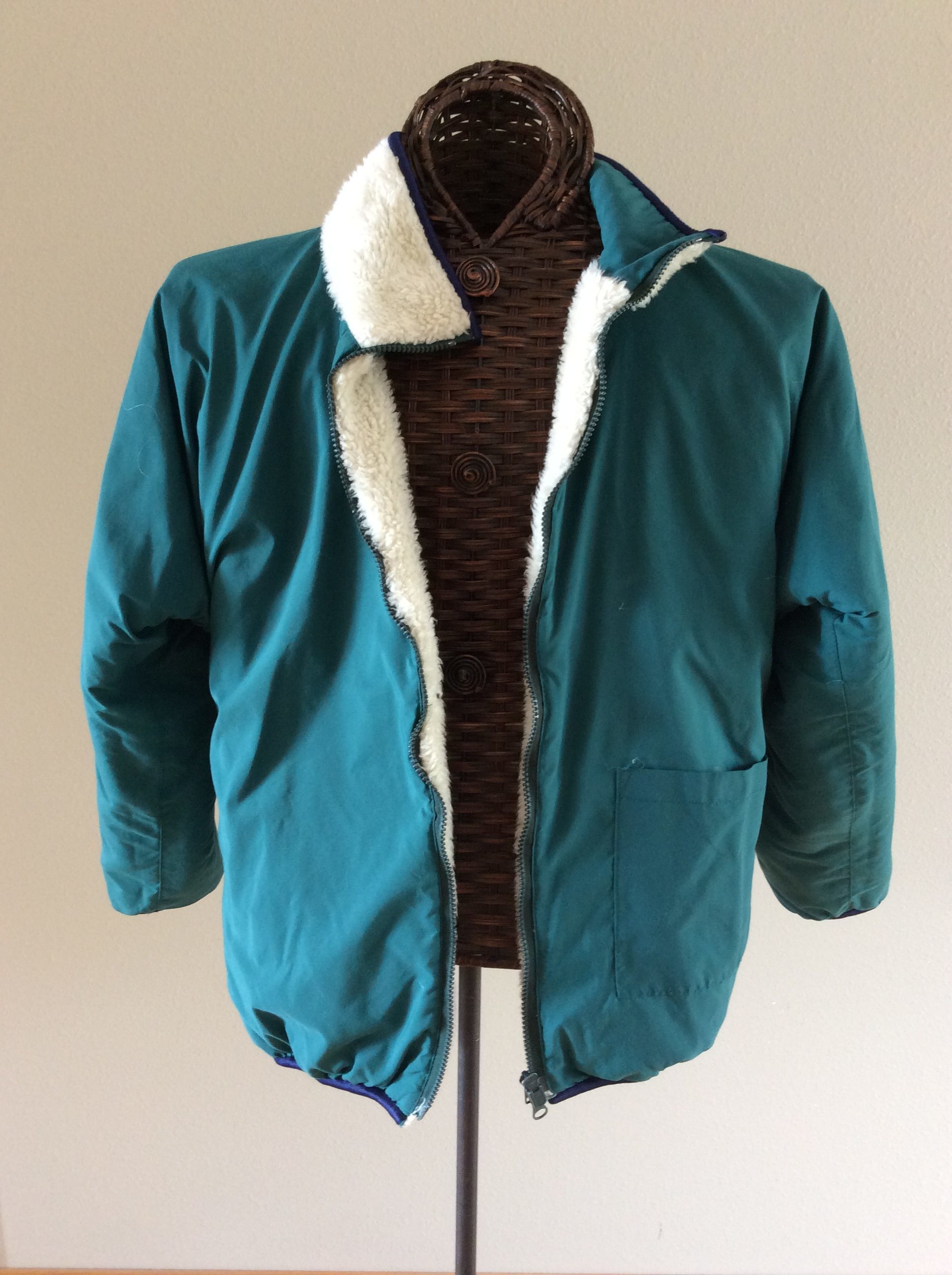
Made Fleece Jacket with
Two-Way Zipper


Have you wanted to sew outdoor recreation garments?  You know you could if patterns, outerwear apparel fabric and specialty hardware were to be found.  Well, am here to tell you all is readily available if you know where to look.  But first..

A Bit of Outerwear Apparel Background

Specialty RTW outdoor garments, e.g., skiwear, climbing gear, wetsuits, etc., are costly, difficult to find if a sportswear store is not nearby, and probably pretty boring in color and design.   And, fit is likely an issue, especially for extra tall or short figures.

Growing children require new outer wear every year; you’re lucky if they don’t outgrow mid-season.

I was in this situation when my three children were all on the ski team for multiple years.  Hand-me-downs weren’t possible with two girls and a boy.  Plus, the oldest daughter was 2″ shorter than her younger sister.  This was cause for much teasing, especially when she turned out to be taller than her younger brother.  FYI:  as adult sibs, it no longer seems to make a difference.

Pricey outdoor/winter clothing came to be a big issue with the family budget as MN climate requires warm gear for at least four months of the year.  Happily, the fashion was to wear athletic outdoor gear off the ski hill.  Therefore, only one jacket was required for daily wear and sports.

Outerwear Apparel History

Patagonia

Patagonia was an ‘In’ brand with skiers and much craved by my two daughters.  Recall the price was around $100 when this particular style came out.  Multiply that by two and there was no way the budget could handle it.

outerwear apparel fabric

Patagonia Classic Retro-X Fleece Jacket Photo courtesy Patagonia


The jacket above has proved so popular it is still in the Patagonia lineup.  It’s been updated to a Synchilla®  fabric made from polyester and recycled plastic beverage bottles.

The appealing feature at the time–other than the Patagonia label–was the light weight fabric and only one layer of fabric that was warm, windproof, and ‘bulkless’.  Outerwear of the day, provided warmth through bulk; the new tech fabrics were warm without bulk or weight that restricted movement.

Luckily I was able to find similar fabrics, zippers, etc., and hacked a pattern.  Remember, this is the 1980s–BI–Before Internet.

The fleece (nothing special, just poly) and purple lycra came from a local discount warehouse, SR Harris, still a favorite for Midwest sewists.

The two-way zipper and the teal Supplex lining probably came from an Oregon outerwear fabric store (more about that later).

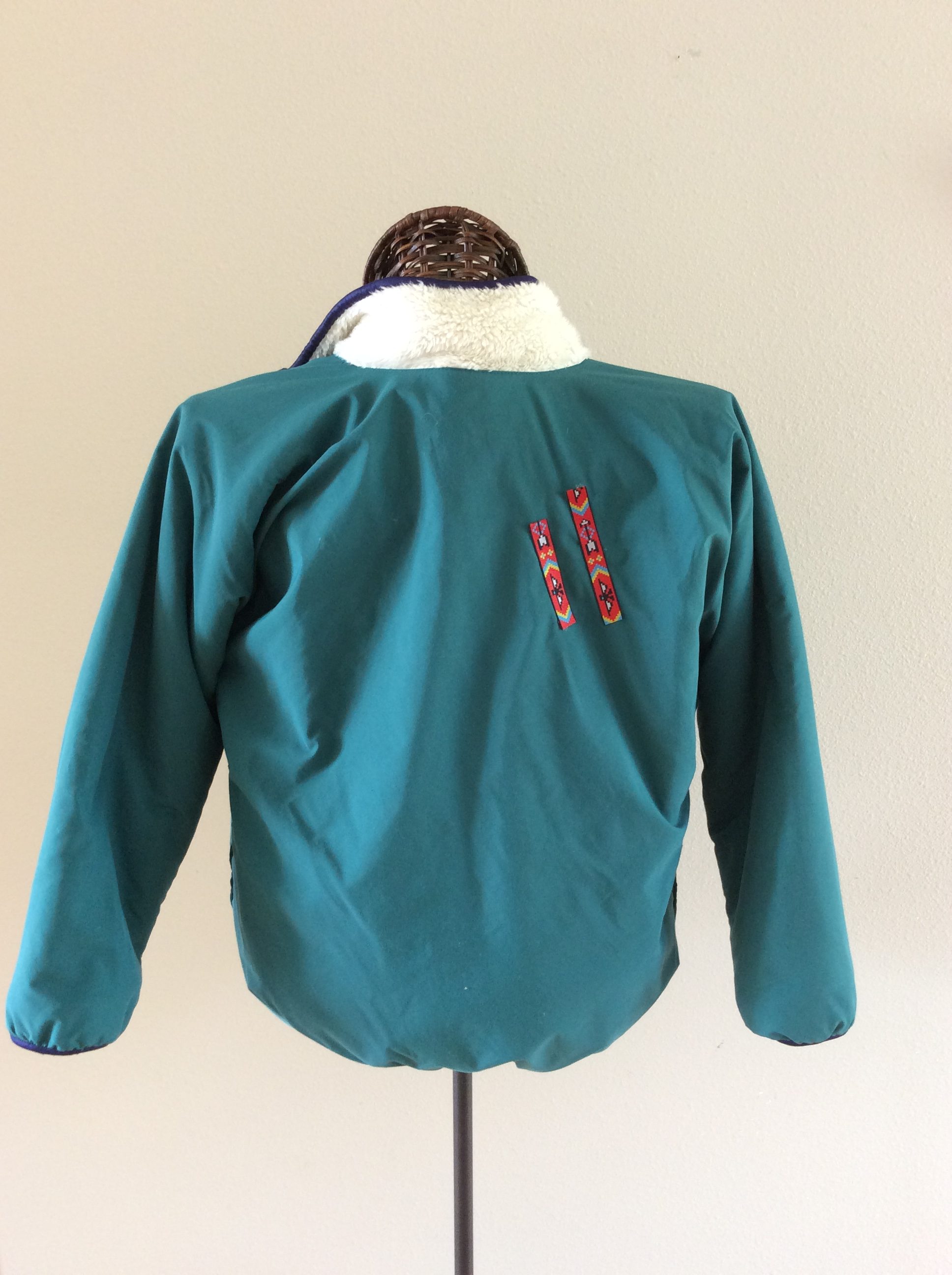
Here is one of the two Made jackets.  This one never left with the owner and is now mine.

The Supplex lining makes it pretty much windproof yet breathable.  The fleece will absorb rain but the lining keeps one dry.

The distinctive feature is the lycra swimsuit fabric gathering the wrist and waistband, and binding the neckband.  Copying this technique from RTW took a lot of surreptitious examination in department store fitting rooms.

Outerwear Fabric, Patterns, Hardware

I became acquainted with outerwear sources through sewing expos and mail ordered fabrics and patterns.  Now, most are available via the Internet.

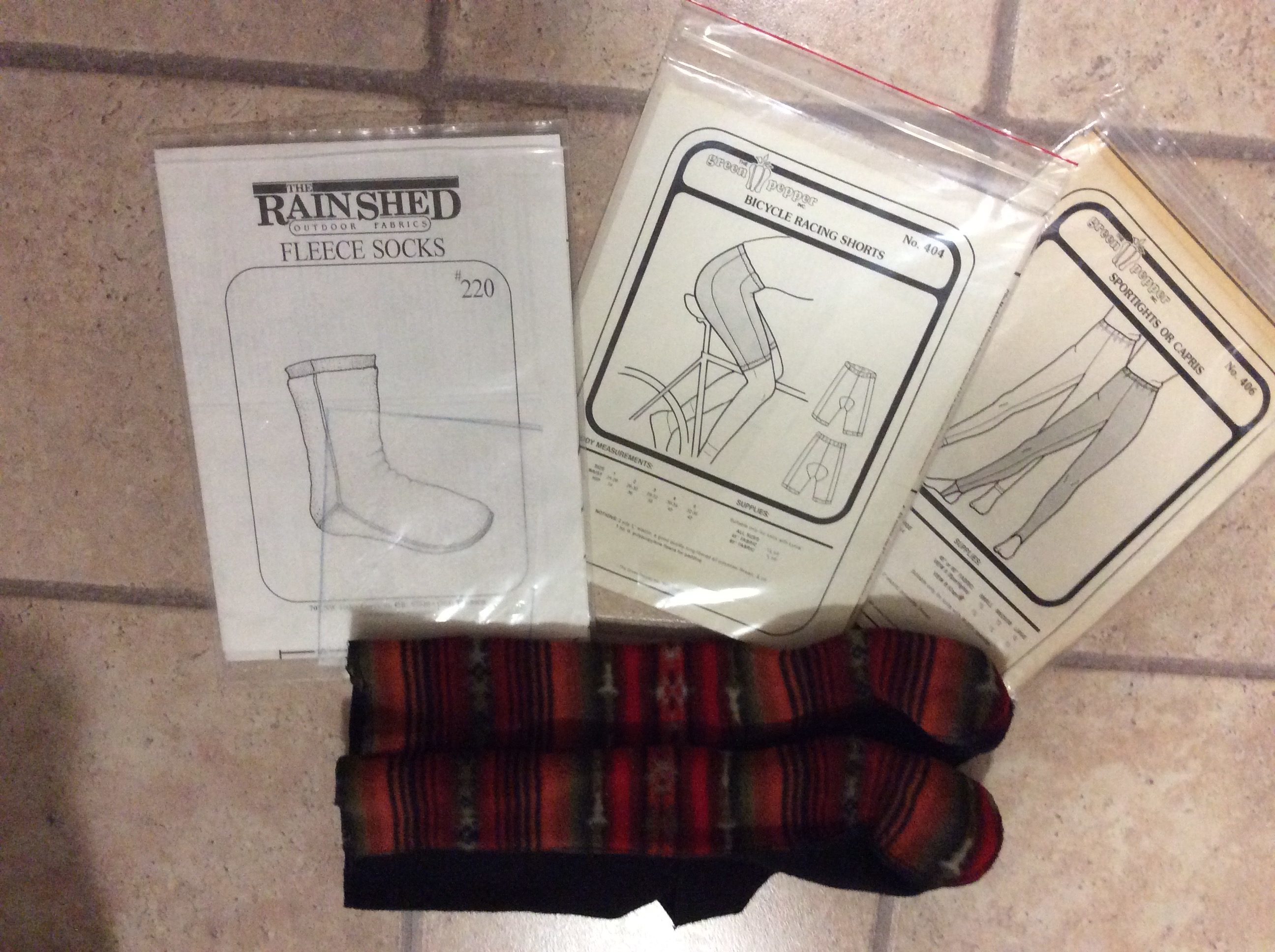
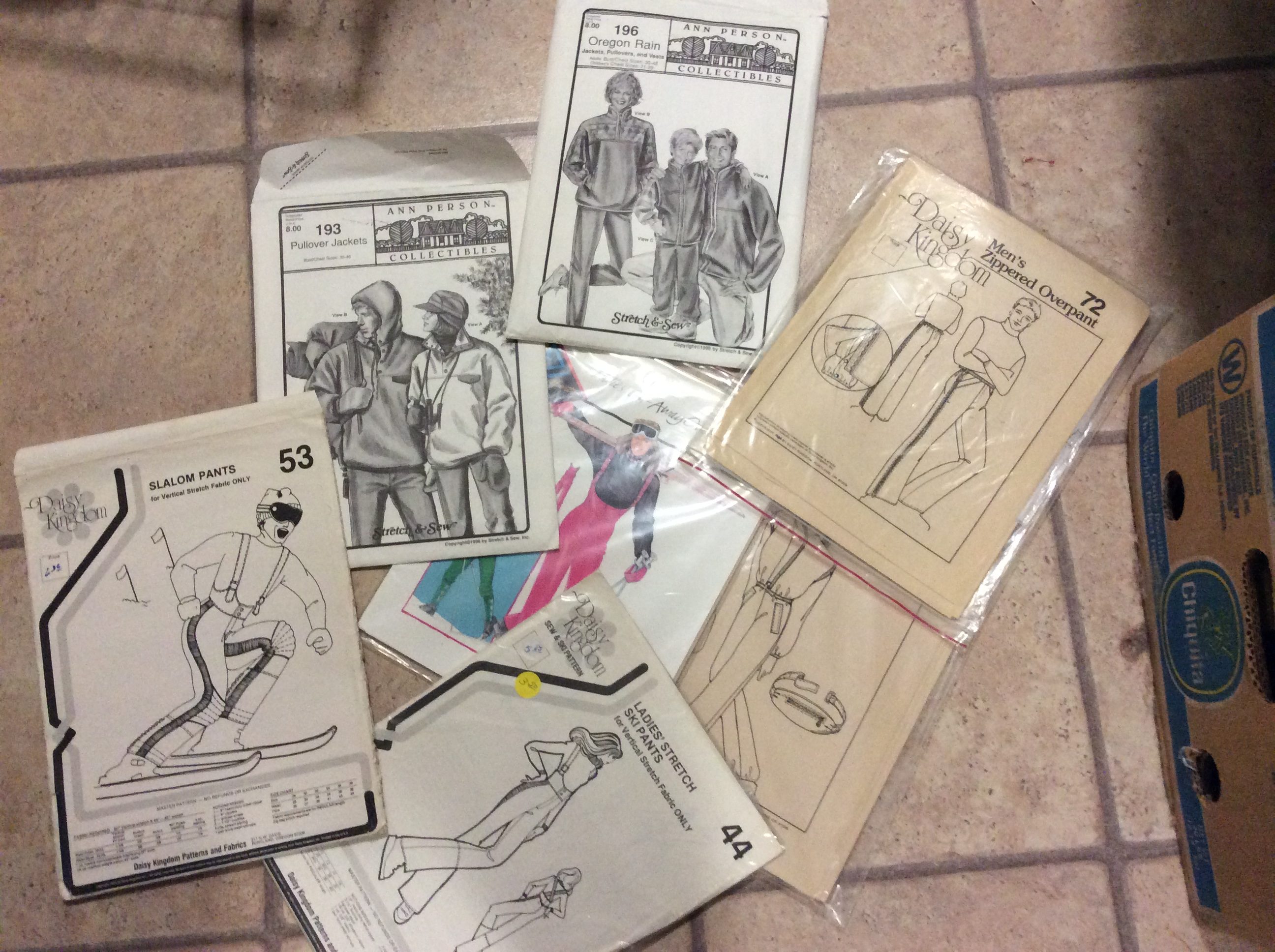
These are some of the patterns and swatches lurking in my back drawers.  Scroll down to see more pattern options.

When these outerwear patterns were first published, they were a breath of fresh air; the design was practically a duplicate of RTW.  Whereas, the Big 4 patterns, other than Designer, were hopelessly dated.  The translation of RTW fashion to pattern took a long time.

Most of these patterns are Indie patterns and were originally sold only by the owner.  Now, more and more are available on multiple sites.

This email from Butterick prompted me to write  as I know many of you will be champing at the bit to sew up your very own Made Outerwear Apparel now that you know everything you need is readily available.  Green Pepper, a popular outerwear pattern is now available on the Butterick site.


Outerwear Fabric and Notions Merchants.

The following are merchants I met at sewing expos in Minnesota, a good place to market outdoor wear DIY products.

Rainshed and Seattle Fabrics are from the Northwest, Oregon and Washington.  Both businesses apparently got a start looking for fabric sources to DIY the growing popularity of RTW outerwear.

When the fabrics and notions couldn’t be found at the typical fabric wholesaler shows, vendors were individually sourced and soon these businesses grew and grew and are currently active and popular.

Seattle Fabrics

Seattle Fabrics best offering, in my opinion, is their wide selection of neoprene in several thicknessess.  The fabric descriptions are detailed and will help you select the best option for your project.

outwear apparel fabric

Seattle Fabric–a few of their products.


The RainShed

RainShed has the most comprehensive collection of outerwear patterns.  You will find them to be fashionable and a good duplicate of what is out there in RTW.  These are just a few examples.

outerwear apparel fabrics

The RainShed Products


outerwear apparel fabrics

Green Pepper


outerwear apparel fabrics

Suitability Patterns


outerwear apparel fabrics

Stretch and Sew AKA Ann Person Patterns


outerwear apparel fabrics

Storm Mountain Patterns


outerwear apparel fabrics

Daisy Kingdom Patterns


outerwear apparel fabrics

RainShed Patterns


More Resources

Do not have personal experience with the next two resources but the websites looks promising.

Outdoor Wilderness Fabrics

Quest Outfitters


Posted in FIBER FASHION FUN | Tagged , , , , , , , , , , , , , , , | Leave a comment

It’s a Wrap! Breaking the Rules with Lois Ericson

Breaking the Rules with Lois Ericson

Lois Ericson

Lois Ericson

Lois Ericson was a forerunner in the field of home sewing education.  From her Salem, Oregon studio, she was sewing, experimenting, writing, self-publishing patterns, creating, and teaching locally.

Then, in the 1980’s, the formation of the American Sewing Guild (ASG) and their sponsored events, opened up outlets for many women who were quietly pursuing their sewing habits.  All of a sudden, sewing went from a solitary activity to a shared, community event.  People like Lois, Marcy Tilton, Roberta Carr, Sandra Betzina, Donna Salyers, Clothilde, Mary Lou Rankin, Mary Ellen Flury, now had a place to dispense their knowledge.  Best of all, we had–and have–up-front, close and personal access to the creative ideas, books, patterns, of these talented, charismatic people.

Have you noticed how sewers–and quilters, knitters, needleworkers, etc.–are such Fun, Interesting people? 


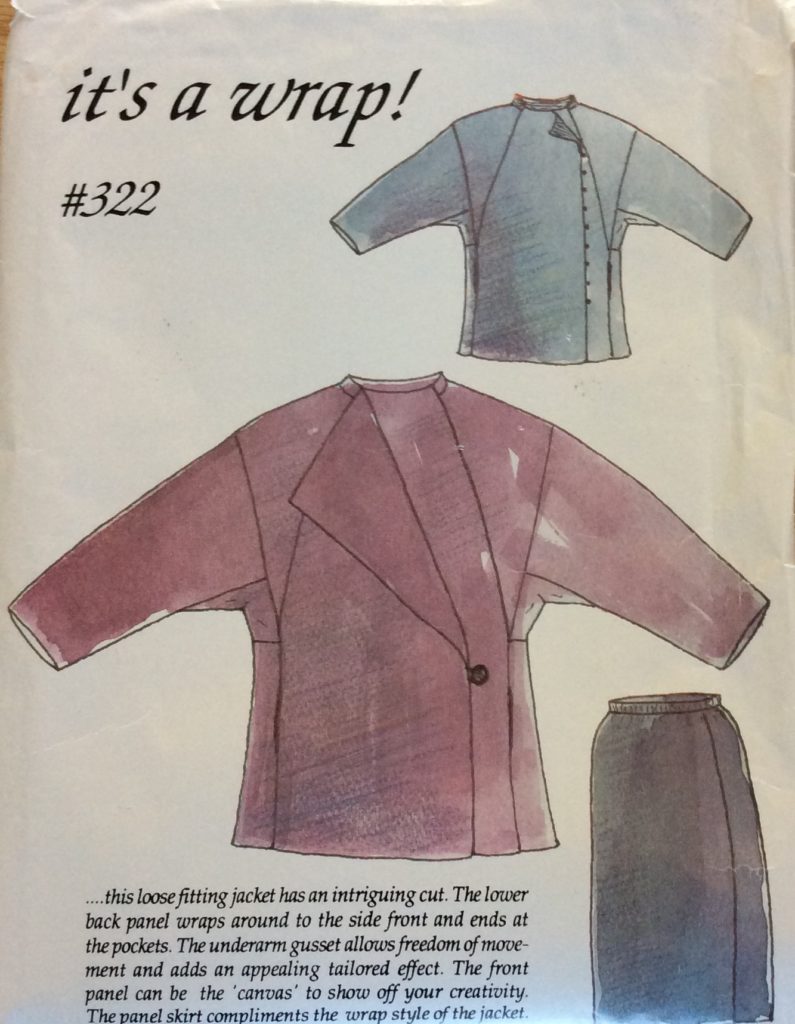
it’s a wrap!

Lois’ patterns recently surfaced in a rummage through my pattern stash.  By choosing ‘its a wrap!’ all sort of memories came flooding back of meeting Lois at sewing conventions, taking her classes and being excited by her creativity.

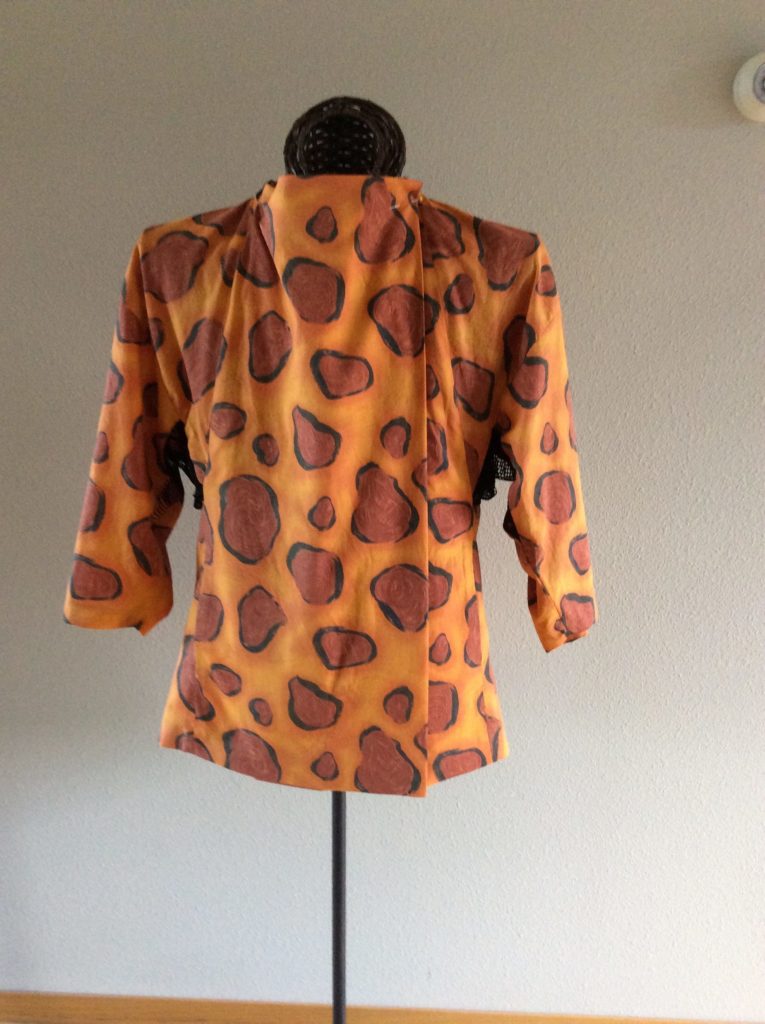
I chose a cotton abstract orange and black print from Fabrix in San Francisco.  It’s the perfect color for pre-Fall when trees are starting to turn from green to orange, red, and yellow yet the daytime temps are in the 70’s.

The fabric was in the discount bin so decided it would be a great ‘muslin’.  Turns out I love the fabric–just enough body, soft and supple, and doesn’t display a propensity to wrinkles.

And, love, love, love, the pattern.  Bonus–it has pockets.

http://youtu.be/0TLOsGfd1W4

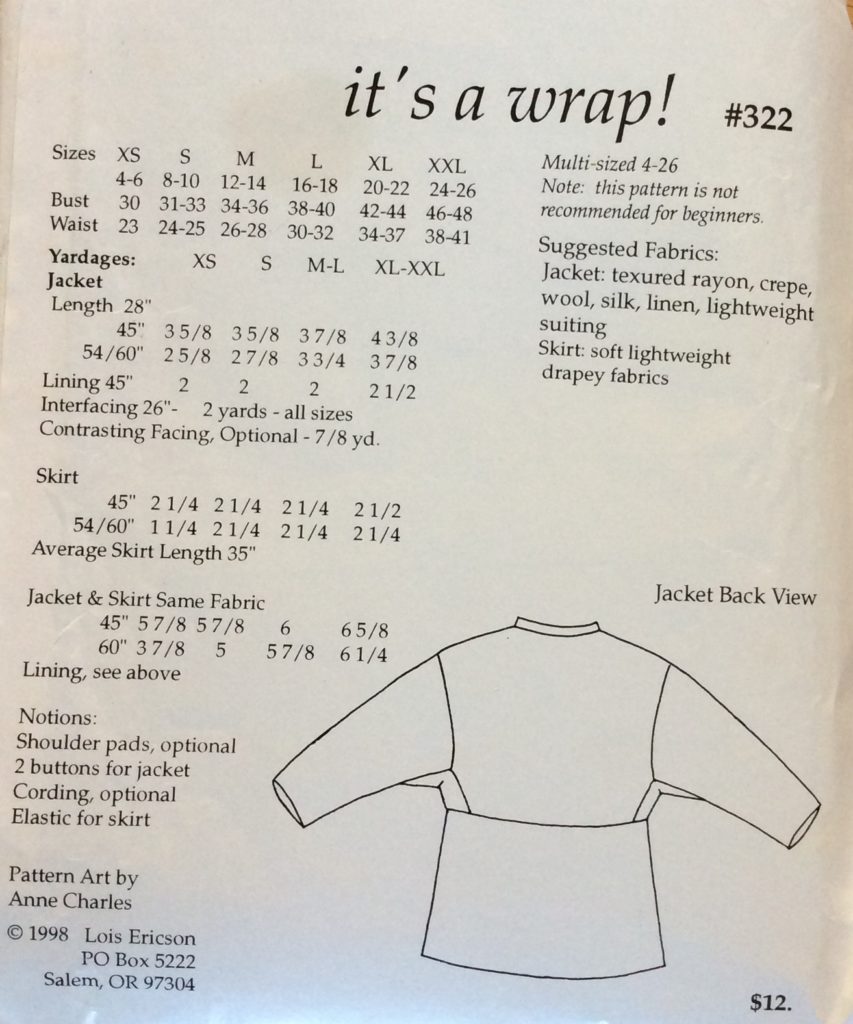
This is Not a Pattern for Beginners

The Guide sheet does say this pattern is not for beginners; wholeheartedly agree.  However, carefully following the instructions will take you through the most confusing–the gussets.

Decided the fabric needed a boost so found some Halloween mesh and added it as the gusset and the back neck band.


Finishing with Options

All was hunky dorrie until it came to placing button–

No Placement Mark; for the button loop, but not the button.  No big deal, will just try on, match center front…Wait, No CenterFront!  How can that be????

Tried on, lapped right front over left, positioned as best as possible per the pattern drawing.  Sewed on the button.  Glad I had figured out best way to sew on a shank button.

Took one last look at Guide Sheet to see if I’d missed anything.  Sure enough; missed the last page, Options.  Here were all kinds of creative suggestions for using the large front panel for quilting, beading, painting…

Then suggestions on how to fold and wear the overlap.  This is where I was inspired to add the mesh and lap right over left exposing the front panel mesh–photos above.

Creative Options are a feature of all Lois Ericson patterns.


Version I   BORING

 After all was sewn and done, added more mesh fused with my fave–Steam-a-Seam 2— to inside of left front and across back seam.

Version II


And, an Off-Center Lap

Horror of Horrors!  That front panel edge is on the straight grain, and now it’s placed off center?

Know what?  It works!

Lois Ericson

Off Center Lap


Lois Ericson Patterns to Inspire and Motivate

Here are a couple more Lois Ericson patterns in my stash and one other garment made in the late 90’s and still in my closet.  Another Shopping the Closet, not only for the clothes but for the memories.

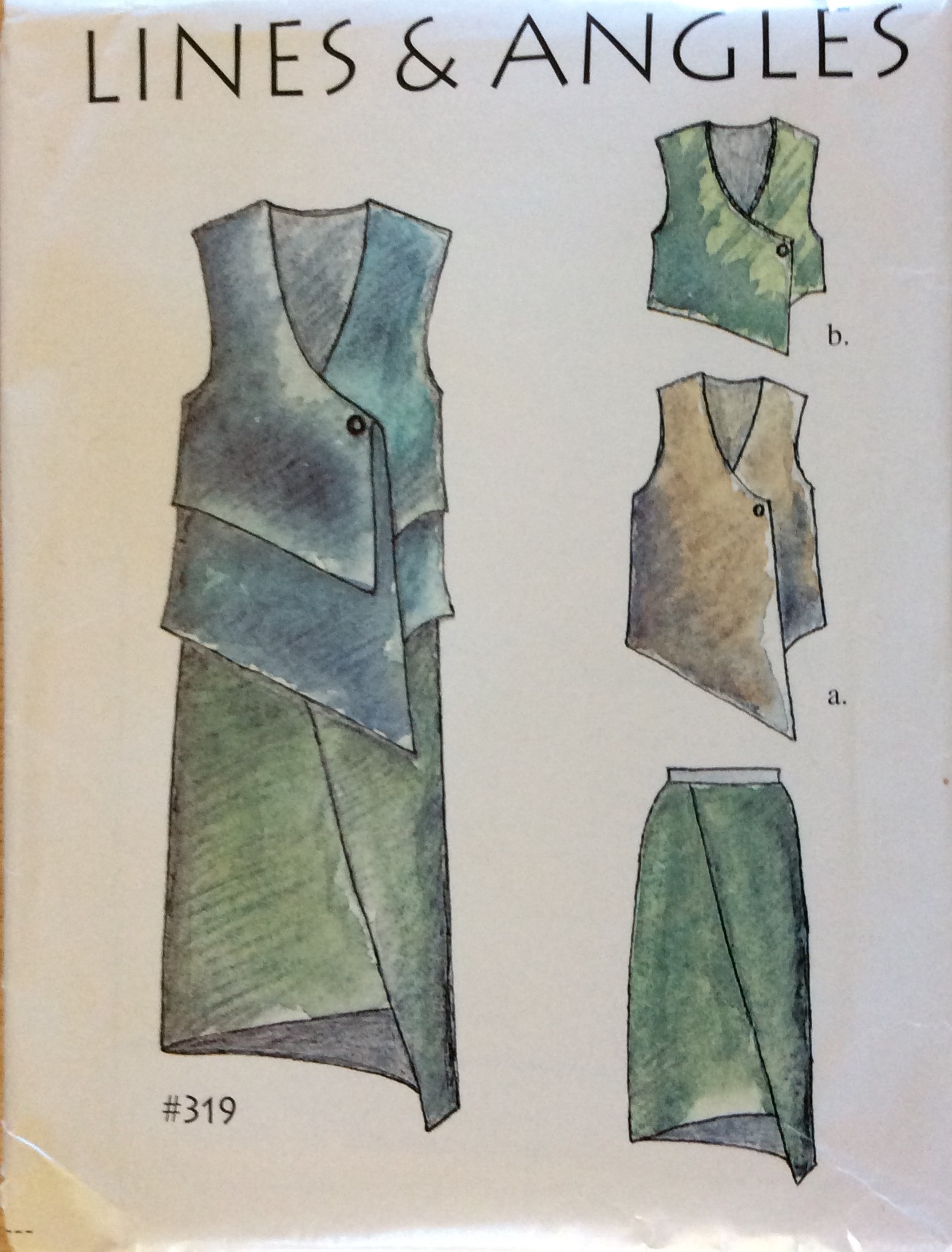
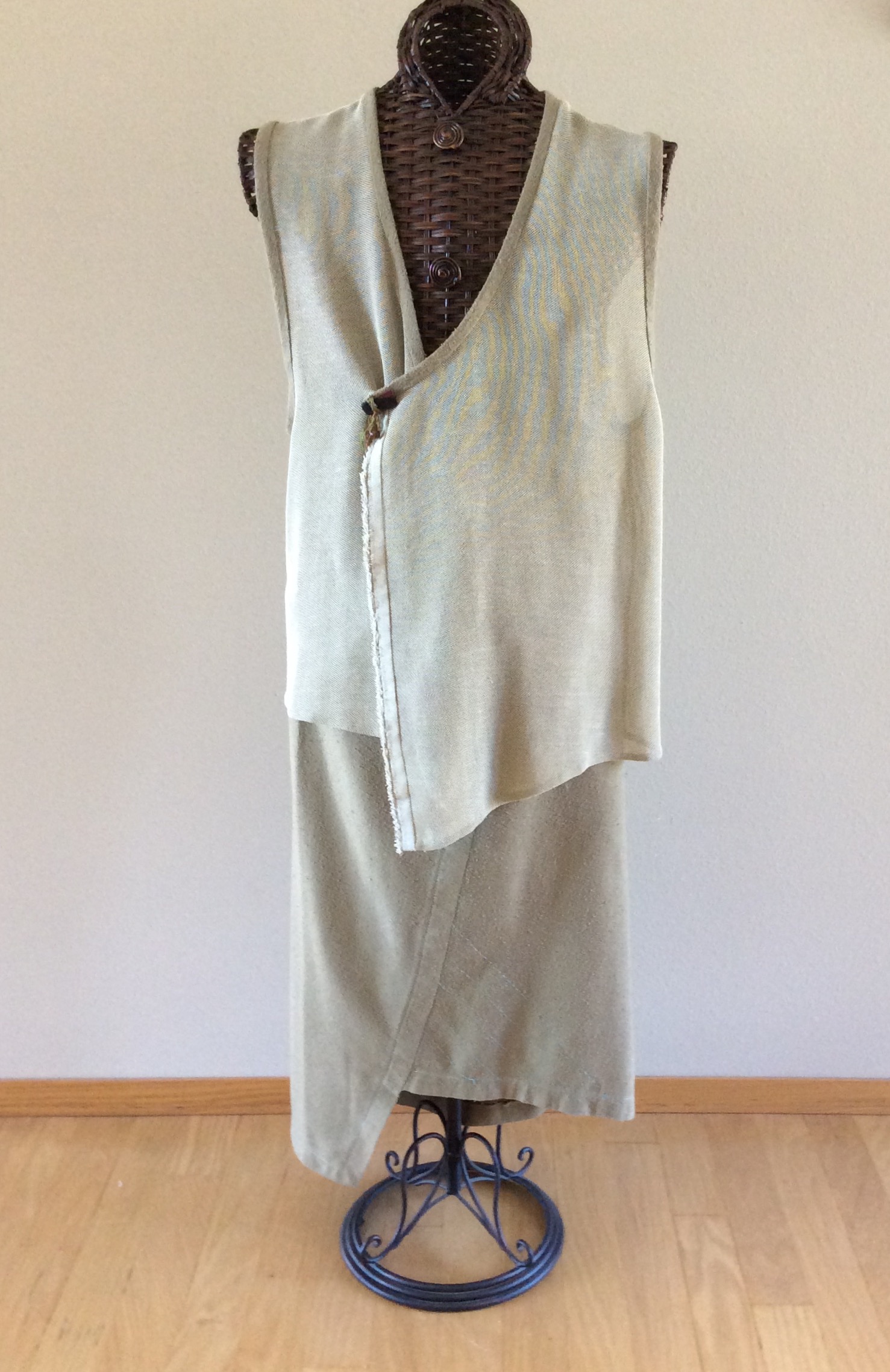
Lines and Angles Silk Noil and Bound Poly Mesh Vest

The skirt merits special mention.  It is one piece cut on the bias; an inspired design and a quick and dirty make.

Originally wore vest with a short sleeve sweater but will now consider wearing over a camisole

Books

These are some of Lois’ books available on Amazon.  You won’t go wrong purchasing any or all of them.

The links are offered as a convenience for you to review and purchase these recommended books.

FYI:  As a long-time Amazon customer, heartily recommend purchasing books on Amazon.  If not a Prime member with free shipping, keep a wish list and then make one purchase to meet the minimum.  Amazon has the best prices and is my go-to site to compare prices.

Below are affiliate links that will generate a bonus for me if you purchase by clicking on the link.  The bonus to me does not increase the purchase price.  In any case, thank you for shopping books by Lois Ericson.  You won’t be disappointed.


Lois contributed many articles to Threads over the years. Here are just a few examples of her great work.

Resist-and-Spray Technique for Dyeing Fabric
Textures: From Photo to Fabric
Master Class: More Great Fabric Manipulations
Unconventional Buttonholes

Thanx Lois, for granting permission to break the rules.

And, Thank You for thinking outside the box to inspire us all.

Related:

[lptw_recentposts layout=”thumbnail” post_type=”post” link_target=”new” category_id=”3″ space_hor=”10″ space_ver=”10″ columns=”2″ order=”DESC” orderby=”date” posts_per_page=”4″ post_offset=”0″ reverse_post_order=”false” exclude_current_post=”false” override_colors=”false” background_color=”#4CAF50″ text_color=”#ffffff” show_date_before_title=”false” show_date=”false” show_time=”false” show_time_before=”false” show_subtitle=”false” date_format=”F j, Y” time_format=”g:i a” no_thumbnails=”show”]


Posted in FIBER FASHION FUN | Tagged , , , , , , , | 1 Comment

SHOP THE CLOSET

Wardrobe Quandary?…Shop the Closet

I recently enjoyed a birthday celebration trip to NYC and as it was just a long weekend trip, I didn’t obsess about wardrobe–until the night before.  And then–I panicked!

A note about my daily wardrobe:  I am retired and live on a Lake in Midwest USA.  Summer weather is hot and humid.  On any given day I will probably be in the garden, on the beach, on the Lake.  My go-to wardrobe is a t-shirt/swimsuit top, shorts and flipflops.  If I need to go ‘to the store’, will switch out t-shirts, trade shorts for capri pants, and hose down the feet before slipping on sandals.

However, I do have a ‘work’ wardrobe that hasn’t been updated in the four years since I retired.  It also includes several–well, Many–pieces that can only be classified as Vintage.  I just can’t let go.  And now I’m glad I haven’t.

Fortunately, I remembered reading a blog about Shopping Your Closet.                                    The tag line is:   ‘Outside every closet is a woman who thinks she’s got nothing to wear.’

So here I am, standing in front of my closet…


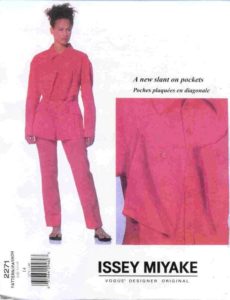
Issey Miyake Vogue 2271

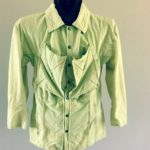
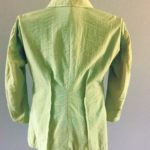
Eventually pulled out a pea-green Issey Miyake jacket from 1999.

Please forgive the photo color inconsistency; a difficult color to photograph.          True color is closer to the photo on the right.

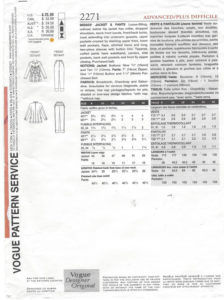
That particular jacket was made in 1999 from an Issey Miyake Vogue  pattern, 2271, now OOP and didn’t find on Etsy or eBay.

The jacket got used everyday in NYC , either worn in air conditioned buildings or stuffed in my tote.


Have been a fan of Issey Miyake since Vogue launched the Individualist patterns in 1984.

In the 90’s, Marcy Tilton was doing Pattern Reviews for Threads Magazine and I was asked to try the pattern and report.  However, the pattern had not been published so received a croquis printed on 10# white paper (or heavier) and no sewing guide–see Croquis photo above.  The pattern  was available by the time the article published, Issue #83, June/July 1999.

Luckily I had a bit of sewing experience and could figure out the bellows pockets; however, the notch in the collar back took consultation with several sew buddies.

Happened to have many yards of the pea-green crinkled nylon (I think it’s nylon; sure acts like it) and used it to make a muslin which turned out to be a wearable jacket.  The fabric makes for a rain-resistant and travel-friendly garment.  Have never ironed and launders  beautifully.

The only changes I made was to cut two garments and sew together for a self-lined jacket–perfect for this light-weight fabric.  The soft fabric drape is also perfect for the extended shoulder and the voluminous pockets.  Wouldn’t recommend the pockets for anything over a B bra cup.

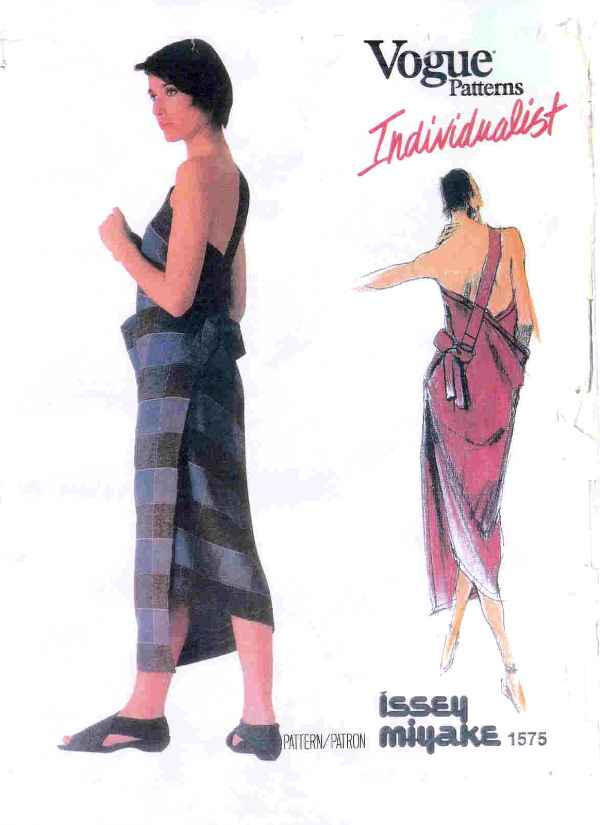
Issey Miyake Vogue 1575

Out of Sight, Out of Mind

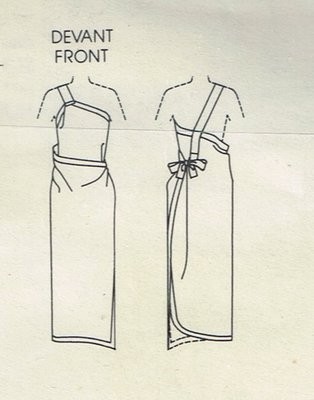
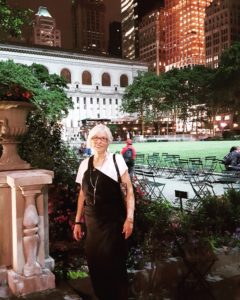
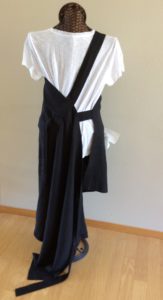
The next garment I fished out of an under-bed drawer is another Issey Miyake 1575 from 1985.

Hadn’t worn forever and couldn’t remember how to tie it on.  Thanx to my daughter and WiFi as it took two of us and Google to get dressed for a night on the town.

TIP:  don’t suggest going shirtless as it moves around as it is worn.


Fabric is a heavy slubbed linen/poly blend, in black.  Again, different lighting makes some of the photos appear to be navy.


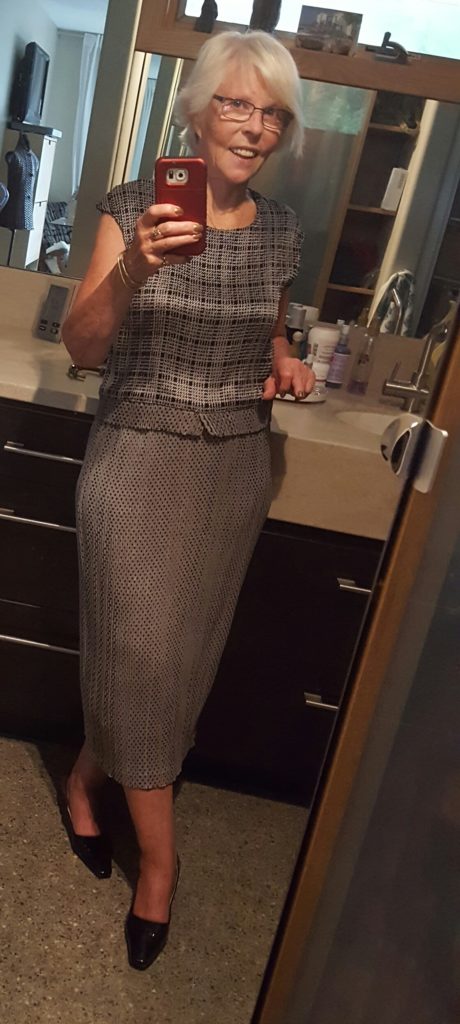
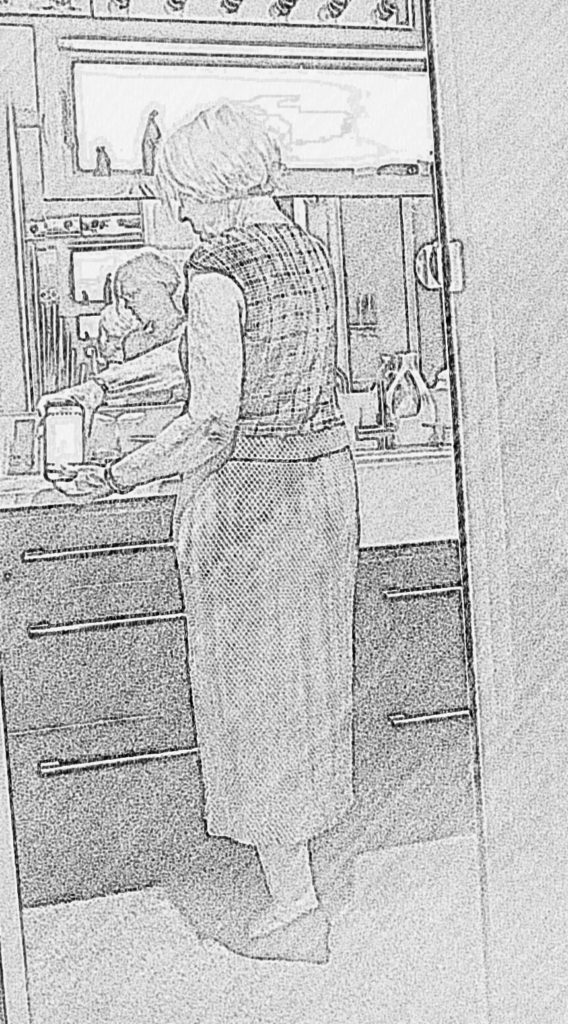
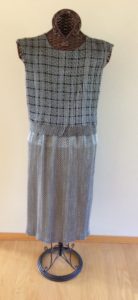
A Permanently Pleated Fabric Dress

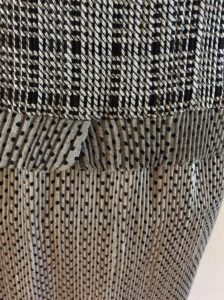
The third garment is more recent–within the past 12 years.  The fabric is permanently pleated silk in two coordinating designs.  The top waist band is the wrong side of the skirt fabric.

It’s the perfect travel dress as it’s a twist/roll and pack, shake out and wear garment.

Don’t recall what pattern was used, probably hacked.

At the time this was sewn, couldn’t find any patterns for using pleated fabrics so just winged it based on what I had seen in RTW.

  • Let fabric relax on cutting table; do not stretch out pleats as the ease from the pleats will be removed.
  • Size–draped on my body; didn’t want to stretch out the pleats but should just skim the body.
  • Do not stretch fabric flat when sewing or the seam/hem will be rippled.  I wanted a smooth seam (at Top band) and hem (skirt).  Sample, Sample, Sample.
  • For a rippled hem, I’d recommend a serger rolled-hem done while stretching the fabric flat.
  • Bonus–lengthwise seams disappear within the pleats.
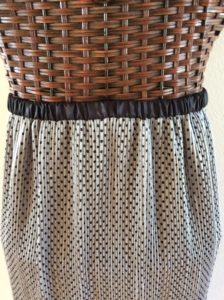
  • The skirt is a fabric width with elastic waist as determined above
  • Top–armhole and neckline is finished with a narrow zigzag and turned under 1/4″ and hand tacked in place.
  • Top Waistband–a strip of the skirt fabric folded right-sides-together, ends finished, stitched to top with 1/2″ seam allowance.  Finished ends are overlapped slightly at center front.
  • Skirt Hem–raw edge finished with narrow zigzag, turned up about 1.5″ to add some weight to the bottom, and gently hand-tacked in place without stretching the pleats flat.

With these three items from my closet, I was very well-dressed everywhere I went.       AND, I didn’t need to sew or buy anything just for this trip.

Happy shopping from your closet.  Let me know how it works for you?

On the Draft Board

Check back for an upcoming article on a a sewing pattern designed specifically for pleated fabric.

shop the closet

Tote

And all about my tote worn with the Issey garments.  This is the one thing I did purchase prior to the trip.


[lptw_recentposts layout=”thumbnail” post_type=”post” link_target=”new” tags_id=”123,260,330,245″ space_hor=”10″ space_ver=”10″ columns=”2″ order=”DESC” orderby=”date” posts_per_page=”4″ post_offset=”0″ reverse_post_order=”false” exclude_current_post=”false” override_colors=”false” background_color=”#4CAF50″ text_color=”#ffffff” show_date_before_title=”false” show_date=”false” show_time=”false” show_time_before=”false” show_subtitle=”false” date_format=”F j, Y” time_format=”g:i a” no_thumbnails=”show”]


Posted in FIBER FASHION FUN | Tagged , , , , , , , , , , , | Leave a comment

Can This Fabric be Saved?

Can This Fabric be Saved?


I recently bought about eight different fabrics at one time and one piece is cut incorrectly, plus, the fabric is horribly off-grain.  As you can see, the horizontal design is curved when it should be straight.

The edge closest to my blue toes (should I have cropped them out?  Nah!), is from the previous cut.  The edge at the top of the photo is how this piece was cut from the bolt.  Am guessing (since I wasn’t watching), it was cut from the ‘other’ side as the cut doesn’t follow the fabric design–it should.

off-grain fabric

One-half yard of a Nicole Miller fabric, acrylic, poly, ???

Fabric Grain refers to the direction of the threads/yarn that make up the fabric.  Woven fabric has two distinct grains–lengthwise and crosswise and they must be perpendicular to each other before cutting the garment pieces.

Knits also have a lengthwise and crosswise grain based on the ribs of the knit.

In any case, the design of the fabric should be straight, if that was the original intent.

Not measured at all evenly.

Not measured at all evenly.


This is a reversible, lace-type knit fabric and the ‘other’ side is the same as the white borders.  Can’t begin to tug the two layers apart so am surmising they are bonded together.  However, the fabric is quite soft and supple.

Because this is a Lace Knit, there is no ribbing to follow for grain, but can use the grey design.

Part of the distortion may be attributed to how it is wound on the bolt.                              This is a mechanical process and the fabric grain is often distorted due to the stretching.

You didn’t think there were Elves magically winding the fabric on the bolt, did you?

off-grain fabric

White Lace ‘Other’ Side


Straightening Off-Grain Fabric

This design fits in with the project I have in mind but it needs to be STRAIGHT.                    I tried various methods to straighten this off-grain fabric.

Here is what I did.

  1. Pulled the fabric on the diagonal and then the cross-grain/knit from both sides.
    off-grain fabric

    The ripples are from the cross-grain stretching.
    Lookin Good.

  2. Soaked fabric in warm water, spun out in the washer, arranged on floor to dry.  Aligned fabric edge with floor plank.
    off-grain fabric

    Fabric is drying.  Looks Good…

  3. Pressed with an Elna Press, a large shoe/plate and a lift-up lid.  The lid applies pressure when locked in place.  I smoothed the fabric in the shape I wanted, covered with a press cloth, spritzed with water and locked and loaded the lid.
    off-grain fabric

    Elna Press with pressed portion hanging down. Lookin’ even better!


There are many brands of presses. Elna was the first to come out with one and mine is an original.  Click on the link to see just one of the current Elna versions then scroll down the page to see other brands.

FYI: terrific for fusing interfacing.  Does several small pieces at once and large areas of body shapes.  The pressure is the key.
RESULTS

Sob???

In the end, nothing worked.
Fabric still is distorted.  My plan is/was to cut along each horizontal stripe of the design and sew it to another piece of fabric to make a collage of wide stripes–4″ or more wide.

Can you image how that would hang on the vertical?  It would pull the other fabrics off kilter.

off-grain

Other project fabrics

off-grain faabric

Final Result


off-grain fabric

A Return


Posted in FIBER FASHION FUN | Tagged , , , , , , | Leave a comment

Great Douglas County MN Get-Together aka Fair


fair

Douglas County Fair


A Review of the 2016 Douglas County Fair

Fairs are a staple here in the Midwest.  In July and August you can attend a Fair every week, many times, multiple locations.

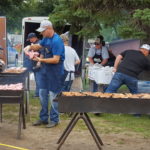
Fairs have been an institution since the first settlers arrived and needed a way to sell their products, socialize with their widely separated neighbors, and obtain bragging rights for their produce and farm animals.

I grew up in McCleod County, MN, and, at that time, the Fair was in September, after school started.  The Fair was so important to the community that school was closed for several afternoons so we could attend.

Minnesota became a State in 1858 and the McLeod County Fair was established in 1872.

I now live in Douglas County, MN, where the Fair is still an important and well-attended community event.  As the area has become more urban than rural, the Fair has incorporated events for all community members but still features rural activities such as animal husbandry and farm equipment.

MACHINE EXHIBITS

At one time, a Huge part of any Fair was the farm equipment exhibit.  Machinery Hill separated the men and boys from the women and girls.

Machinery Hill now doesn’t exist–even at the State Fair–or a small semblance may contain lawn mowers, snowblowers and ATVs.

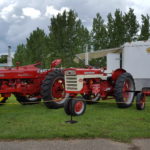
In 2010, Machinery Hill at the MN State Fair, sported Vintage tractors and other farm implements–all motorized.

There is a distinctive sound to each brand of tractor that anyone growing up on a farm can identify just by sound.


A TOUR OF THE DOUGLAS COUNTY FAIR 2016

Heritage Event

Heritage Event

Heritage events are a large part of the Fair as you can see from the signboard.


FAIR FOOD

If Rommegrot and Lefse are not to your liking, there is plenty of other food.  You won’t see Krazy fried food combos here that are at the State Fair.

But you will see:


FAIR OPEN CLASS EXHIBITS

This is where you will find sewing, crafts, jams, pies, cakes and cookies, and more….

fair


4H AT THE FAIR–HEAD, HEART, HANDS, HEALTH

I pledge my head to clearer thinking,
My heart to greater loyalty,
My hands to larger service,
and my health to better living,
for my club, my community, my country, and my world


4H exhibits are by far the largest group at the Fair.  Once just for rural youth, now an International organization for all youth–rural and urban.

A small sample of the projects on display.

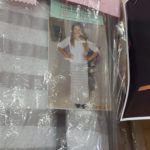
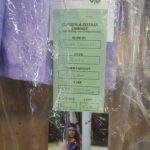
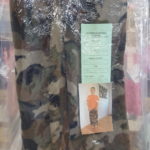
Clothing projects can be Purchased or Made.  Purchased focuses on quality, cost, use, care, suitability, all good things to keep in mind to defeat impluse buying.

The Rube Goldberg Projects

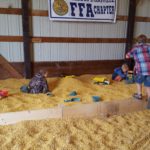
CHILDREN’S BARNYARD

Sponsored by Future Farmers of America–FFA

World’s largest agricultural youth organization that trains young adults for careers in the vast industry of agriculture.

FFA Children's Barnyard

FFA Children’s Barnyard


4H ANIMAL EXHIBITS

wp-1472242700547.jpg


The Auction is a bittersweet end to a year of raising a 4H animal entry.


And Then There Is Everything Else

Merry-Go-Round has no music ?


FINALLY, NO FAIR IS COMPLETE WITHOUT…


Related Posts

[lptw_recentposts layout=”thumbnail” post_type=”post” link_target=”new” authors_id=”2″ tags_id=”39,68,158,175,180,210″ category_id=”8″ space_hor=”10″ space_ver=”10″ columns=”2″ order=”DESC” orderby=”date” posts_per_page=”4″ post_offset=”0″ reverse_post_order=”false” exclude_current_post=”false” override_colors=”false” background_color=”#4CAF50″ text_color=”#ffffff” show_date_before_title=”false” show_date=”false” show_time=”false” show_time_before=”false” show_subtitle=”false” date_format=”m/d/Y” time_format=”g:i:s a” no_thumbnails=”show”]
Posted in OUT AND ABOUT | Tagged , , , , , , , | Leave a comment

Snoop Shopping While Out & About

Snoop Shopping

Took a day off to head to the TC of Minneapolis/St. Paul, MN, to stock up on the fantastic storage items I always find at Ikea and do some Snoop Shopping at MOA, which is, conveniently, right across the street from Ikea.

IKEA

A few of the items that came home from Ikea


MOA and Nordstroms

Only had two hours for lunch and shopping so went directly to 2nd floor Designers.  No sense messing around with anything under $500.  To be perfectly clear, am Snoop Shopping–not Buying!  Looking for inspiration for fashion and sewing techniques/finishes.

Lanvin

This struck me for the dress draping and the fabric.  The skirt is a metallic floral brocade pencil skirt; the blouse is a silk long-sleeved in a stylized floral print.  The juxtaposition of the prints is attracting me and will be looking for something similar.

Lanvin snoop shopping

Draped dress of doublecloth; silk blouse with pencil skirt

The draped dress is a doublecloth; the wrong side is a reverse of the right side–white with black dots.  The armhole edges are finished with narrow petersham ribbon–not the stiff poly stuff called grosgrain, but the soft, flexible petersham .  Here’s a link to Susan Khalje’s definitive article on Petersham from Threads magazine.

Akris

Drooling over this digital border print fabric in a simple long-sleeved dress.  The dress has a mock turtle neck with a zipper up the front.  The french seams from the shoulder curve to the side seam with a zipper pocket at the end of seam.  Couldn’t have done that without flexible zippers.

Akris snoop shopping

Akris doublecloth dress with digital animal border print. Those are ‘snowflakes’ on the rest of the dress.

This is also a doublecloth fabric, fiber unknown–was undercover taking this photo, so didn’t get to read all the labels.  You can see the inside of the fabric on the turned back cuff; it’s a finely woven grey fabric.  The two fabrics woven together are quite soft and supple.

Edges are finished as for Doublefaced fabric–split fabrics and turn edges into each other, slip stitch folded edges together.    Doublefaced and doublecloth are similar construction; have only seen doublefaced in wool, but then, could have missed something.  Doublecloth tends to be cotton and/or blends as the above two.  Will be looking for more doublecloth fabrics.

Handbags

On my way out, walked by the Handbags and right in front was this bag from Akris.shoulder tote

When I got home, I dug out this bag I made sometime ago from Vogue 8760.

Vogue 8760

Vogue 8760

shoulder tote


shoulder tote

Tote with fabric front and vinyl trim and back

Shoulder tote

Tote with back panel to slip over suitcase handle


Shoes

Guess what?  Shoe department is directly across from Handbags.  This pair struck me.


And these are ones I bought before my trip to NYC.  Wanted a slipon–TSA demands shoe removal–and stylish comfort.

platform sneakersYeah, they are White!

But–only pair left, in my size, slipons, extremely comfortable.

Brought them home and then figured out how to make them Black.


Vinyl spray dye

platform sneakers

Spray dyeing shoes.


Found this vinyl and fabric spray dye at an automotive supply store but also at Amazon. 

Taped the white platform soles and stuffed the insides with paper and sprayed away.

They are the perfect shoe for traveling and lots of walking.  Plus they are fashionable and look good with dresses, skirts, leggings, jeans…

Please note these have been worn all over the streets of NYC so the insides are not pristine and neither are the white soles–that’s Dirt!  Will scrub them up before I wear again.  Bet I’ll be resorting to white shoe polish.  Did you ever do that to your White Buck shoes?

Platform Sneakers

Ta Da


Hope this may have inspired you and don’t forget to do your own Snoop Shopping.  Never know what you’ll come across.

Happy weekend!

Related Blog

What A Hoot

[jetpack-related-posts]

Posted in FIBER FASHION FUN, OUT AND ABOUT | Tagged , , , , , | 1 Comment

33 Steps and One Secret to Sewing on a Button

Sew on a Button with a Thread Shank


33 Steps–That got your attention.

Actually, it may be that many, as have tried to include all the tips and tricks I’ve accumulated.  And want this to be the be-all, end-all button sewing tutorial.

Sewing on a button isn’t difficult but it seems to be the ‘bugaboo’ of all sewing tasks.  Have you ever babied a dangling button just to avoid having to sew it back on?  Well, here’s the scoop on sewing on buttons that will always look good and last.

Just remember the following Secret and Tip:


A Thread Shank is the Number One Secret

That’s the extra thread between the button and the fabric that provides room for the correct seating of the buttonhole under the button.  A thread shank is absolutely necessary for thick fabrics but is even advantageous for shirts and blouses.  The shank also is a strong attachment as it is firmly wrapped with thread providing strength through more thread and more abrasion resistance.  Abrading of the thread is the #1 cause of missing buttons; the buttonhole moves back and forth under the button as the garment is worn, buttoned and unbuttoned.

No. 1 Tip for Sewing on Buttons

Do not use knots–at beginning or end of stitching.  Typical place for knots is on the wrong side; it’s just going to rub off during wear, and pretty soon the button is loose/lost.

Knots under the button get in the way of the shank, plus they too rub off due to abrasion from the buttonhole.


Tools

Tools

Tools

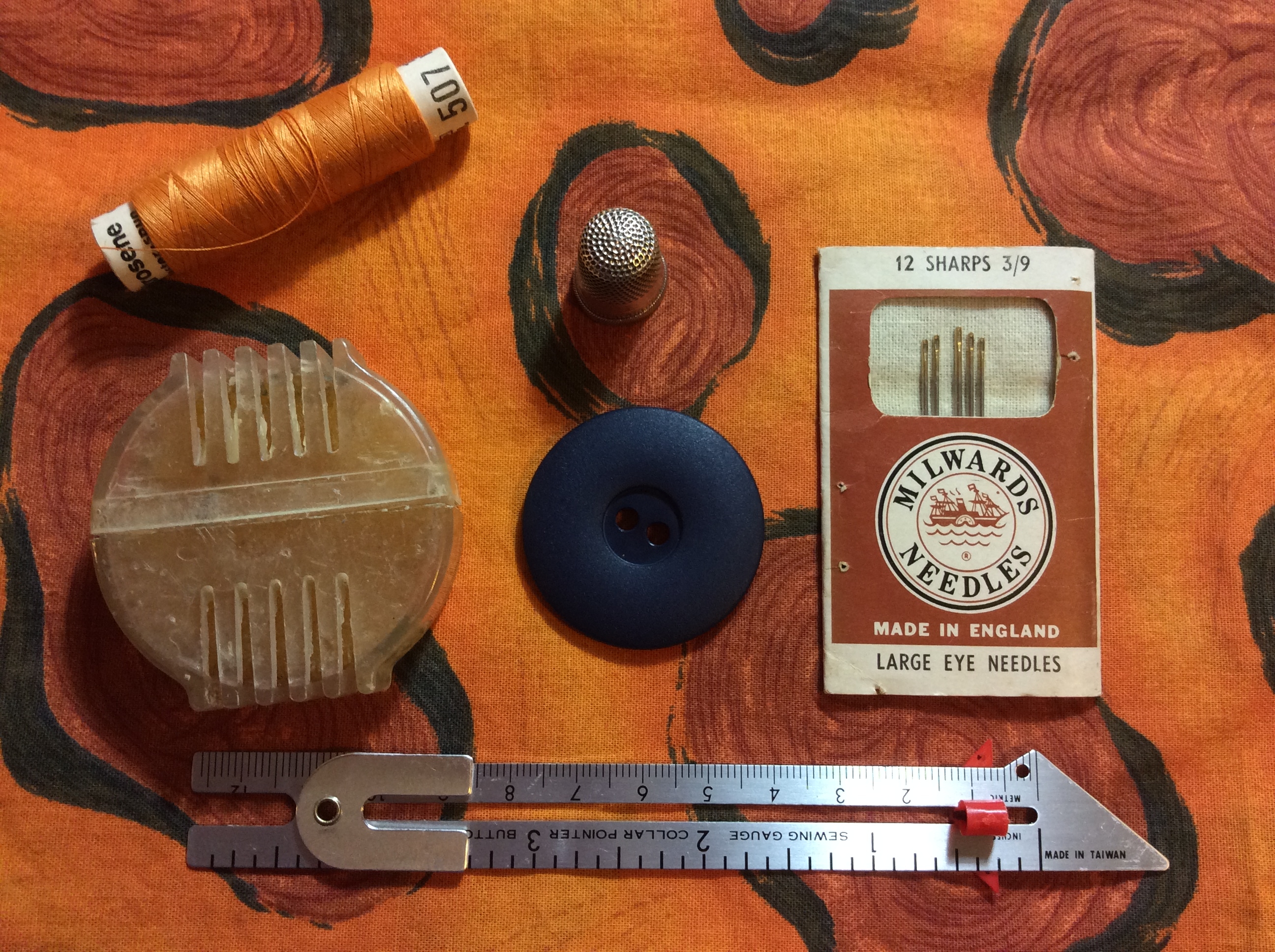
  1. 3″-4″scissors with sharp points; easy to get in tight spaces and nip threads
  2. Beeswax; this comes in a holder that separates threads for complete coating.  Wax strengthens the thread, prevents knotting, eases needle threading.  You can also use it to improve the glide on dresser drawers.
  3. Seam Gauge with Button Spacer
  4. Sharps Large Eye Hand Sewing Needles.  Sharps are an all-purpose needle with a round eye for easy threading.  The larger the size number the thinner the needle shaft.  For thick or stiff fabrics, a size from 1-4 means a thicker shaft that won’t bend/break when pulled thru the fabric.  An assortment of sizes in the 5-10 range will provide needles for most hand sewing needs.
  5. Thread–all-purpose polyester thread has high breakage and abrasion resistance–the button hole edges will rub on the thread.  Use a double strand of thread so less stitches are needed to secure button; 3-5 stitches through the holes is sufficient, any more and it just looks messy.
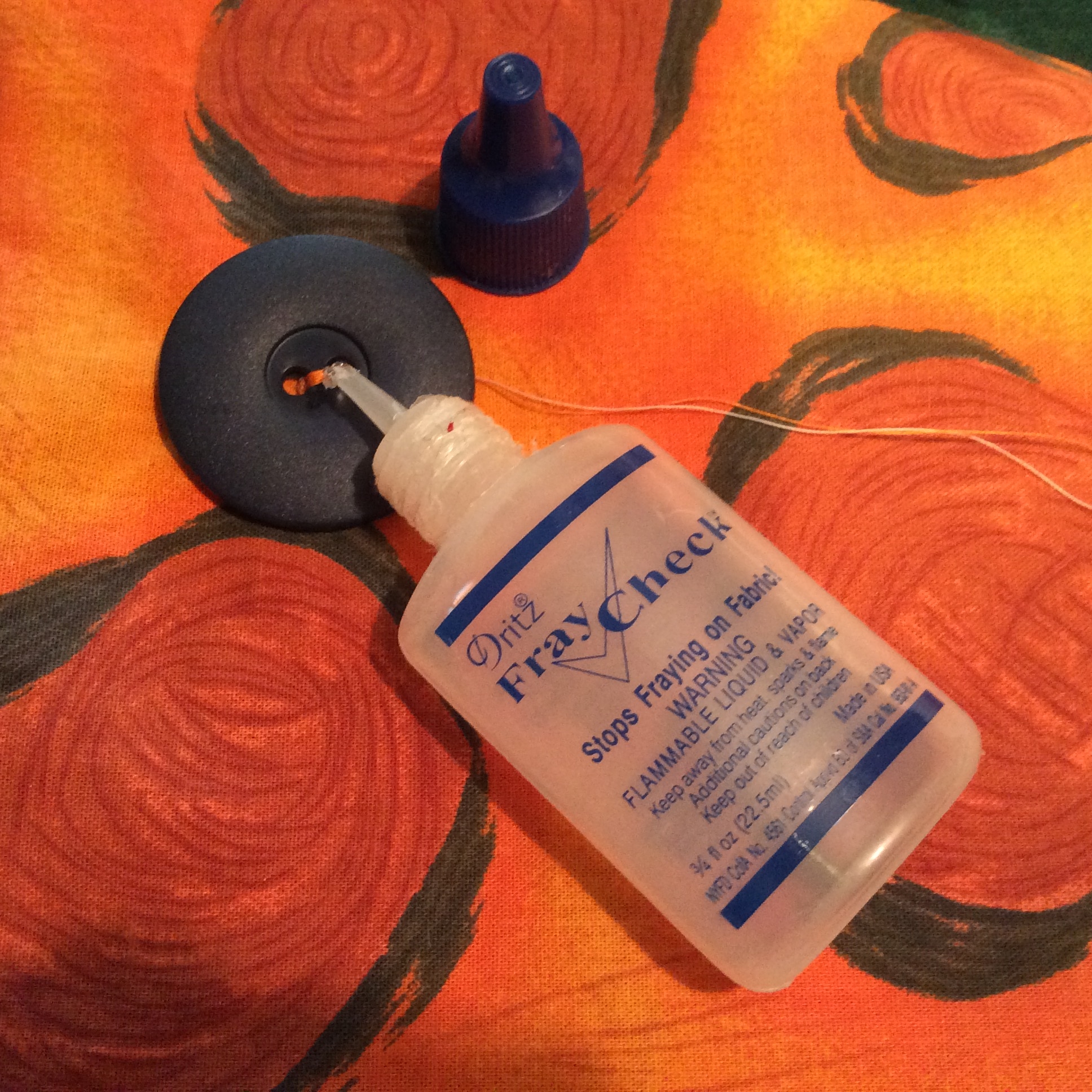
  6. Fray Check/Seam Sealant secures thread ends and fabric fraying.  It is washable and dry cleanable.


Button Sewing by Hand

sewing on a button

Draw thread over beeswax separating strands for full coverage.


Sewing on a button

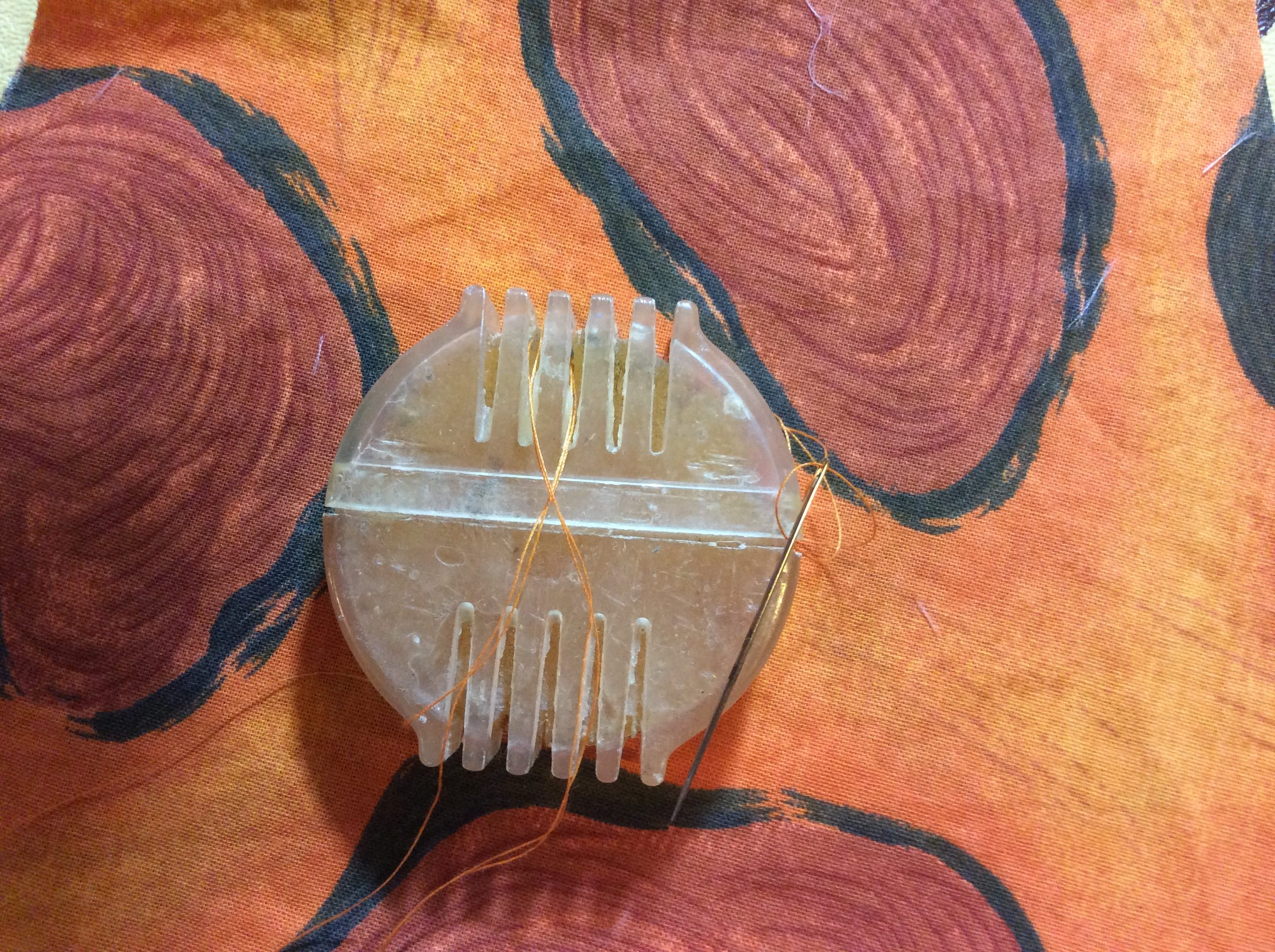
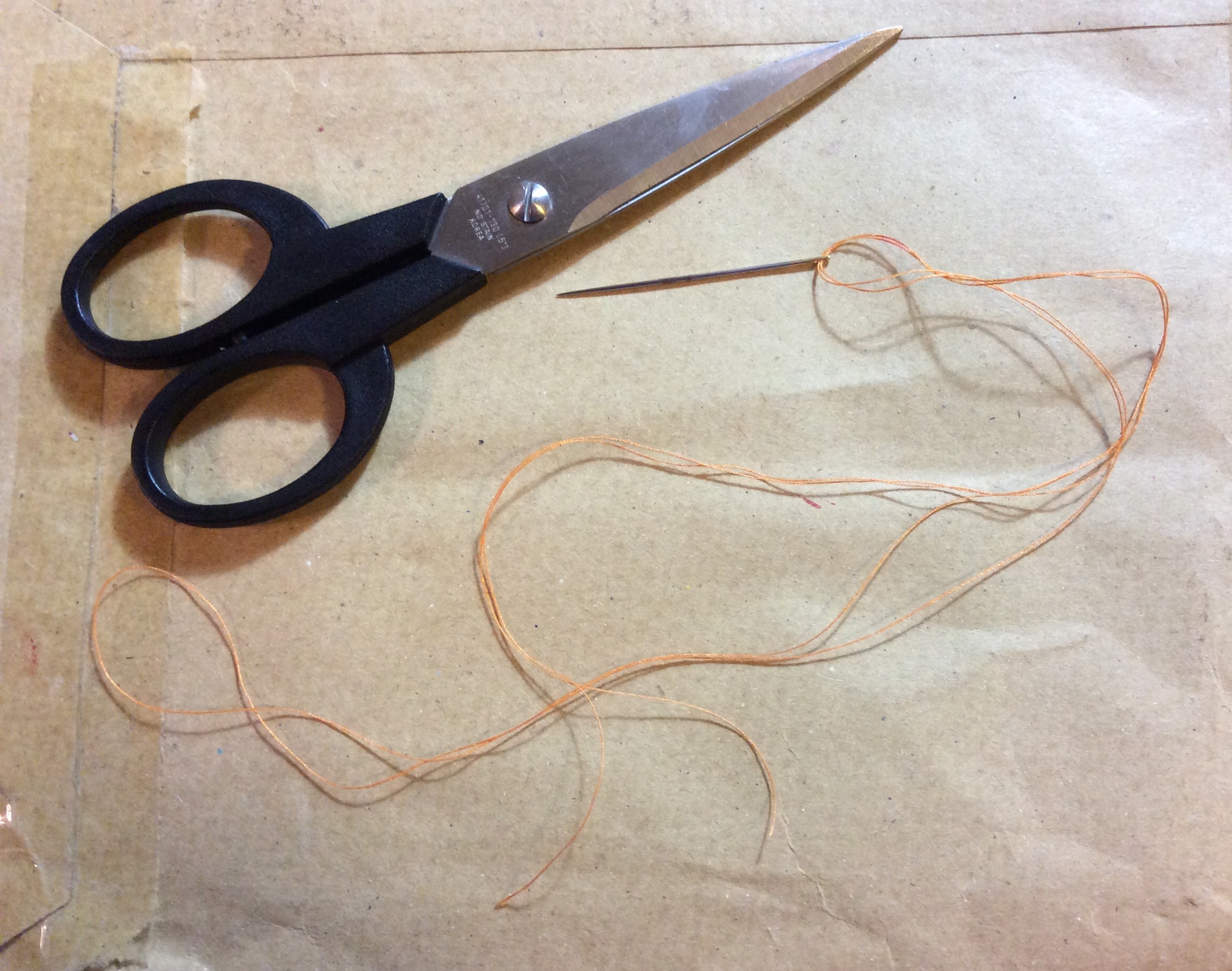
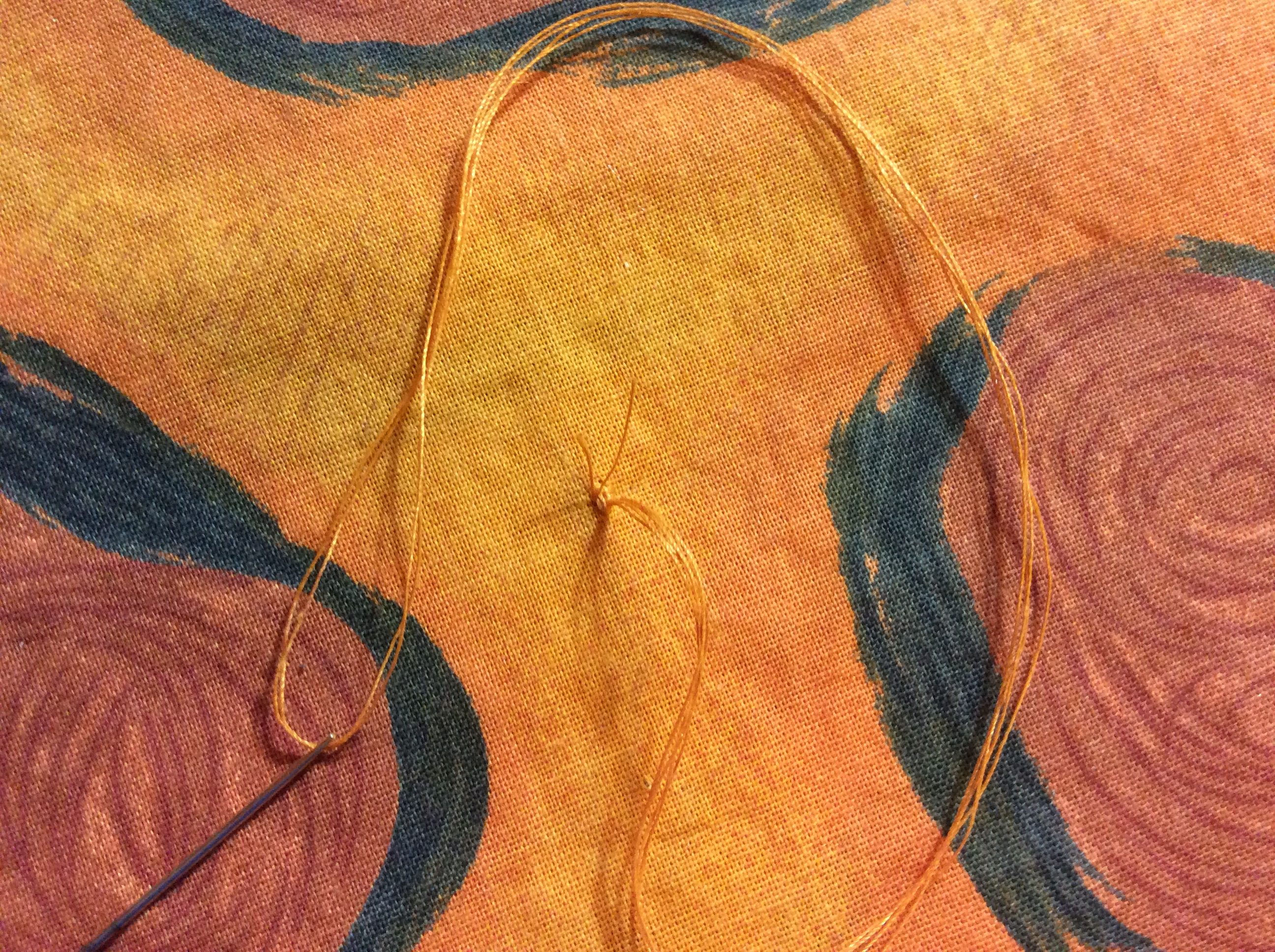
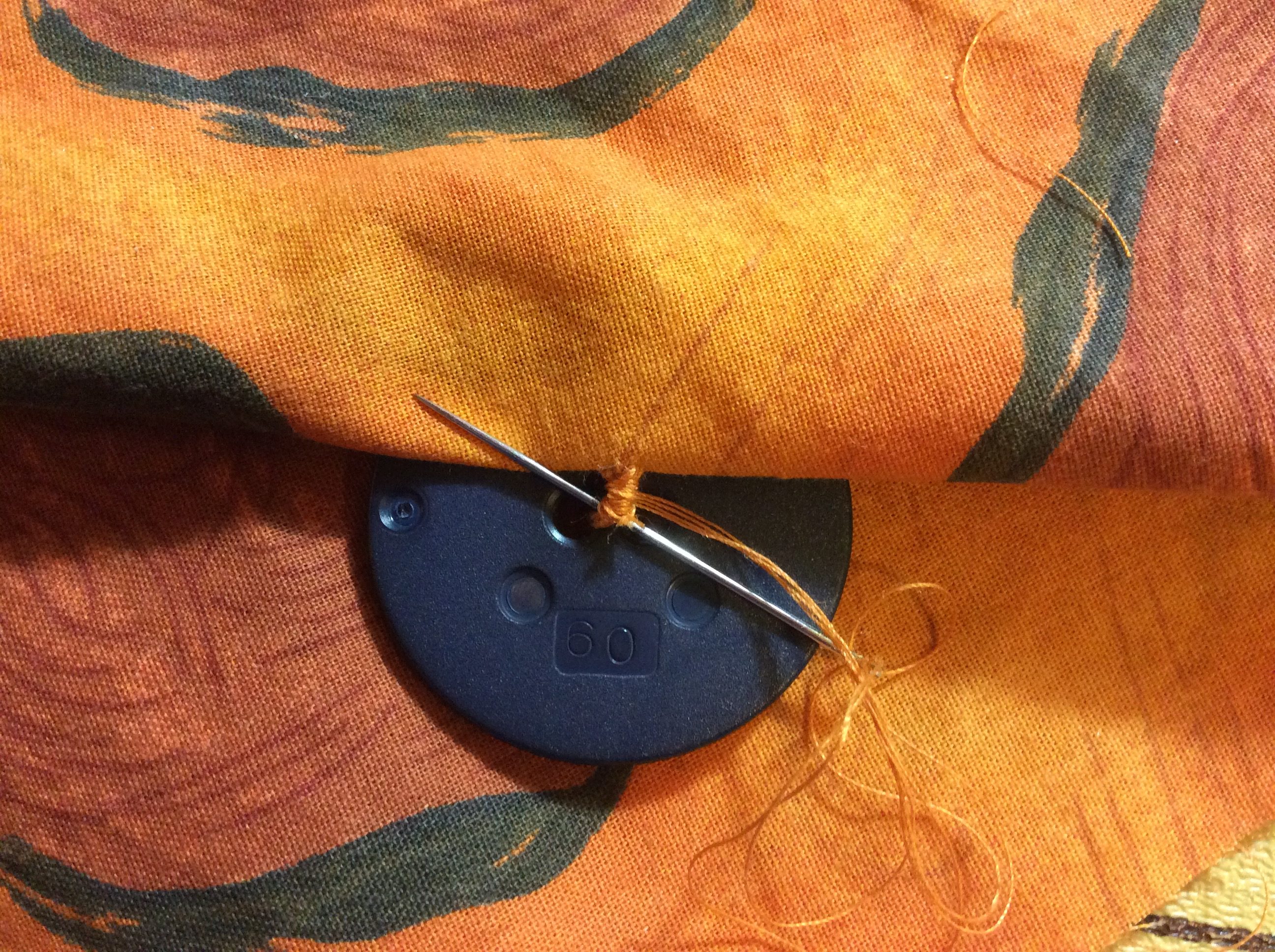
Thread needle with Double Strand Thread with loop and two cut ends


Sewing on a button

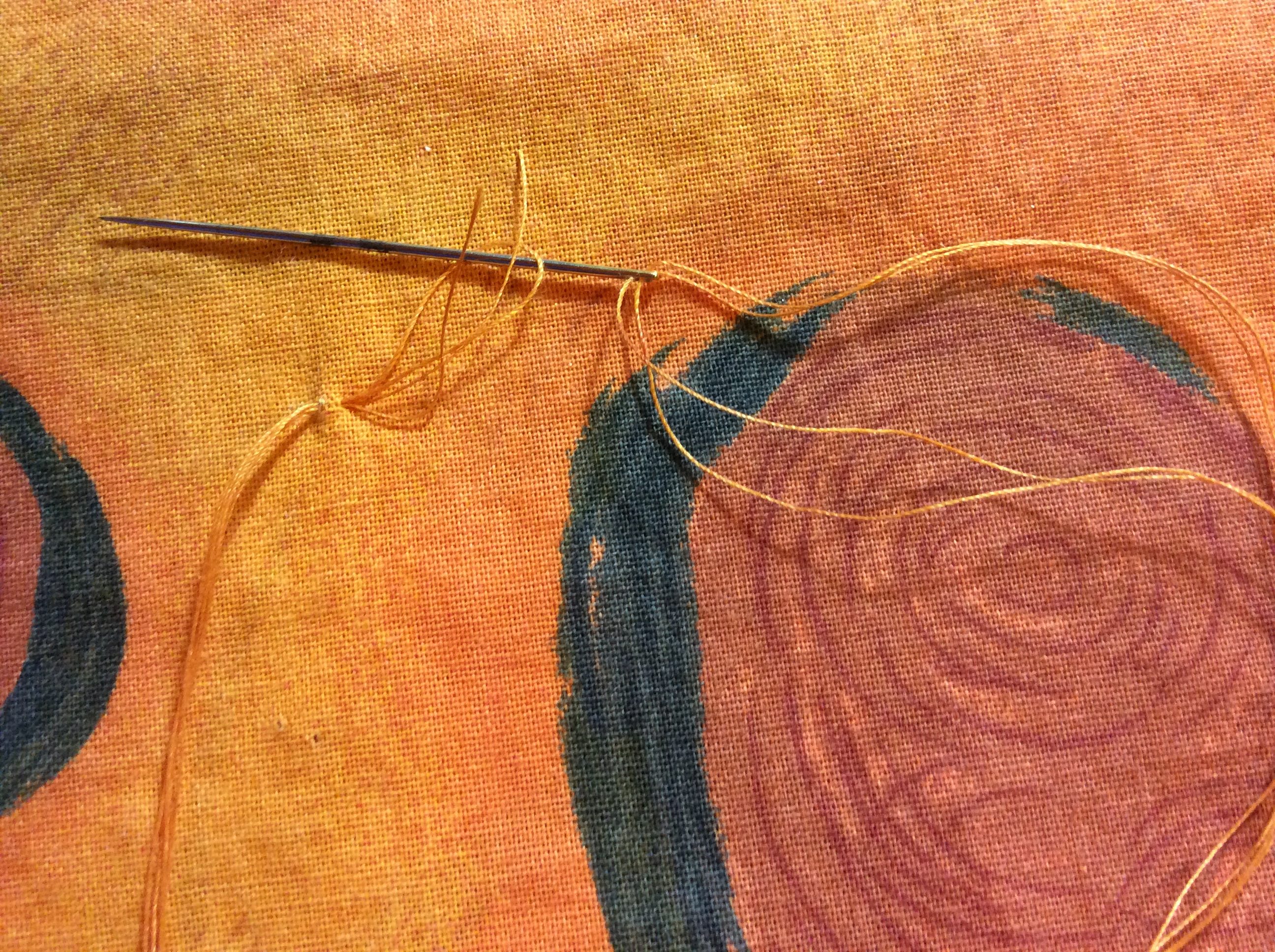
Take one small stitch; leave loop on top; insert needle thru loop

Sewing on a button

Anchor thread by tugging thread snug thru loop


Sewing on a button

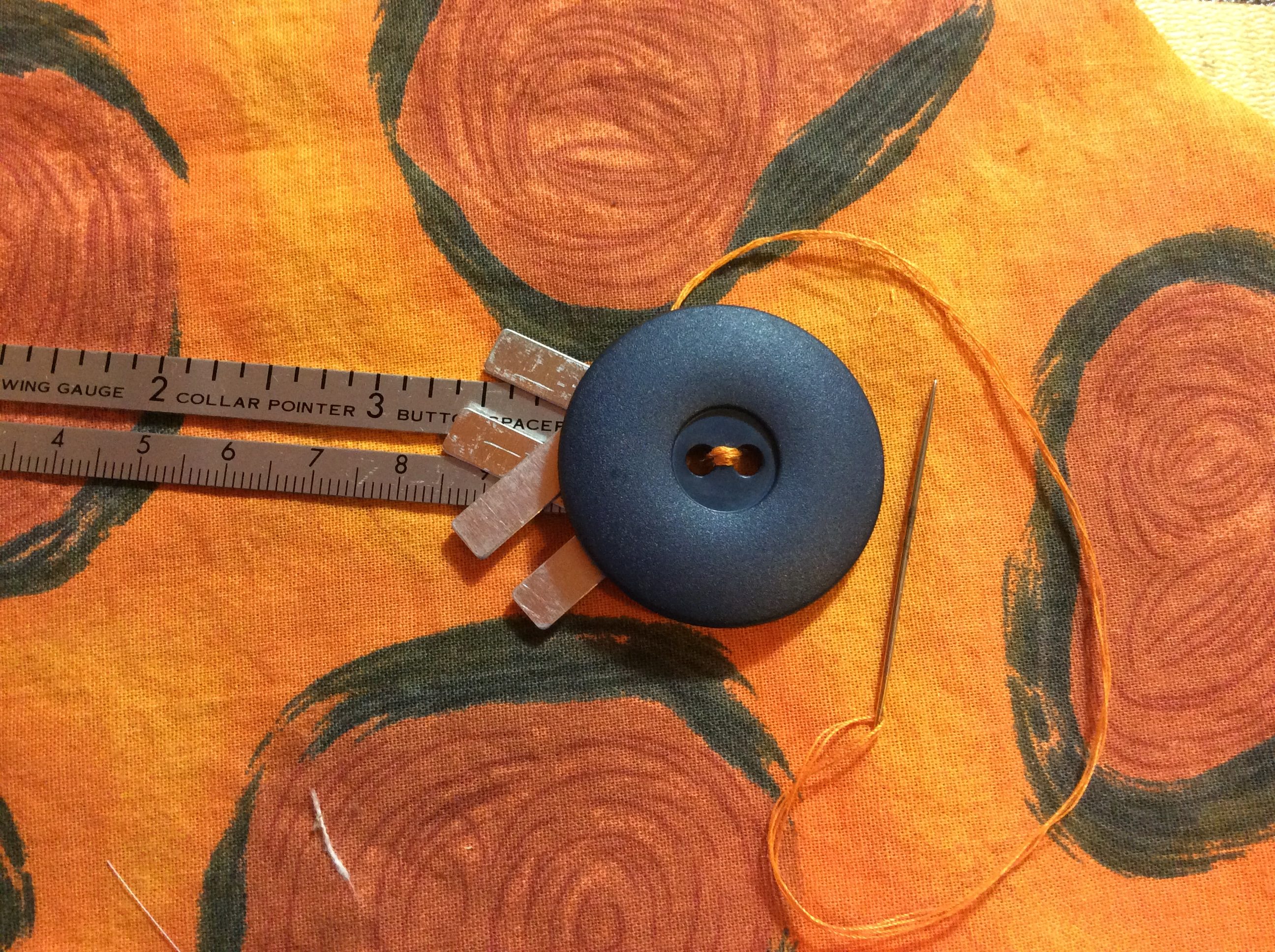
Insert button spacer(s) under button holes. Stitch thru button holes 3-5 times.


Sewing on a button

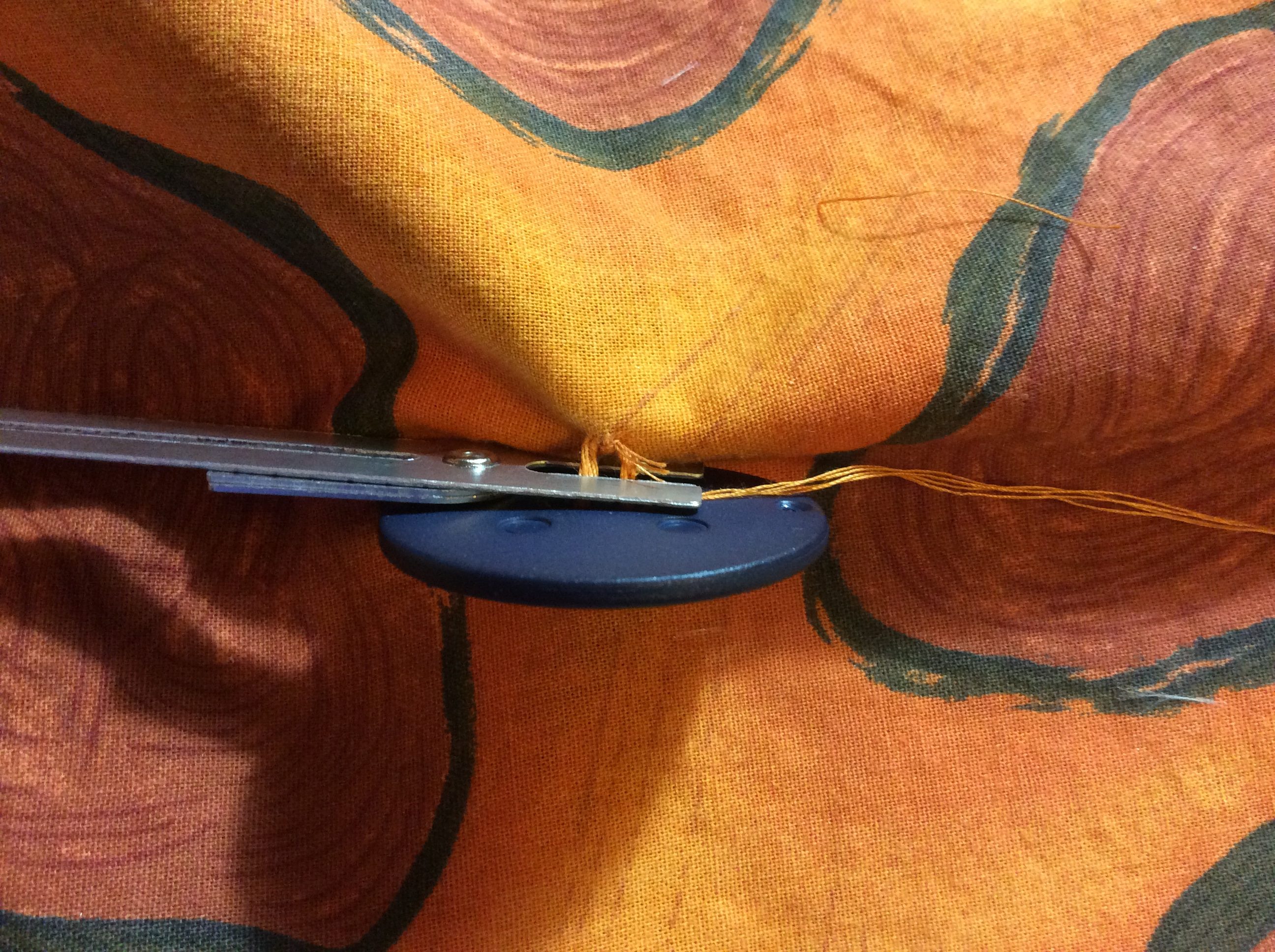
View between button and fabric with button spacer in place


Sewing on a button

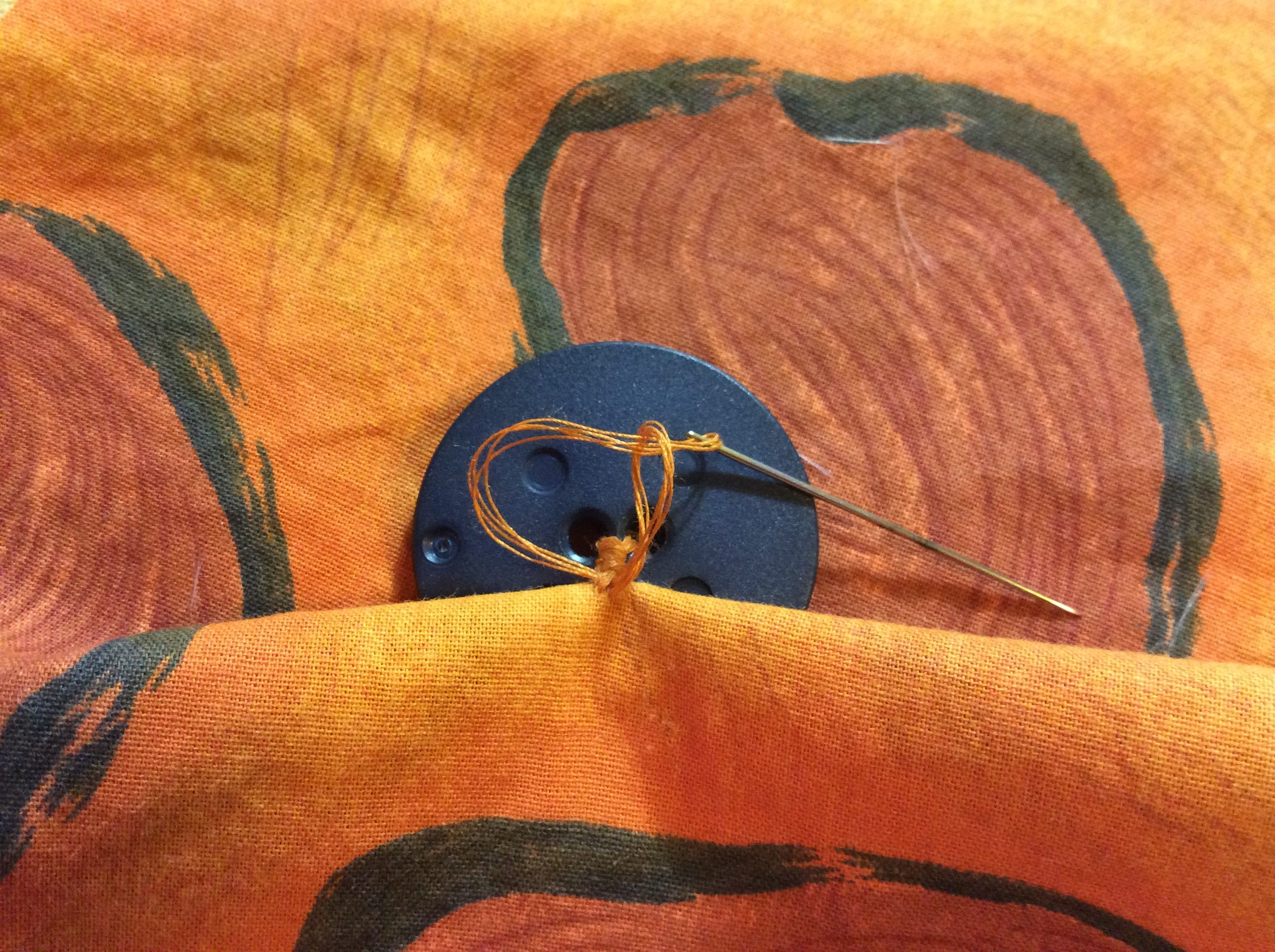
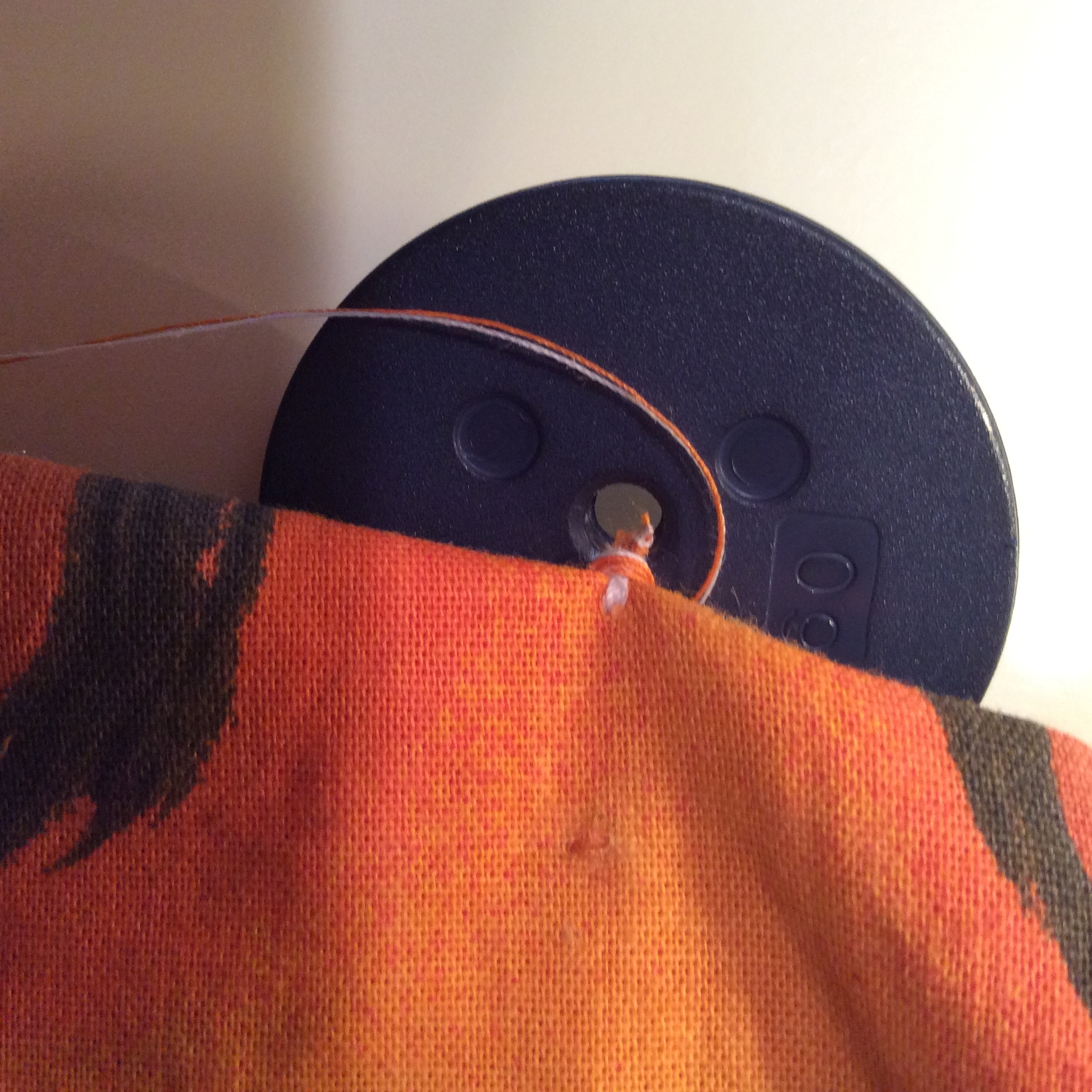
Wrap thread tightly around shank 3-5 times

Sewing on a button

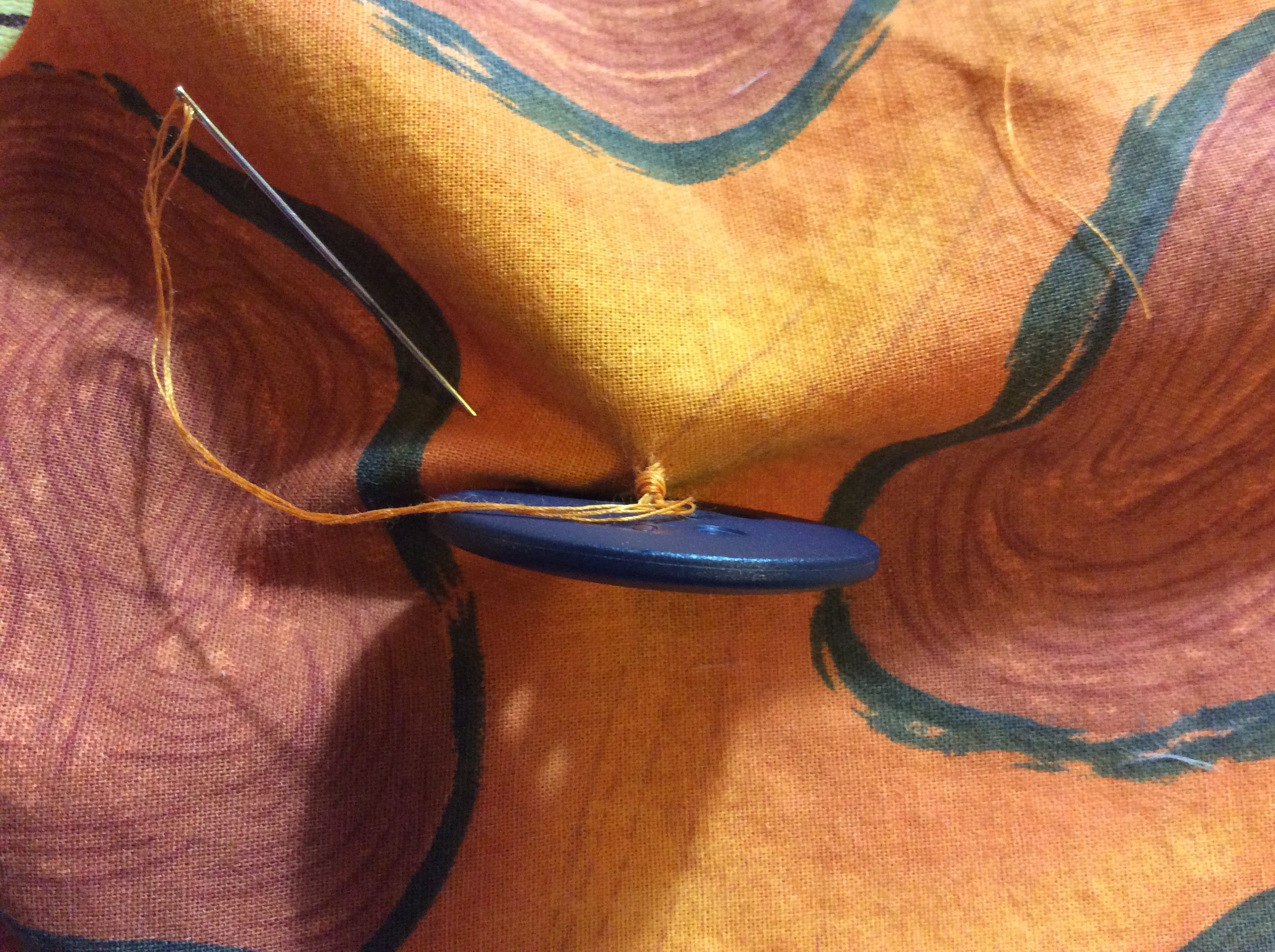
Draw needle thru thread shank


Sewing on a button

Create loop and draw needle thru loop

Sewing on a button

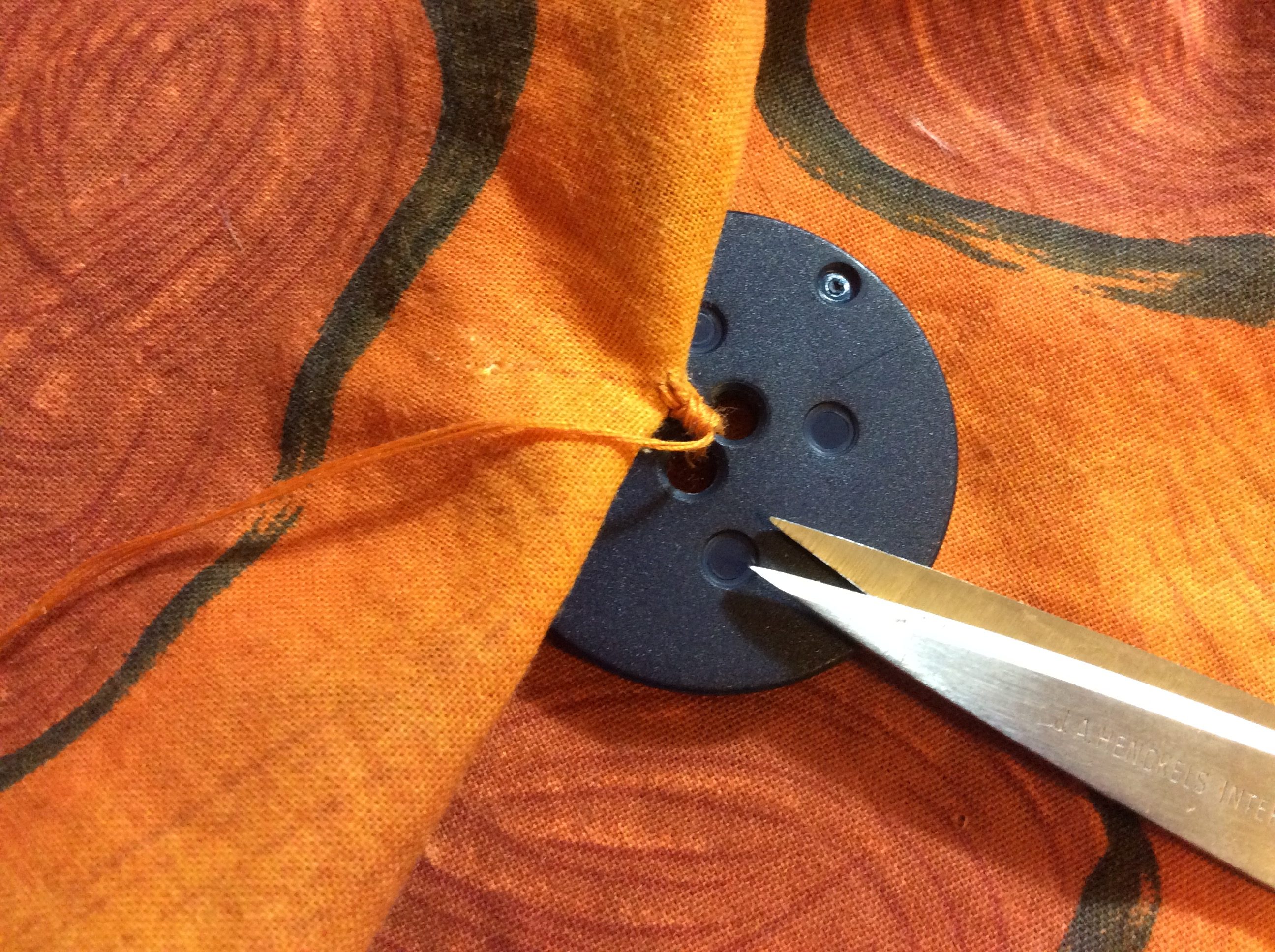
Draw needle thru shank from bottom to top


Sewing on a button

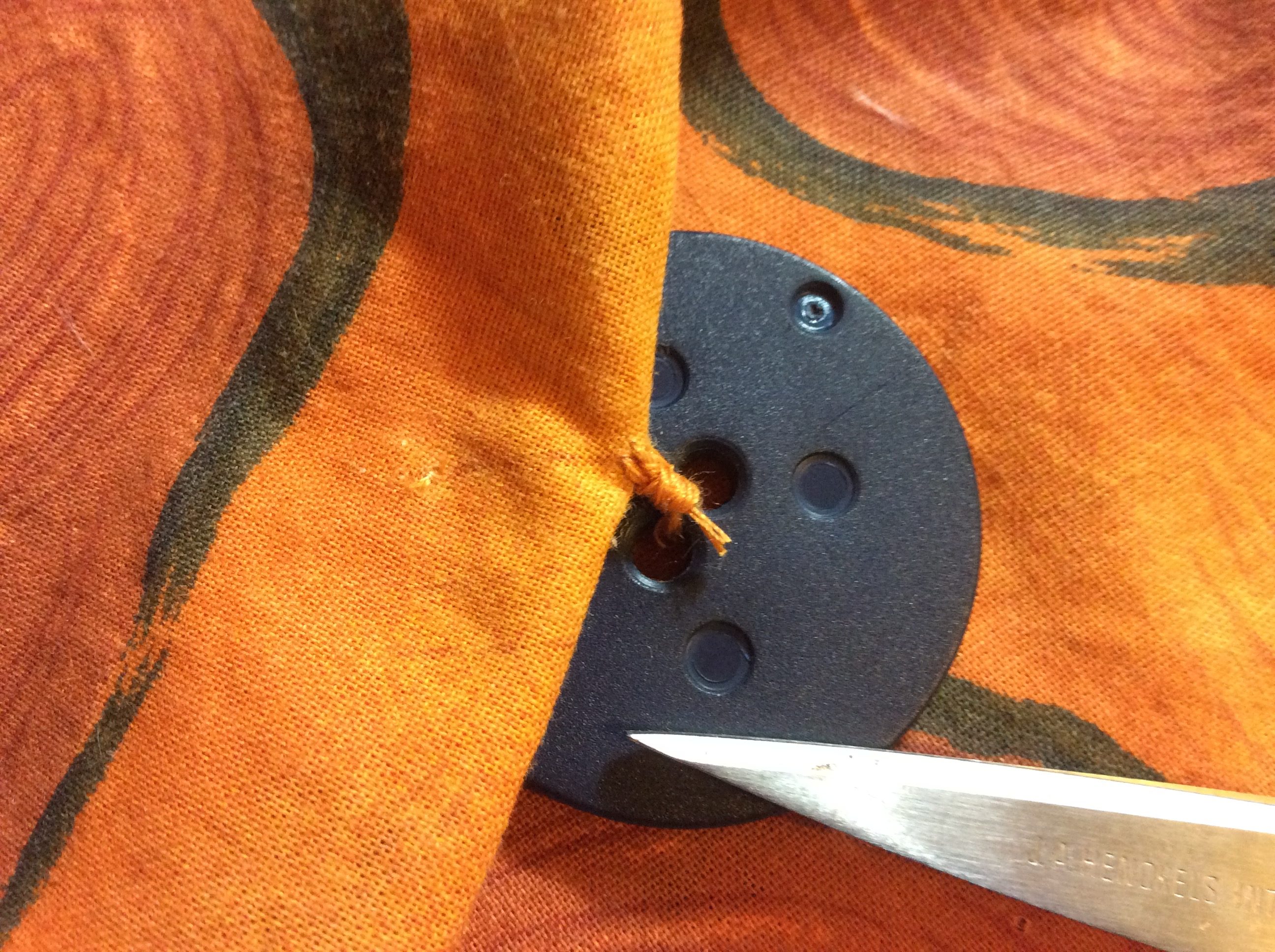
Trim thread leaving short ends–a little extra thread can’t hurt just in case ends do want to work out.

sewing on button

Dot threads with Fray Check or clear nail polish for extra security.

Button Sewing by Machine

Only buttons with holes can be sewn by machine; buttons with integrated shanks must be sewn by hand.

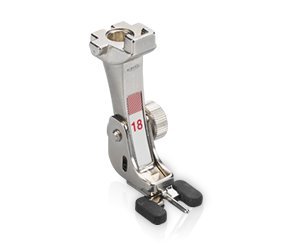
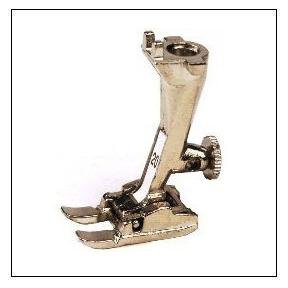
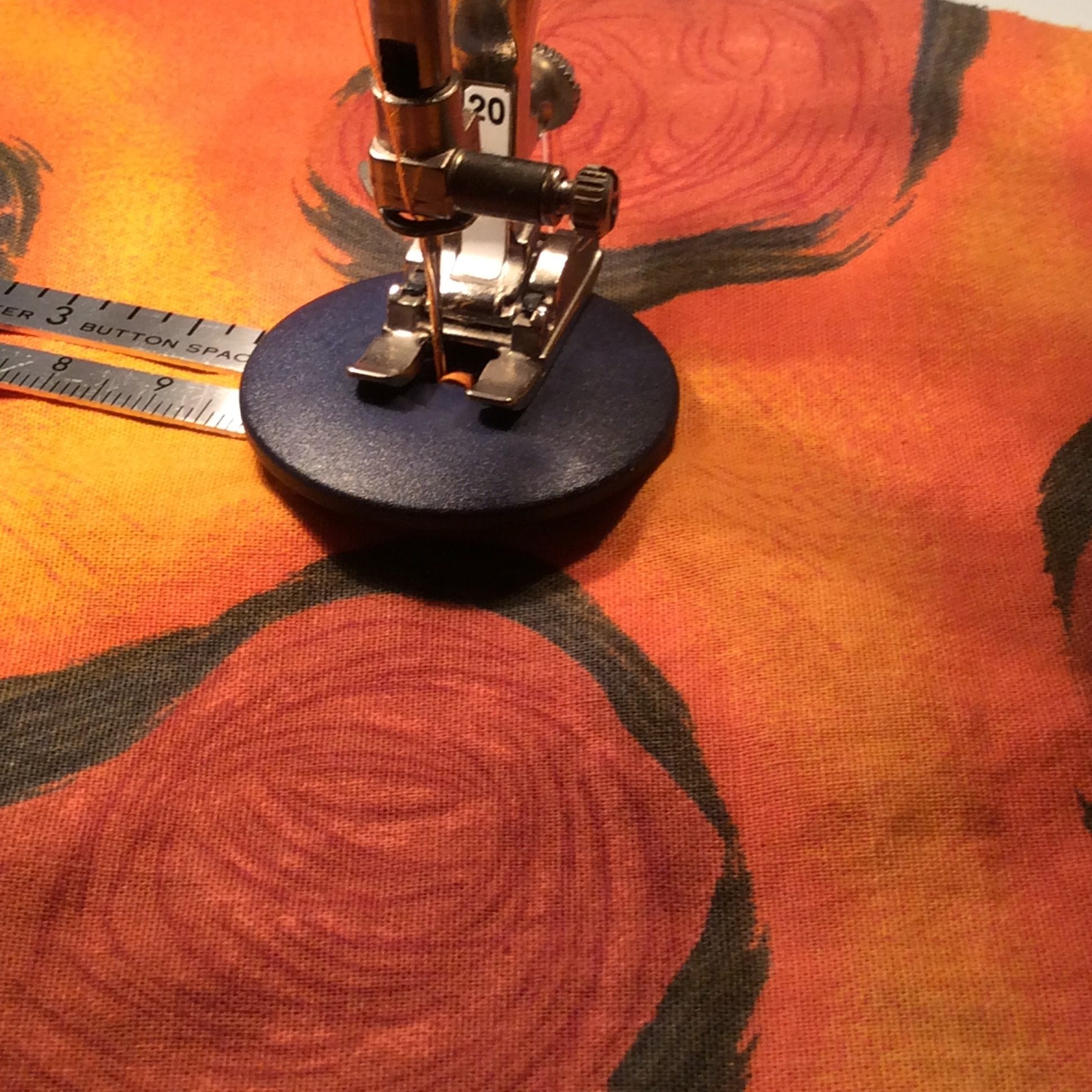
Bernina and other brands of sewing machines have specific presser feet for sewing on buttons.  It even has a pin to sew over thus making a thread shank.                                            I don’t have one so make do with the #20 Bernina open toe presser foot.


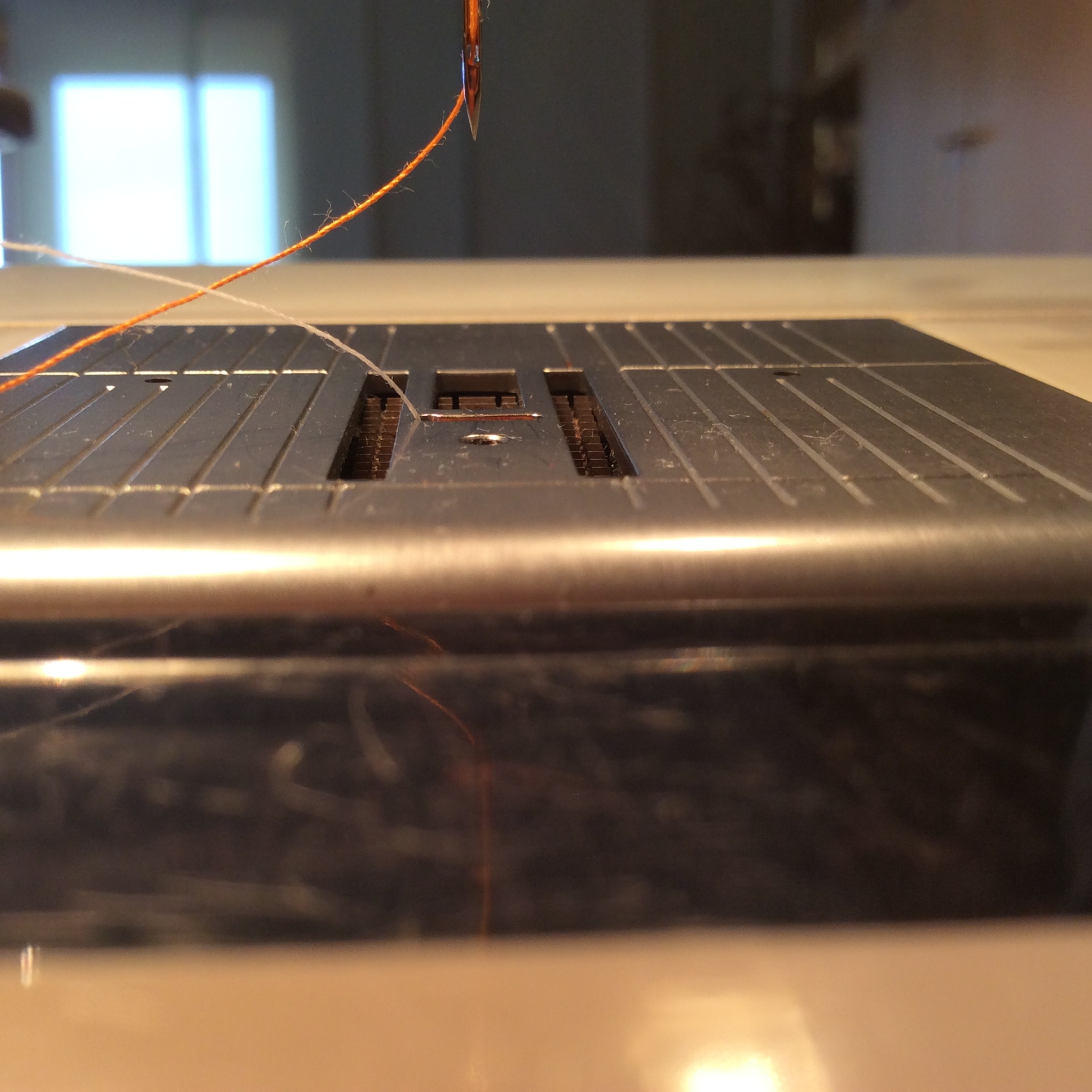
Lower Feed Dog. The Feed Dog is what grips the bottom of the fabric and moves it under the needle. Lowering the Dogs, keeps the fabric stationary so zigzag stitches can go back and forth between the button hole

Lower Feed Dog. The Feed Dog is what grips the bottom of the fabric and moves it under the needle. Lowering the Dogs, keeps the fabric stationary so zigzag stitches can go back and forth between the button holes

sewing on a button

Take one stitch in fabric and pull up bobbin thread. Arrange both threads to one side.


Position button and button spacer under presser foot.

Position button and button spacer under presser foot.

IMG_1799

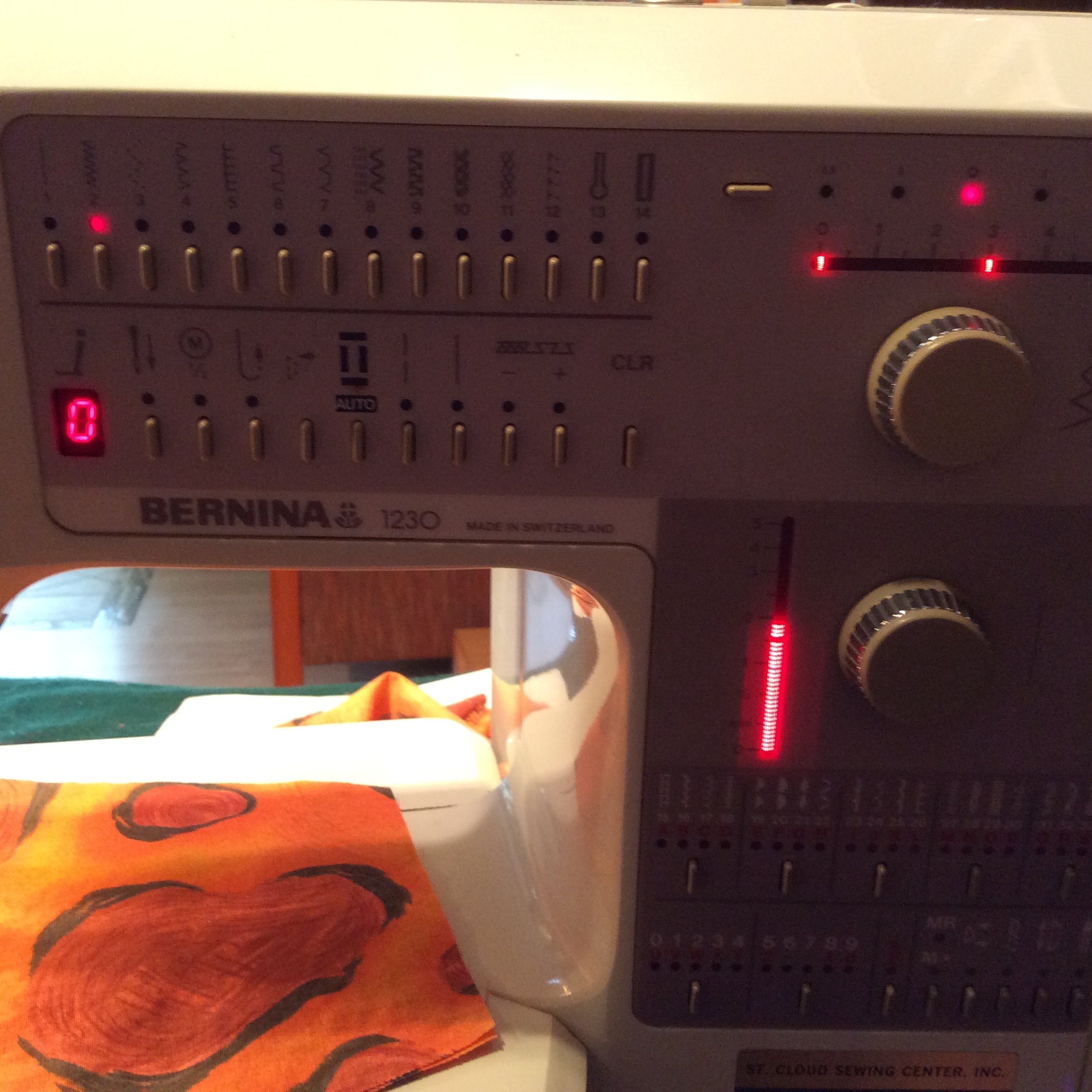
Set zigzag stitche width to zero–see stitch width indicator upper right above. Stitch 2-3 times in one button hole to anchor threads.


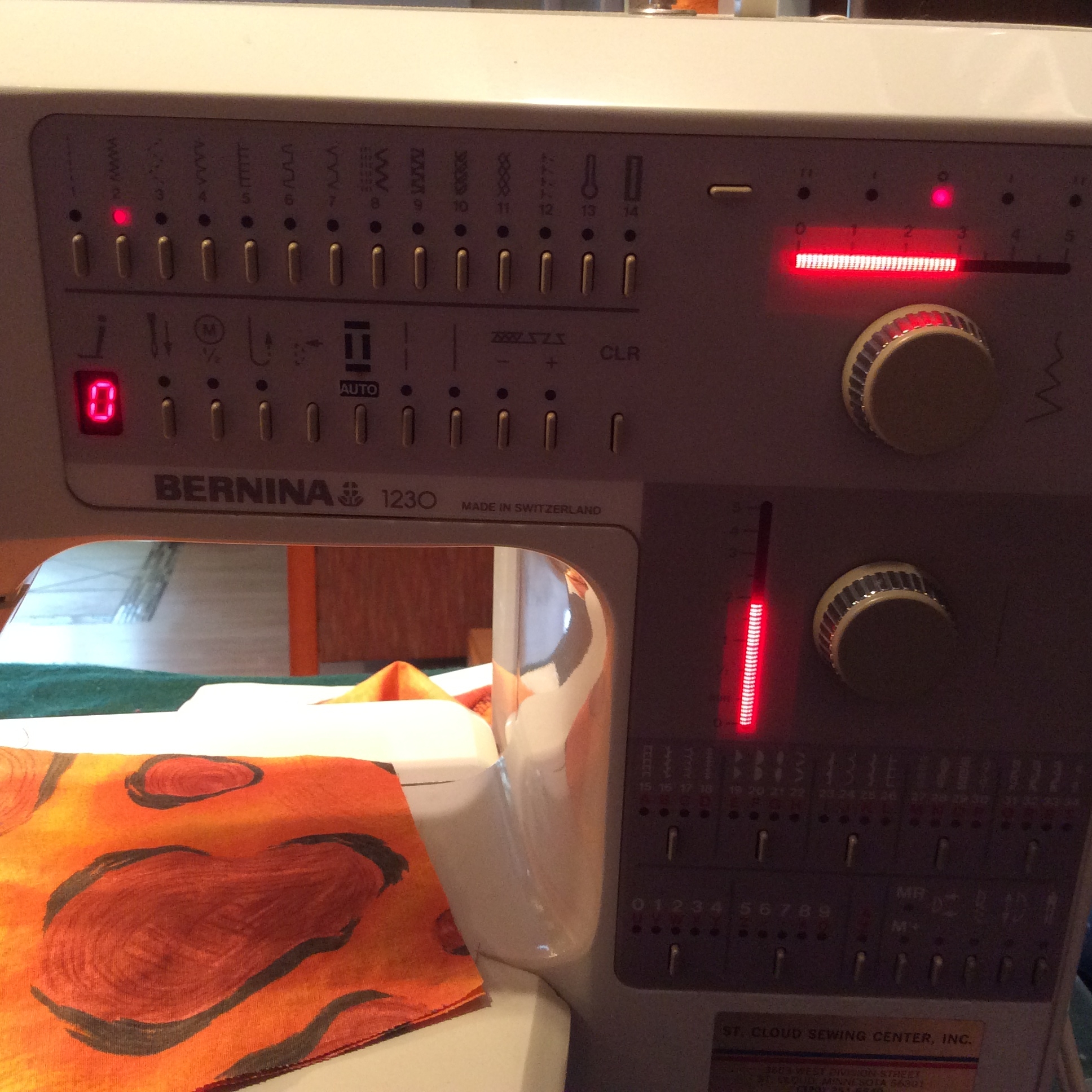
Set stitch width to 3-4–wide enough for needle to zigzag across both holes. Zigzag 3-4 times. Anchor as for first button hole.

sewing on button by machine

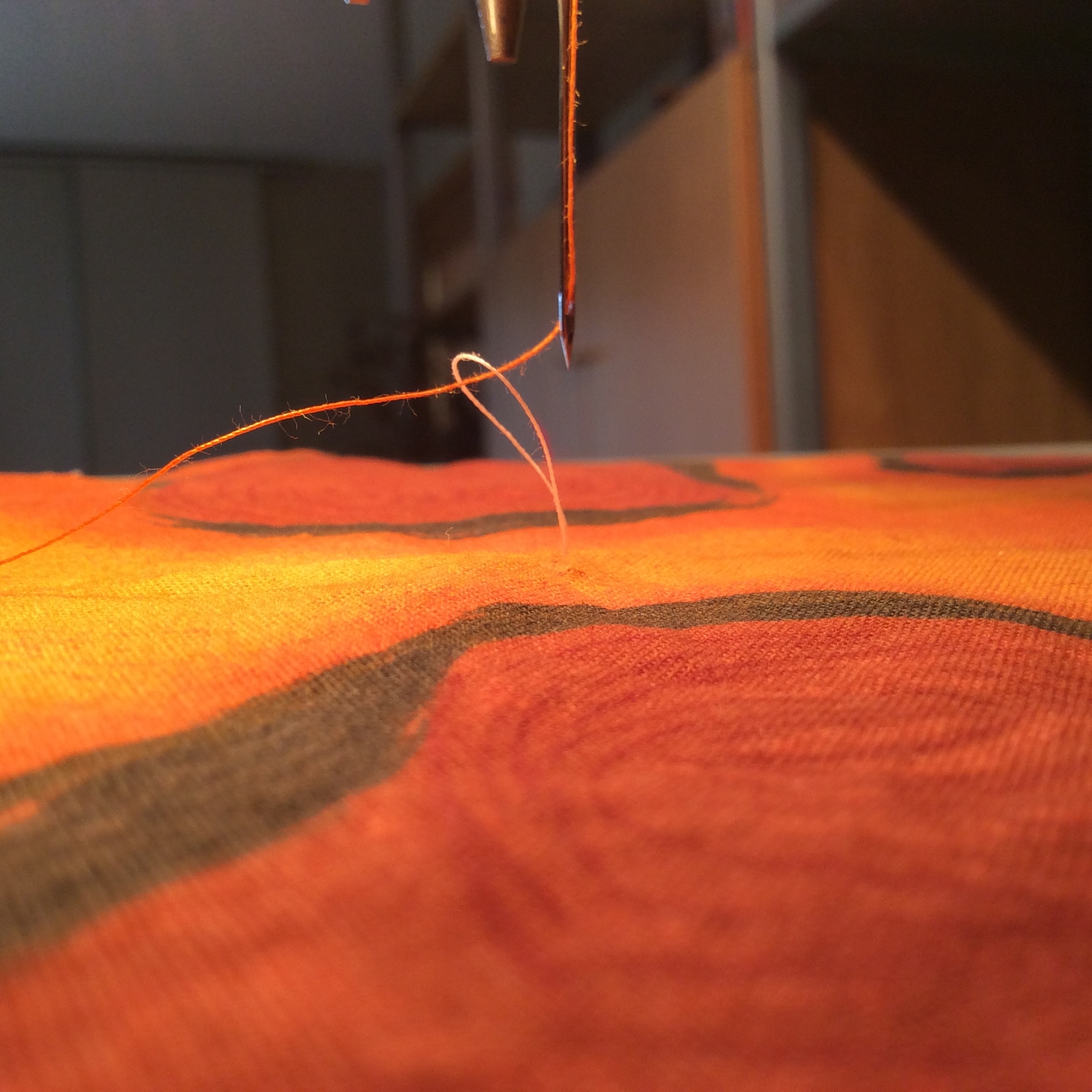
Cut thread leaving a long tail–12-15″. Tug upper thread (orange) to pull up bobbin thread loop(white).  Both threads should be under button.


sewing on button by machine

Wrap threads around shank and finish as in Hand Sewn Button

sewing on button

Dot threads with Fray Check or clear nail polish for extra security.


Sewing on a Button that has an Integrated Shank

Buttons with integrated shanks are more common on large buttons suitable for coats.  They still need a thread shank which provides strength and abrasion resistance.  The tightly wrapped shank is stronger than just several thread loops through the button shank.

sewing on button with integrated shank

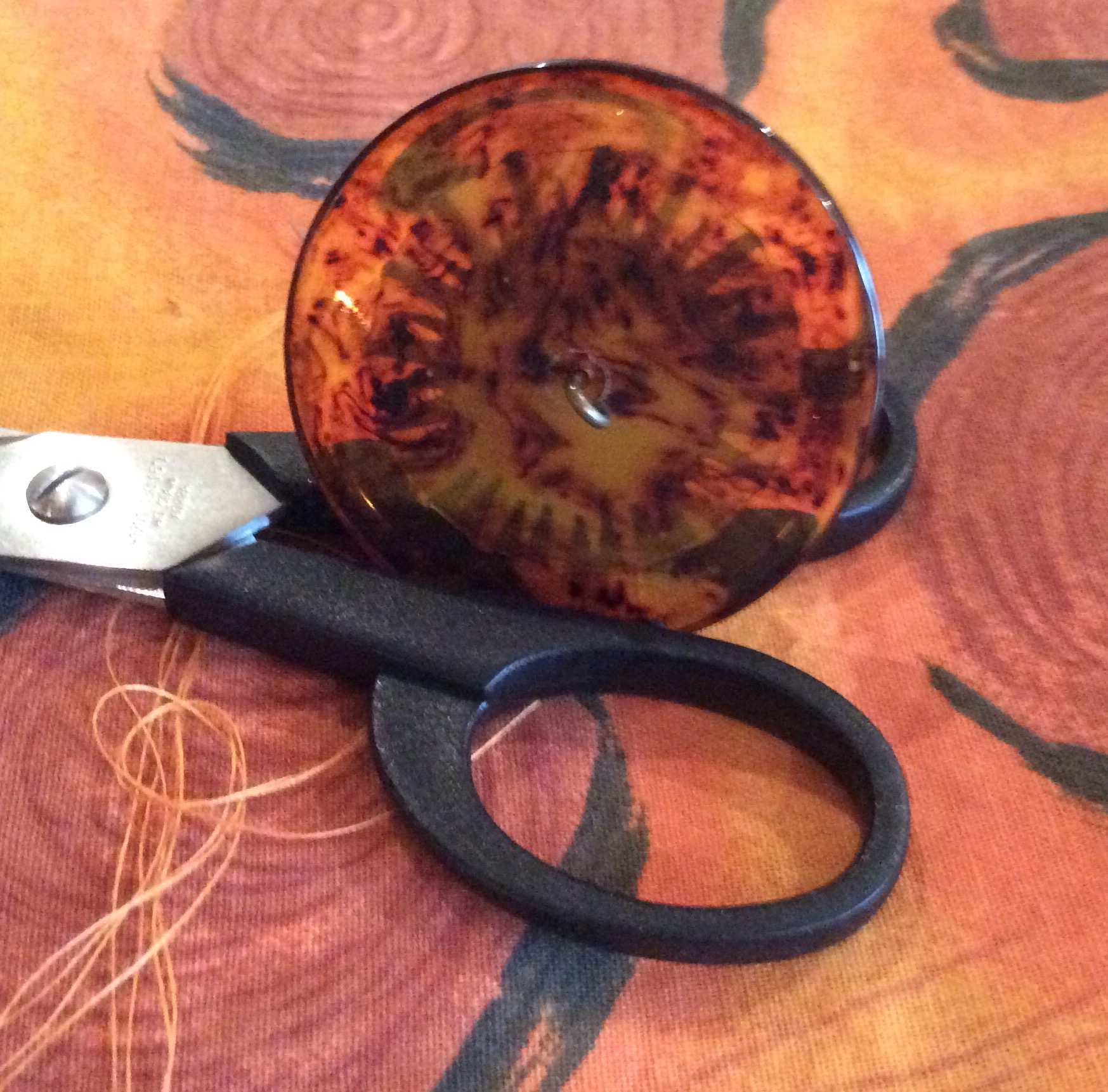
Resin button with embedded metal loop, aka Shank

Button sewing with integrated shank

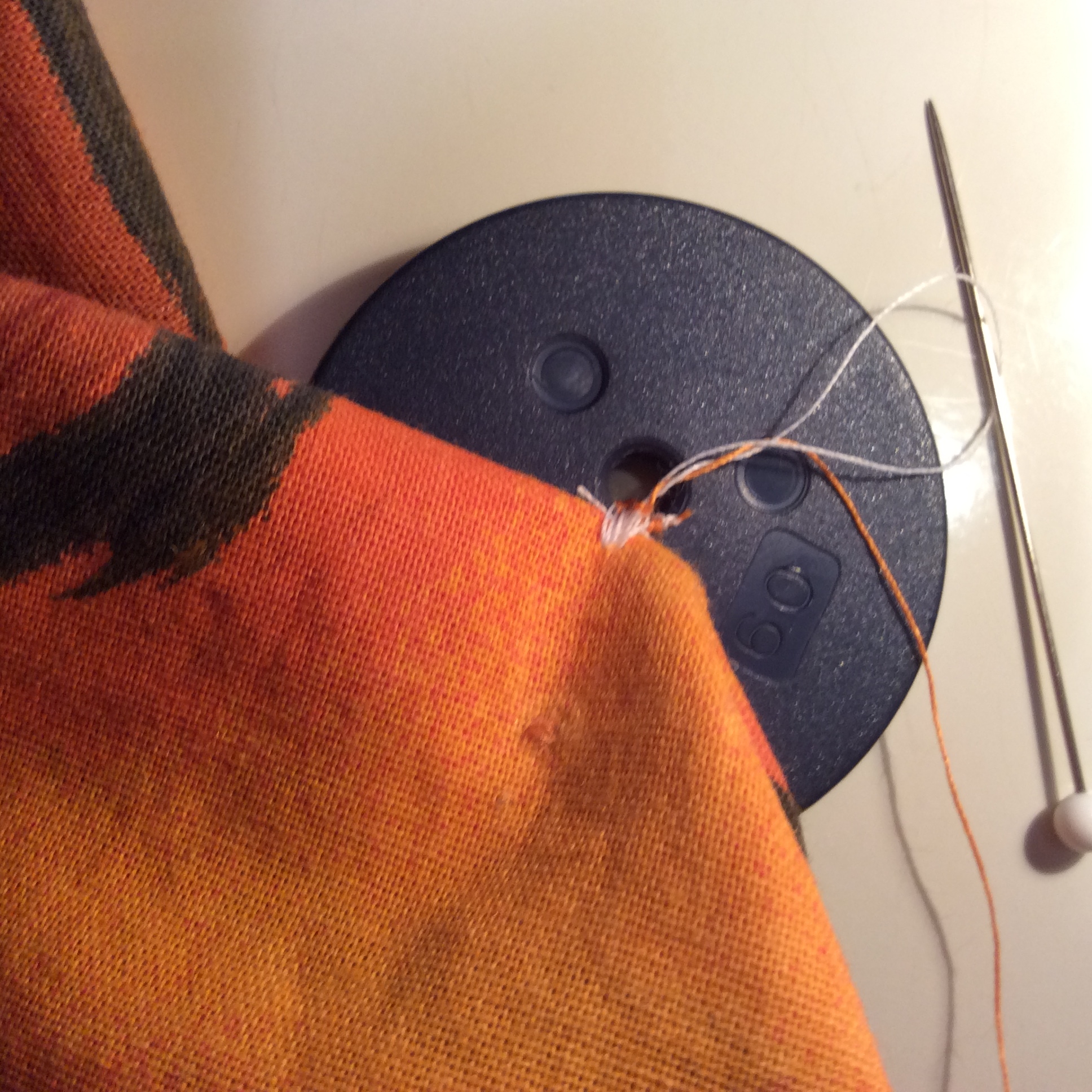
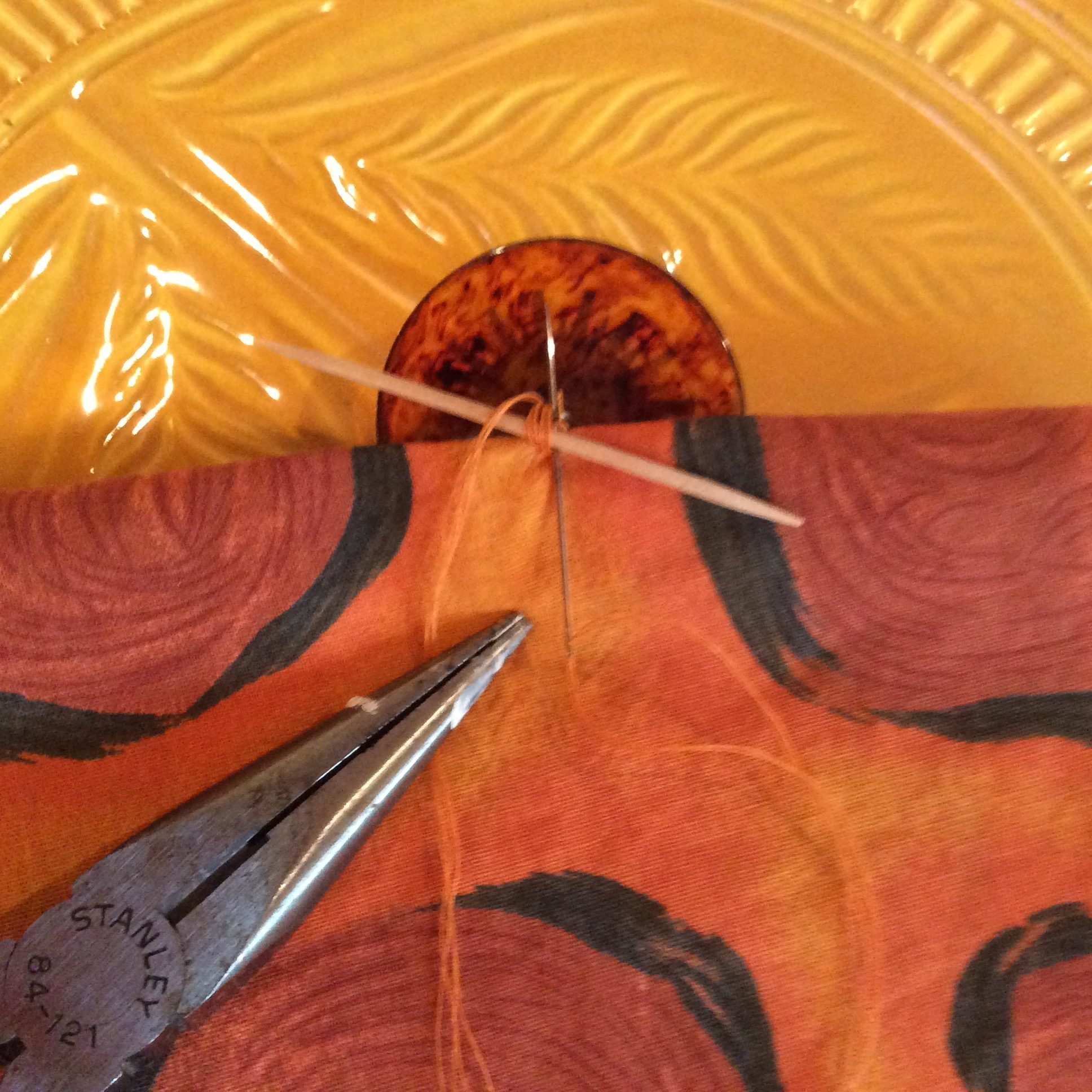
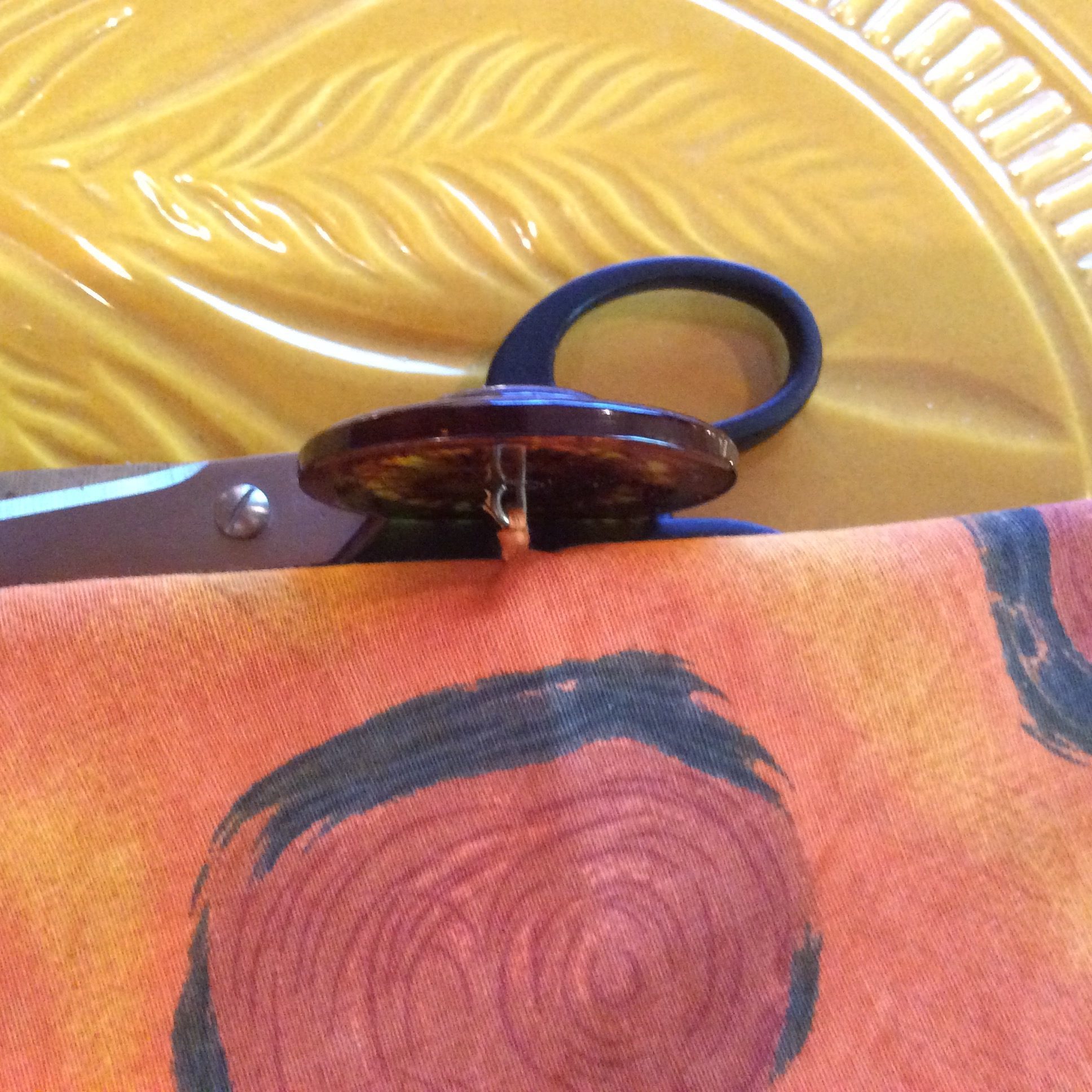
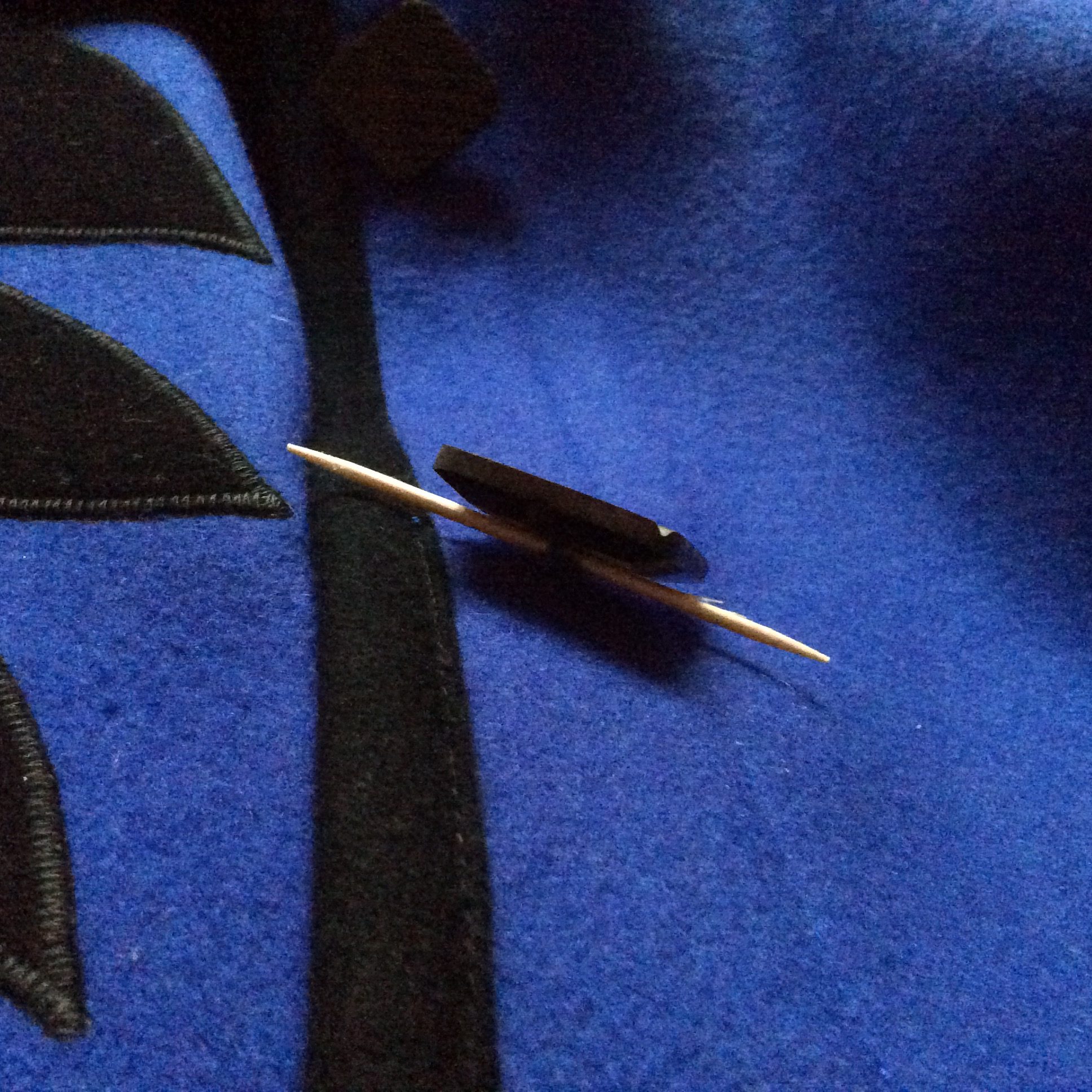
Anchor thread; fold fabric at button placement; stitch thru fold and button shank. Insert toothpick spacer under button shank and take 3-4 more stitches. A needle-nose pliers is a help in grasping needle in tight spaces


button sewing with integrated shank

Remove toothpick spacer; wrap thread around thread shank and secure as for Hand Sewn/Machine Sewn Button.

button sewing with integrated shank

Ta-Da


And, this is absolutely Everything you need to know to successfully sew on buttons that will stay sewn!

Related

Not Just Any Seam Gauge


Posted in FIBER FASHION FUN | Tagged , , , , , | Leave a comment

Not Just Any Old Seam Gauge

 Not Just Any Old Seam Gauge

AKA  Seam Gauge, Point Turner & Button Spacer

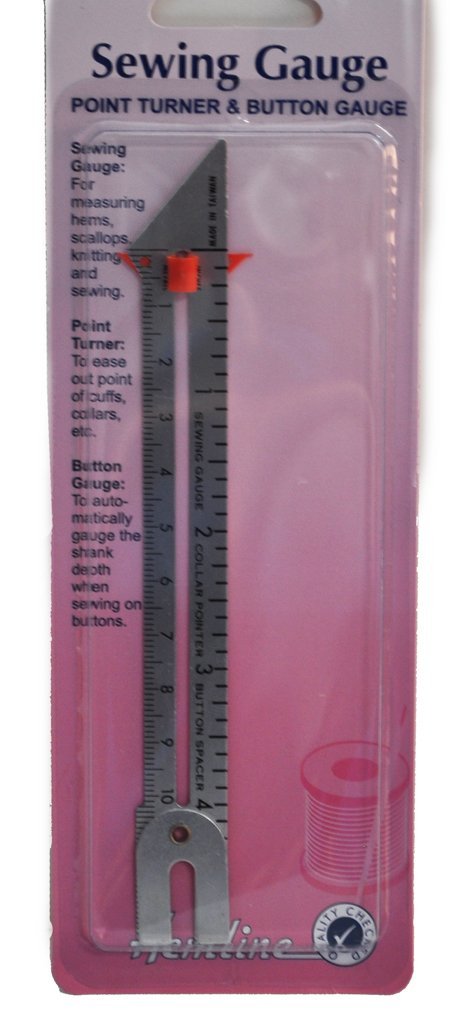
Sewing Gauge, Point Turner & Button Gauge

It’s here; ordered this Seam Gauge through Amazon, shipped from UK, on June 19th and it arrived on June 27th.  After Amazon said it would arrive, earliest, July 15th.  Praise be!

Now why would I order a simple sewing tool from across the Pond?  Because I couldn’t find it here in the US.  See previous blog, Hemline, Sewing, Knitting and Seam Gauge.

The Seam Gauge has been a staple in my sewing kit since a patent was granted in 1967.  There are several at various locations in my sewing room:

    • cutting mat
    • ironing board
    • sewing machine
    • sewing caddy next to sewing machine
    • knitting bag
    • stash of new ones in supply drawer

And, they all look like this.

Seam Gauge

My Stash; the ones I could find.

Similar but no Button Spacer!


It’s All About the Button Spacer

It’s called a Button Gauge on the package, but Button Spacer is more descriptive, therefore, I shall call it that from now on.

So why did I need to send to UK for another Seam Gauge?  And pay almost three times what it would cost in a sewing store?  It’s all about the Button Spacer–that U-shaped appendage at one end.  There are two that swivel plus the ruler itself.

You see, buttons need  a thread shank, yes, even buttons with built-on shanks; more necessary for thick, bulky fabrics.  The thread shank acts as a support for the button lifting it slightly off the garment,  allowing space for the overlapping fabric to fit between the button and the garment.  Ever seen garments that bunch up around the button?  Not enough room under the button!

Typically sewers have used toothpicks on top of the button and sewn over it (or under if button has a shank); then the toothpick is removed revealing extra thread length–shank.  The button is pulled to the top of the shank and the attachment thread is wrapped around the thread (under the button) lifting the button off the fabric, providing space for the overlap fabric to fit under the button.

Button Gauge

Thread Shank on a button that already has a shank.

A toothpick is not the most user friendly; it’s short, and sharp.  Now the Button Spacer is at the end of a 6″ ruler that is rigid and provides more support while wrestling a button into submission.


Button Spacer Grade = A-

 Sewing Gauge

The two swivel spacers are swung to the side and only the spacer on the end is being used

Now that I’ve tried out the Button Spacer, I’m giving this tool a A-, because:

  • better than a toothpick but a bit unwieldy holding it in place when hand sewing,
  • and don’t think even using all three spacers will provide enough shank for really thick fabrics.
  • And, it obviously cannot be used with a button that already has a shank; still need to resort to the toothpick, knitting needle…

However, when using for machine sewing, it is perfect; slide  under the button, lower the presser foot and it stays in place until done sewing.

Position button and button spacer under presser foot.

Position button and button spacer under presser foot.

Related

33 Steps to Sewing on a Button


Posted in FIBER FASHION FUN | Tagged , , , , | 1 Comment

Hemline Sewing Knitting and Seam Gauge

Hemline Sewing Knitting and Seam Gauge

A sewing gauge was the first sewing tool introduced to me in my 7th grade Home Economics class.  Well, actually, it was probably the third or fourth, after scissors and pins.  So it’s safe to say I’ve been using this sewing tool for 60 plus years.  There is one on the ironing board, cutting board, and next to the sewing machine, serger, coffee table, and several on reserve. And none of them look like this itereation.

A seam gauge is a multi-purpose sewing tool used primarily for measuring small spaces–hems, seam allowances, button/buttonhole spacing, etc.  It’s also a point turner.  But the “Best Thing Since Sliced Bread” on this particular gauge, is the button gauge/spacer.  See the U-shaped piece at the bottom of the gauge.


I’ve always inserted a toothpick, aka button spacer, either on top of or under a button, to use as a button spacer.  Even Martha Stewart uses a toothpick.

The purpose of a button spacer is to elevate the button providing space for the garment overlap to fit between the button and the garment underlap.  This is necessary for particularly heavy, thick coating fabrics.

Here is a link to a good blog tutorial on sewing on a button with a thread shank.

Hemming Sewing Knittiing and Seam Gauge

Using toothpick to make a thread shank

Hemming Sewing Knitting and Seam Gauge

Thread Shank on a button that already has a shank.


Button Spacer

As you can imagine, a toothpick is not the best choice for a spacer:  it’s small, difficult to hold in place, and it’s sharp.  And where is a toothpick when you need one!  However, I always have a seam gauge handy, hence also a button spacer.

The button spacer on the end of the sewing gauge appears to be large enough to give good support to the button, it’s moveable, and the 6″ length of the gauge makes it easy to control with one hand while stitching with the other.

I say “appears” as I haven’t actually tried this particular gauge.  When I first came across it a couple of months ago, I could only find it in the UK.  As you can imagine, the postage across the Pond was astronomical.


Great News!!!!

Just discovered it on Amazon–and, drum roll, Shipping is Free.

It comes from UK so shipping will take 10+ days; definitely worth it.  I’m ordering several while I’m at it and will report on the gauge’s usefulness and convenience.

In the meantime, here is the link to the article where I first read about the Hemline Sewing Knitting Gauge.  House of Pinherio is a well known UK blog.

Let’s hear from anyone who has had the opportunity to use the Hemline Sewing Knitting and Seam Gauge

Posted in FIBER FASHION FUN | Tagged , , , | Leave a comment

Camo for the Metro Man

2016 Update

Father’s Day is June 19, 2016.

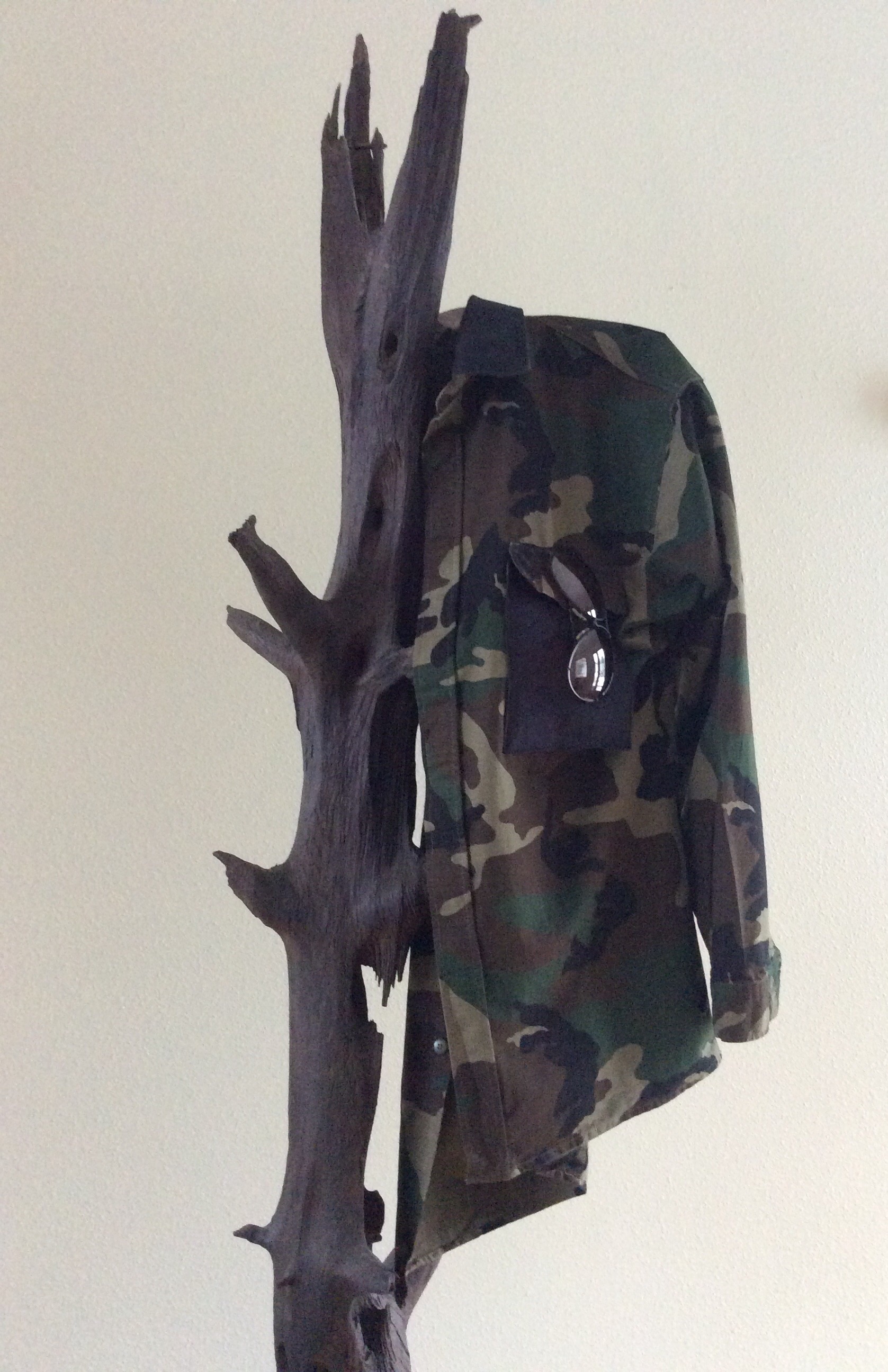
So, here’s my tip for the Perfect Father’s Day Gift. A Camo Shirt/Jacket is The Gift a Dad, husband, brother, boy friend, will wear.  Whether he is a farmer or a  Silicon Valley CEO (especially if he’s in the ‘Valley’), and you can borrow it too.

Camo for the Metro Man

Camo for the Metro Man


2016 More

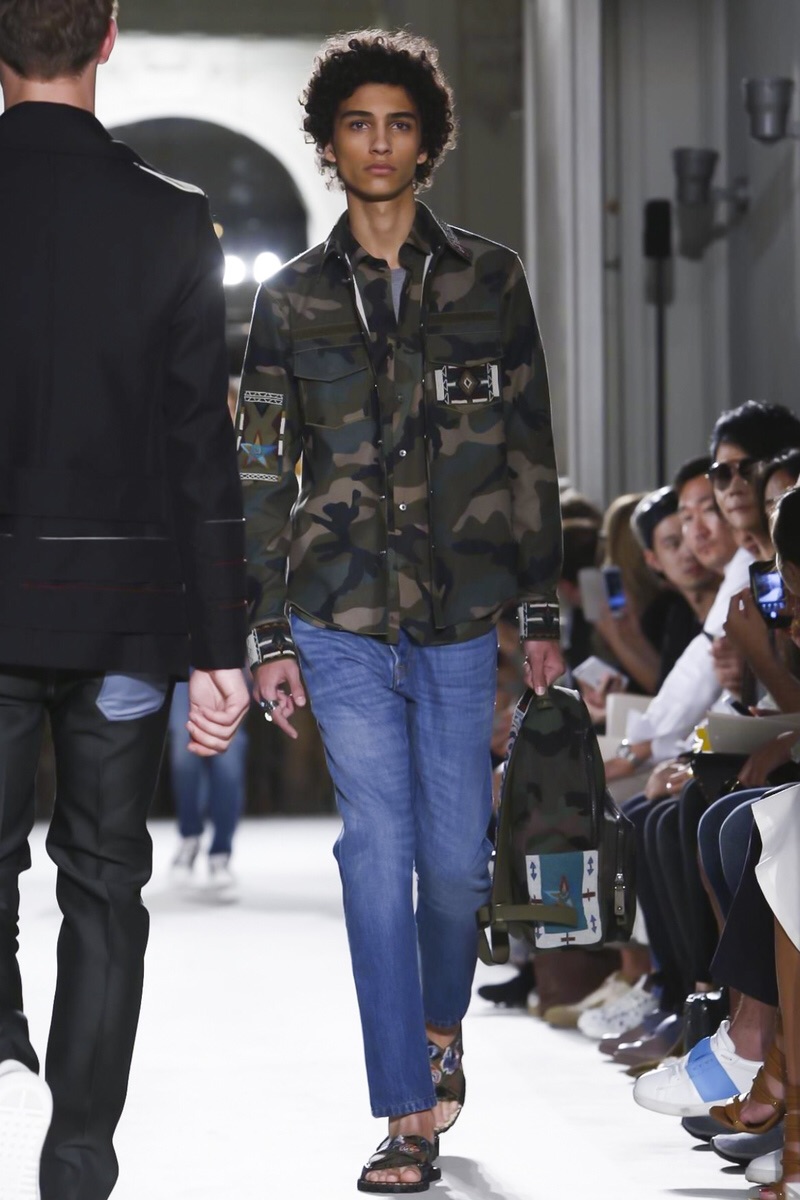
I’ve been writing about Camo since 2012–here and here–and it just doesn’t go away.  Valentino is on the bandwagon–those Italian men know how to dress

Valentino is featuring camo in the Spring Summer 2016 collection and one is a clone of my Camo for the Metro Guy.  Shame on you Valentino; I did it first!

But mine is the Real Deal, an authentic military shirt/jacket.

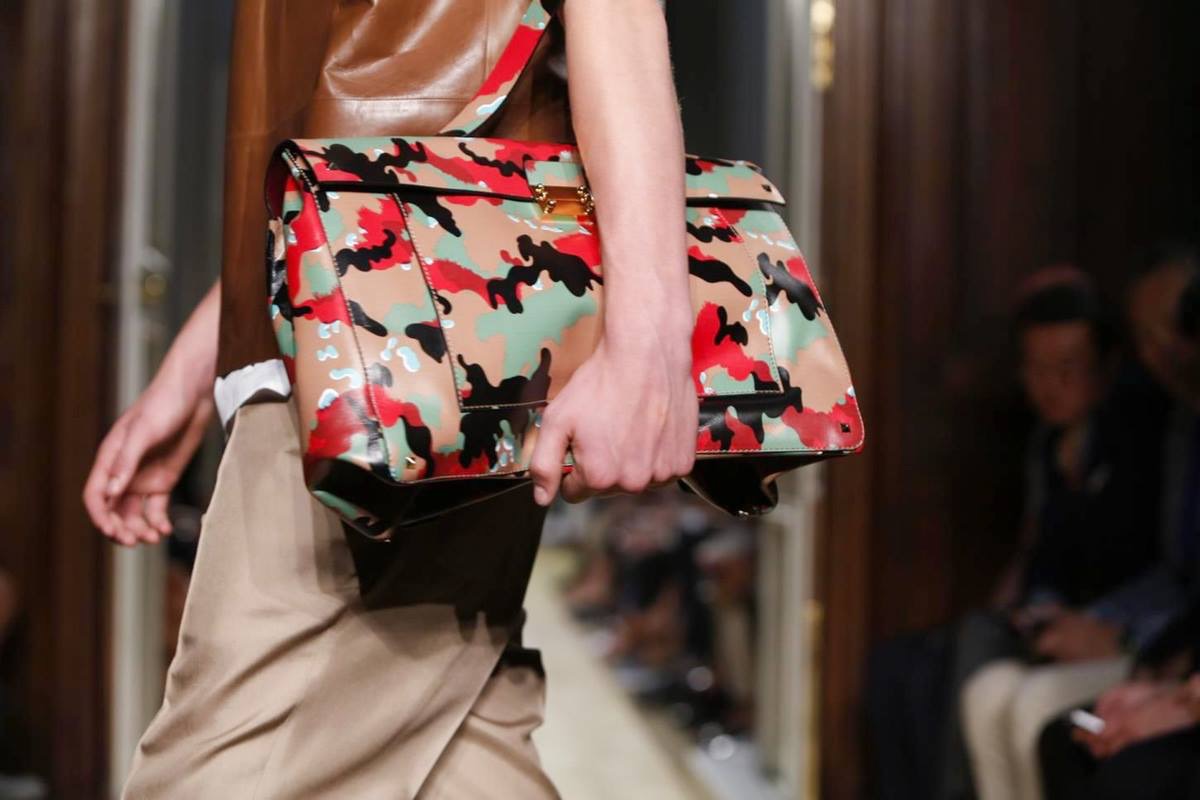
Totally original to Valentino is this messenger bag in an  Alpenflage European camo pattern.  Put a shoulder strap on this and it’s on my wardrobe!

Alpenflage Camo from Valentino

Alpenflage Camo from Valentino

Camo for the Metro Guy

An authentic camo, ripstop fabric shirt from an Eastern European army is the latest in my Etsy neupurposed camo shirts.  And was prompted by a need for a gift for a San Francisco Metro Guy.

Camo for the Metro Man

Camo for the Metro Man

The inspiration is a recent Wall Street Journal article with streetwear photos from Italy.  Those Italian Men are definitely Metro Guys.

My Metro Guy wouldn’t go for the puffer vest over a pinstripe; he wouldn’t even go for a pinstripe!  Smart guy!  But the Shirt Jacket will definitely fit in with the SF Marina crowd–not the ones in the Hoodies but those driving the discreet Audi, BMW, Mercedes. Continue reading

Posted in FIBER FASHION FUN | Tagged , , , , , , , , , , , , | 1 Comment

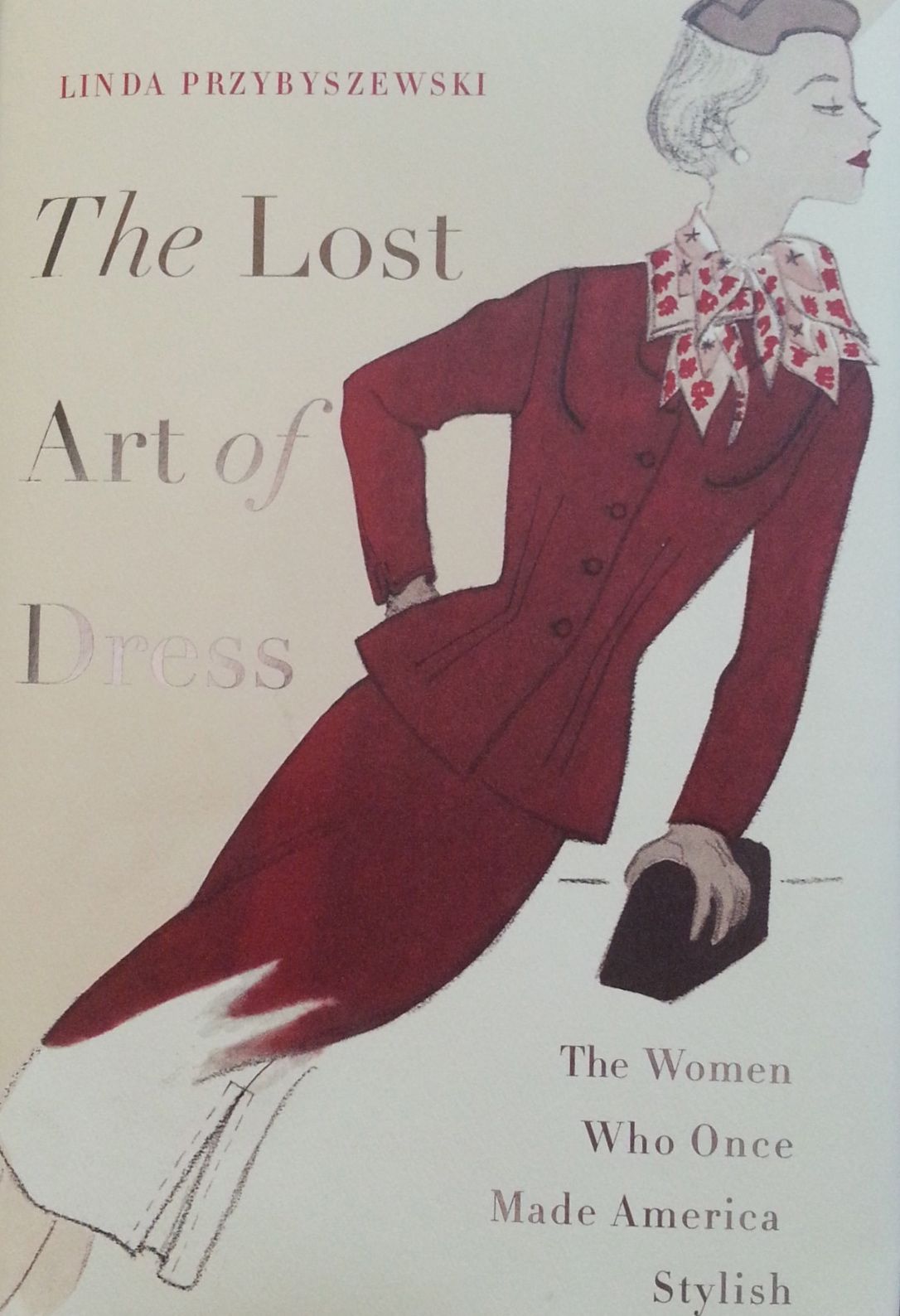
A Book Review–The Lost Art of Dress–The Women Who Once Made America Stylish

The Lost Art of Dress

The Perfect Mother’s Day Gift.

Update–May 2016

Received as Mother’s Day gift in 2014 and immediately devoured it.  Two years later it is still a recommended read.  Enjoy the review; didn’t change a word for the original post!

The Lost Art of Dress–The Women Who Once Made America Stylish by Linda Przybyszewski.

What a book it is; 288 pages, illustrations, 33 pages of notes and 15 pages of index.   This is a textbook, history book, reference book; not the casual read one would expect.  Don’t be put off by it’s textbook format as it is so much more.  The Lost Art of Dress is a fascinating, readable, intellectual treatise on women’s dress in America.  I recommend it as an enjoyable, educational summer read.

Linda Przybyszewski, the author, is associate professor of history at the University of Notre Dame in South Bend, IN.  She is also a dressmaker, she comes from a family of dressmakers, and a fashion connoisseur. Continue reading

Posted in FIBER FASHION FUN | Tagged , , , , | 3 Comments

ITALIAN STYLE


Screen shot 2014-10-27 at 12.19.52 PM

May 2016 Update

Fashion and Textile Museum, London, Thursday 16 June
“Take a stylish look at Italian fashion from the end of the Second World War to the present day. Join fashion experts Sonnet Stanfill and Lucia Savi as they discuss how ‘Made in Italy’ became a mark of style and the designers who helped define it.
Sonnet Stanfill curated ‘The Glamour of Italian Fashion 1945–2014 at the Victoria and Albert Museum which is now on an international tour and edited the accompanying publication.”

Event includes viewing of Missoni Art Colour and a glass of wine.  Wish the Concorde was still flying, would love to see the Missoni.

Following is the review of the Sonnet Stanfill curated Italian Style Fashion exhibit from 2014.  A truly worthwhile review of the history and influence of Italian Fashion.  Nothing better since! Continue reading

Posted in FIBER FASHION FUN, OUT AND ABOUT | Tagged , , , , , , , , , , , , | 1 Comment

From Blah to Bling


From Blah to Bling

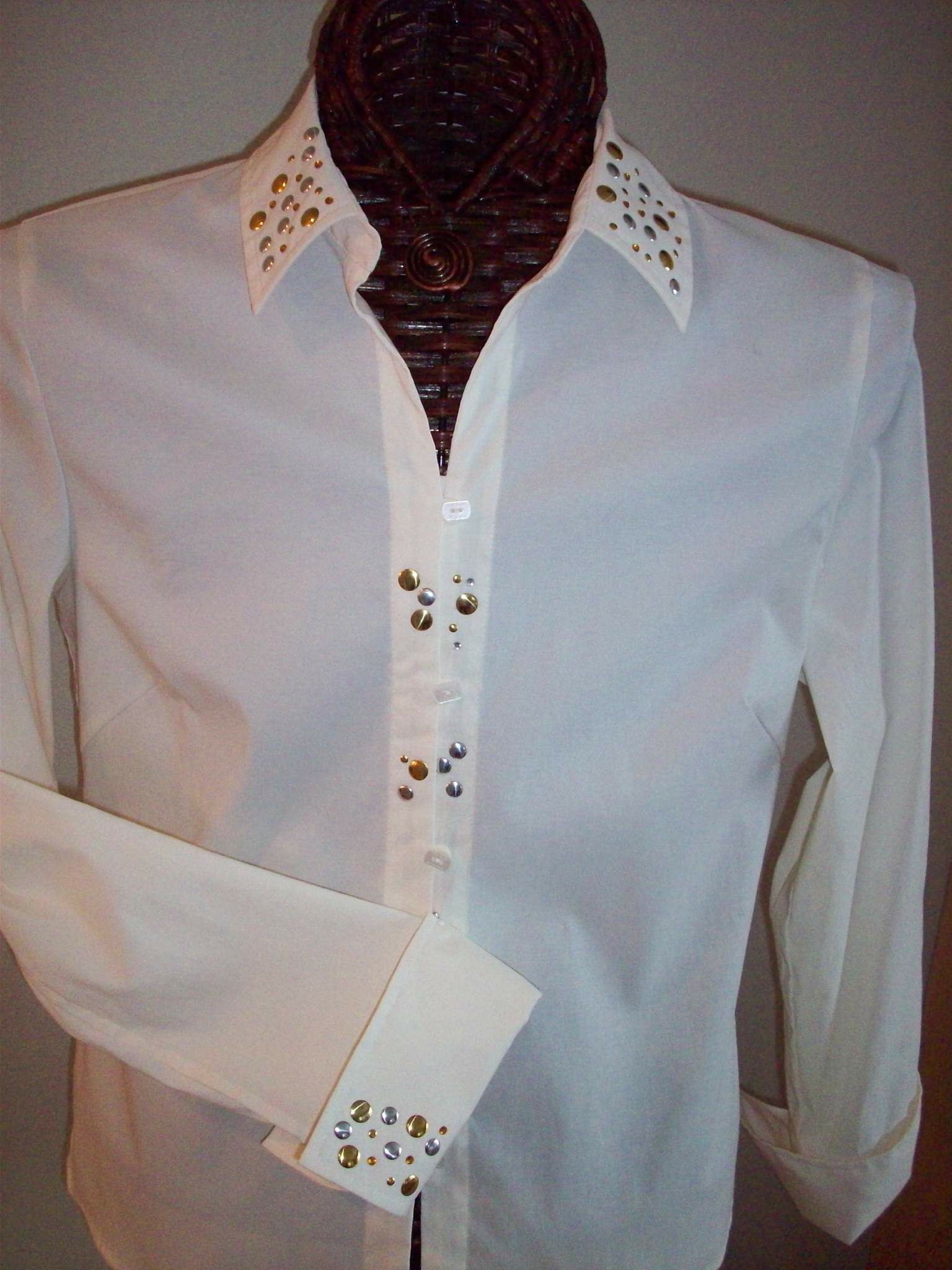
UPDATED SHIRT WITH IRON-ON STUDS


Updated 5/17/16

Getting out the Spring/Summer clothes and this blouse surfaced again.  Although this is from 2013, Bling is still trendy in daytime wear.  Actually, after all this time, it has graduated from Trend to Fashion.

Perhaps you have a blouse ready for an upgrade.


Updated 9/28/13

You know how you think your ideas are one-of-a kind?   Unfortunately–or Fortunately–they are not.  (That’s why 15th Century explorers, who had limited communication between each other, all decided to seek the New World at the same time.)

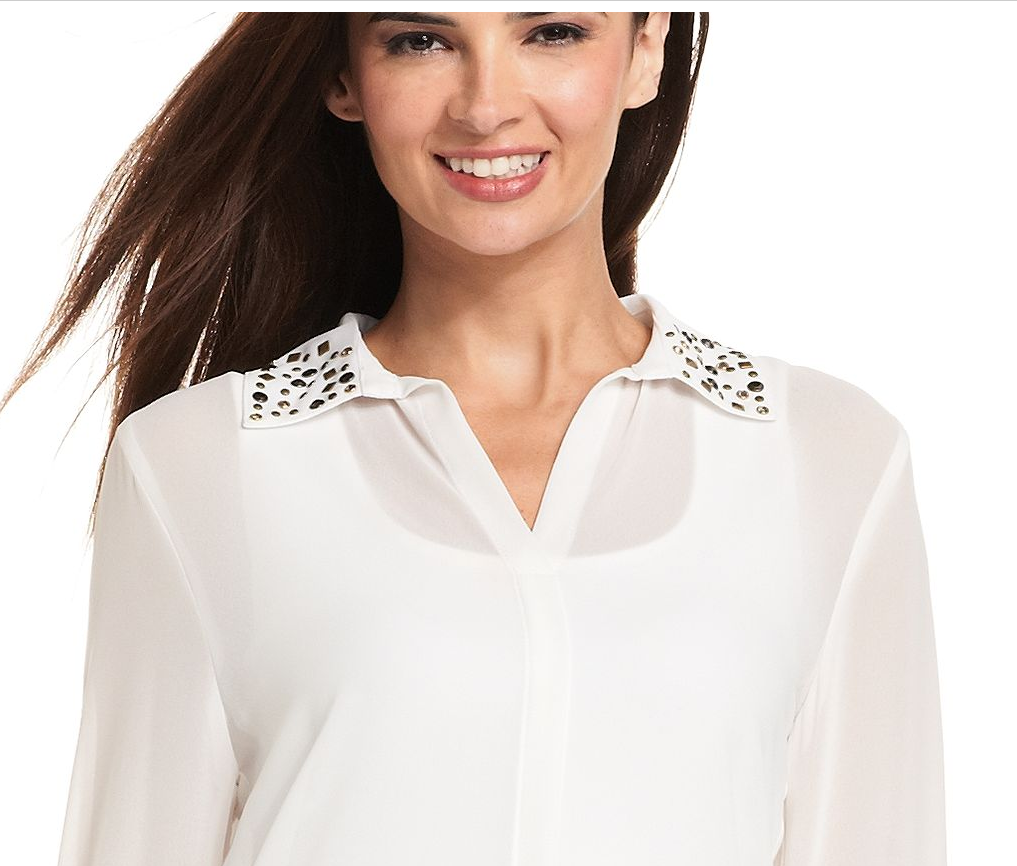
Imagine my surprise to see this studded blouse in my local department store–identical to one I  made in April.

Screen shot 2013-09-28 at 9.09.02 AM

ny collection


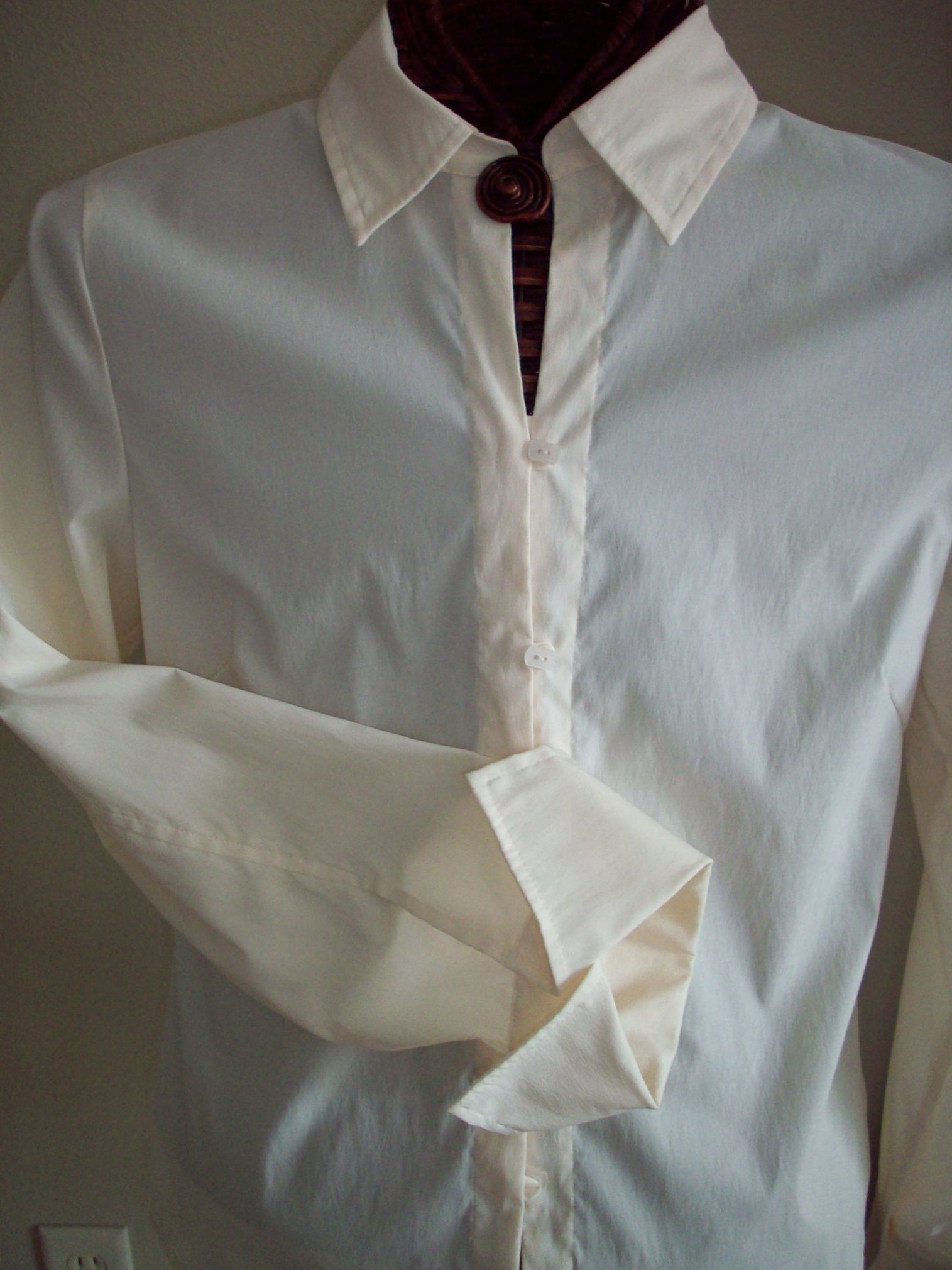
BASIC SHIRT

BASIC SHIRT

Here is that shirt that has been worn a few times under a sweater and then relegated to the back of a drawer as ‘too good to toss’ and consignment store didn’t want.  Hey, what do they know?

What originally attracted me was the fiber content of poly, nylon and spandex.  Poly and nylon mean it is easy care–machine wash warm, hang to dry and wear.  Although the fit skims the body, a bit of spandex is always welcome for stretching and reaching.

The photo makes the garment appear wrinkled but this is due to the slight texture in the yarn that hides wrinkles. Continue reading

Posted in FIBER FASHION FUN | Tagged , , , , | 1 Comment